
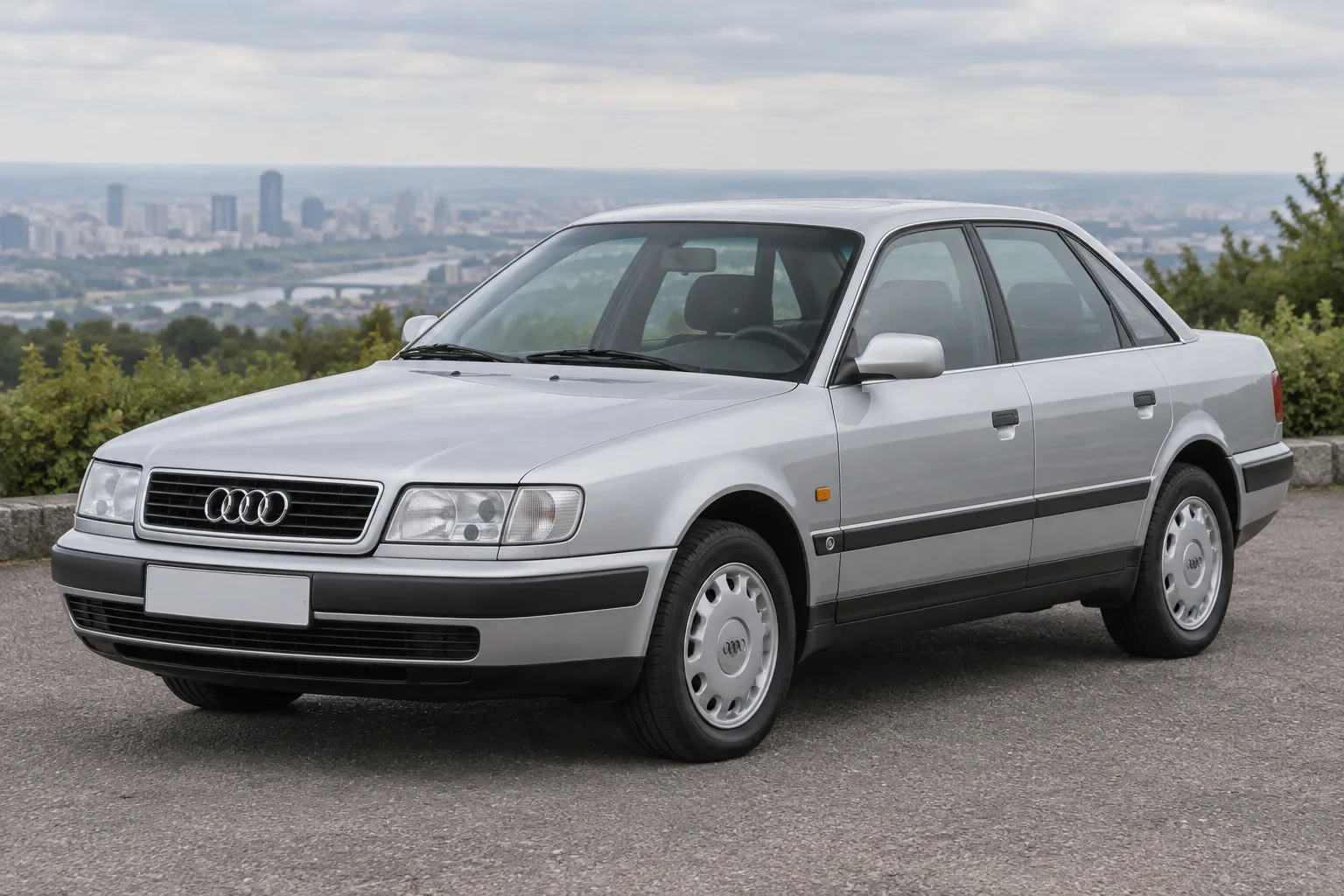
Audi 100 / A6 C4
Audi 100/A6 C4 rating (1990–1997): condition, documents, inspection and conditions of sale of the car.
Indicative purchase price
Below market value
Final price agreed after inspection.
Value my car1Why buyers choose this model
Audi series 100 began to collect in the late 60s. Later, the Germans abandoned this name in favor of the better-known nomenclature A6.
2What buyers check
Model history
Audi series 100 began to collect in the late 60s. Later, the Germans abandoned this name in favor of the better-known nomenclature A6. The last generation of “slices” debuted on the market in 1991. At the same time, a sports version of the model appeared, designated by the S4 index, under the hood of which gasoline engines were installed - a 2.2-liter R5 or a 4.2-liter V8.
In the autumn of 1991, the wagon debuted, traditionally for the brand, marked Avant. While the sedan boasted a 510-litre trunk, the station wagon offered only an average of 390 litres. It was possible to increase the capacity by folding the rear seats. The Avant had a similar range of engines and could be equipped with a Quattro all-wheel drive system.
In 1994, the Audi 100 C4 was upgraded. The car received slightly modified headlights, taillights, new mirrors and bumpers. A little refreshed and interior. Along with restyling, a new designation was introduced: the name “100” was replaced by the A6, and the sports modification instead of the S4 received the S6 index. Production of the Audi A6 C4 ended in 1997, when the more modern, more technologically advanced and more attractive Audi A6 C5 was released.
Engines
Two decades ago, Audi made sure that the choice of engines for the A6 was as wide as possible. As a result, many people, deciding to buy, can not decide which of the engines suits them best. Do not pay attention to the 4-cylinder engines, except for the 140-horsepower version of the 2-liter unit. They are very weak and therefore have to consume too much fuel. The most optimal are engines with a working volume of 2.0 l / 140 hp. and 2.3 l R5. The V6 and V8 are the option for real Audi 100 fans who don’t count on high fuel consumption or high maintenance costs. No matter which engine you choose, you will have to accept possible malfunctions. After all, the car has been around for many years. What's failing? Most often ignition coils and flowmeter. Inconstant belts and timing, which do not withstand the time allotted by the manufacturer. The optimal replacement interval is 60,000 km. You should also pay attention to the valve cover - oil leaks often occur from under it. In addition to gasoline engines, the Audi 100 received diesel units. Compared to modern diesel engines, they can be considered “eternal”. The 2.4-liter unit creates the least problems, slightly worse than the 2.5 and 1.9 TDI. If you want the most dynamic option, then without fear you can choose the top 140-horsepower 2.5 TDI (not to be confused with the unreliable engine of the later generation 2.5 TDI V6). This is the best car for the 2.5 TDI. The rest of us just don't have the strength.
Technical features
Transmissions: 5 or 6-speed mechanics, as well as 4 or 5-speed “automatic”.
Depending on the type of drive, the "hundred" could be front-wheel drive or with drive on all four wheels. Quattro’s all-wheel drive was a big plus, especially in terms of passive safety. However, the system increases the cost of operation. We have to spend more on maintenance and, above all, on gasoline.
The suspension is a classic scheme - in front of the Macpherson rack, and behind - a torsion beam. In all-wheel drive versions, a multi-link scheme works on the rear axle.
Common faults
Reliability and high quality have always been the strength of the Audi 100/A6, which is why motorists love this model. Despite its age, the A6 C4 holds up pretty well, but is not without its drawbacks. Often the steering mechanism fails. With age, gaps appear, and reika begins to knock. The hydraulic booster pump is also available.
They do not differ in the stamina of the starter and generator. With age, the probability of failure of the control unit and the fuel level indicator increases.
It is necessary to carefully check the condition of the cooling system (temperature sensor, expansion tank and pump, antifreeze leaks). In case of failure, the costs of repairing an overheated engine are inevitable. In versions with the Quattro all-wheel drive system, higher rear suspension repair costs should be taken into account.
Often capricious are such elements as air conditioner compressor, electric power windows, hatch opening mechanism, thermostat, various relays, parking brake mechanism.
3Pre-purchase checklist
Model history
- Later, the Germans abandoned this name in favor of the better-known nomenclature A6.
Engines
- No matter which engine you choose, you will have to accept possible malfunctions.
- You should also pay attention to the valve cover - oil leaks often occur from under it.
- The 2.4-liter unit creates the least problems, slightly worse than the 2.5 and 1.9 TDI.
- Faults are most often associated with advanced age and concern: injection system (pump and nozzles), turbocharger, and flowmeter.
Common faults
- With age, the probability of failure of the control unit and the fuel level indicator increases.
- It is necessary to carefully check the condition of the cooling system (temperature sensor, expansion tank and pump, antifreeze leaks).
- In case of failure, the costs of repairing an overheated engine are inevitable.
- In versions with the Quattro all-wheel drive system, higher rear suspension repair costs should be taken into account.
4Challenges of selling privately
The Audi 100/A6 C4 is a near-perfect German car that, despite the years, not only looks good, but is also quite reliable. A big plus is the availability of inexpensive spare parts and a rich equipment of young specimens. A wide range of engines and suspension settings deserves special praise. But there are downsides. V6 and V8 engines require astronomical fuel costs. Unfortunately, finding a copy in decent condition is not a very simple task.
- Later, the Germans abandoned this name in favor of the better-known nomenclature of the A6.
- Engines: No matter which engine you choose, you will have to come to terms with possible malfunctions.
- Technical features: Transmissions: 5- or 6-speed mechanics, as well as 4- or 5-speed "automatic".
- Failures: With age, the probability of failure of the control unit and the fuel level indicator increases.
Shows, bargaining and re-registration take time: buyers look, promise to think and disappear. Fair price after inspection closes the auction on the spot. If money is needed urgently, the purchase takes away waiting and repeat displays.
5How selling to us works
Leave a request with the car data. We will discuss the preliminary assessment and inspection. After checking the status and documents, we agree on the final price and terms of the transaction.