
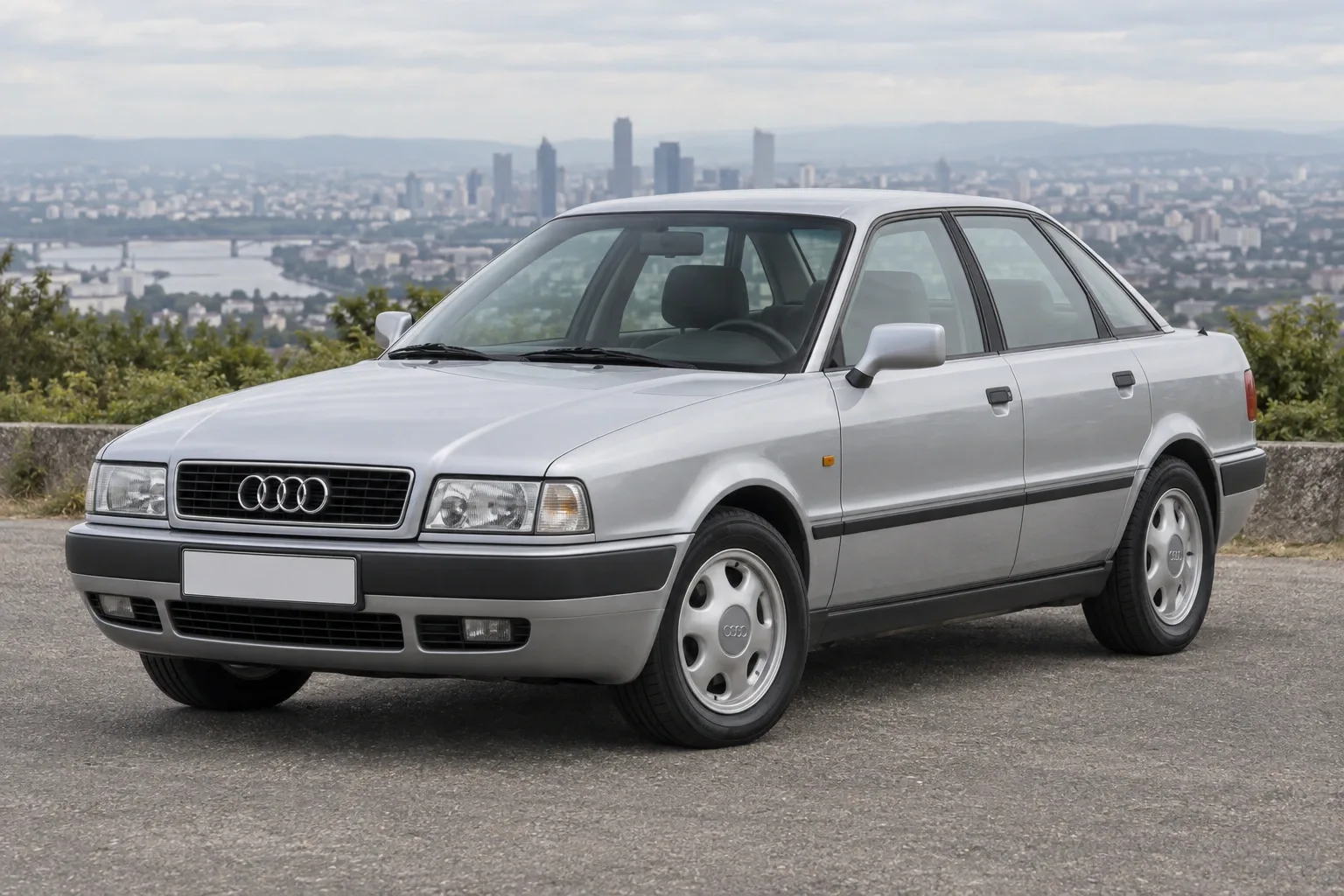
Audi 80 B4
Audi 80 B4 rating (1991-1996): condition, documents, inspection and conditions of sale of the car.
Indicative purchase price
Below market value
Final price agreed after inspection.
Value my car1Why buyers choose this model
The Audi 80 still deserves the attention of those who want to buy a truly reliable car that won’t empty their pockets. In addition, it will provide a decent level of comfort and safety.
2What buyers check
Design features
The Audi 80 B3 and B4 are theoretically the same car, but with some technical differences. The B4 received a modified platform with a wheelbase increased by 70 mm. The fuel tank was placed under the floor, not as in B3 - behind the sofa. The transformation allowed to build a version of the Avant wagon. Previously, only the sedan and coupe were available. It is worth noting that the B3 sedan has a more spacious trunk than the B4 sedan – 453 liters against 430. The design of the Audi 80 is very simple, so the car is very reliable. A galvanized body is not prone to corrosion, unless it has been hastily repaired in some garage. Despite the lack of pillows, the car is quite safe. All thanks to the unique design of the Procon-Ten. In a frontal collision, the engine retracts the steering wheel through the cable system and additionally attracts seat belts. This significantly reduces the risk of head impact on the steering wheel. The airbag in the steering wheel appeared only in 1993. The car is front-wheel drive, although it has a longitudinal engine. The suspension design is simple. In front - Macpherson struts, behind - a torsion beam. The settings provide a high level of comfort and controllability. Driving performance is impressive. Offered models and all-wheel drive Quattro. This is a standard design with a differential and a constant distribution of thrust along the axes. The system significantly improves wheel grip and handling – the Audi 80 B 4 goes like on rails. However, the all-wheel drive transmission limits the space of the trunk - the floor is located higher.
Interior
The interior today seems outdated, but back in the 90s it was considered luxurious. A large steering wheel, easily readable pointers, a short gear lever, comfortable seats and good performance quality. Convenient access to the cabin is provided by wide-opening doors.
The car was well-equipped. But on the other hand, in poorer versions, the equipment was primitive. Today, air conditioning is the most important element in everyday operation.
Engines
The range of B4 engines is quite large. The base 1.6-liter gasoline engine developed from 76 to 102 hp. Later, an upgraded version of this unit fell under the hood of the Skoda Octavia and Volkswagen Golf VI.
Much more often cars with a 2-liter 2.0 and 2.0 E engine left the salons. The engine provided from 90 to 140 hp (in the 16-valve version). In addition, there were available: 5-cylinder - a volume of 2.3 liters (133 hp) and two V6 - 2.6 l/150 hp and 2.8 l/174 hp.
Almost all gasoline units were equipped with multi-point injection, mainly electronically controlled. the 5-cylinder has mechanical injection and therefore is completely unsuitable for gas power. Only the basic versions of 1.6 and 2.0 liters are equipped with a simple single-point injection.
The absolute novelty in the lineup was the diesel 1.9 TDI, which replaced the outdated 1.6 TD. The modern design with direct fuel injection debuted in the B4. Turbodiesel developed 90 hp and became famous for its durability and economy. In parallel, a 75-horsepower diesel of the same volume was offered with the mark TD. He is a typical crow horse and does not deserve attention.
Which engine should you choose?
The market is dominated by samples with a 2-liter gasoline engine, which acted in three versions. 90-horsepower has a single-point injection and a simple design. Variety 2. 0 E was equipped with multipoint injection and developed 115 hp. The top 16-valve variation had a return of 140 hp. The weakest option is recommended for those who do not care about dynamics. The average fuel consumption will be 8-10 l / 100 km. 16-valve unit, although it does not cause many problems, but more expensive in repair. But it has the best dynamic characteristics - 9.6 seconds to 100 km / h. But it consumes more than 12 liters. The optimal choice is 2.0 E (115 hp). This unit was used even in the successor to the Audi A4 B5. He is quietly undergoing the introduction of gas equipment. Any failures arise solely from negligence. Minor defects relate to the ignition system and intake system - leakage on the segment between the flowmeter and the collector. At the same time, due to age, any of the elements of the attachment equipment can fail, oil leaks occur (from under the lid of the valves and glands), and rust attacks the exhaust system. A water pump can also flow, which will cause a shortage of coolant, overheating and burnout of the gasket of the GBC. To the same result leads and corrosion of the heat switch of the electric fan of the radiator. Fortunately, eliminating defects does not require huge efforts and resources. Unlike a galvanized body, the exhaust system rusts quickly. 1. 9 TDI is an engine that is legendary. Today, however, these are just legends. Turbodiesel is demanding to maintain.
What else can go wrong?
Considering the age, any of the elements of the equipment may fail, but there are no characteristic sick places.
The owner can afford to travel on bad roads. The suspension is designed in such a way that major repairs do not seem too expensive. Front triangular levers made of steel (from 1500 rubles) have replaceable ball supports (from 400 rubles). Some note not too long-lasting sleeves of levers. The rear axle is so primitive that there is, in principle, nothing to break.
In general, the braking system is very effective, and many of the copies were provided with ABS. Trouble can deliver parking brake, which often sour. Its mechanism requires preventive inspection and cleaning.
Failures also occur in the operation of electrical equipment: lighting systems, electric windows or a central lock.
Quite often, the tubes of liquid supply to the nozzles of the glass washer are separated.
Operating costs
The Audi 80 is a very cheap car to operate. All thanks to reliability, durability and good availability of spare parts. Any mechanic can cope with possible problems. Many faults can be eliminated even on their own.
3Pre-purchase checklist
Design features
- A galvanized body is not prone to corrosion, unless it has been hastily repaired in some garage.
Which engine should you choose?
- The weakest option is recommended for those who do not care about dynamics.
- The 16-valve unit, although it does not cause many problems, is more expensive to repair.
- Any failures arise solely from negligence.
- At the same time, due to age, any of the elements of the attachment equipment can fail, oil leaks occur (from under the lid of the valves and glands), and rust attacks the exhaust system.
- A water pump can also flow, which will cause a shortage of coolant, overheating and burnout of the gasket of the GBC.
- To the same result leads and corrosion of the heat switch of the electric fan of the radiator.
- The simple design of the node (there is no system for changing geometry) is easily repairable.
- The cost of a new nozzle is about 26 000 rubles, and repairs – 4-6 thousand rubles per piece.
What else can go wrong?
- Considering the age, any of the elements of the equipment may fail, but there are no characteristic sick places.
- The suspension is designed in such a way that major repairs do not seem too expensive.
- Its mechanism requires preventive inspection and cleaning.
Operating costs
- Any mechanic can cope with possible problems.
- Many faults can be eliminated even on their own.
4Challenges of selling privately
The car was produced from 1991 to 1996. Technical condition, as a rule, does not depend on age, but is the main factor in pricing. Prices for the Audi B4 start in the area of 50 000 rubles, and for the most well-groomed copies ask 200-250 thousand rubles.
The market has the most sedans. The vast majority of them have a manual transmission and front-wheel drive.
Despite its age, the Audi 80 is worth a look. Eighties – one of the eternal cars of the “old school”, which will always be in price, and will survive more than one generation of Audi A4.
- Design features: Galvanized body is not prone to corrosion, unless it was hastily repaired in some garage.
- The interior today seems outdated, but back in the 90s it was considered luxurious.
- Engines: The range of B4 motors is quite large.
- Which engine to choose?: The 16-valve unit, although it does not cause many problems, is more expensive to repair.
- What else breaks?: Given the age, any of the equipment may fail, but there are no characteristic sore spots.
- Operational costs: Any mechanic can handle the problems.
Shows, bargaining and re-registration take time: buyers look, promise to think and disappear. Fair price after inspection closes the auction on the spot. If money is needed urgently, the purchase takes away waiting and repeat displays.
5How selling to us works
Leave a request with the car data. We will discuss the preliminary assessment and inspection. After checking the status and documents, we agree on the final price and terms of the transaction.