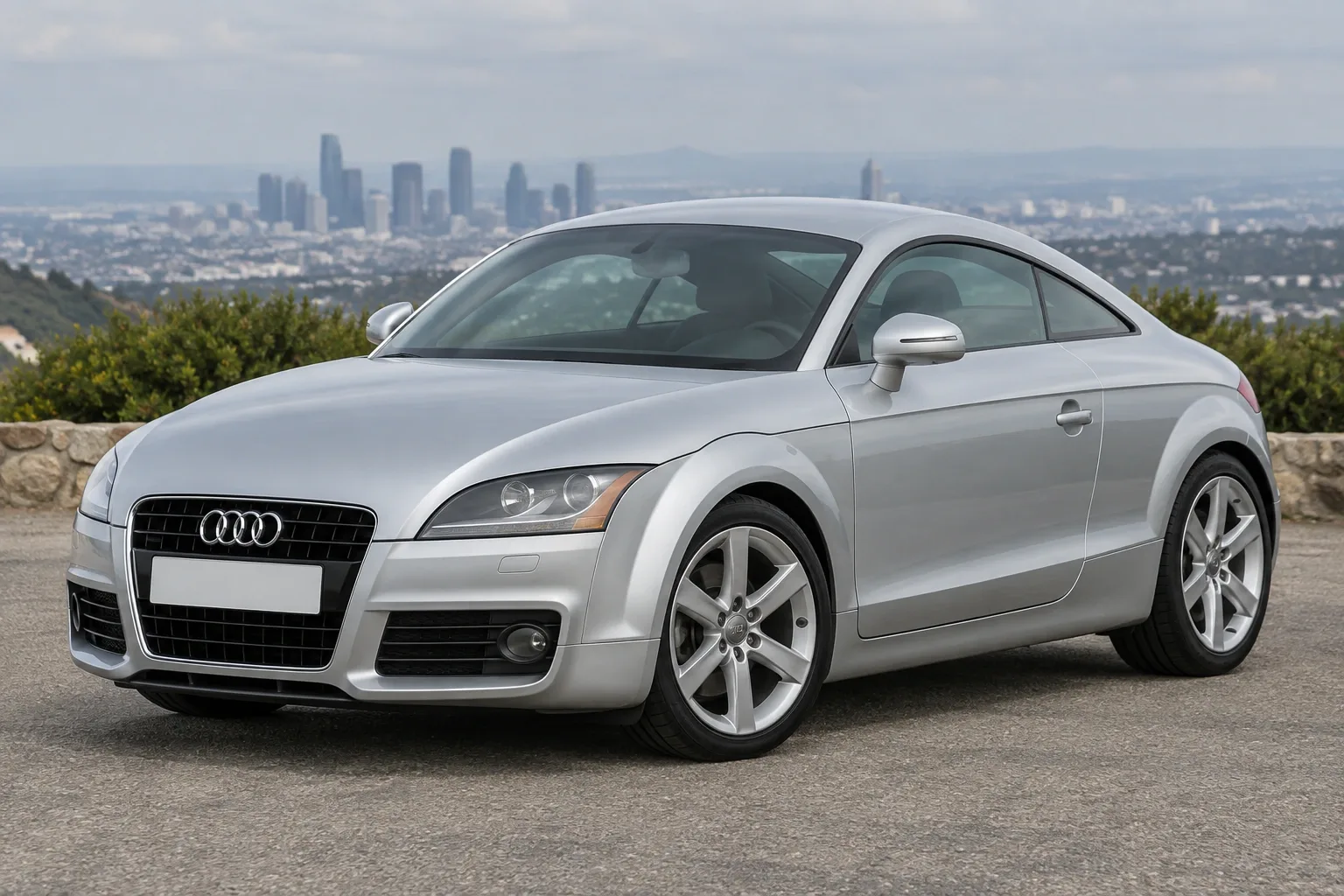
Audi TT 2 / 8J
Audi TT 2/8J (2006–2013): condition, documents, inspection and conditions of sale of the car.
Indicative purchase price
Below market value
Final price agreed after inspection.
Value my car1Why buyers choose this model
The history of the second-generation Audi TT begins in 2005, when the sports coupe was presented at the Tokyo Motor Show. Production of the car began in the fall of 2006, and the roadster (convertible) debuted on the market only a year later. For the style was responsible for the famous Italian designer Walter de Silva. In the first quarter of 2008, the Germans offered a sporty S-version and a charged one, the RS TT. In 2010, the Audi TT was updated. In addition to minor stylistic changes, the engine line was edited. The little-demanded 3.2-liter gasoline engine was sent to retirement, and the 2-liter TFSI received an additional power charge. In this form, the car was produced before the appearance of a successor in 2014. During its existence, the second generation Audi TT has received several awards from the world's leading automotive publications: the Top Gear Coupe of the Year in 2006, the Five Gear Car of the Year in 2006 and the World Car Design and Autobild Best Design of the Year in 2007.
2What buyers check
Design features
The second generation of Audi TT is built according to a scheme similar to its predecessor. The chassis is derived from the Volkswagen Golf, the engine is installed transversely in the front of the car, and the drive is front or full. Although the second TT is based on the platform of the fifth Golf, it uses the aluminium space frame of the Audi Space Frame. It is made up of 42% aluminum, the rest is made of steel. The front of the body has aluminum panels, which reduced the difference in mass between the heavy front and light rear.
In addition to the redesigned design and new engines, Audi has offered a revolutionary solution for this model – the adaptive suspension of the Audi Magnetic Ride. Shock absorbers are able to adapt to current conditions, changing their damping properties, which significantly improves the behavior of the car. This “gadget” was offered only as an option. When purchasing an Audi TT with “magical” shock absorbers, do not forget that their cost is much higher than usual.
The cover of the convertible is rigid with electrohydraulic control, designed to work at ambient temperatures above minus 15 degrees Celsius. Transformation on the go is possible up to a speed of 50 km / h.
Unlike the first generation Audi TT, the coupe was not tested according to the EuroNCAP methodology.
Engines
The engine lineup is represented by the following power units: gasoline - R4 1. 8 TFSI (160 hp), R4 2. 0 TFSI (200-211 hp and 272 hp versions of S), R5 2. 5 TFSI (340-360 hp versions of RS and RS Plus), V6 3. 2 (250 hp) and diesel - R4 2. 0 TDI CR (170 hp). All engines of the German TT are well known from other models of the Volkswagen AG concern. However, compared to other cars, the performance of the engines for TT significantly increased. Thus, even the basic engine allows the coupe to accelerate to 100 km / h in just 7 seconds. It does consume a lot of fuel at the same time. In turn, the top-end versions of the RS and RS Plus can easily compete with much more expensive competitors. Drive from the traffic lights BMW M3 or Audi RS6 will not be difficult, thanks to the rapid dynamics – only about 4 seconds to 100 km / h. To a large extent, this is due to the system "Launch Control", which allows you to start not with idling speeds, but with speeds corresponding to the maximum torque. Equally impressive is the RS Plus’ top speed of 280 km/h. It doesn’t really matter which engine you choose. Either way, you will be happy with the dynamics. But do all engines guarantee long and smooth operation? The 1.8 TFSI and 2.0 TDI CR versions are the most attractive to most potential customers. These are the only engines in the entire set that demonstrate a good ratio of performance and reasonable fuel consumption. But, unfortunately, both units can cause problems. Okay, 1.
Transmission
Unfortunately, the four-wheel drive is not the traditional Quattro, well known from other Audi models. In this case, the rear axle is connected only in emergency cases using the Haldex coupling of the 4th generation. Of course, this scheme does not work as well as a permanent four-wheel drive with a central differential, but still copes with its task well.
The torque from the engine is transmitted to the wheels through a 6-speed manual transmission or an automatic transmission of the S-Tronic - DSG6 or DSG7.
Walking
The front suspension is very reliable and rarely causes trouble. Regular monitoring requires only anthers SRUS - sometimes they break.
On the front axle, McPherson struts are used, and on the rear - a multi-link scheme.
The Audi TT chassis is hardly suitable for long-distance travel. The car is very rigid. The German coupe sport is even tougher than the Audi A3 and VW Golf V. Such suspension is ideal for smooth asphalt, but on the coatings with irregularities there is a clear discomfort. With adaptive shock absorbers, the situation is a little better.
When wearing the bushings of the rear axle, an extraneous noise appears, and the car begins to swim.
Dirt can get into the bearing and destroy it - soon there will be noise.
Typical problems and malfunctions
The most serious problem facing the second-generation Audi TT is the same as that of most other Volkswagen AG vehicles. It is a robotic transmission with dual clutch S-Tronic (DSG). In instances that have reached 200,000 km, wear of bearings and mechatronics is inevitably observed. One possible way to avoid the risk of failure is to change the transmission oil at least once every 60,000 km. Shocks are often eliminated with software updates. The manual transmission, unlike the S-Tronic, does not cause any problems. Another weakness of the German coupe is the Haldex coupe, which often gives up under the endless pressure of the driver’s sports ambitions. There are also cases of failure of the vacuum brake amplifier. Electricity has its own whims, too. Most often, you have to face interruptions in the operation of the audio system, the central lock, electric windows and the ignition lock. In addition, sometimes there are failures in the operation of the steering lobes control gearbox S-Tronic, or break the mechanism of opening the roof (at the convertible). One of the main problems is water. Traces of moisture should be sought in the trunk and under the front seats. In cars with Bose audio system, water gets on the amplifier located in the trunk and disables it. At the trunk lid, the hinge of the shock absorber often pops out, which, shooting the rod, damages the paintwork. The mechanism of the rear spoiler drive often sours or rusts. Regular lubrication of the node will help to prolong the life of the mechanism.
3Pre-purchase checklist
Engines
- 0 TDI CR is the most attractive to most potential customers.
- But, unfortunately, both units can cause problems.
- Chain drive problems are also found in the 2.0 TFSI.
- But let’s face it: these cars do not buy with the last money and do not spare money for maintenance.
- Another problem is excessive consumption of oil.
- In particular, it is strongly recommended to fill up with gasoline with an octane number of at least 98.
- Direct injection motors also have problems with the pressure regulator.
- Of these, only the V6 volume of 3.2 liters since 2010 is free from this ailment, but suffers from rapid wear of the camshaft chains and the tensioner.
Walking
- When wearing the bushings of the rear axle, an extraneous noise appears, and the car begins to swim.
Typical problems and malfunctions
- The most serious problem facing the second-generation Audi TT is the same as that of most other Volkswagen AG vehicles.
- In instances that have reached 200,000 km, wear of bearings and mechatronics is inevitably observed.
- One possible way to avoid the risk of failure is to change the transmission oil at least once every 60,000 km.
- The manual transmission, unlike the S-Tronic, does not cause any problems.
- There are also cases of failure of the vacuum brake amplifier.
- In addition, sometimes there are failures in the operation of the steering lobes control gearbox S-Tronic, or break the mechanism of opening the roof (at the convertible).
- One of the main problems is water.
- Traces of moisture should be sought in the trunk and under the front seats.
4Challenges of selling privately
The design of the Audi TT of the first generation looked contradictory: some considered this style phenomenal, others complained that the front and rear parts are too similar to each other. The second edition of the German athlete has grown up and began to look much more attractive. Let the "teteteshka" and does not satisfy the tastes of absolutely all people, but with confidence we can say that it is very beautiful.
By purchasing this model, you will get not only unique shapes and good finish quality, but also, above all, glorious handling. Most likely, owners will have to face the malfunction of individual units and quite high prices for spare parts. In addition, you will have to put up with a small amount of space in the cabin and frequent visits to gas stations. Unfortunately, the cost of Audi TT in the secondary market is still quite high.
- Design features: The second generation of Audi TT is built according to a scheme similar to its predecessor.
- Engines: 0 TDI CRs are the most attractive to most potential customers.
- Transmission: Unfortunately, the four-wheel drive is not the traditional Quattro, well known from other Audi models.
- Driving: When the rear axle bushing wears out, an extraneous noise appears and the car begins to float.
- Typical problems and malfunctions: The most serious problem facing the second-generation Audi TT is the same as most other Volkswagen AG vehicles.
Shows, bargaining and re-registration take time: buyers look, promise to think and disappear. Fair price after inspection closes the auction on the spot. If money is needed urgently, the purchase takes away waiting and repeat displays.
5How selling to us works
Leave a request with the car data. We will discuss the preliminary assessment and inspection. After checking the status and documents, we agree on the final price and terms of the transaction.