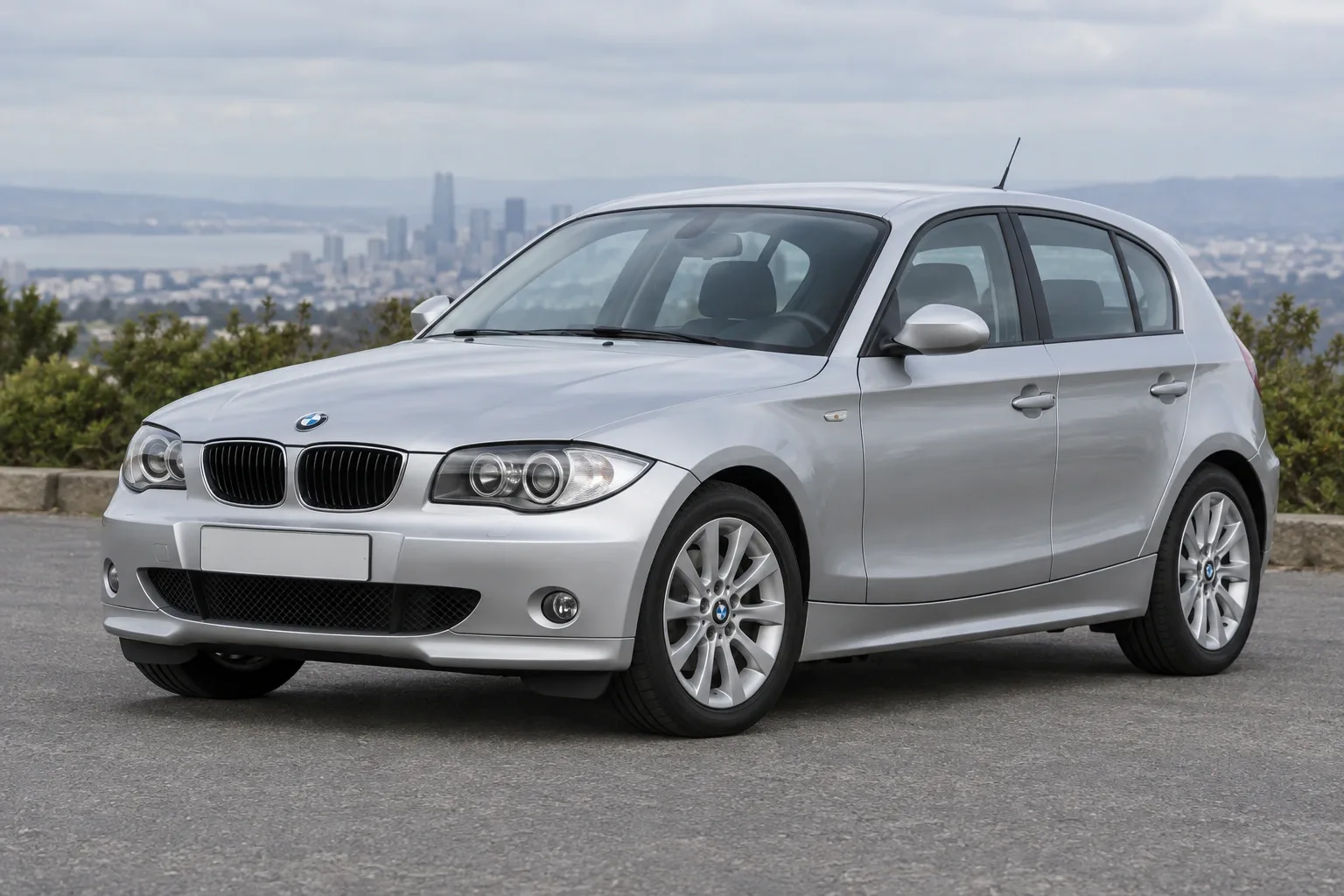
BMW 1 E87/E81/E82/E88
Rating BMW 1 E87/E81/E82/E88 (2004–2011): condition, documents, inspection and conditions of sale of the car.
Indicative purchase price
Below market value
Final price agreed after inspection.
Value my car1Why buyers choose this model
More and more premium car manufacturers are trying to build small cars. A vivid example of this is the BMW 1 Munich, which went into production in 2004. First appeared five-door version of the E87, and two years later – three-door E81. In 2007, the manufacturer updated the model. Changes affected the interior (the quality of materials has increased, the central panel has been regrouped) and the body (new headlights, the shape of the air intakes has been changed and the rear optics have been adjusted). At the end of 2007, the two-door coupe (E82) entered the market, which acquired new engines with a capacity of 218 hp (125i) and 306 hp (135i), and the sports M-version - a 3-liter engine with a return of 340 hp. In March 2008, the E88 series convertible appeared. Hatchback in 2011 gave way to the successor of the F20. Coupe and convertible were assembled until 2013.
2What buyers check
What is it?
The “one” is full of paradoxes, which is why some people love it and others condemn it. German automaker has created a “small” BMW on adult technology. Most of the components are shared with the BMW 3 e90. The Bavarians had to save on space in the cabin. It’s all about the concept of the car: rear-wheel drive and ideal weight distribution along the axles in a ratio of 50:50. To do this, the engine was shifted back behind the front axle, which affected the amount of free space inside. But if the driver and front passenger are not much deprived and feel quite comfortable, then on the second row the situation is completely different. The driver is 178 cm tall and will hardly sit down on his own. The BMW 1 is a great position behind the wheel. In this parameter, the “one” exceeds even other BMW models. The driver of the BMW 130i can expect to be able to fit as sportily as possible. No other BMW will you sit so low and so far away. The ideal location behind the wheel can pick up even a 2-meter person. The sensations are enhanced by high-quality sports seats with adjustable lateral support and a sharp small diameter steering wheel with a thick rim. Due to the absence of a spare wheel, the trunk is able to accommodate 330 liters of luggage. The problem with the "spatch" is solved with the help of Run-Flat tires. Unfortunately, otherwise BMW 1 is not as good as competitors: poor trim levels, quality finishing materials and assemblies, unusual for Bavarets, etc. "One", by BMW standards, is staffed very modestly. You will know this immediately as soon as you try to adjust the seat belts to the height.
How's it going?
The concern about the quality of the interior disappears after several kilometers of the way. The BMW E87 is very fast. The combination of rear-wheel drive and perfect axle weighting allows you to pass any turns. Driving a BMW 1, it feels like a racing map. The wild turns are breathtaking. But be careful. In extreme situations, the car behaves unpredictable, and the depth of skid due to excessive rotation can be an unpleasant surprise.
The worst thing is on dry asphalt, for which the “one” holds to the last very tenaciously. But once the limit is exceeded, the grip will be drastically lost and the BMW 1 will turn into an unguided projectile (especially with the DSC system disabled). On a wet surface, the edge followed by a slip feels better, and the skid develops smoother - there is time to correct the situation.
Petrol engines
The BMW 1 Series was accompanied by a huge line of powertrains. The base was a gasoline four-cylinder engine with a working volume of 1.6 liters with a capacity of 116 hp (116i / N45) with distributed fuel injection. It has been most widely distributed. Unfortunately, some owners are not happy with the engine. For example, after a cold start, only two or three cylinders were grasped. The manufacturer tried to solve the problem by improving the engine control program, but to no avail. Sometimes the tensioner of the chain was surrendered, which immediately jumped on several links. The problem was solved during service actions - they installed a modernized tensioner with a large stroke of the rod. Another drawback is the relatively high fuel consumption, which is usually 10 liters per 100 km. In 2007, a new 116i appeared with a 122-horsepower N43 under the hood. It has received a number of technologies aimed at reducing fuel consumption. The engine also has problems with the timing system drive - the chain is stretched. Adds trouble and direct fuel injection. Bad gasoline finishes the nozzles to 80-100 thousand km. In addition, the TNVD may fail. Sometimes you have to face even bullies on the walls of cylinders. In this case, the repair is not advisable. Replacement of the engine is required: 100-140 thousand rubles plus 20-40 thousand rubles for work. Another common unit is the 2-liter 4-cylinder N46 (118i and 120i). He also did not avoid certain setbacks. For example, prematurely dies the tensioner of the chain timing system.
Diesel engines
The four-cylinder diesel engine was installed from the first days of BMW 1 production. In the European market, the second-hand version 118d is more common, less often - 120d. Both versions received the M47 series engine. This is a representative of the old school, which appeared in the late 90s.
German engineers managed to rid the turbodiesel of the characteristic failure of thrust with the subsequent throw. In order to increase the smoothness of the engine, a special cartridge with two balancing shafts was installed here. A pair of timing system drive chains is located in a classic place - in the front.
The engine turned out to be quite reliable, but also “gluttonous”. The average consumption is 6 l / 100 km. The two-mass flywheel boasts good endurance.
In 2007, the M47 was replaced by the N47, which was a completely different design. The block is poured out of aluminum, and a pair of timing system chains moved to the side of the gearbox. Balancing shafts are now located in the block. Piezoelectric fuel injectors are installed in 120d, and electromagnetic ones are installed in 118d.
The new N47 has excellent performance, but the reliability leaves much to be desired. The biggest problem is the drive of the timing system, namely the upper chain, which drives the TNVD and one of the camshafts. The disease manifests itself after 100,000 km. When the chain is weakened, extraneous noise appears in the engine compartment. The consequences can be very sad. To replace the stretched chain, you will have to remove the engine, since it is located behind.
In the 177-horsepower BMW 120d, you must be ready to eliminate possible malfunction of the EGR valve, turbocharger or starter.
Transmission
In addition to the manual transmission, paired with the engines could be used one of two 6-speed automatic transmissions: ZF (6HP19 until 2007, 6HP21 after 2007) or GM (6L45R). The machine needs regular oil updates, which is guaranteed to prolong its life.
The first major repair of GM boxes has to face after 200-250 thousand km. Oil pump, hydroblock or hydrotransformer are handed over. One of the common reasons for complaints is tremors during transitions between 2 and 3 gears. As practice shows, with such symptoms, the box is able to travel more than 200,000 km.
In the case of ZF, intervention may be needed sooner. The service life of solenoids is about 100-150 thousand km. Later comes the turn of bushings, hydrotransformer and hydroblock. Trouble can be brought by mechatronics, sensitive to the state of oil.
The rear gearbox rarely fails. After 200-250 thousand km can flow glands. If you do not eliminate the leak in time and do not monitor the level of oil, then soon there will be a hum informing about the wear of bearings. For the restoration repair will have to pay about 25 000 rubles.
Walking
In the case of the BMW 1, you don’t have to worry about the suspension components, as they are designed for high loads. Floating Silentblocks often wear out behind them - creaking appears.
Beating on the steering wheel occurs due to the brake discs that are driven from overheating. When purchasing a BMW 130, you need to take into account faster wear of brake pads - after about 20-30 thousand km. If the car will move mainly on the highway, their resource will increase by about 1.5 times. Brake discs are able to survive 2-3 sets of brake pads.
Typical problems and malfunctions
In the interior of the bowels of the front panel, creaks are sometimes issued. After restyling, this problem is much less common.
With age, side mirrors often turn when unfolding. Soured lock mechanism, which must be cleaned, having previously disassembled the mirror.
Sometimes owners after prolonged rains find water in the cabin. It leaks through the unstuck noise insulation inside the doors.
Electrical problems are mostly related to power failures. For example, due to oxidation or decay of the plug of the plus wire under the bottom. The cost of a new wire is from 16 000 rubles. Power can disappear on the "plus" supplied to the fuse block, which is located behind the glove compartment. And fans of the cooling system cease to turn on due to the rotting of the wire at the entrance to the control unit.
After 70-100 thousand km, the electric lock of the ELV steering wheel is sometimes given: the steering wheel is blocked, and the engine does not start. The blocker is assembled with a steering column - from 50,000 rubles. They are usually done in a cheaper way. The control unit is refashioned to work without ELV, and the lock latch is removed from the steering rack.
The FRM unit responsible for the operation of the central lock and outdoor lighting can also fail. Fortunately, it can be reanimated by software method - 6-10 thousand rubles.
Owners of the first “penny” were often pestered by flashing signal lamps. The problem was solved by updating the software.
After 150-200 thousand km, an additional pump is sometimes handed over - the efficiency of the heating system decreases. The new pump is available for 7 000 rubles.
Service
Thanks to the condition-based service self-diagnostics system, the car itself warns the driver about the need for maintenance. The system monitors the period of oil change, wear of brake pads (separately front and rear axles), the condition of the brake fluid and the particulate filter (in diesel versions).
3Pre-purchase checklist
What is it?
- The problem with the "spatch" is solved with the help of Run-Flat tires.
- A terrible audio system has problems with the quality of radio signals.
How's it going?
- But once the limit is exceeded, the grip will be drastically lost and the BMW 1 will turn into an unguided projectile (especially with the DSC system disabled).
- On a wet surface, the edge followed by a slip feels better, and the skid develops smoother - there is time to correct the situation.
Petrol engines
- The manufacturer tried to solve the problem by improving the engine control program, but to no avail.
- The problem was solved during service actions - they installed a modernized tensioner with a large stroke of the rod.
- The engine also has problems with the timing system drive - the chain is stretched.
- Sometimes you have to face even bullies on the walls of cylinders. In this case, the repair is not advisable.
- Replacement of the engine is required: 100-140 thousand rubles plus 20-40 thousand rubles for work.
- The system sometimes fails due to the decay of the plug of the plus wire under the bottom or due to the failure of the servo motor.
- To eliminate it, it is necessary to replace oil caps - from 10 000 rubles (with work).
- To suggest the problem can be a fire "oil".
Diesel engines
- Piezoelectric fuel injectors are installed in 120d, and electromagnetic ones are installed in 118d.
- The biggest problem is the drive of the timing system, namely the upper chain, which drives the TNVD and one of the camshafts. The disease manifests itself after 100,000 km.
- In the 177-horsepower BMW 120d, you must be ready to eliminate possible malfunction of the EGR valve, turbocharger or starter.
Transmission
- The first major repair of GM boxes has to face after 200-250 thousand km.
- The rear gearbox rarely fails. After 200-250 thousand km can flow glands.
- If you do not eliminate the leak in time and do not monitor the level of oil, then soon there will be a hum informing about the wear of bearings.
- For the restoration repair will have to pay about 25 000 rubles.
Walking
- When purchasing a BMW 130, you need to take into account faster wear of brake pads - after about 20-30 thousand km.
Typical problems and malfunctions
- After restyling, this problem is much less common.
- Soured lock mechanism, which must be cleaned, having previously disassembled the mirror.
- Electrical problems are mostly related to power failures.
- For example, due to oxidation or decay of the plug of the plus wire under the bottom.
- And fans of the cooling system cease to turn on due to the rotting of the wire at the entrance to the control unit.
Service
- Thanks to the condition-based service self-diagnostics system, the car itself warns the driver about the need for maintenance.
- The system monitors the period of oil change, wear of brake pads (separately front and rear axles), the condition of the brake fluid and the particulate filter (in diesel versions).
4Challenges of selling privately
Most consider the "one" impractical and poorly equipped, especially the basic versions with a cheap interior. You can accept that, you just have to drive. Informative steering, clear transmission, rear-wheel drive and six-cylinder engine fill the driver with adrenaline and love for BMW from the first meters.
- What is it?: The problem with "spatch" is solved with the help of Run-Flat tires.
- But once the limit is exceeded, the grip will be drastically lost and the BMW 1 will turn into an unguided projectile (especially with the DSC system disabled).
- Gasoline engines: The manufacturer tried to solve the problem by improving the engine control program, but to no avail.
- Diesel engines: Piezoelectric fuel injectors are installed in 120d and electromagnetic ones are installed in 118d.
- The first major repair of GM boxes has to face after 200-250 thousand km.
- Purchasing a BMW 130, you need to take into account faster wear of brake pads - about 20-30 thousand km.
- Typical problems and malfunctions: After restyling, this problem is much less common.
- Service: The system tracks the period of oil change, wear of brake pads (separately front and rear axles), the condition of the brake fluid and the particulate filter (in diesel versions).
Shows, bargaining and re-registration take time: buyers look, promise to think and disappear. Fair price after inspection closes the auction on the spot. If money is needed urgently, the purchase takes away waiting and repeat displays.
5How selling to us works
Leave a request with the car data. We will discuss the preliminary assessment and inspection. After checking the status and documents, we agree on the final price and terms of the transaction.