
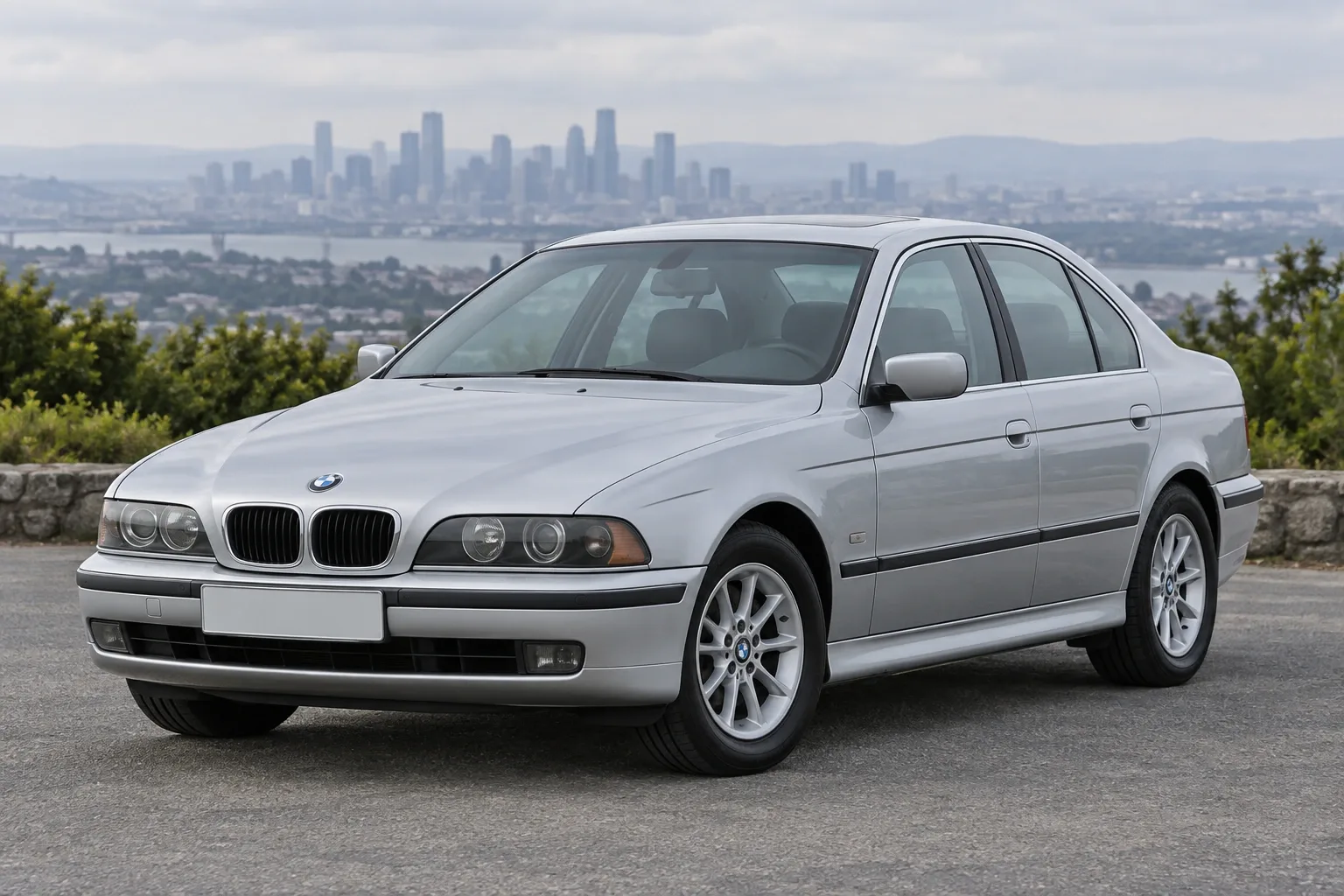
BMW 5 E39
Rating of the BMW 5 E39 (1995–2003): condition, documents, inspection and conditions of sale of the car.
Indicative purchase price
Below market value
Final price agreed after inspection.
Value my car1Why buyers choose this model
The BMW 5 Series was one of the best cars in the E segment. He fascinated with the harmony of lines, which skillfully combined dynamic image and elegance with the light hand of designers. The BMW E39 is over 20 years old. Therefore, do not deceive yourself - the Bavarian "five" are in old age, especially pre-restyling modifications. However, the silhouette was left out of time and is still capable of admiration. Interior design should also be recognized as successful. A simple front panel helps to maintain ergonomics at the highest level, and the readability of the readings of the instruments is exemplary. Fans of the brand appreciate the emphasis on the driver – a slightly deployed center console. Upholstery and plastic in the cabin of the highest quality. The car looks relatively fresh inside, despite the years that have passed. The biggest problem with the BMW 5 Series is its small space. Passengers in the back seat are particularly affected. The 5 Series also has a relatively small boot of 460 litres, which is less than the Audi A6 C5 and Mercedes E-Classe W210. The wagon can accommodate from 410 to 1525 liters of luggage. Fortunately, the trunk has the correct shape, which allows you to use its volume by one hundred percent.
2What buyers check
Which engine should you choose?
From the point of view of economy, it is considered that diesel modifications are the most preferred. However, in the case of the BMW 5 Series, there are a number of important points. Among the diesel versions, 525 tds are predominantly common. 143-horsepower turbodiesel does not provide excellent dynamics (10.4 s to 100 km / h) and at the same time is voracious. In urban mode, such a BMW burns more than 11 liters of diesel. In addition, the piston rings wear out, fuel pumps and the cooling system pump fail. 3-liter turbodiesel version 530d accelerates the “five” to 100 km / h in 8 seconds. The power unit operates quietly and is more economical than the diesel series tds. However, its second evolution with a capacity of 193 hp was on the verge of foul. In addition to chronic problems with cracks in the head of the block and early retirement of the turbocharger, the vortex valves in the intake manifold failed. One day, one of them broke off and flew into the cylinder, destroying everything in its path - the piston, the valve, the cylinder wall. The older version with a capacity of 184 hp is not subject to this problem. Among the diesel modifications are also found models 520d and 525d. 2-liter diesel engines are too weak, but consume less than 8 liters of fuel in the city. However, the savings from low fuel consumption will not be able to cover the costs of troubleshooting frequent faults. 136-horsepower engine has problems with the fuel pump, turbocharger, two-mass flywheel and generator pulley. 525d is slightly more economical, but slower than 530d. In the range of gasoline engines, the most common 2-liter unit with a capacity of 150 liters. with.
Transmission
Be careful with the GM5L40 automatic transmission. The ceiling of the repairless mileage of the 5-speed machine from GM was about 150,000 km. And the repairs are very expensive. A little to push back the trip to the service will help preventative oil change, which is not provided for by the maintenance plan.
But ZF products can easily do without intervention up to 350-450 thousand km. Of course, provided that the oil is regularly updated. Subsequent repairs will cost 60-120 thousand rubles.
Even with a manual transmission, you can not relax. Replacing the clutch will require significant costs - about 10-15 thousand rubles. Together with it, it is necessary to update the two-mass flywheel (20,000 rubles). In addition, after 400-500 thousand km, it is necessary to repair the box itself - synchronizers and bearings wear out (20-60 thousand rubles).
Walking
The five E39 had a reputation as the best sedan in the late nineties and the new millennium. This is due to the almost entirely aluminum suspension on both axles. The body does not tilt in turns, the wheels seem to be glued to the surface of the road - the suspension provides comfort and confidence in movement. It also gives you the accuracy of the steering.
Unfortunately, the poor condition of Russian roads significantly affects the state of the running. Quite quickly, the sleeves of the front transverse levers, the sleeves and racks of the transverse stability stabilizer, floating Silent blocks are surrendered. Current repairs may require up to 20,000 rubles.
The owners of the BMW 5 Series believe that the suspension needs a serious bulkhead every 100-150 thousand km. Mechanics recommend using quality parts, such as Meyle or Lemforder. Otherwise, the same procedure will be needed again soon.
Along with this, in age-old cars, you have to face the failure of the GUR pump (4000 rubles) and a faulty steering rack (20 000 rubles with work).
Typical problems and malfunctions
The Bavarian sedan often has problems with electrical and electronics. Faults are subject to: temperature sensors of the climate installation, airbags, ABS and xenon light level. In addition, to breakage slopes electric windows and a set of indicators, often burns out the display. Subsequently, the control units ABS and DSC (Stabilization System) require repair. You will need a soldering fee - 7-12 thousand rubles. Among the mechanical damages are common: loss of tightness of the radiator, the appearance of backlash in the steering (steering cardinal) and wear of the elastic clutch of the driveshaft. Another widespread problem is fogging of headlights. The brake amplifier is located in a box under the left dust filter, which can become clogged with, for example, leaves. This leads to the accumulation of water, which the amplifier sucks in and once releases into the intake manifold, which leads to the destruction of the engine. So watch for noise during braking. Age, of course, affects the "purity" of body iron. Rust actively develops on the thresholds, trunk lid, on wheel arches, at the bottom of the doors, on the bottom and in the trunk niche. Corrosion also affects fuel lines. In some instances, cracking of the support cups of the front shock absorbers is found. Pay attention to the mirrors. If they are equipped with electrochromic glass, replacing blinded or damaged glass will require a lot of money. Besides, they often like to steal. Generally, well-maintained BMW E39s are not considered problematic, but that doesn’t mean operating costs will be low.
M52 (petrol R6, vanos)
The prestyled six-cylinder 520i (150 hp), 523i (170 hp) and 528i (193 hp) with variable timing phases were distinguished by excellent sound, excellent dynamics and reasonable fuel consumption. However, the two-liter is noticeably weaker. The engines are completely reliable, but already have large mileage.
M54 (petrol R6, double vanos)
This is a new generation of six-cylinder gasoline engines 520i (170 hp), 525i (192 hp) and 530i (231 hp). They are better than the M52 in every way, but they have lost a bit of charisma, a nice sound and are not as strong. The base 520i has improved in dynamics.
M62 (V8 petrol, valvetronic)
Among the malfunctions are known problems with the ventilation system of the crankcase and the stability of the idle. Buying the 535i with its 245 hp doesn’t make sense because of the more balanced 530i. But the 540i (286 hp) is a more interesting option.
M51 (Diesel R6)
Surviving distributed fuel injection diesels used to be more valuable. But today, their dynamics and fuel consumption are disappointing. In addition, they are under threat of overheating the head of the block during the "race" on the highway. You can still consider 525tds (143 hp), but 525td (116 hp) is not exactly necessary to take.
M47 (Diesel R4, turbocharging, high-pressure direct injection)
This is the first 4-cylinder 520d diesel engine (136 hp) to test high-pressure injection produced by a rotary pump. Owners had to deal with cracking of the block head and turbine failures.
M57 (Diesel R6, turbocharging, Common Rail I and II injection system)
Both generations of the six-cylinder 525d (163 hp) 530d (184, then 193 hp) turbodiesel seem to come from another world. Fast, strong, economical and quiet. Faults of the turbocharger and cracking of the block head also occurred. Bosch’s electromagnetic nozzles can be repaired for a reasonable price. the 193-horsepower 530d is more spectacular, thanks in large part to the second-generation Common Rail. Unfortunately, he got vortex flaps that can come off and hit the cylinders.
3Pre-purchase checklist
Which engine should you choose?
- In addition, the piston rings wear out, fuel pumps and the cooling system pump fail.
- In addition to chronic problems with cracks in the head of the block and early retirement of the turbocharger, the vortex valves in the intake manifold failed.
- One day, one of them broke off and flew into the cylinder, destroying everything in its path - the piston, the valve, the cylinder wall. The older version with a capacity of 184 hp is not subject to this problem.
- However, the savings from low fuel consumption will not be able to cover the costs of fixing frequent faults.
- The 136-horsepower engine has problems with the fuel pump, turbocharger, two-mass flywheel and generator pulley.
- The only serious problem is with the design of the crankcase gas ventilation system.
- Its valve should be updated every second oil change (about 2500 rubles).
- However, the engine itself, if you do not take into account the notorious problem of clogged ventilation of the crankcase, does not usually cause serious trouble.
Transmission
- Be careful with the GM5L40 automatic transmission.
- The ceiling of the repairless mileage of the 5-speed machine from GM was about 150,000 km. And the repairs are very expensive.
- A little to push back the trip to the service will help preventative oil change, which is not provided for by the maintenance plan.
- Subsequent repairs will cost 60-120 thousand rubles.
- Replacing the clutch will require significant costs - about 10-15 thousand rubles.
- In the area of the box itself, the synchronizers and bearings wear out (20-60 thousand rubles).
Walking
- Current repairs may require up to 20,000 rubles.
- Along with this, in age-old cars, you have to face the failure of the GUR pump (4000 rubles) and a faulty steering rack (20 000 rubles with work).
Typical problems and malfunctions
- The Bavarian sedan often has problems with electrical and electronics.
- Faults are subject to: temperature sensors of the climate installation, airbags, ABS and xenon light level.
- Subsequently, the control units ABS and DSC (Stabilization System) require repair. You will need a soldering fee - 7-12 thousand rubles.
- Among mechanical damages are common: loss of tightness of the radiator, the appearance of backlash in the steering (steering cardinal) and wear of the elastic clutch of the driveshaft.
- Another widespread problem is fogging of headlights.
- Rust actively develops on the thresholds, trunk lid, on wheel arches, at the bottom of the doors, on the bottom and in the trunk niche.
- Corrosion also affects fuel lines.
- If they are equipped with electrochromic glass, replacing blinded or damaged glass will require a lot of money. Besides, they often like to steal.
M54 (petrol R6, double vanos)
- They are better than the M52 in every way, but they have lost a bit of charisma, a nice sound and are not as strong. The base 520i has improved in dynamics.
M62 (V8 petrol, valvetronic)
- Among the malfunctions are known problems with the ventilation system of the crankcase and the stability of the idle. Buying the 535i with its 245 hp
M47 (Diesel R4, turbocharging, high-pressure direct injection)
- Owners had to deal with cracking of the block head and turbine failures.
M57 (Diesel R6, turbocharging, Common Rail I and II injection system)
- Faults of the turbocharger and cracking of the block head also occurred.
- Bosch’s electromagnetic nozzles can be repaired for reasonable money.
4Challenges of selling privately
The BMW 5 Series E39 was a huge success in the market. Despite the high prices, about 200,000 cars were sold worldwide each year. In the past, the high demand has contributed to a rather impressive number of offers in the secondary market. Today, there is a wide choice available. But in order not to run into a time mine, you need to be very careful! Portals about car sales are just crammed with copies after serious accidents or run to death.
As for equipment, it is simple: the larger the engine, the larger the list of equipment. Basic modifications have at their disposal a set of airbags, electric packages, climate control, and top versions even in our time can impress a huge list of additional equipment. For BMW 5 2001-2002 release today ask a lot - about 300-400 thousand rubles.
The BMW 5 Series is a good alternative to a family car. It is able to conquer the driver, and passengers will appreciate the quality of interior decoration and high level of equipment. The least problematic are gasoline engines. In the process of operation, you will often have to deal with the repair of suspension, electrics and the elimination of oil leaks.
- Which engine to choose?: In addition, piston rings wear out, fuel pumps and cooling system pumps fail.
- Transmission: The ceiling of the repairless mileage of the 5-speed machine from GM was about 150,000 km. And the repairs are very expensive.
- Driving: Current repairs may require up to 20,000 rubles.
- Typical problems and malfunctions: The Bavarian sedan often has electrical and electronic problems.
Shows, bargaining and re-registration take time: buyers look, promise to think and disappear. Fair price after inspection closes the auction on the spot. If money is needed urgently, the purchase takes away waiting and repeat displays.
5How selling to us works
Leave a request with the car data. We will discuss the preliminary assessment and inspection. After checking the status and documents, we agree on the final price and terms of the transaction.