
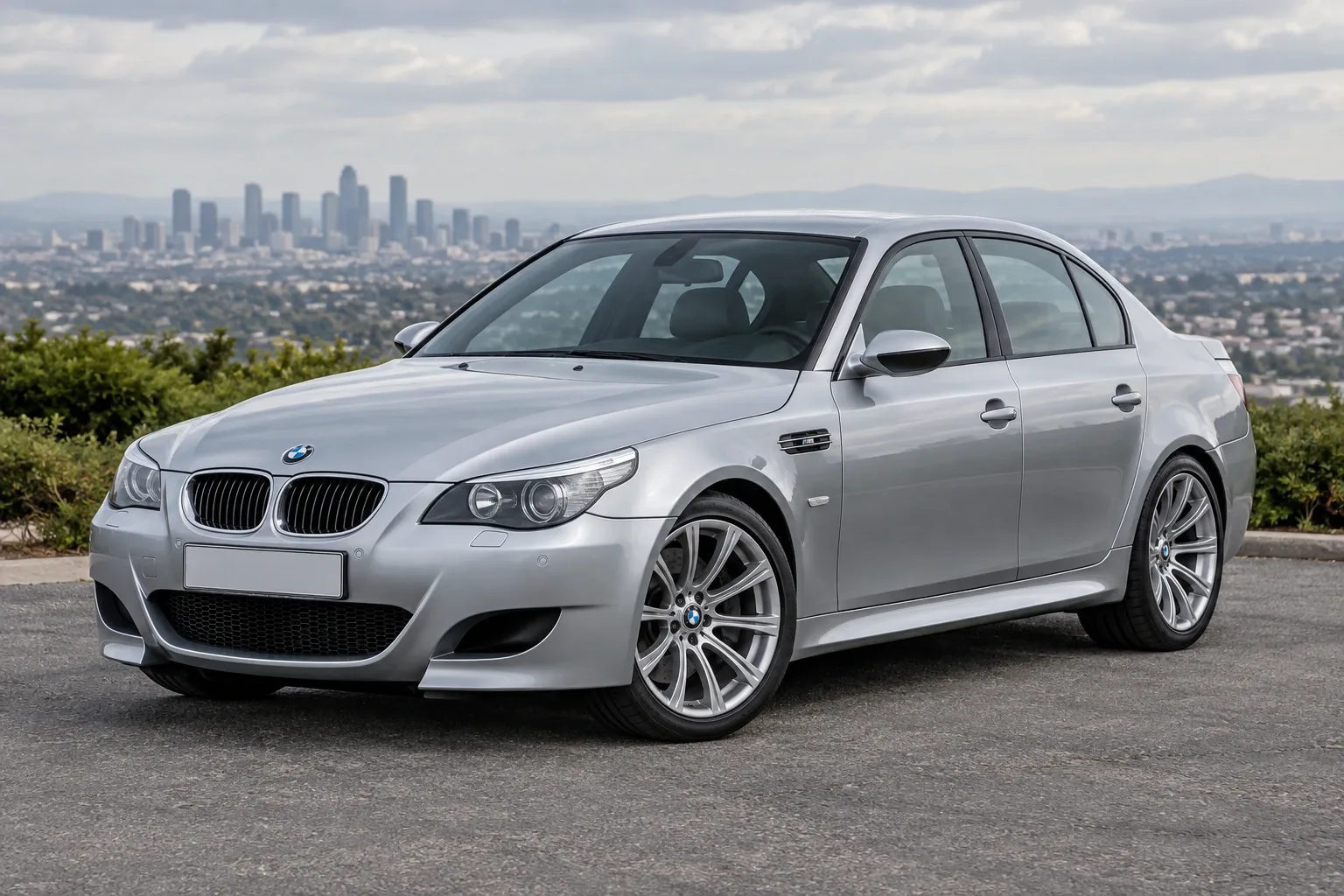
BMW M5 E60
Rating of the BMW M5 E60 (2004–2010): condition, documents, inspection and conditions of sale of the car.
Indicative purchase price
Below market value
Final price agreed after inspection.
Value my car1Why buyers choose this model
The history of the BMW M5 began in 1979 with the debut of the BMW M535i E12 series with an engine boosted to 218 hp. But it was not the real M5, but only its harbinger.
2What buyers check
Review
The history of the BMW M5 began in 1979 with the debut of the BMW M535i E12 series with an engine boosted to 218 hp. But it was not the real M5, but only its harbinger. The true M5 of the first generation appeared only in the mid-80s in the model range of the E28 series. The car, like its predecessor, had an inline 6-cylinder engine with a capacity of 286 hp under the hood. Acceleration to the first hundred was only 6.5 seconds. The R6 also came under the hood of the second-generation M5 E34, produced from 1988 to 1995. At the beginning it was a 3.6-liter engine with a capacity of 315 hp, and later it was replaced by a 3.7-liter engine with a return of 340 hp. Thanks to various improvements, engineers managed to reduce the acceleration time to 100 km / h from 6.3 seconds to 5.9 seconds. The next breakthrough came in 1998, when BMW unveiled the third generation of the already iconic M5 at the Geneva Motor Show. This time, the Bavarians decided to abandon the inline six-cylinder engine in favor of a more powerful 5-liter V8. The S62B50 engine provided 400 hp at peak. Now the emka reached the first hundred in 5.3 seconds. BMW initially wanted to abandon the development of the M5 version for the E39 series, citing the fact that the BMW 540i is already quite fast. However, the decision soon changed. Mercedes has launched the E55 AMG (W210) sports sedan. This time, BMW became the first M5 not to be assembled manually. The next generation BMW M5 E60 series is even more revolutionary. Among the innovations are not only the 10-cylinder V-shaped engine and the smg III gearbox, but also the ability to get a roomy sports wagon.
Engine
5-liter gasoline V10 power 507 hp - a true masterpiece of German technology. 10-cylinders, 40 valves and phase control system VANOS. From one liter of working volume, Bavarian engineers were able to remove 101.5 horsepower. In everyday conditions, the engine uses only 400 hp, but after pressing the “M” button, another 107 horsepower wakes up. Power 507 hp is achieved at very high speeds - 8250 rpm. The maximum torque of 520 Nm is available with 6100 rpm. The first hundred on the speed indicator is overcome after 4.8 seconds (4.7 seconds for the version with an improved automated transmission SMG). The speed limit is limited electronically at around 250 km/h. After removing the electronic collar, it is possible to overcome the magical barrier of 300 km / h without much difficulty. But in addition to its excellent performance, the V10 also has drawbacks. The sports sedan in the city easily burns more than 20 liters per 100 km. If you often press the gas to the end, the flow will increase to about 28 l / 100 km. Owners of the BMW M5 E60 complain about the too small fuel tank, which sometimes have to be refueled barely 200 km. However, this does not mean that you cannot travel a long distance on one tank. It all depends on the driving style. You can get used to everything, but not to the faults. What could break in the engine? First of all, the VANOS valve timing system, or rather the electric valve, responsible for its proper operation. If the engine is bubbling like a diesel, then it should be quickly delivered to the mechanic.
Technical features
BMW M5 is a front engine, rear-wheel drive and LSD friction differential to improve the quality of wheel adhesion. Torque is transmitted through the 7-speed sequential transmission SMG. For the American market, a version of the M5 with a 6-speed mechanics was available. On the front and rear axles, an advanced multi-link suspension is applied. In crash tests according to EuroNCAP E60 earned 4 stars.
Typical malfunctions
Owners of the BMW 5 E60 note too short life of the clutch. Sometimes it has to be changed after 60-70 thousand km. The two-mass flywheel is also failing. The transmission is often capricious - the faulty control unit is to blame for this. The defect manifests itself with strong twitches during switching.
Accelerate the wear of components and too frequent frisky starts using the Launch Control system. Its efficiency is impressive – the car is derailed like a rocket. But at this point, many nodes and components are experiencing huge loads.
Another weakness is the too gentle power steering. Active "handling" can end with a visit to the service. Sometimes you have to change not only the steering pump, but also the rack, pipes and even a tank with liquid.
3Pre-purchase checklist
Review
- This time, the Bavarians decided to abandon the inline six-cylinder engine in favor of a more powerful 5-liter V8.
- BMW initially wanted to abandon the development of the M5 version for the E39 series, citing the fact that the BMW 540i is already quite fast. However, the decision soon changed.
- Seeing little interest in the sports wagon, BMW abandoned the production of the F10 M5 in this body type.
Engine
- You can get used to everything, but not to the faults. What could break in the engine?
- If the engine is bubbling like a diesel, then it should be quickly delivered to the mechanic.
- In addition, there are cases of premature wear of the crankshaft liners, as well as failure of lambda probes (oxygen sensors) and both fuel pumps.
- Before buying, it is necessary to check the liquid in the hydraulic booster tank - whether there are metal sawdust there.
Typical malfunctions
- The two-mass flywheel is also failing.
- Accelerate the wear of components and too frequent frisky starts using the Launch Control system.
4Challenges of selling privately
The BMW M5 E60 is a car that needs no introduction. Excellent driving qualities, unearthly power and purebred sound of the engine are those qualities for which they acquire “emka”. In addition, you get a lot of luxury: leather seats, bi-xenon headlights, many modern electronic systems, a high-end audio system and many other interesting gadgets.
But there is always something to pay for all this. Excellent dynamics makes you visit gas stations more often. And high loads on the transmission lead to unpleasant malfunctions that cannot be eliminated cheaply. Having decided on the M5, you need to be ready for more frequent replacement of tires and brake elements. In addition, the car can not be serviced by the first mechanics, as the "emka" is all permeated with electronics. Most work requires a connection to a special computer to calibrate the equipment being repaired. Unfortunately, few people have experience in the maintenance of such a machine.
- This time, the Bavarians decided to abandon the inline six-cylinder engine in favor of a more powerful 5-liter V8.
- Engine: You can get used to everything, but not to malfunctions. What could break in the engine?
- Technical features: BMW M5 is a front engine, rear-wheel drive and LSD friction differential to improve the quality of wheel adhesion.
- Typical malfunctions: The two-mass flywheel also fails.
Shows, bargaining and re-registration take time: buyers look, promise to think and disappear. Fair price after inspection closes the auction on the spot. If money is needed urgently, the purchase takes away waiting and repeat displays.
5How selling to us works
Leave a request with the car data. We will discuss the preliminary assessment and inspection. After checking the status and documents, we agree on the final price and terms of the transaction.