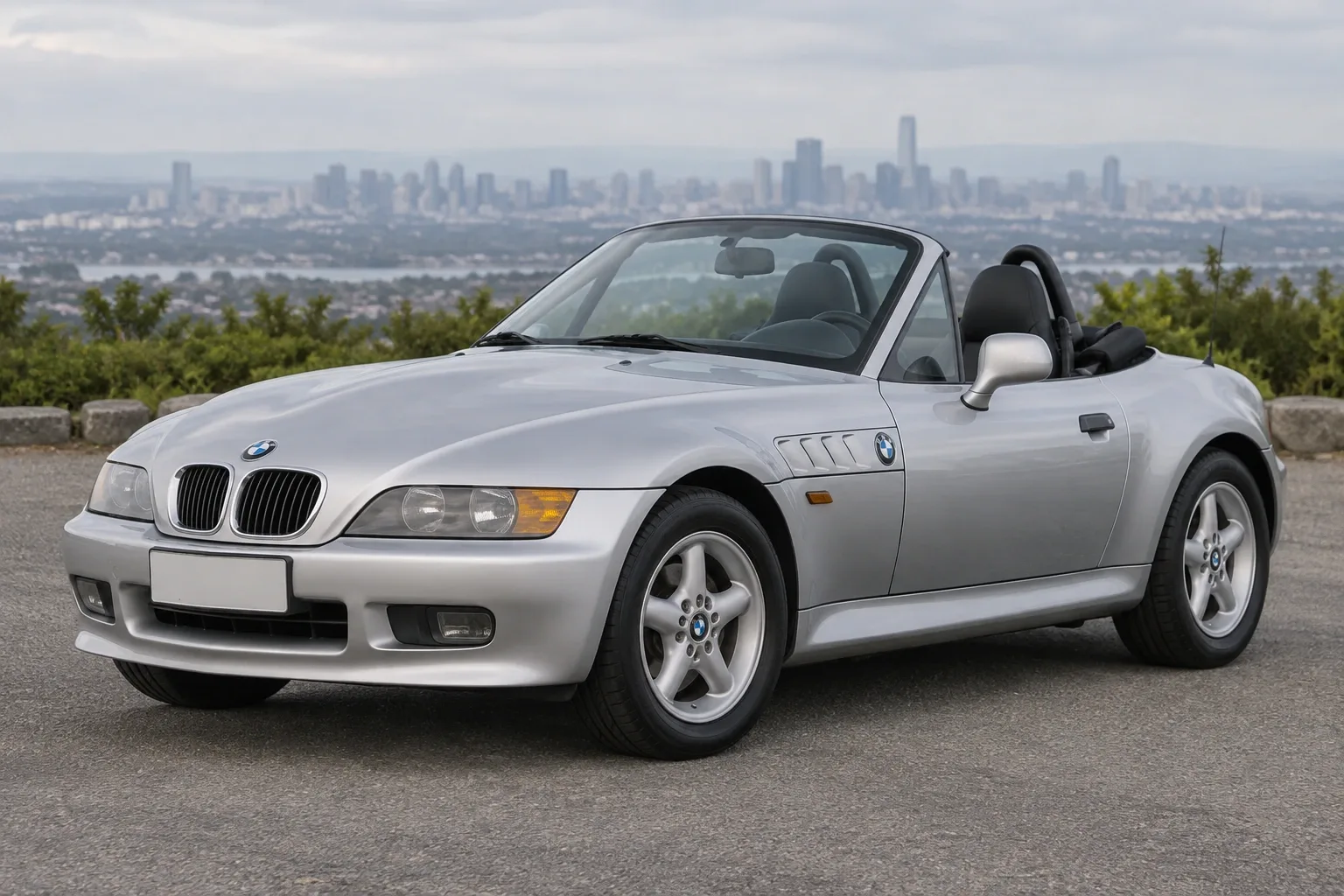
BMW Z3
BMW Z3 evaluation (1996–2002): condition, documents, inspection and conditions of sale of the car.
Indicative purchase price
Below market value
Final price agreed after inspection.
Value my car1Why buyers choose this model
The BMW Z3 is one of the least popular models in the BMW lineup. Despite his brilliant debut as a James Bond car in the movie Golden Eye in 1995 and good sales in the beginning, all subsequent years saw a decline in sales. In total, about 300,000 machines were sold, of which about 6,000 are top-end M-versions. In the secondary market, the Z3 is not much in demand. Of course, except for the top sports versions, which are always popular among collectors.
2What buyers check
Model history
1995 – presentation of the model in the roadster version (E36/7)
1998 – the lineup was replenished by a coupe (E36/8), and the engine range – a top-end R6 with a volume of 3.2 liters
Design features
The self-supporting body hides the components of the old three E30, the newer E36 and the first generation 3 Series Compact. This means that you don’t have to worry about most of the spare parts.
The BMW E36 shared engines, transmission, brakes, steering and front suspension. The rear wheels rest on swinging levers borrowed from the older BMW E30. In any case, the running gear settings trace the sporty genes typical of BMW. And controlled skid is easy to give even with the weakest engine - 1.8 / 115 hp. You don’t have to rely on electronic assistants. The traction control system appeared only at the very end of production.
The significant advantage of the BMW Z3 is good interior insulation and efficient heating. Thanks to this, the roadster can be used on cold and rainy days.
The original interior overlaps with the BMW E36 Compact. It is devoid of fireworks, but made in a typical brand style. It is quite cramped and simple inside, which not everyone will like. Many owners noted that the quality of the assembly cabin is lower than in larger models of BMW. But it's more of an exaggeration.
Engines
If BMW, it is only with a 6-cylinder engine under the hood. At least that’s what the brand’s fans say. But the Z3 is the exception. For happiness, even 140-strong “four” – 1. 9 16V – is enough. The best in the lineup are the inline "sixes": 2.8 / 193 hp and 3.2 / 321 hp (M Roadster). In the case of powerful engines will have to be considered with high fuel consumption. First, four-cylinder engines with a volume of 1.8 liters (M43) and 1.9 liters (M44) fell under the hood. The first is an 8-valve (well known for the 318 iS E36 coupe), the second is a 16-valve one. Six-cylinder capacity of 2.0 and 2.8 liters from the M52 series appeared in 1997. In 2000, they were replaced by more modern R6 - 2. 2 and 3. 0 series M54. All engines are recommended. The gas distribution mechanism uses a long-lasting chain. However, due to the natural aging of seals, local leaks of coolant and oil are observed every now and then. Low failure rates can be expected unless the engine is overheated and it is not the M-version. Overheating is a typical pain of old BMW engines. If in the case of four-cylinder units with cast-iron unit everything can do, then for aluminum six-cylinder engines the consequences can be fatal. The reason is the concept of a cooling system operating at high temperatures and some design miscalculations. For example, the M52 engines used a pump with a plastic impeller. When the stains were broken, overheating was inevitable. Bavarian engines are characterized by increased oil consumption.
Driving and transmission
The components on the front axle have an average service life of 70,000 km. The rear suspension elements, on the contrary, are more durable. Unpleasant malfunction becomes wear of the rear differential. He's starting to hum.
Many owners are interested in the possibility of expanding the narrow gauge. It is possible, but in addition to replacing the wings, bumper and doors, you will have to work with the suspension. The cheapest way is to install the rings under the discs. However, it is better to replace the entire suspension with a wider one, as in versions 2.8 and 3.0. The beam is the same, but the levers are different. Parts for modifications are better to choose personally, since sellers do not always know what they put in ads, and visual differences are barely noticeable.
Typical problems and malfunctions
Minor problems with body corrosion are more of a norm for the age BMW Z3. Body parts are a scarce commodity. Substitutes are virtually non-existent. Finding original details is necessary in the disassembly.
Leaks through the canvas roof are a common convertible problem. More often, water penetrates inside through a multi-component rubber seal above the door. With age, scuffles on the tarp are inevitable. A soft roof is expensive. There are two versions of the roof – electric and mechanical. You can buy a hard roof, but not all Z3s are equipped with eyelets for its fastening.
Sometimes there are problems with the roof. In the manual version – it is necessary to lubricate the hinges or replace the gas cylinders (if any). In electrical versions, first of all, it is necessary to make sure that the switch has a connection to the mass.
During operation, the rear window is wiped or burst. It's made of plastic. Replacement is not particularly difficult, since the glass is connected to the roof with a type of zipper-zipper with a self-adhesive seal. Some old copies have glass sewn.
Over time, the bushings wear out, through which the screws that fasten the rails of the seats pass, and a backlash appears. The windows are also failing.
If you wish, you can buy new original security arcs and install it yourself, although it is not easy. Initially, not all of the copies were equipped with them.
3Pre-purchase checklist
Engines
- Low failure rates can be expected unless the engine is overheated and it is not the M-version.
- When the stains were broken, overheating was inevitable.
Driving and transmission
- Unpleasant malfunction becomes wear of the rear differential. He's starting to hum.
Typical problems and malfunctions
- Minor problems with body corrosion are more of a norm for the age BMW Z3.
- Leaks through the canvas roof are a common convertible problem.
- With age, scuffles on the tarp are inevitable. A soft roof is expensive.
- In the manual version – it is necessary to lubricate the hinges or replace the gas cylinders (if any).
- In electrical versions, first of all, it is necessary to make sure that the switch has a connection to the mass.
- Replacement is not particularly difficult, since the glass is connected to the roof with a type of zipper-zipper with a self-adhesive seal.
- Over time, the bushings wear out, through which the screws that fasten the rails of the seats pass, and a backlash appears. The windows are also failing.
4Challenges of selling privately
The BMW Z3 is the perfect second car in the family. It has an original style, and operating costs are not scary. Many components are suitable from the popular triples E30 and E36. However, the purchase of Z3 should not be rushed. Many cars have fallen victim to unprofessional tuning.
- Model history: 1995 - presentation of the model in the roadster version (E36/7) 1998 - the lineup was replenished by the coupe (E36/8), and the motor range - top-end R6 with a volume of 3.2 liters
- Design features: The self-supporting body hides the components of the old E30, the newer E36 and the first generation 3 Series Compact.
- Engines: Low failure rates can be expected unless the engine is overheated and it is not the M-version.
- Driving and transmission: An unpleasant malfunction becomes wear of the rear differential. He's starting to hum.
- Typical problems and malfunctions: Minor problems with body corrosion are more of a norm for the age-old BMW Z3.
Shows, bargaining and re-registration take time: buyers look, promise to think and disappear. Fair price after inspection closes the auction on the spot. If money is needed urgently, the purchase takes away waiting and repeat displays.
5How selling to us works
Leave a request with the car data. We will discuss the preliminary assessment and inspection. After checking the status and documents, we agree on the final price and terms of the transaction.