
Cadillac CTS 2
Valuation of the Cadillac CTS 2 (2008–2013): condition, paperwork, inspection and terms of sale.
Indicative purchase price
Below market value
Final price agreed after inspection.
Value my car1Why buyers choose this model
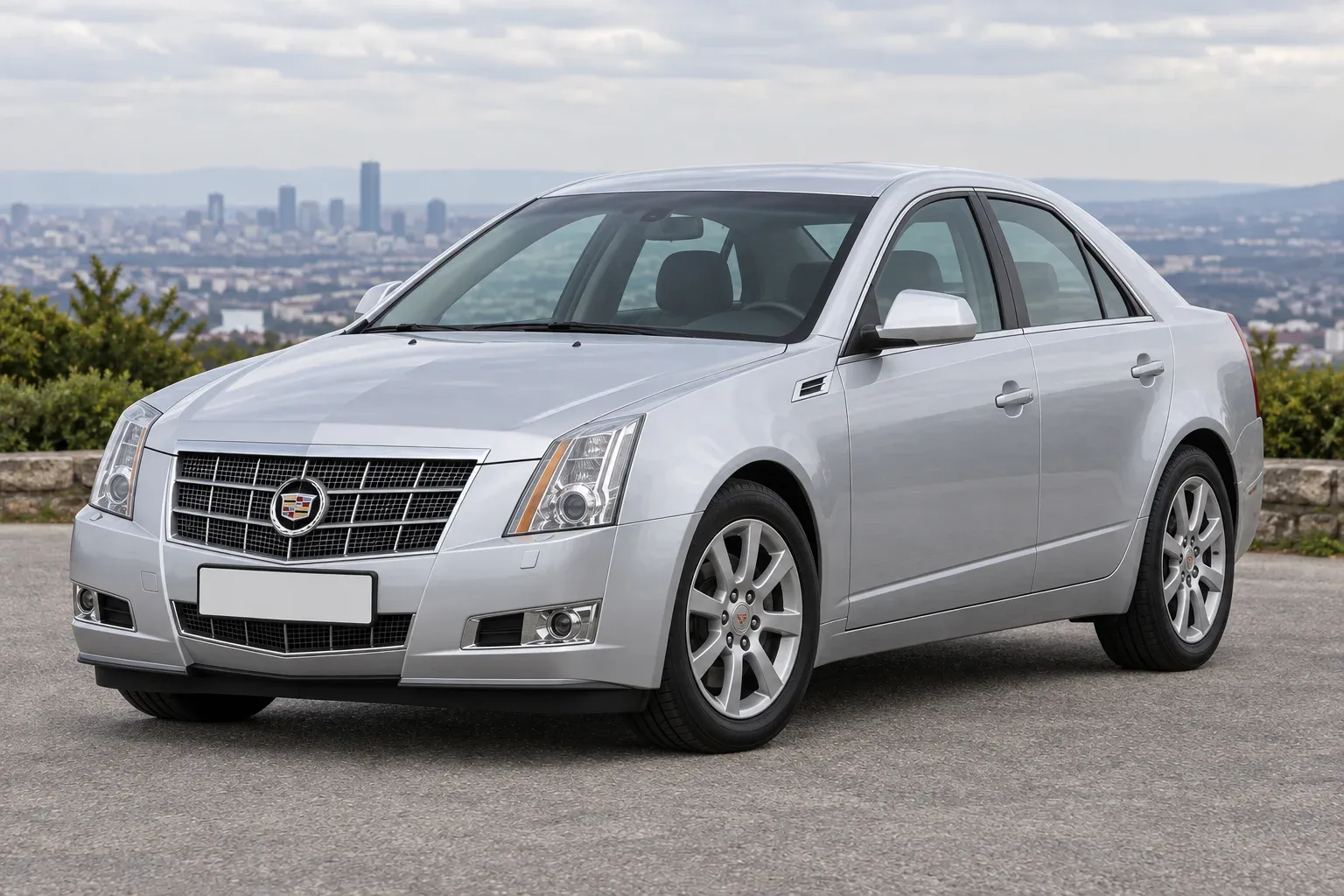
The Cadillac CTS debuted in 2003. Its second generation arrived in 2008 to compete with the BMW 3 Series and Infiniti G37. An estate version was introduced in 2010, followed by a coupe in 2011. The model received a minor facelift in 2012. The CTS II retains the general shape of its predecessor but has a more distinctive appearance, with a stocky stance, sharp edges and extensive chrome trim. Despite the steeply raked rear window, the rear bench is spacious and comfortable, especially compared with smaller cars in the same price bracket. However, it comfortably accommodates only two people. The interior divides opinion: its bold, striking design departs from the conservative approach and differs from that of German saloons. The controls are nevertheless easy to see, reach and understand. The Cadillac CTS also delivers on the road. It handles well and offers greater comfort than the Infiniti or BMW. The steering is precise and predictable. The six-speed automatic shifts smoothly during relaxed driving and responds briskly when needed. However, the CTS is slower than the BMW 335i and Lexus IS350 because it weighs an extra 300 kg. The Cadillac CTS did not achieve five stars in the frontal collision test, although it performed well in the other tests. Its safety equipment includes stability control, ABS and side curtain airbags, but rear side airbags are not provided.
2What buyers check
Review
Cadillac CTS was introduced in 2003. In 2008, the second generation was released, designed to compete with the BMW 3 and Infiniti G37. In 2010, the version in the body of the station wagon was presented, and in 2011 - coupe. In 2012, the model experienced a small facelift. The general shapes of the CTS II are similar to its predecessor, but the appearance has become more charismatic. The car stands out with stocky addition, sharp edges and an abundance of chrome. However, despite the steep bevel of the rear window, the CFS offers a roomy and comfortable sofa, especially when compared to smaller cars competing in price. But only two people will be comfortable in the back. A lot of controversy is generated by the interior, which violates the conservative approach. It was too catchy and bright. His style is not like the one we are used to seeing in German sedans. At the same time, each control element is noticeable, accessible and understandable. Cadillac CTS will not disappoint with its road manners. It is well-driven and much more comfortable than Infiniti or BMW. The steering is clear and predictable. the 6-speed automatic smoothly changes gears during leisurely driving and switches vigorously when needed. However, the CTS is slower than the BMW 335i and Lexus IS350 due to the extra 300kg of weight. Cadillac CTS failed to get a five in the head-on collision test, but it withstood all other tests with honor. The sedan is equipped with all safety systems, including stability control system, ABS and side curtains. However, the rear side airbags are not provided here.
Engines
Under the hood of the American you can find V-shaped "sixes": volume of 2.8 l / 210 hp and 3.6 l / 258-263 and 300-304 hp. All units received a system of changing the phases of gas distribution, and 300-horsepower - direct fuel injection.
In 2010, the base models in the United States began to be equipped with a 3-liter V6 (270 hp) with direct fuel injection. And after restyling, the top 3.6 V6 was updated: the head of the block, the intake and exhaust manifold was redesigned, the fuel injectors, intake valves and the fuel pump were updated.
All engines have a chain type valve timing drive. The chains in the cars of 2008 were often stretched after 50-100 thousand km, although not all. Two years later, the chains were upgraded, and the problem became less common. More often, motor chains with a volume of 3.6 liters are stretched. When the chain is stretched, there are interruptions in the engine, thrust falls, and errors appear. Pull with the replacement of the chain is not worth it - a jump and a meeting of valves with pistons are possible. There have been cases. To replace the valve timing will have to prepare 30-40 thousand rubles.
Ignition coils (from 2 000 rubles) have to be changed at a distance of 100-200 thousand km. Periodically requires attention and cooling system – refuses an additional pump (from 5 000 rubles), corrosive radiator, or stops working fan (resistor fails).
Transmission
American versions with a top engine could be equipped with a 6-speed manual transmission Aisin AY6. In Russia, only models with the GM Hydra-Matic 6L50 automatic were supplied.
The machine is quite reliable. Problems with it are rare - at least so far and mainly in cars with a 3.6-liter unit. And that, not before 200,000 km. The oil in the box is contaminated quite quickly, so it is recommended to update it every 40-60 thousand km. It is necessary to pay attention to the condition of the cooling tubes of automatic transmission oil - they often leak.
As an option, an all-wheel drive system was offered, available only for cars with 3.6 and 3.0. In the normal state, the rear axle is the leading, and if necessary, up to 50% of the thrust is transferred to the front wheels. In the transmission, sometimes you have to face the replacement of leaky glands.
Walking
There's a two-lever system on the front axle. The upper and lower levers are aluminum. A multi-link scheme is used in the back.
There are several options for factory suspension settings, which differ in the balance between handling and comfort. The toughest - FE3 - was installed on rear-wheel drive CTS with a 3.6-liter engine. All other modifications were supposed to be FE2 - the optimal compromise. FE1 is the softest, but it has not been officially installed.
Stage bearings (from 6000 rubles) go 50-150 thousand km - begin to buzz, a backlash appears, or a magnetic tape crumbles. The levers of the front suspension (about 17 000 rubles) serve more than 100-150 thousand km, the rear - more than 150-200 thousand km. By this time, the springs are significantly subsided.
After 50-150 thousand km, the intermediate steering shaft (from 9000 rubles) can be worn. In this case, when the steering wheel is rotated, clicks, crunch or knock are heard, and a backlash is detected in the node. After 100-150 thousand km, the steering rack sometimes begins to knock or leak.
Typical problems and malfunctions
Many had to face the detachment of paint on the trunk lid in the area of the additional stop light and nameplates. Decorative chromium with age fades and peels.
On the dorestyling copies often appear cracks at the place of adjoining the bumper to the body elements. It's all about flimsy mounts. The defect was later fixed.
Some owners of cars with a hatch have to deal with leaks. It's not always the fault of clogged drainage. Often the factory sealant is dried up, or the sealant is handed over.
One of the common problems is that doors do not open from the outside, often front doors. It's all about door handles - micro-switches fail, less often the antenna. The handles (2-6 thousand rubles) can fail after 20-50 thousand km. Sometimes the boot opening button also brings down the wiring.
With age, the salon often begins to creak. Upholstery of chairs is not particularly resistant to wear and may lose its presentation after 100-150 thousand km.
Over time, corrosion occurs on the left spar (from the bottom side). There is also a fuel line attachment. The metal “weakens” and the pistons fly out and the fuel tubes begin to walk. In the advanced case, they can be rubbed, which will lead to leaks and fire. From old age, the mounting of fuel tubes is given in the area of the shock absorber cup, which is also fraught. Therefore, the condition of the fuel tubes and their attachment places should be regularly monitored.
3Pre-purchase checklist
Review
- The 6-speed automatic smoothly changes gears during leisurely driving and switches vigorously when needed.
Engines
- Two years later, the chains were upgraded, and the problem became less common.
- Periodically requires attention and cooling system – refuses an additional pump (from 5 000 rubles), corrosive radiator, or stops working fan (resistor fails).
Transmission
- Problems with it are rare - at least so far and mainly in cars with a 3.6-liter unit. And that, not before 200,000 km.
- The oil in the box is contaminated quite quickly, so it is recommended to update it every 40-60 thousand km.
- It is necessary to pay attention to the condition of the cooling tubes of automatic transmission oil - they often leak.
- In the normal state, the rear axle is the leading, and if necessary, up to 50% of the thrust is transferred to the front wheels.
Walking
- km - begin to buzz, there is a backlash, or a magnetic tape crumbles.
- km can wear intermediate steering shaft (from 9000 rubles).
- In this case, when the steering wheel is rotated, clicks, crunch or knock are heard, and a backlash is detected in the node. In 100,000 to 150,000.
Typical problems and malfunctions
- Some owners of cars with a hatch have to deal with leaks.
- One of the common problems is that doors do not open from the outside, often front doors.
- It's all about door handles - micro-switches fail, less often the antenna. Pens (2-6 thousand).
- Sometimes the boot opening button also brings down the wiring.
- Upholstery of chairs is not particularly resistant to wear and may lose its presentation after 100-150 thousand km.
- Over time, corrosion occurs on the left spar (from the bottom side).
- Therefore, the condition of the fuel tubes and their attachment places should be regularly monitored.
4Challenges of selling privately
Most often, the problems were delivered by the first cars of 2008. In 2009, some of the problems were eliminated, and after restyling, reliability was slightly tightened. In the case of repair, it should be remembered that the resource of even expensive original spare parts is much higher than cheap analogues. When choosing a Cadillac CTS, it is better to focus on finding restyled instances.
- Cadillac CTS was introduced in 2003.
- Engines: Two years later, the circuits were upgraded and the problem became less common.
- Transmission: Problems with it are rare - at least so far and mostly in cars with a 3.6-liter unit. And that, not before 200,000 km.
- Walking: km - begin to buzz, a backlash appears, or a magnetic tape crumbles.
- Typical problems and malfunctions: Some owners of hatch machines have to deal with leaks.
Shows, bargaining and re-registration take time: buyers look, promise to think and disappear. Fair price after inspection closes the auction on the spot. If money is needed urgently, the purchase takes away waiting and repeat displays.
5How selling to us works
Leave a request with the car data. We will discuss the preliminary assessment and inspection. After checking the status and documents, we agree on the final price and terms of the transaction.