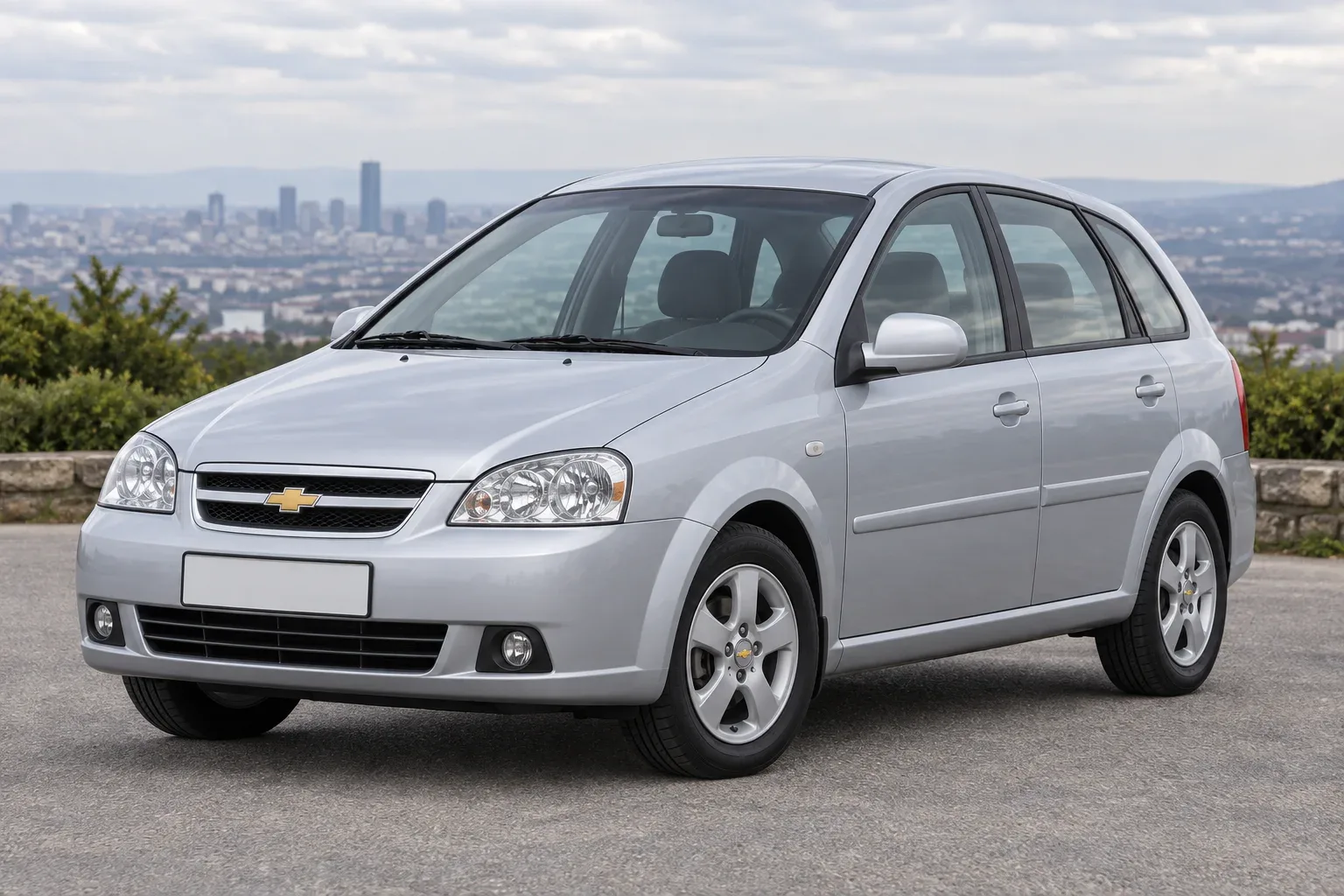
Chevrolet Lacetti
Valuation of the Chevrolet Lacetti (2004–2013): condition, paperwork, inspection and terms of sale.
Indicative purchase price
Below market value
Final price agreed after inspection.
Value my car1Why buyers choose this model
The Chevrolet Lacetti was first shown in 2003. The new model replaced the Daewoo Nubira.
2What buyers check
Review
The Chevrolet Lacetti was first shown in 2003. The new model replaced the Daewoo Nubira. The design of the brainchild of the South Korean automaker GM Daewoo was developed by Italian studios: a sedan and wagon - in Pinafarina, and a hatchback - in Giorgetto Giugiaro. Chevrolet sales began in 2004. In Europe, the sedan and wagon retained the name Nubira. In 2007, a special version of the WTCC street edition appeared, in the style of the WTCC championship cars, where Lacetti took prizes. From the production version, the model differs in the presence of a rear spoiler, sports kit and cast discs. #
The Russian Lacetti was equipped with three gasoline atmospherics with a volume of 1.4 liters (94 hp), 1.6 liters (109 hp) and 1.8 liters (121 hp). For European buyers, a 2-liter turbodiesel with a return of 120 hp was provided. All engines have pelian roots, which inherited increased "sweating" (oiling) with a run of more than 100-150 thousand km. In general, the engines are not bad, many of them easily overcome the line of 250-350 thousand km. Further, an increase in oil consumption is possible, eliminated by replacing oil caps or oil-removable rings (10-40 thousand rubles). The most reliable is the power unit with a working volume of 1.8 liters. # #
The drive of the gas distribution mechanism on all engines is belted, with a recommended replacement interval of 60,000 km. Updating the drive of the valve timing will cost 10-16 thousand rubles. There are cases of breakage of the belt of the valve timing. To eliminate the consequences had to spend 40-80 thousand rubles. It will not be superfluous to replace the timing and put a new pump (from 1400 rubles for an analog or 5200 rubles for the original). Even if when inspecting the coolant pump, there is no doubt about its performance. In fact, the pump rarely reaches the 2nd replacement of the HRM belt. Luft pulley pump or leaking coolant can appear after 80-100 thousand km. The generator belt on the first Lacetti often did not reach even the first replacement of the belt timing due to the plastic roller of the tensioner, which collapsed when worn and cut the belt with sharp edges. Subsequently, the manufacturer began to install a metal roller, which has a much larger resource. The scalp is almost eternal. ##Shoes
The flashing oil of the engine lubrication system is usually a consequence of poor contact on the oil pressure sensor or even failure of the sensor itself. Some needed a replacement sensor at the first 10,000 km, others – only after 100,000 km. The harbinger of the imminent death of the sensor are traces of leakage of oil from under it. But after the sunbathing, the "Oliver" occasionally met more dramatic situations. Because of the clogged mesh of the oil receiver, the pressure in the lubrication system dropped, and the inserts were turned. Auto mechanics believe that the cause of clogging is a large amount of sludge, which occurs due to an excessive interval of oil change (15,000 km), which is also not always of high quality. It is recommended to reduce the interval to 7-10 thousand km and be more careful when choosing oil. # #
On the engines of 1.4 and 1.6 liters until 2008 of release, there was hanging and jamming of valves due to the formation of sodium. At the end of 2008, the design of the valve rod was refined, and the inner diameter of the sleeve was increased, which eliminated jamming. But there was a side effect - a specific knock (clasp) after heating up the engine. The cause of the occurrence of soot is poor-quality gasoline and frequent trips over short distances with an unheated engine. Auto mechanics tend to believe that the appearance of carbon monoxide contributes to the valve recirculation of exhaust gases EGR. It supplies the exhaust gases to the combustion chamber to ensure the combustion of the fuel-air mixture at lower temperatures and pressure and, as a result, to reduce harmful substances in the exhaust gases - nitrogen oxides. They also suggest that a standard thermostat tuned to a temperature of 87 degrees also contributes to the “cold” combustion of fuel. All this does not ensure self-cleaning of candles and valves from sofa. "Panacea" - to silence the EGR valve and install a hotter thermostat with an opening temperature of 92 degrees. # #
After 100-200 thousand km, cracks in the expansion tank of coolant (1-2 thousand rubles) could occur. The thermostat nurses at least 100-150 thousand km. Over time, the thermostat body begins to skip antifreeze (800-2000 rubles). A little later, you may need to replace the cooling system. The radiator can leak when running more than 150-200 thousand km (from 5000 rubles for an analog or 17 000 rubles for the original).
Laying the valve cover begins to "etat" the oil after 50-100 thousand km. When opening, it will not be superfluous to change the lining of the valve cover bolts. The most reliable and cheap analogue is the ring of the oil system for old KAMAZ engines. With age, a simple replacement of the gasket can not get rid of, and you have to change the valve cover (from 3,000 rubles for an analog or 7-9 thousand rubles for the original). After 100,000 km in engines 1.8 for a source of extraneous sound often took hydraulic compensators, after the replacement of which nothing changed dramatically. The cause of knocking in plastic flaps in the intake manifold (valve change geometry). After 100-200 thousand km could fail the pump (from 1300 rubles for the analogue or 41 000 rubles for the original). Due to the failure of the pressure sensor of the fuel pump, engine malfunctions caused by a change or drop in fuel pressure could occur. Problems with the launch after 100-200 thousand km could begin because of the retracting starter relay (bendix - 7-13 thousand rubles). Unpleasant phenomena, such as jitters or choking, could appear after 100-200 thousand km due to the failure of the oxygen sensor (1.2-4.5 thousand rubles), less often due to a malfunction of the throttle unit (8-19 thousand rubles) or a contaminated absolute pressure sensor in the intake manifold (500-1500 rubles). Over time, the sensor of the camshaft position began to fail, less often - the crankshaft position sensor (600-1300 rubles). The catalyst can clog after 150-200 thousand km of run. After 200-300 thousand km, sometimes it breaks through the gasket of the cylinder head. # #
Problems with a manual gearbox are considered rare, but still sometimes occur after 300,000 km. Bearings or gears wear out. The oil in the manual transmission, according to the manufacturer, is designed for the entire life of the box. It is better to ignore this claim. Many car service providers recommend a replacement every 60,000 km. The clutch resource largely depends on the operating conditions and driving style. Its replacement will most likely be necessary for a run of more than 150-200 thousand km. The remcomplette will pull for 8-10 thousand rubles. For work will be asked in the area of 5-6 thousand rubles. The squeezable bearing sometimes fails earlier (from 3,500 rubles for an analog or 8600 rubles for the original). After 100,000 km on the gear selection rod could appear fogging. Many people didn't pay attention to it. Replacing the squirrel eliminates the problem. After 200-250 thousand km wears the backstage of the choice of gears (helicopter). The defect leads to difficulties with the inclusion of gears. The cost of the backstage collection is about 3000 rubles. #
There are two types of automatic transmissions: the Japanese AISIN 81-40LE (paired with 1.6 liters) and the German ZF 4HP16. Some sources claim that the engines of 1.8 liters were equipped with the Japanese AISIN 55-51LE automatic transmission. Serious problems with machines are rare. There were cases of destruction of the planetary transmission, wear of bearings and a package of frictions after 200-300 thousand km of run. The cost of repairs is about 80 000 rubles. The occurrence of shocks at the time of gear shifting after 50-100 thousand km is associated with the failure of the sensor of the position of the selector. The analogue will cost 2500-3000 rubles, and work on its replacement - in 2000 rubles. The oil used in the machine is designed for the entire service life, and the filter replacement is provided only in case of repair. Auto service providers recommend the first replacement of the working fluid to be performed at 60,000 km, and subsequently produce it every 30,000 km. The filter box should be changed after 90,000 km. The glands of Lacetti drives with both the manual transmission and automatic transmission sometimes begin to poison after 100-150 thousand km of run. # #
The first to surrender the stabilizer racks, starting to knock after 50-60 thousand km. The replacement is recommended to be performed on the analogue of the CTR, which is the supplier of the original. FEBEST rarely lives more than 20,000 km. Rear shock absorbers can flow after 50-60 thousand km, and later and the front - after 70-80 thousand km. Staff racks in working condition often begin to knock because of the backlash of the shock absorber rod. The bearings are delivered after 100,000 km. Ballrooms run more than 100-150 thousand km (from 600 rubles for an analogue or 2400 rubles for the original). Front landing bearings reach up to 150-200 thousand km. They change separately from the hub: 1.3-1.8 thousand rubles plus 1000 rubles for work. Rear stage bearings usually last more than 200,000 km. They are assembled with a hub: from 4000 rubles for an analogue or 13,000 rubles for the original. #
A slight creak when swaying the steering wheel left-right occurs due to the anther at the bottom of the steering column when running more than 100-120 thousand km. Silicone lubrication treatment eliminates "extra sounds". The steering rack sometimes begins to knock or flow after 150-200 thousand km (from 14 000 rubles for an analogue or 37 000 rubles for the original). Taping of the steering shaft cardinal may appear after 150-200 thousand km. The new cardinal is available for 18 000 rubles in the original or 4-5 thousand rubles for an analogue. Individual owners are able to replace crosses cost 500-600 rubles. The pump GUR can be asked for replacement after 150-200 thousand km due to the appearance of a hum and pulley back. The original pump assembly is available for 26 000 rubles, and the price tag for analogues starts at 6000 rubles. Some reanimate the pump by overpressing the bearing. ## Brakes
In age instances, brake hoses can burst (200-900 rubles). Sometimes the brake tube of the right rear wheel fails - it rots (1500 rubles for the original). Time also affects the serviceability of the parking brake cable, which wedges and tears (from 700 rubles for an analog or 2000 rubles for the original). After 150-200 thousand km can fail one of the sensors ABS (from 600 rubles for analogue or 2800 rubles for the original). There were problems with the ABS block - it began to leak, or the electronic part refused. #
The external SRUS can crunch after 150-200 thousand km (from 2000 rubles per analogue). The internal SRUS usually runs over 200-300 thousand km (from 3000 rubles for an analogue or 7000 rubles for the original). In cars older than 10-15 years, the right drive shaft is often destroyed due to corrosion of metal under the balancer. The replacement can be purchased for 8-13 thousand rubles, and the original drive - for 54 000 rubles. # # Body
Protection against corrosion Chevrolet Lacetti on a solid three ... with a plus. The reason for this is insufficient resistance of body parts to an aggressive environment in the formation of chips, especially on the hood and roof. In some instances, rust points appear on the arches of the rear wheels, and paint swells along the edge of the hood. In age instances, it is necessary to treat rapids and wheel arches (28-46 thousand rubles). Small scratches form on the side windows over time. It is noteworthy that the Lacetti glass Korean assembly is more resistant to impact. The hood loop gives the right hinge a nasty knock and creak to the salon on the right from under the glove compartment. After the riveting of the hinge, there is a pleasant silence. Many people notice the lifting of the hood at speeds above 100-120 km / h. From its "surfacing" can be eliminated by changing the length of the rubber stop under the hood, adjusting the lock and pin, as well as gluing the seal on the upper edge of the headlight. Curved lid of the trunk is not uncommon - the difference in distances between the lid and the rear wings is noticeable to the naked eye. The gaps are easy to set, adjusting the position of the hinges.
3Pre-purchase checklist
Engines
- In general, the engines are not bad, many of them easily overcome the line of 250-350 thousand km.
Belts.
- The drive of the gas distribution mechanism on all engines is belted, with a recommended replacement interval of 60,000 km.
- Even if when inspecting the coolant pump, there is no doubt about its performance.
- Luft pulley pump or leaking coolant can appear after 80-100 thousand km.
- The generator belt on the first Lacetti often did not reach even the first replacement of the belt timing due to the plastic roller of the tensioner, which collapsed when worn and cut the belt with sharp edges.
Olives
- Some needed a replacement sensor at the first 10,000 km, others – only after 100,000 km.
- It is recommended to reduce the interval to 7-10 thousand.
Valve hanging
- But there was a side effect - a specific knock (clasp) after heating up the engine.
Cooling system
- km could occur cracks in the expansion tank of coolant (1-2 thousand rubles).
- A little later, you may need to replace the cooling system.
- The radiator can leak when running more than 150-200 thousand.
Other problems
- The cause of knocking in plastic flaps in the intake manifold (valve change geometry).
- Due to the failure of the pressure sensor of the fuel pump, engine malfunctions caused by a change or drop in fuel pressure could occur.
- Problems with launch after 100-200 thousand
- km due to the failure of the oxygen sensor (1.2-4.5 thousand).
- RUB), less often due to a malfunction of the throttle node (8-19 thousand.
- To eliminate the malfunction will have to spend 15-20 thousand rubles.
- After 10-15 years, the silencer can rot (from 3000 rubles for an analogue or 59 000 rubles for the original).
ICSW
- Problems with a manual gearbox are considered rare, but still sometimes occur after 300,000 km. Bearings or gears wear out.
- Many car service providers recommend a replacement every 60,000 km.
- Its replacement will most likely be necessary for a run of more than 150-200 thousand km. The remcomplette will pull for 8-10 thousand rubles. For work will be asked in the area of 5-6 thousand rubles.
- The squeezable bearing sometimes fails earlier (from 3,500 rubles for an analog or 8600 rubles for the original).
- After 100,000 km on the gear selection rod could appear fogging. Many people didn't pay attention to it. Replacing the squirrel eliminates the problem.
DISTRIBUTION
- Serious problems with machines are rare.
- There were cases of destruction of the planetary transmission, wear of bearings and a package of frictions after 200-300 thousand km of run.
- The cost of repairs is about 80 000 rubles.
- km is associated with the failure of the selector position sensor.
- The oil used in the machine is designed for the entire service life, and the filter replacement is provided only in case of repair.
- Auto service providers recommend the first replacement of the working fluid to be performed at 60,000 km, and subsequently produce it every 30,000 km.
Walking
- The replacement is recommended to be performed on the analogue of the CTR, which is the supplier of the original.
- Rear shock absorbers can leak after 50-60 thousand.
- Staff racks in working condition often begin to knock because of the backlash of the shock absorber rod.
Steering
- The steering rack sometimes starts knocking or leaking after 150,000 to 200,000.
- Taping of the steering shaft cardinal may appear after 150-200 thousand km.
- It was a hum and a pulley.
Brakes
- Sometimes the brake tube of the right rear wheel fails - it rots (1500 rubles for the original).
- km can fail one of the sensors ABS (from 600 rubles for an analog or 2800 rubles for the original).
- There were problems with the ABS block - it began to leak, or the electronic part refused.
Drives.
- In cars older than 10-15 years, the right drive shaft is often destroyed due to corrosion of metal under the balancer.
Bodywork
- Protection against corrosion Chevrolet Lacetti on a solid three ... with a plus.
- The reason for this is insufficient resistance of body parts to an aggressive environment in the formation of chips, especially on the hood and roof.
- In some instances, rust points appear on the arches of the rear wheels, and paint swells along the edge of the hood.
- The hood loop gives the right hinge a nasty knock and creak to the salon on the right from under the glove compartment.
- Motor failure mainly occurs due to insufficient tightness of the body and the ingress of liquid inside - on the electric board, where the tracks are oxidized.
Interior
- The noise emitted by the back of the sofa is often perceived as the thud of the suspension.
Heater and air conditioner
- The radiator can clog or leak after 200,000 to 300,000.
Electrician.
- Problem places include: frequent burnout of fuses, flashing of the clock display, "glitch" of the central lock, washer and fuel level indicator.
- Problems with the control of external light alarms and headlights occur due to jamming of the contacts of the steering switch as a result of melting of the plastic substrate.
- The contact group was later redesigned and the problems virtually disappeared.
- Problems in the air conditioning-recycling-heating of the rear window after 100-150 thousand
- The soldering of the tracks (about 1000 rubles) usually brings back the problem block.
- The airbag bulb lights up due to poor contact in the connector of the pillow control unit. The block itself fails less often.
- The new generator in the original is very expensive - 60 000 rubles. Analogues cost more than 8000 rubles. Comprehensive repairs will cost 5-8 thousand rubles.
4Challenges of selling privately
In general, despite the wide variety of possible problems, the likelihood of their manifestation on one copy is not high. Yes, there are weaknesses, but still compared to competitors Chevrolet Lacetti is quite stable and reliable. Even despite its solid age, the inexpensive Lacetti is still ready to give battle to the pushing young.
- Review: Chevrolet Lacetti was first shown in 2003.
- Engines: In general, the engines are not bad, many of them easily overcome the milestone of 250-350 thousand km.
- Rear shock absorbers can leak after 50-60 thousand.
- Body: Protection against corrosion Chevrolet Lacetti on a solid three ... with a plus.
- Interior: The noise emitted by the back of the sofa is often perceived as the sound of the suspension.
- Heater and air conditioner: The radiator can clog or leak after 200,000 to 300,000.
- Electricity: Problem places include: frequent burnout of fuses, flashing of the clock display, "glitch" of the central lock, washer and fuel level indicator.
Shows, bargaining and re-registration take time: buyers look, promise to think and disappear. Fair price after inspection closes the auction on the spot. If money is needed urgently, the purchase takes away waiting and repeat displays.
5How selling to us works
Leave a request with the car data. We will discuss the preliminary assessment and inspection. After checking the status and documents, we agree on the final price and terms of the transaction.