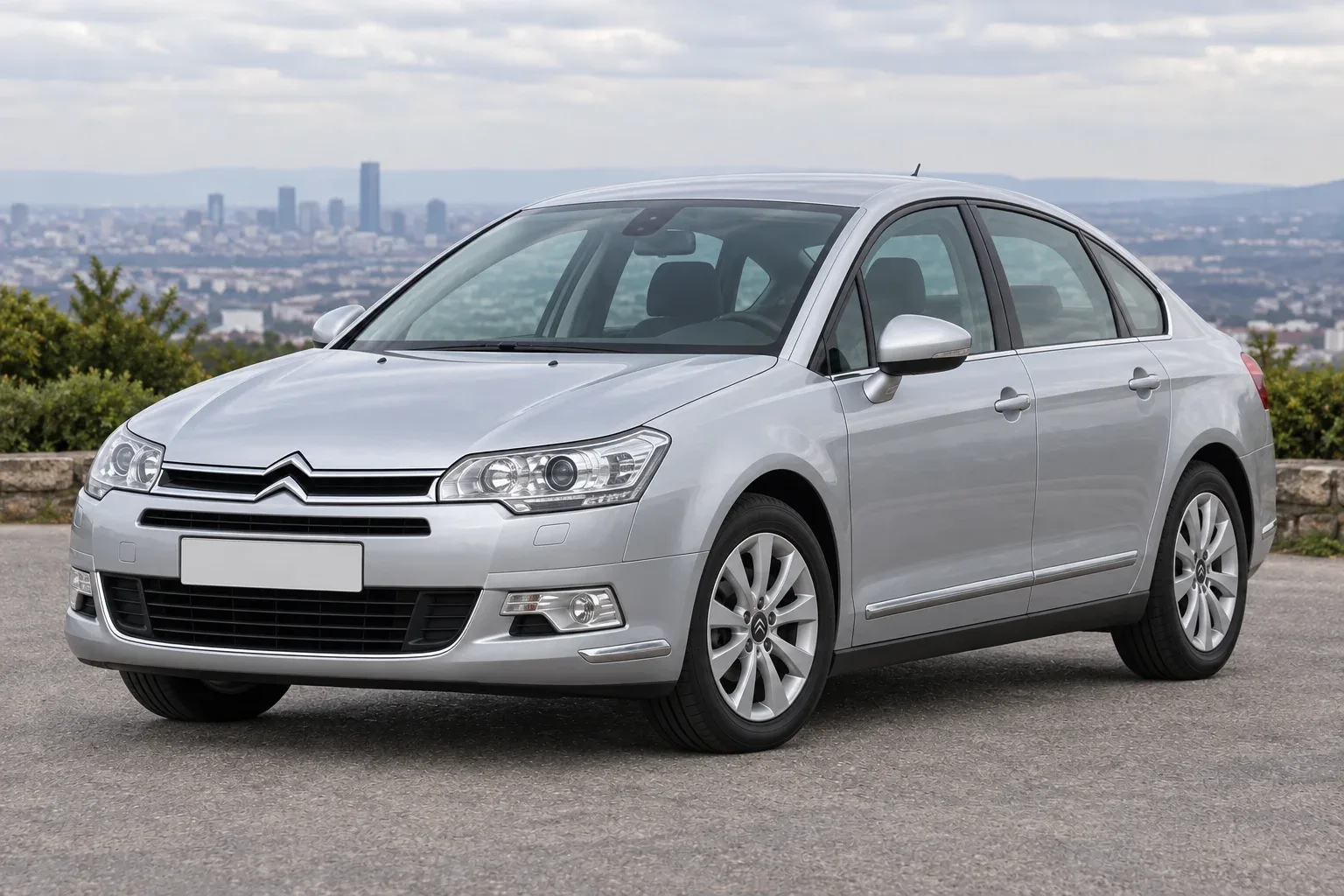
Citroën C5 X7
Valuation of the Citroën C5 X7 (2007–2017): condition, paperwork, inspection and terms of sale.
Indicative purchase price
Below market value
Final price agreed after inspection.
Value my car1Why buyers choose this model
The second-generation C5 is a mid-range car aiming for business class, the so-called D+ class. Serial production of the C5 was launched in April 2008. The car is based on the PF3 platform, shared with the Citroen C6 and Peugeot 407. The exterior of the C5 received typical German shapes. Citroen C5 was offered with two types of body – sedan and station wagon. In 2010, a number of design improvements were carried out, the configuration was revised and the engine line was adjusted, and in 2012 the C5 underwent a “soft” restyling.
2What buyers check
Engines
A wide range of engines was offered for the Citroen C5. Gasoline: atmospheric - 1.6 liters (120 hp), 1.8 liters (127 hp), 2.0 l (143 hp), V6 3.0 l (215 hp) and 1.6 TNR with turbocharging (155 hp). Diesel: 1.6 (109 hp), 2.0 l (138 hp), 2.2 l (200 hp), V6 2.7 l (200 hp) and V6 3.0 l (240 hp). The most problems were delivered by the 1.6 TNR engine, which was offered since October 2009. The engine was developed in collaboration with BMW engineers. The engine managed to show its unruly disposition on the Citroen C4 and Peugeot 308 cars. The main problems are the stretching of the chain after 30-40 thousand km and the wear of seats camouflaged after 50-60 thousand km. Later, the power unit was finalized, and after 2011, problems are less common. The stretched chain will require about 10 thousand rubles to replace it. The 2.0 HDI turbodiesel is not rarely deaf on the go. The reason is the pressure regulator on the TNVD and the hanging of the EGR valve. After restyling, the ailment almost does not occur. Also on the dorestyling 2.0 HDI in the cold sometimes did not include the regular heater Webasto: blocked due to freezing of the diesel. There are also common engine malfunctions: not turning on or vice versa not turning off the engine cooling fan, the “glues” of the engine cooling temperature sensor and the pump flow. For engines with belt-driven HRM (1.8i, 2.0i, 2.0HDi) the belt replacement is prescribed after 120 thousand km. But in practice there were isolated cases of breakage of the belt after 60 thousand km. The consequences are predictable – the flexion of the valves. Therefore, some car service providers recommend changing the belt after 60 thousand.
Transmission
In pair with the engines, mechanical and automatic transmissions were installed. "Mechanics" of two types: 5-speed - for gasoline 1.8 (only with manual transmission) and 2.0 liters, as well as diesel 1.6 HDi and 6-speed - for 1.6 TNR and diesel 2.0 HDi and 2.2 HDi. Owners of the C5 with a manual transmission after 50-90 thousand km often note the appearance of buzzing for gas discharge on the 3rd, 4th or 5th gears. This phenomenon is a feature of the box, which does not affect its resource. After 80-90 thousand km, there are sometimes problems with native clutch. The cost of the new original set is about 10 thousand rubles, the analogue is about 5 thousand rubles. In frosts, transmission cables can be seized, and an attempt to include transmission by force often leads to the destruction of the plastic sleeve of the curtain. For the new node will have to pay about 7-9 thousand rubles. There are two automatic boxes. 4-speed AL4 was installed exclusively on the 2-liter gasoline version, 6-speed Aisin - on all other versions. "Automatic" AL4 is widely used on French cars, in particular in the Citroën C4 and Peugeot 308. The only common problem of this box is the appearance of aftershocks after 60-80 thousand km due to failure of the electric valves of pressure distribution. The cost of repair is about 20-30 thousand rubles. Owners of cars with Japanese automatic transmission "Aisin" also note the appearance of aftershocks during switching or immediately after stopping. This box is used on the Volkswagen Group cars. Tremors are a common problem after 60-100 thousand km.
Walking
The main advantage of the Citroen C5 is the Hydractive III+ hydropneumatic suspension, which provides comfortable movement on the roads. Hydropneumatic racks on the first copies often began to leak after 30-60 thousand km. The racks of the manufacturer KYB exist only in the original, the cost of one rack is about 9-10 thousand rubles. In 2010, the hydraulic resistant was finalized, and the problem was almost exhausted. Aluminum tubes supply fluid to the rear hydraulic racks often "leak" after 40-60 thousand km. The main reason is corrosion. According to the official service employees, the manufacturer has upgraded the tubes, but the problems with the tubes periodically recur after 4-5 years of operation. The cost of new tubes at dealers is about 7-8 thousand rubles, the same amount of work on replacement is about 8 thousand rubles. The cost of pipes on the side is about 3-6 thousand rubles. After 100-150 thousand km, the hydrosphere fails (the membrane breaks), and the suspension becomes noticeably tougher. In total, 7 hydrospheres were used in the hydraulic circuit. The cost of one new original hydrosphere is about 5-6 thousand rubles, analogue - about 2-3 thousand rubles. Episodically slip cases of failure of the valve of the suspension level (the car rises in jerks, 17-18 thousand rubles) and the control unit of the hydraulic suspension BHI (40-45 thousand rubles). The front stabilizer of transverse stability stands more than 50-60 thousand km, the same amount of bushings serve. The rear stabilizer stands care for more than 60-80 thousand km. After 60-100 thousand km, wear of the lower ball support and the Silent blocks of the front suspension is found.
Body and salon
Chrome decorative linings on the body eventually darken and swell. In warm weather, owners sometimes notice that the rear bumper is barely noticeable waves. With the cold snap, the “wave effect” disappears. Some owners notice clicks/squeaks when opening doors. The reason is the wear of the door lock.
On cars older than 3-4 years due to corrosion of the window lifting mechanism, the cable often breaks off. The cost of the original mechanism in the collection of about 9-10 thousand rubles, analogue - about 3-4 thousand rubles.
On Citroen C5 until 2010 there were problems with the mechanism of opening the hood: the cable broke, the guide or the opening key broke off.
Due to the oxidation of the contacts of the locks on the first Citroen C5, the onboard computer began to pester messages about open doors, accompanying the warning with sound signals. Later, the contacts were made sealed, and there were no problems with the locks.
Many owners note a decrease in the quality of finishing materials on cars assembled after 2010. Claims cause cracking of the casing of the automatic transmission and manual transmission lever, peeling the steering wheel after 20-30 thousand km and rubbing silver plastic lining on the steering wheel and door handles. Sometimes questions are raised about the worn leather upholstery of the seats of the combined interior leather-cloth and the refused heating of the seats due to the break of contacts.
Electrician.
Due to the loss of contact on the board of the control unit climate control, there are cases of failure of the temperature regulator: when the handle rotates, the temperature does not change. The cost of a new block at dealers is about 14-15 thousand rubles, in the "store" - about 10 thousand rubles. High-quality soldering of the unit (500-600 rubles) restores its efficiency.
Some owners of the C5 over 4-5 years old had to face spontaneous shutdown of the tape recorder. A possible cause is overheating.
The parking sensor fails due to moisture in the 3-4-ies. The cost of the original sensor is about 3-4 thousand rubles.
Sometimes there are problems with the generator. The cost of the new generator is about 20-25 thousand rubles. Often it is possible to restore the native starter for 3-6 thousand rubles.
3Pre-purchase checklist
Engines
- The most problems were delivered by the 1.6 TNR engine, which was offered since October 2009.
- The main problems are the pulling of the chain after 30-40 thousand.
- Wear and wear of seats camouflaged after 50-60 thousand km.
- Later, the power unit was finalized, and after 2011, problems are less common.
- There are also common engine malfunctions: not turning on or vice versa not turning off the engine cooling fan, the “glues” of the engine cooling temperature sensor and the pump flow.
- For engines with belt-driven HRM (1.8i, 2.0i, 2.0HDi) the belt replacement is prescribed after 120 thousand km.
- Therefore, some car service providers recommend changing the belt after 60 thousand.
Transmission
- Sometimes there are problems with the native clutch.
- The only common problem with this box is the appearance of aftershocks after 60-80 thousand.
- km due to failure of the electric pressure distribution valves. The cost of repair is about 20-30 thousand rubles.
- Tremors are a common problem after 60-100 thousand km.
- The reason is the hydrovalve block, which over time is clogged with wear products.
- The recipe for longevity is a partial change of oil in the box every 60 thousand.
- In winter, cars older than 3-4 years often have problems with the gear selector - the lever is not removed from the position "R".
- There are no systematic problems with this box.
Walking
- In 2010, the hydraulic resistant was finalized, and the problem was almost exhausted.
- Aluminum tubes supply fluid to the rear hydraulic racks often "leak" after 40-60 thousand km. The main reason is corrosion.
- According to the official service employees, the manufacturer has upgraded the tubes, but the problems with the tubes periodically recur after 4-5 years of operation.
- km meets the wear of the lower ball support and Silent blocks of the front suspension.
- km may appear backlash or leakage in the steering rack. The cost of a new reiki is about 40-50 thousand rubles.
- roubles) and failure of the brake pedal contact switch.
- Illuminating a message of wear of brake pads, accompanied by an audible signal, is a common problem.
- The reason is the rotting of the wear sensor wire.
Body and salon
- Some owners notice clicks/squeaks when opening doors. The reason is the wear of the door lock.
- On cars older than 3-4 years due to corrosion of the window lifting mechanism, the cable often breaks off.
- On Citroen C5 until 2010 there were problems with the mechanism of opening the hood: the cable broke, the guide or the opening key broke off.
- Later, the contacts were made sealed, and there were no problems with the locks.
- Sometimes questions are raised about the worn leather upholstery of the seats of the combined interior leather-cloth and the refused heating of the seats due to the break of contacts.
Electrician.
- Due to the loss of contact on the board of the control unit climate control, there are cases of failure of the temperature regulator: when the handle rotates, the temperature does not change.
- Some owners of the C5 over 4-5 years old had to face spontaneous shutdown of the tape recorder. A possible cause is overheating.
- The parking sensor fails due to moisture in the 3-4-ies.
- Sometimes there are problems with the generator.
4Challenges of selling privately
The second-generation Citroen C5 has its own unique charisma, but in terms of reliability, nothing is issued. The design improvements of 2010 allowed to rise to the average level of reliability. Most often, owners have to face malfunctions of the hydropneumatic suspension.
- Engines: The 1.6 TNR engine, which was offered since October 2009, was the most problematic.
- Transmission: km sometimes encounter problems with native clutch.
- In 2010, the hydraulic resistant was finalized, and the problem was almost exhausted.
- Body and salon: Some owners notice clicks/creaks when opening doors. The reason is the wear of the door lock.
- Electricity: Due to the loss of contact on the board of the control unit climate control, there are cases of failure of the temperature regulator: when the handle rotates, the temperature does not change.
Shows, bargaining and re-registration take time: buyers look, promise to think and disappear. Fair price after inspection closes the auction on the spot. If money is needed urgently, the purchase takes away waiting and repeat displays.
5How selling to us works
Leave a request with the car data. We will discuss the preliminary assessment and inspection. After checking the status and documents, we agree on the final price and terms of the transaction.