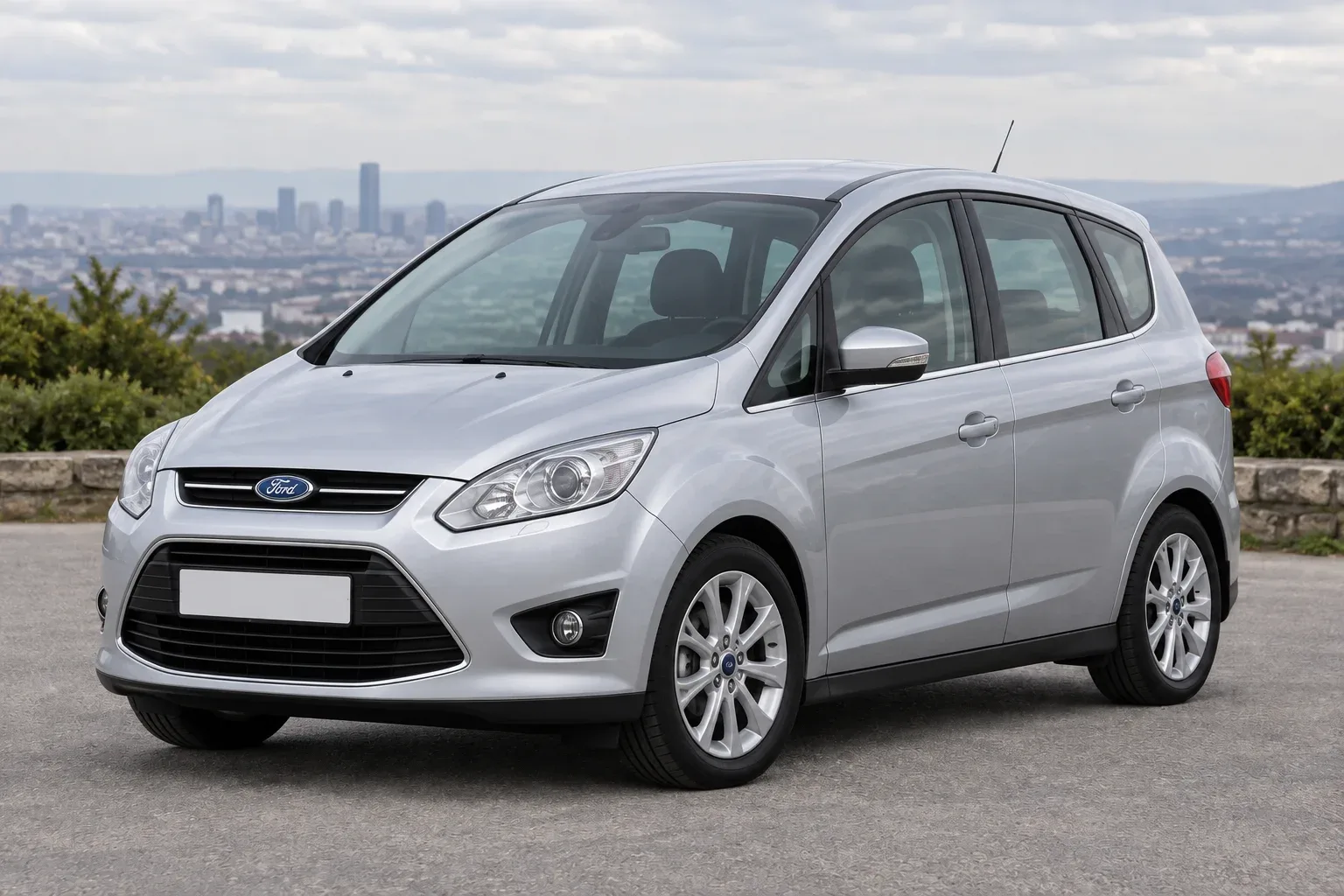
Ford C-Max 2 / Grand C-Max
Valuation of the Ford C-Max 2 / Grand C-Max (2010–2018): condition, paperwork, inspection and terms of sale.
Indicative purchase price
Below market value
Final price agreed after inspection.
Value my car1Why buyers choose this model
The second-generation Ford C-Max was introduced in 2009, and sales began in 2010. The compact van offered two body options. In addition to the main "short" you could get an elongated - Grand C-Max. It has a length of 4,520 mm instead of 4,380 mm, and an increased wheelbase of 2,788 mm against 2,648 mm. As a result, the Grand S-Mach provides much more space in the cabin. The manufacturer immediately took advantage of this, offering two more seats for an additional fee. The standard Grand has 5 seats. At the same time, unlike the standard S-Mach, the Grand has sliding rear doors. They're manually controlled. The usual C-Max is only five-seater with classic side doors. In 2014, the model was updated. The front part and the line of power units were revised. In particular, the engines were adapted to Euro 6 emission standards.
2What buyers check
Engine lineup
1.0 EcoBoost / 100 and 125 hp - since 2013
1.6 Ti-VCT / 105 and 126 hp – from 2010 to 2014, renamed 1.6 Duratec from 2014
1.6 Duratec / 86 and 125 hp - since 2014
1.5 EcoBoost / 150 and 182 hp - since 2014
1.6 EcoBoost / 150 and 179 hp – from 2010 to 2014
1.5 TDCi / 95, 105 and 120 hp - since 2014
1.6 TDCi / 95 and 116 hp – from 2010 to 2014
2.0 TDCi / 116, 140 and 163 hp – from 2010 to 2014
Petrol engines
The base 1.6 Ti-VCT series Sigma was developed in conjunction with Yamaha. Its main difference is reliability. After 160,000 km, the gear belt is required to be replaced. The work should be entrusted only to an experienced motorist. None of the gears have a veneer connection. Therefore, it is necessary to observe the exact order of action, and the axial bolts should be tightened up to a certain point. An interesting scheme has a drive belt. It only powers the generator and air conditioner compressor. Its service life is about 200,000 km. The feature of the temporary drive of hinged units is the absence of a tensioner. The gaps of the valves are controlled mechanically. Ford does not set a control interval, but the service recommends that it be carried out simultaneously with the update of the valve timing. The problem is that the entire pusher changes, and for this it is necessary to dismantle the corresponding camshaft. Therefore, it is not recommended to convert the engine to run on liquefied gas. 1. 6 Ti-VCT is vulnerable to oil quality. If you neglect timely maintenance, the resource will not exceed 300,000 km. The symptom of the approaching overhaul will be an increased oil consumption. In some cases, in atmospheric 1. 6, the engine controller is brought in. This defect bypassed the turbocharged 1. 6 Ecoboost. 1. 6 EcoBoost is built on the basis of units of the Sigma series. The turbo engine provides good dynamics, but sometimes betrays its owners. The nozzles settle on the nozzle, which worsens the spray, and they begin to transfuse. Ultimately, this can lead to the burnout of the piston, which will be a verdict for the engine.
Diesel engines
The 1.6 TDCi and 2.0 TDCi diesel engines meet Euro-5 emission standards and are developed in cooperation with PSA. The smaller one is the French DV6 and the larger one is the DW10. However, Ford diesels have become more and more different from the original over the years. This is most noticeable in the exhaust gas cleaning system. In 1.6 TDCi, the particulate filter is installed immediately behind the catalyst. The simplest particulate filter is used here. Its burning is carried out by supplying an additional portion of diesel fuel. It hits the catalyst and ignites, thereby increasing the temperature inside the DPF filter. Unfortunately, this decision can lead to dilution of the oil with diesel. However, this is more typical when using biodiesel, which can only be found within the EU. At 2.0 TDCi, the particulate filter is located “old-fashioned,” i.e. far beyond the catalyst. Using the same circuit as in 1.6 TDCi does not guarantee reliable burnout. Therefore, a more complex system is used here. Diesel fuel is supplied to the exhaust pipe in front of the filter, and its ignition is from an incandescent candle. 1. 5 TDCi and 2. 0 TDCi/170 hp (since 2014) meet Euro-6 emission standards, for which, among other things, a nitrogen oxide catalyst is used. 1. 6 TDCi is a very good companion on the road. It's light and warms up quickly. At the same time, it is prone to accumulation of sediments. First of all, the sludge accumulates in the oil pan due to its unfortunate shape. The disease inherited from its predecessor, who met the standards of Euro-4.
Transmission
Only 2.0 TDCi (except 116 hp) could be equipped with an automatic transmission with dual clutch PowerShift. The rest were paired with 6-speed mechanics.
1.6 Ti-VCT was combined exclusively with the 5-speed iB5 manual transmission produced by Getrag. Despite the easy and precise switching, the design of the box is no longer new. It was introduced to Ford in the mid-90s with the arrival of the Fiesta 96. In the past, the iB5 was a bit noisy, but since then the box has been upgraded and in the S-Mach it is no longer noisy.
Robotic Powershift does not often fail. However, individual owners had to change either the clutch or the mechatronic, and someone - both. Every 60,000 km, the oil in the box needs to be updated. This will help extend the life of the clutch working in the oil bath.
One of the typical problems of the robot is a faulty shaft speed sensor.
Walking
An independent 4-lever suspension is used at the back. Its weak spot is eccentric, with the help of which the angles of installation of wheels are regulated. At high runs, they'll sour. There is therefore nothing left but to replace the whole lower lever, of which the eccentric is a part. Otherwise, it is impossible to set the geometry of the rear axle.
Like the Ford Focus 3, the S-Mach is quite hardy. Thanks to the pleasant prices of some original spare parts, it almost doesn’t matter that the lower transverse lever on the front axle changes only entirely with the Silentblocks and ball support. The lever has an unusually massive design made with the use of pure casting. This is not a welded design of metal sheets, as in modern compact models of the Volkswagen Group.
The C-Max/Grand C-Max uses long racks of the transverse stability stabilizer. As the years go by and miles travel, they start knocking, but like other cars, they are cheap and easy to change.
Other problems and malfunctions
Sometimes parking sensors fail. The dirt gets on the wiring and causes corrosion. When one sensor fails, the system shuts down all the others.
We also have to deal with failures in the operation of door locks. The reason is moisture.
Over time, it begins to corrode and loses its tightness radiator air conditioning system.
3Pre-purchase checklist
Petrol engines
- After 160,000 km, the gear belt is required to be replaced.
- The work should be entrusted only to an experienced motorist.
- Therefore, it is necessary to observe the exact order of action, and the axial bolts should be tightened up to a certain point.
- Ford does not set a control interval, but the service recommends that it be carried out simultaneously with the update of the valve timing.
- The problem is that the entire pusher changes, and for this it is necessary to dismantle the corresponding camshaft.
- In this regard, it is not recommended to convert the engine to work on liquefied gas.
- The symptom of the approaching overhaul will be an increased oil consumption.
- This is also worth adding the problems with the TNVD and turbocharger.
- For the Ecoboost series, it is extremely important to use original candles and change them every 60,000 km.
Diesel engines
- Ford solved the problem in an interesting way.
- The same should be done when replacing the turbocharger.
- Some recommend spilling a little fresh oil that will displace the old one left at the bottom of the crankcase.
- 6 TDCi are less prone to carbonization, as they have a more persistent seal. Sometimes, however, nozzles fail.
Transmission
- Robotic Powershift does not often fail.
- Every 60,000 km, the oil in the box needs to be updated.
- One of the typical problems of the robot is a faulty shaft speed sensor.
Other problems and malfunctions
- Sometimes parking sensors fail.
- The dirt gets on the wiring and causes corrosion.
- When one sensor fails, the system shuts down all the others.
4Challenges of selling privately
While the predecessor is still very popular, the second-generation S-Mach has not been able to replicate its success. At the time of its release, the market offered many attractive alternatives, especially French-made ones. Opponents of the C4 Picasso and Renault Scenic are more affordable and more practical. Although driving performance is an advantage of Ford, but a small trunk scares away potential buyers. A more interesting option will be the enlarged Grand C-Max with rear sliding side doors.
- Engine range: 1.0 EcoBoost / 100 and 125 hp - since 2013 1.6 Ti-VCT / 105 and 126 hp
- Gasoline engines: After 160,000 km, a replacement of the gear belt is required.
- Diesel engines: Ford solved the problem in an interesting way.
- Transmission: The Robotic Powershift fails rarely.
- Driving: An independent 4-lever suspension is used behind.
- Other problems and malfunctions: Sometimes parking sensors fail.
Shows, bargaining and re-registration take time: buyers look, promise to think and disappear. Fair price after inspection closes the auction on the spot. If money is needed urgently, the purchase takes away waiting and repeat displays.
5How selling to us works
Leave a request with the car data. We will discuss the preliminary assessment and inspection. After checking the status and documents, we agree on the final price and terms of the transaction.