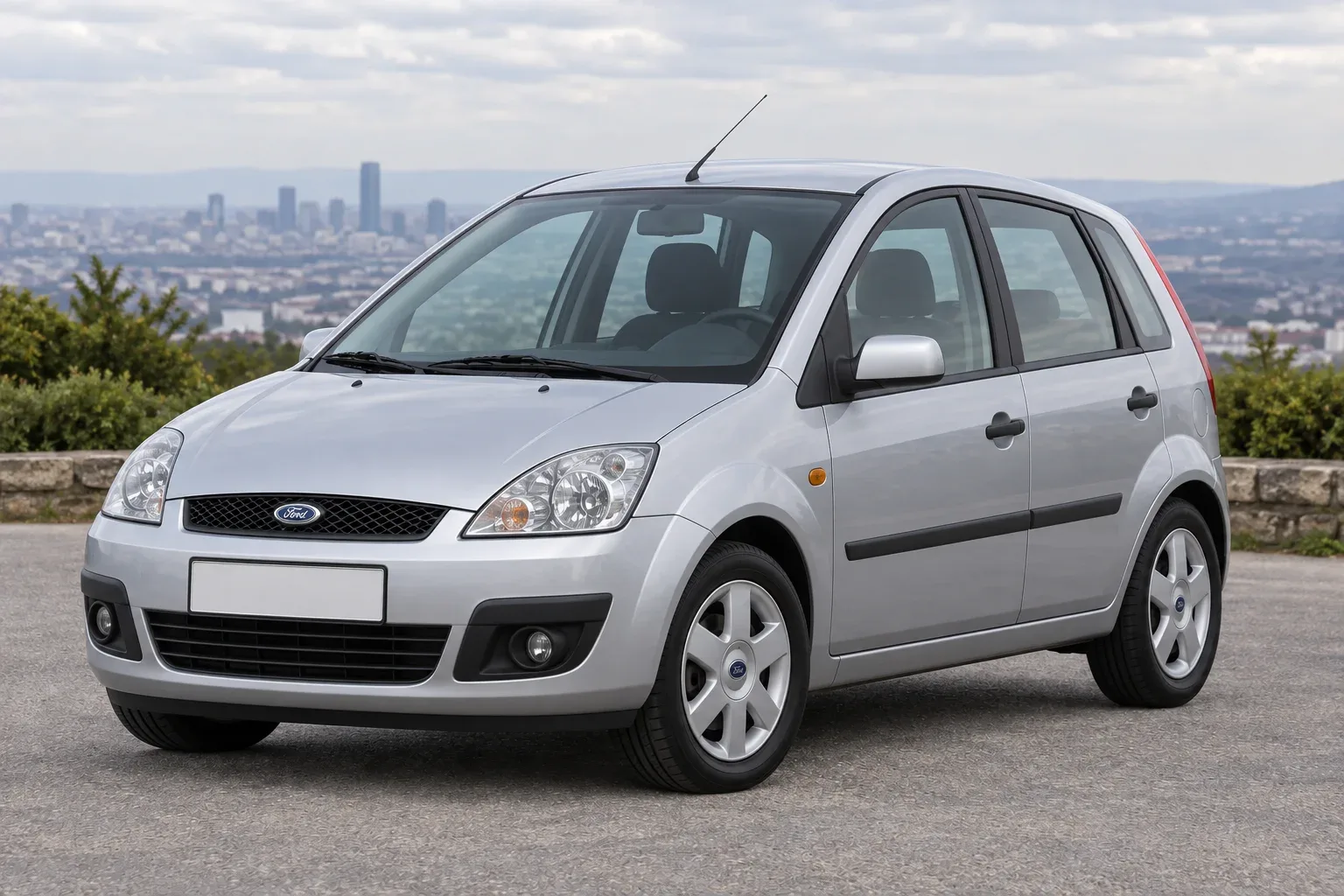
Ford Fiesta 5
Valuation of the Ford Fiesta 5 (2002–2008): condition, paperwork, inspection and terms of sale.
Indicative purchase price
Below market value
Final price agreed after inspection.
Value my car1Why buyers choose this model
The fifth-generation Ford Fiesta has its own style that is getting little attention today. It’s all about the outdated design that was once popular at the beginning of the second millennium. Similar combinations of lines and shapes were the Ford Focus and Ford Mondeo of the time. On the basis of Fiesta, a universal city car called Fusion was even created, resembling, on the one hand, a microvan, and on the other, a crossover. The Fiesta 5 was produced from 2001 to 2008, and in 2005 the model underwent a restyling. The Ford Fiesta was available in the back of a 3- and 5-door hatchback. In addition, in some countries, the car was offered as a sedan, a van and even a crossover. Only four will be in the hatchback salon. It is worth noting the small and uncomfortable seats. Not only in front, but also in the back. Sports seats of the S and ST versions, despite the noticeable lateral support, fix the body less than expected. In the trunk of the car there are only 284 liters of space (268 liters in the 3-door). In the interior of Fiesta reigns complete order - all the controls are logically located. The interior looks more pleasant in cars richer in equipment. The Ford Fiesta has a conventional design. The chassis with a wheelbase of 2486 mm rests on the front struts McPherson and a torsion beam with spaced springs and shock absorbers at the rear. The baby is surprisingly agile and the steering is accurate.
2What buyers check
Engines
The range of gasoline units for a small car is quite wide. It starts with a 75-horsepower engine of 1.25 liters. But it's not the weakest engine. A simpler design of the 1.3-liter unit develops only 60 or 70 hp. In addition, gasoline engines with a volume of 1.4 and 1.6 liters with a capacity of 80 and 100 hp were installed, respectively. The sports version of the Fiesta ST model was equipped with a 2-liter engine with a recoil of 150 hp.
For a small hatchback, diesel units of the TDCi family, developed in conjunction with PSA, were also provided. The smallest volume of 1.4 liters developed power 68 hp, and the larger capacity of 1.6 liters provided 90 hp. The first is devoid of a vulnerable two-mass flywheel and a variable geometry turbocharger.
Which engine should you choose?
All engines are worthy of recommendations except for 1.3-liter recoil of 60 hp. The thing is, he's too weak. It is better to choose its 70-strong modification. The main advantage of the 8-valve engine is a very simple and reliable design. The mechanism of the HRM type OHC includes only one camshaft, which is driven by a chain. The disadvantages include high fuel consumption. This unit is quite tolerant to gas equipment, without causing concerns about serious failures following the conversion. 1.25-liter Duratec gives the car higher dynamics and at the same time consumes very little fuel - about 6.5-7 liters per 100 km. The biggest advantage of this engine is its incredible survivability. The only thing that can fail is inexpensive equipment, for example, an idling regulator (about 2500 rubles), a cooling system pump (from 1500 rubles) or any of the sensors. Unfortunately, this engine does not like gas equipment. At least it should be of high quality and competently configured. The same applies to larger gasoline engines with a volume of 1.4 and 1.6 liters. The 1.4 and 1.6-liter powertrains were also used in the more scalable Ford Focus. The first, less desirable because of mediocre performance. The second is much more energetic and provides sufficient power reserve for dynamic driving. The engine itself is very reliable. Failures are extremely rare, and even then due to attachments. The same can be said for the 1.4-liter engine.
Transmission
All Fiesta are equipped with a 5-speed manual gearbox iB5. Technically, this is an evolution of the previous 4-speed box, known since the 70s. 5th speed box received in 1982. The mechanics are characterized by good accuracy and ease of switching.
The feature of the box is the noise in the front of the car at idling. If the second gear is lost or the fifth one howls, then the synchronizers in combination with the fork of the gearshift mechanism are to blame. Both were common in the time of the guarantee. Today, such repairs will pull 40 000 rubles.
Typical problems and malfunctions
The Ford Fiesta 5 wear process is very slow. The salon doesn't age too fast. However, in the basic versions in the interior there are parts from cheap plastic, which is worse resist external influences. When buying a three-door car, be careful - you can easily break the plastic handle of tilting the front seats forward. It is located in the upper back and often fails. The pen itself is inexpensive. However, difficulties with recline of the chair back can arise due to the cable mechanism. Ford offers it as a separate part, but to replace it, you need to disassemble the seat. The body does not rust as much as its predecessor, but an additional inspection of the lower part of the car will not hurt. Corrosion can be detected at the attachment points of individual components and exhaust system elements, at the back of the floor, within the side windows, at joints or welds. The suspension does not create any problems, and its details are not expensive. The front lever is completely collapsible, i.e. it allows you to limit yourself to replacing only the worn-out part - the Silent block or ball support (from 420 rubles). For diesel modifications, rapid wear of hub bearings and SRUS is characteristic. Gasoline fiestas had a classic hydraulic power steering, and diesel - electrohydraulic. With age, corrosion occurs on the power wires and electric pump connectors. In this case, from time to time the steering wheel becomes heavier. The reliability of the Ford Fiesta is difficult to find fault with, since there are practically no characteristic malfunctions.
Operating costs
The cost of operating the Ford Fiesta can be attributed to very low. And it is not only in high reliability, but also in cheap and easily available substitutes. The car has a fairly simple design. Therefore, any mechanic can cope with the fifth Fiesta, and maintenance can be carried out independently. The only thing that is expensive is the rear brake drums (from 3 000 rubles), but their replacement is very rare.
Diesel versions will require a lot of costs. After 150 000 km of run increases the probability of failure of nozzles (from 28 000 rubles) or turbocharger (from 20 000 rubles).
Model history
2001 - In November, the fifth generation was presented at the Frankfurt Motor Show. The body is a three- and five-door hatchback. Engines: petrol 1.3 8V OHC, 2.25 16V, 1.4 16V, 1.6 16V and diesel 1.4 TDCi 8V.
2004 - in the spring, a new robotic gearbox Durashift EST appeared in combination with a gasoline 1.4 and diesel 1.4 TDCi. 1.6 16V was aggregated by a 4-speed automatic.
2005 - Sports versions were presented in the spring. The base with the S marking was equipped with engines 1.4, 1.6 and 1.4 TDCi. The top ST was equipped exclusively with 2.0 16V (three-door body). In the fall, there was a restyling. There are new headlights with transparent optics, updated front panel and instrument panel (made of better materials).
3Pre-purchase checklist
Which engine should you choose?
- Failures are extremely rare, and even then due to attachments.
- However, a 1.4-liter diesel is potentially much more expensive to repair any gasoline engine.
- Yes, it does not guarantee the complete absence of malfunctions, but those that occur are minor.
- The 1.6-liter turbodiesel is quite reliable and relatively cheap to repair.
- There are a lot of reports of problems with 1.6 TDCi/HDi.
- In practice, the 90-horsepower version requires only regular maintenance and occasional minor repairs.
Transmission
- If the second gear is lost or the fifth one howls, then the synchronizers in combination with the fork of the gearshift mechanism are to blame.
- Today, such repairs will pull 40 000 rubles.
Typical problems and malfunctions
- The Ford Fiesta 5 wear process is very slow. The salon doesn't age too fast.
- It is located in the upper back and often fails. The pen itself is inexpensive.
- Ford offers it as a separate part, but to replace it, you need to disassemble the seat.
- The body does not rust as much as its predecessor, but an additional inspection of the lower part of the car will not hurt.
- Corrosion can be detected at the attachment points of individual components and exhaust system elements, at the back of the floor, within the side windows, at joints or welds.
- The suspension does not create any problems, and its details are not expensive. The front arm is completely collapsible, i.e.
- For diesel modifications, rapid wear of hub bearings and SRUS is characteristic.
- With age, corrosion occurs on the power wires and electric pump connectors.
Operating costs
- The only thing that is expensive is the rear brake drums (from 3 000 rubles), but their replacement is very rare.
4Challenges of selling privately
Sales announcements are dominated by the Ford Fiesta 5 with small-volume petrol engines. Most of them were imported from abroad. Among the range you will easily find both 3-door and 5-door modifications. However, in the list of proposals almost completely absent cars with a 1.6-liter turbodiesel.
Overall, the choice is quite large. The cheapest copies can be purchased for 150 000 rubles, and the youngest and most well-groomed - for 350 000 rubles.
- Engines: The range of gasoline units for a small car is quite wide.
- Which engine to choose?: Faults are extremely rare, and even then due to attachments.
- Transmission: If the second gear is "lost" or the "fifth" howls, then the synchronizers in combination with the fork of the gearshift mechanism are to blame.
- Typical problems and malfunctions: The Ford Fiesta 5 wear process is very slow. The salon doesn't age too fast.
- Operating costs: The only thing that is expensive is the rear brake drums (from 3 000 rubles), but their replacement is very rare.
- Model history: 2001 - In November, the fifth generation was presented at the Frankfurt Motor Show. The body is a three- and five-door hatchback. Engines: petrol 1. 3 8V OHC, 2. 25 16V, 1. 4 16V, 1. 6 16V and diesel 1. 4 TDCi 8V.
Shows, bargaining and re-registration take time: buyers look, promise to think and disappear. Fair price after inspection closes the auction on the spot. If money is needed urgently, the purchase takes away waiting and repeat displays.
5How selling to us works
Leave a request with the car data. We will discuss the preliminary assessment and inspection. After checking the status and documents, we agree on the final price and terms of the transaction.