Ford Fiesta 6
Valuation of the Ford Fiesta 6 (2008–2017): condition, paperwork, inspection and terms of sale.
Indicative purchase price
Below market value
Final price agreed after inspection.
Value my car1Why buyers choose this model
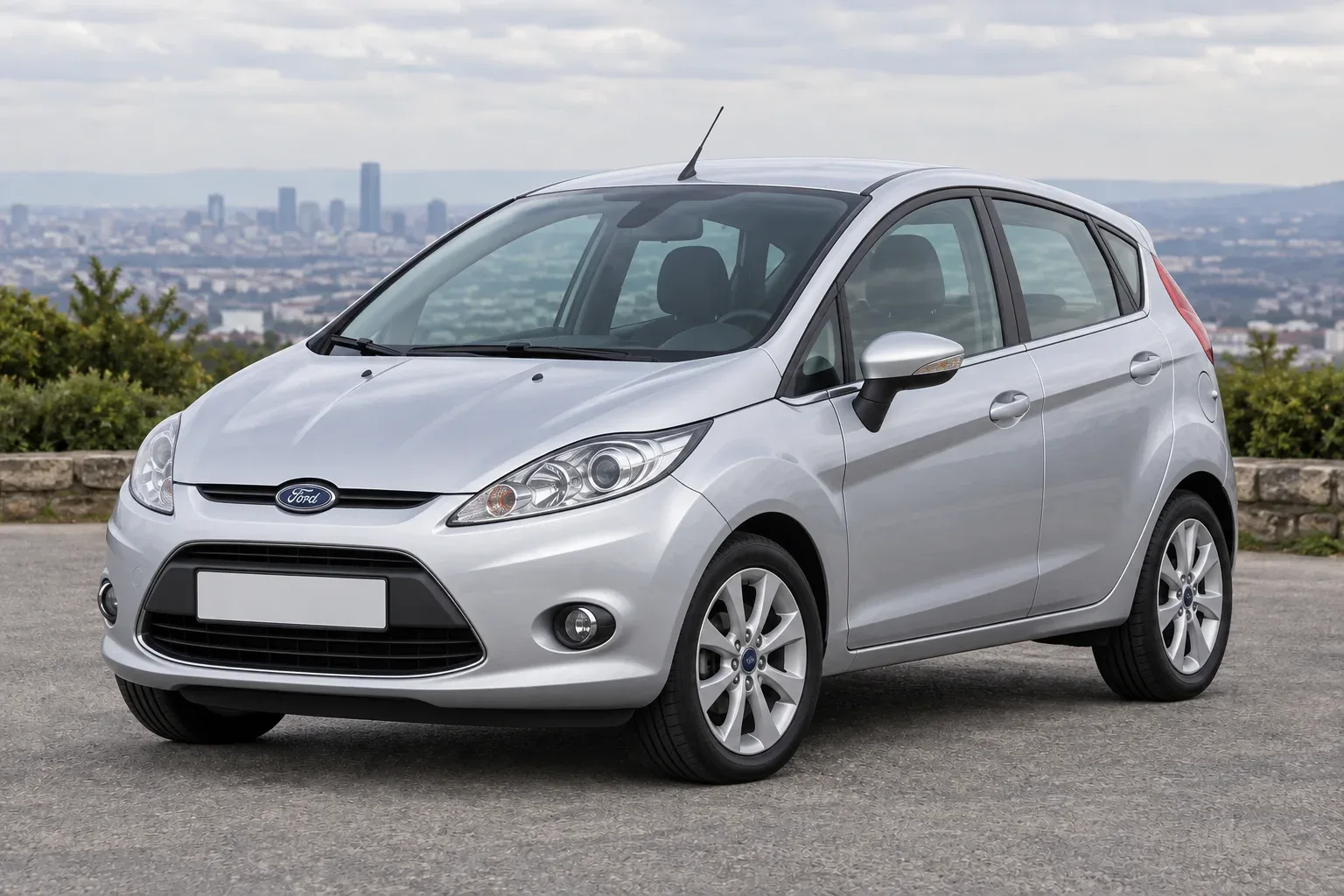
Ford Fiesta sixth generation debuted in the fall of 2008. The model from Cologne immediately won the hearts of fans of modern, elegant and pleasant in the management of compacts. It quickly became the second best-selling car in Europe and the leader in sales in the B segment. Success is hardly a matter of chance. The Ford Fiesta is compact and proportional, and despite the years that have passed, it still looks fresh. The rising line of windows and spoiler on the trunk lid give the compact a predatory look. Fiesta looks especially attractive in pastel colors. It is a pity that it is not easy to find such a coloring in the secondary market, there are dominated by “serious” colors. In 2012, the model underwent facelifting - Ford significantly increased the grille and refreshed the line of power units.
2What buyers check
Body and salon
There were several types of body: 3 and more practical 5-door hatchback. The first causes difficulties not only when boarding and disembarking rear passengers, but also in cramped parking lots due to wide doors. In some markets, even a sedan was available. The attractive body hides the modern interior. Decent materials were used in its decoration. The upper part of the front panel has a soft to the touch coating. The unusual layout of the center console pleases the eye, the devices are easy to read, and the meaty steering wheel fits perfectly into your hands. Ford was unable to avoid a few misfires. The amount of space in the second row is limited: tall passengers do not have enough free space in their legs. The luggage compartment has a reasonable volume of 290 liters, but with the back of the sofa folded, a significant ledge occurs. The high edge of the luggage opening makes it difficult to load shopping bags. The improved multimedia system is not the easiest to use, but after a while it still allows you to make friends with yourself. There are no handles on the ceiling, and even in well-equipped versions, the rear windows are only opened manually. However, the list of additional equipment covers all basic needs. Most of the samples are equipped with ABS, ESP, airbags, audio system and air conditioning. 16-inch alloy wheels, leather upholstery and climate control are much less common. It is worth looking for a Fiesta equipped with parking sensors: the view back is very limited. The undisputed advantages of the Ford Fiesta are comfortable, albeit small seats and an ergonomic position behind the wheel.
Walking
Conceptually, the running is not much different from its predecessor and is a combination of McPherson and a torsion beam. Correctly selected chassis settings provide a high level of comfort and good handling. Simple design bravely carries the movement on Russian roads. First of all, you have to change the sleeves and racks of the front stabilizer.
The simple braking system is inexpensive to repair. On the back axle of most versions are reels, which even for the segment "B" - a long-obsolete solution.
The slugs were worn relatively quickly. The noise was generated when the turn was moved (TSI 7/2010).
In steering, an electromechanical amplifier with an electric motor on the steering column is used. Unfortunately, the electric booster sometimes fails. And it has to be changed in the assembly with the steering column. The knot is very expensive. It includes a control unit, which, among other things, powers the electric motor. To do this, it converts the direct current of the onboard network into variable.
The joint of the lead shaft may crack, which affects safety. Ford has upgraded and oiled the knot (TSI 19/10).
Engines
Under the hood of the Ford Fiesta, most of the time-tested engines are installed: gasoline engines with a working volume of 1.25 liters (60 and 82 hp), 1.4 liters (92 and 96 hp), 1.6 l (105, 120 and 134 hp) and diesel engines - 1.4 liters (70 hp) and 1.6 l (75, 90 and 95 hp). Both turbo diesels were developed in collaboration with Peugeot specialists. Used compacts with the latest engines of the latest generation - gasoline 1.0 liters (65, 80, 101 and 125 hp), 1.6 (182 hp) and diesel 1.5 liters (75 hp) are not so popular. Gasoline atmospherics are not elastic. They begin to pull well only at high revs, which affects fuel consumption and noise level in the cabin. To enjoy the dynamics, you need to choose at least a modification with 1.6 Ti-VCT. This engine is equipped with a system of changing the phases of gas distribution, which, unfortunately, sometimes fails. All gasoline units are representatives of the Sigma series and were created in cooperation with the Japanese Yamaha in the mid-90s. Of course, they have been further developed. However, from the very beginning, mechanical adjustment of the valve gap is used here. Only instead of calibration washers were installed pushers, the selection of which is adjusted. Checking the gap is recommended after every 100,000 km. Mechanics do not recommend the use of gas equipment. Since propane-butane is quite dry, valve saddles are poorly lubricated. As a result, their rapid wear occurs, and the valves can burn. The Sigma series engines are really reliable.
Transmission
In addition to the “mechanics”, Ford offered two types of automatic transmissions. For the engine with a working volume of 1.4 liters, a 4-speed automatic was provided, which ensured smooth running, but limited dynamics and increased fuel consumption. For the gasoline 1.6-liter engine, a 6-speed automatic transmission with a dual-clutch Powershift was offered. The box works correctly, but the "speed" of the German DSG is better not to count. 1.6 Ecoboost was combined with 6-speed mechanics.
The 5-speed manual transmission received the designation iB-5. This is a modernized version of the B-5, which was created in 1982. The prefix “i” appeared in 1996 and means “improved”. The revision was made in conjunction with specialists from Getrag. The box is pretty reliable. Among the disadvantages can be noted only the leak of the right-hand drive gland, installed at the factory.
The 4F27E machine was created in conjunction with Mazda. The box was assembled at the Sterling Heights factory in Michigan. To control the operation of the machine, six solenoids are provided, which sometimes fail. To prolong the life of the box, you should replace the oil every 60,000 km. This requires a liquid that meets Ford specification WSS-M2C919-E. The Mercon V can be used as an alternative. Dexron ATF cannot be used.
Typical problems and malfunctions
The Ford Fiesta doesn’t plague its owners with endless malfunctions. Quite the opposite. The car has demonstrated exemplary resistance. The German Association for Control of Technical Condition of Vehicles DEKRA has no big claims to the compact and in all respects assesses the reliability of Fiesta in the class "B" above average. However, experts make complaints about the curved reflectors, insufficient efficiency of brakes and leaking shock absorbers. On some Ford Fiesta, the refueling hatch can skew and damage the paint (TSI 98/2009). Since October 2009, the hatch has been modernized. The model also received high marks in the ADAC report. The best cars were the 2009-2010 years. Among the shortcomings of German experts called the battery, high-voltage wires, candles and ignition coils, fan, radiator, starter, fuel pump, ignition system and immobilizer. The list of potential defects is long, but it is good that the faults do not affect the key components. Ford Fiesta also performed well in TUV reports. The main disadvantages include: frequent burnout of light bulbs in the headlights and insufficiently effective braking of the basic versions with drum brakes at the rear. It is worth noting that in 2011, a serious recall company was carried out to modernize the ABS/ESP hydraulic circuit tubes. They were rubbed against each other, which could later lead to a leak of brake fluid. The most serious problem of old cars is considered corrosion.
3Pre-purchase checklist
Walking
- The simple braking system is inexpensive to repair.
- Unfortunately, the electric booster sometimes fails.
Engines
- Under the hood of the Ford Fiesta, most of the time-tested engines are installed: gasoline engines with a working volume of 1.25 liters (60 and 82 hp), 1.4 liters (92 and 96 hp), 1.6 l (105, 120 and 134 hp) and diesel engines - 1.4 liters (70 hp) and 1.6 l (75, 90 and 95 hp).
- To enjoy the dynamics, you need to choose at least a modification with 1.6 Ti-VCT.
- Checking the gap is recommended after every 100,000 km.
- Mechanics do not recommend the use of gas equipment.
- As a result, their rapid wear occurs, and the valves can burn.
- The reason is the wear of piston rings in combination with the hardening of the valve coils.
- The purchase of such a diesel engine is not recommended for motorists traveling only in the city - the DPF filter will quickly become unusable.
- After a few years of operation, the turbocharger may need to be replaced.
Transmission
- Among the disadvantages can be noted only the leak of the right-hand drive gland, installed at the factory.
- To prolong the life of the box, you should replace the oil every 60,000 km.
Typical problems and malfunctions
- The Ford Fiesta doesn’t plague its owners with endless malfunctions. Quite the opposite.
- The list of potential defects is long, but it is good that the faults do not affect the key components.
- The most serious problem of old cars is considered corrosion.
- However, some owners testify that they find small foci of corrosion in the places of chipping, under the linings and along the edges of the body elements.
- There are problems with electricity - there are malfunctions in the multimedia system and the central lock.
- When looking at used cars from Europe, you should be wary of white cars with a turbodiesel under the hood.
- It is noteworthy, but even with such a mileage, the car does not have obvious signs of wear.
4Challenges of selling privately
- Body and interior: There were several types of body: 3 and more practical 5-door hatchback.
- Driving: The simple braking system is inexpensive to repair.
- Engines: As a result, they wear out quickly and the valves can burn.
- Transmission: Among the disadvantages can be noted only leaking the right-hand drive gland, installed at the factory.
- Typical problems and malfunctions: Ford Fiesta does not plague its owners with a series of endless malfunctions. Quite the opposite.
Shows, bargaining and re-registration take time: buyers look, promise to think and disappear. Fair price after inspection closes the auction on the spot. If money is needed urgently, the purchase takes away waiting and repeat displays.
5How selling to us works
Leave a request with the car data. We will discuss the preliminary assessment and inspection. After checking the status and documents, we agree on the final price and terms of the transaction.