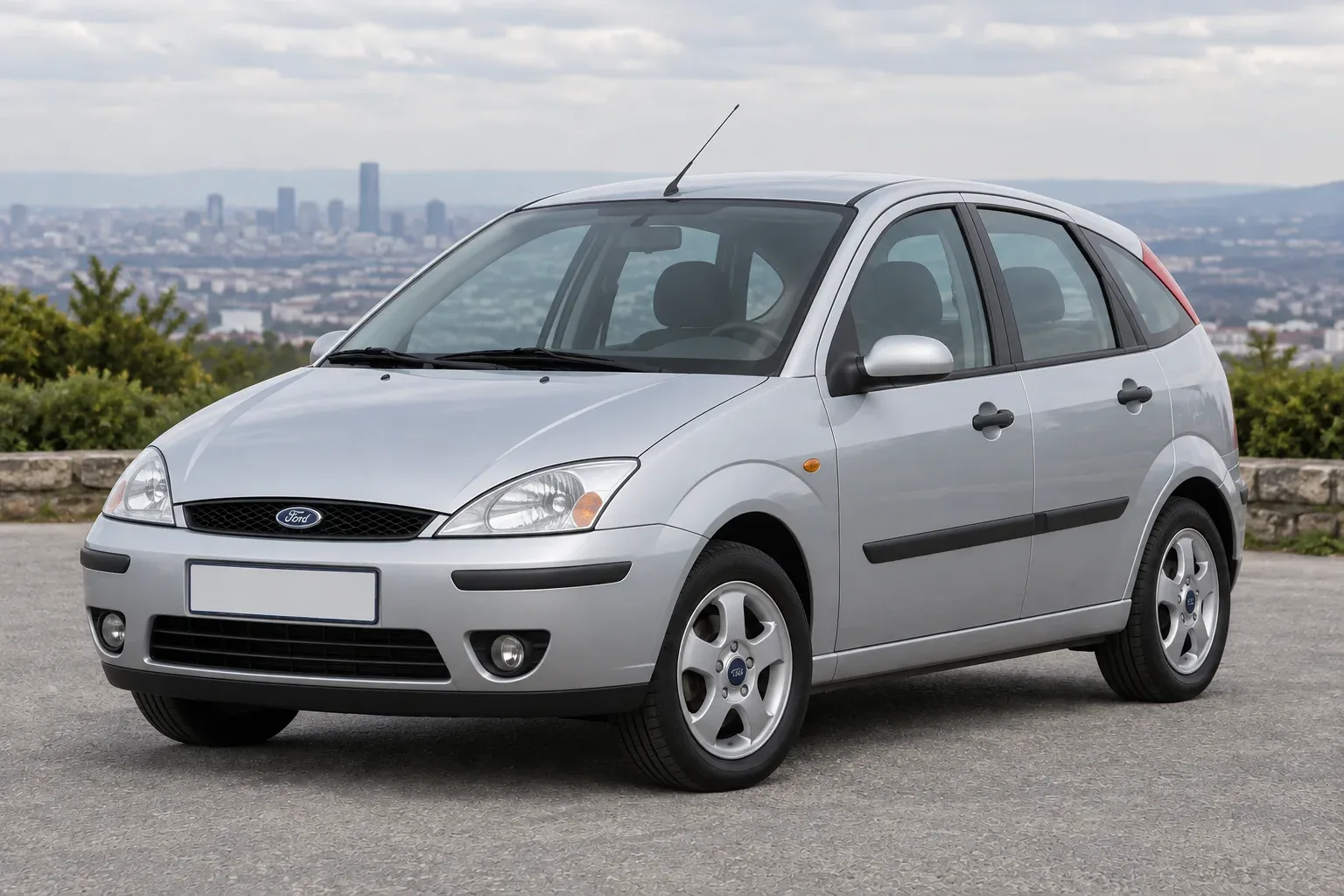
Ford Focus 1
Valuation of the Ford Focus 1 (1998–2005): condition, paperwork, inspection and terms of sale.
Indicative purchase price
Below market value
Final price agreed after inspection.
Value my car1Why buyers choose this model
Who wouldn’t want to ride the 1999 Car of the Year or play the role of the unforgettable racer Colin McRae, who conquered the rally tracks at the wheel of Ford Focus? Especially when buying this car is not associated with sacrifices: a functional and attractive body, an acceptable amount of interior space, quite successful and economical engines. The acquisition is also prompted by an excellent suspension, thanks to which the car behaves as if glued to the asphalt. Unfortunately, most of the offers in the secondary market are not in the best condition. A few years later, it turned out that the Ford Focus 1 has problems with body corrosion. Carefully check the equipment of the copy you are interested in. Modern appearance does not mean the appropriate equipment - even after restyling, the car can have only one airbag and power steering. ABS and electric package were not included in the list of basic equipment. It is believed that the first generation Ford Focus engines are not suitable for the installation of LPG gas equipment. That's partly true. Plastic collectors were sensitive to air explosions in the intake tract, but they disappeared with the advent of multipoint distributed injection. However, this is not a reason to neglect the adjustment of the valves every 40,000 km, which will require about 5,000 rubles.
2What buyers check
The HRM belt
The process of replacing the belt in 16-valve 1.4- and 1.6-liter gasoline engines and diesel engines is not too complicated. The remake consists only of a toothed belt and a tension roller. In the case of gasoline 1.8 and 2.0 liters, two or three rollers have already been installed, depending on the year of release and version. In services, a special tool is used for fixing shafts, but you can do with “folk” methods. Unfortunately, in car services often come 1.6-liter Focus with symptoms of poor performance of the power unit. On inspection, it is found that the belt of the valve timing jumped on one tooth: the engine is working, but it shakes, and it does not develop full power.
Replacing brake pads and discs or brake fluid does not require complex operations, special tools and great knowledge. Troubles can occur when trying to replace rusty tubes: practice and additional tools will be useful for unscrewing rusted tips. All Ford Focus I have ventilated brake discs on the front axle (minimum thickness of 20 mm), and unventilated discs (minimum thickness of 8 mm) or drums (maximum diameter of 204 mm) at the rear. The brake fluid (about 0.7 liters of DOT 4) should be changed every two years. The thickness of the pads and discs (a rod should be controlled at least once a year). ## Power steering
All the first Focuses were equipped with power steering. Maintenance of the power steering is limited to control of tightness (potential leakage sites - pipeline joints) and periodic fluid replacement. As a working fluid, 0.5 liters of the branded Ford S-M2C195A is used, which can be replaced with a liquid close in its characteristics to transmission oils for automatic transmissions, for example, Transmax Dex III or ATF Multivehicle. # # #
The capacity of the lubrication system of gasoline engines is 3.8 liters - for a 1.4 liter engine and 4.3 liters - for all others. No special requirements are imposed on the properties of the oil. It is enough to adhere to the class SH (API) or A1/B1 (ASEA) and viscosity 5W-30 or 5W-40. In the case of diesel units, it is necessary to prepare 5.6 liters of oil with a viscosity of 5W-30 CF class (API). Since turbodiesels were not equipped with a particulate filter, there are no strict requirements for the specific properties of the oil. When replacing it, it is necessary to install a new oil filter, which in gasoline 1.6-2.0 liters is the same as in diesel versions. Ford recommends that you check the engine oil level frequently and change it once a year. In addition, there is a mileage limit of 15,000 km. Given the age of the car and the difficult operating conditions, the recommended period of oil replacement is better to reduce to at least 10 thousand km. The maximum permissible oil consumption should not exceed 0.5 l/1000 km. The distance between the MIN and MAX marks on the probe corresponds to: in gasoline engines - 0.75 liters, and in diesel engines - 1.5 liters. In winter, it is better to maintain a low level of oil, for quick warming, and in summer - a high level - for better cooling. The process of oil change is simple, and the filter is easily accessed from below. However, do not forget that the used oil and old filter are very dangerous for the environment and you can not throw them into the usual garbage. It is advisable to give the waste for disposal. Unfortunately, this is currently only possible in a small number of cities in Russia. ##
Monitoring of tightness and system operation should be carried out regularly, preferably simultaneously with the check of oil levels. In the leaks of coolant is often to blame plastic thermostat housing. Replacement of coolant is required after 5 years or 100,000 km. Ford recommends using a liquid called the Motorcraft Super Plus 2000, but you can use universal coolants, such as Radicool NF Castrol. Note: Power units, depending on the type, have different opening temperature of the thermostat. The water pump is powered by a drive belt (not a valve timing), which should be included in the spare parts kit. Volume of cooling system: gasoline 1.4 and 1.6 l - 5.5 l; 1.8 and 2.0 l - 6.0 l; diesel - 6.5 l. # # Computer diagnostics
Ford Focus of the first generation, as a rule, did not give reason to visit diagnostic centers. However, diagnostics can be very useful in finding faults not only with the engine, but also with assistance systems such as ABS or ESP. To count errors, a universal KTS device, which is found in many automotive workshops, is enough. Therefore, a visit to an authorized Ford service is not required. A diagnostic connector can be found near the driver's legs on the panel under the lid. ## VIN number
The identification number is located under the windshield (seen from the outside along with information about the number of airbags) and on the floor - in the legs of the front passenger. It is worth noting that the VIN number, unlike many companies, Ford allows you to find out not only the model year, but also the exact date of production: year and month. body type: A - 5-door, B - 3-door, F-sedan, N - station wagon,
G - country of manufacture (G - Ford Werke Aktiengesellschaft, Cologne, Germany), C - assembly (C - Saarluis / Langley),
W – year of issue (W – 1998, X – 1999, Y – 2000, 1 – 2001, 2 – 2002, 3 – 2003, etc.),
P is the month of production (here P-August, but the code of envy from the year of release),
Chassis
Everyone knows about the need to adjust the geometry of the suspension. But in the case of the Ford Focus, the rear suspension must also be adjusted. The process itself is not complicated - for this purpose, there are eccentric bolts on the auxiliary beam, which attach the transverse suspension arms. Unfortunately, the bolts rust strongly, and to adjust them have to cut. Therefore, before the procedure, you need to purchase new bolts in advance. The convergence of the front wheels should be set at 0, and the rear wheels - at 2.5 mm (tolerance +/- 1 mm). The reason for the departure of the wheel angle (falling apart), as a rule, become the transverse levers of the suspension. ## Salon filter
The filter is recommended to be changed once a year. Its low price allows you to do this without thinking. Access to the filter can be obtained under the hood, next to the partition (right). To get to it, you need to carefully release the latches on the mounting bar and bend the plastic cover up. After the filter is replaced, everything falls into place. For all modifications of the model, the same cartridge of 350x167x29 mm size is suitable. There are many alternatives to various brands on the market, both conventional and coal. ## Air filter
During the annual maintenance, it is enough to monitor the condition of the filter and clean it thoroughly. A compressor can be used for this. Ford recommends changing the filter every 45,000 to 60,000 km. Fortunately, it is very cheap - only about 250 rubles, so in case of any doubts about its performance, it is better not to delay and replace. The filter has dimensions of 265×147×47 mm and is suitable for almost all power units, except for the Focus ST. To replace the filter, you will need a end key, which must unscrew 4 screws around the perimeter of the body. During replacement, thoroughly clean the air filter body with cloth or compressed air. After installing a new cartridge, pay attention to the location of the seal - a loosely fitting or deformed seal does not perform its important functions. # # Tires
Models with an engine up to 130 hp use 14-inch wheels on steel wheels 5 inches wide or 15-inch on alloy wheels 6 inches wide. Sports versions are shod in 17- or 18-inch wheels. When there are 3 people in the car, it is necessary to set the pressure in the front and rear wheels of 2.2 atm. (0.22 MPa). When fully loaded, it is necessary to raise the pressure on the front axle to 2.3 atm. (0.23 MPa), and on the rear to 3.1 atm. (0.31 MPa). # # Lamps and fuses
One of the major changes in the Ford Focus upgrade process in 2001 was the headlights. In pre-restyling cars for the near and high beams used one H4 lamp 60/55. After the passing beam was responsible for the H7 lamp, and for the far H1 - both 55W. The lamps in fog lamps also changed: H1 gave way to H11, in ST 170 - H3. Xenon was available as an option. Access to the headlights is difficult, but not to the point of hopelessness. First, you need to remove the metal latches, then the black cover, and then you can remove the light bulb. Most other lamps are only available after the case has been dismantled. Despite the easy availability of the reflector screws, do not try to turn them away - another screw is located in the bend and it is difficult to reach. In Focus, medium-sized flat fuses are used. The color indicates the current that the fuse can withstand: brown - 7.5 A, red - 10 A, blue - 15 A, yellow - 20 A, white - 25 A, light green - 30 A, orange - 40 A. And remember, a burnt-out fuse often indicates a fault to be found. ## What breaks down in Ford Focus 1? Even great-looking specimens can further unbalance their owner quite significant shortcomings – so a thorough inspection before buying is mandatory! One of the problems is fairly rapidly progressive corrosion, which can be found on the edges of doors, inside sills, on suspension elements and on the exhaust system. Particular attention should be paid to the condition of brake hoses and tubes. Gasoline units, like the Endura diesel engines, are quite reliable. In diesel engines Duratorq problems concern two-mass flywheel (life about 150 thousand km), starter, nozzles, valve recirculation of exhaust gases (unfortunately, combined with aluminum collector). The suspension carries Russian roads well, and its full bulkhead with original spare parts will pull 60 000 rubles. Repairs will be much cheaper if you change only the individual elements, not the entire lever in the assembly. # # Rust attacks from behind
While the front part of the body resists corrosion well, its rear part gives up quickly. Wheel arches and the back of the rapids are the most favorite places of rust. If you come across a copy without any traces of corrosion, buy it without thinking. The rear brake tubes are also subject to corrosion, which is not safe. Corrosion on elements such as the stabilizer of transverse stability or the brackets of the mounting of the sleeves of the stabilizer is not terrible. But, it would seem, a simple replacement of rubber stabilizer turns into the use of a Bulgarian and a set of new brackets. # #
The steering mechanism can become a source of trouble in two cases: leakage of fluid at the points of connection of pipelines and the appearance of backlash in the steering rack. The recovery process, depending on the service, will require from 10 to 30 thousand rubles. # # Fuel injection system
A diesel with a Common Rail system can cause a lot of problems. One of them: failure of the high pressure pump leakage in the fuel system. ## Pipe turbine interculter
The only problem is the TDCi version. The loss of power and soot from the exhaust pipe have a prosaic cause - damage to the pipe connecting the turbine to the intermediate cooler (intercooler). The pipe (about 1000 rubles) can be replaced by yourself. # # Multi-link suspension
The secret of perfect behavior is the multi-link rear suspension. Unfortunately, the cost of its maintenance is quite high. After 100,000 km in the running room there are backlashes. The first is often broken the transverse lever. Replacing several levers is not so expensive, but for all elements you will have to fork out well - more than 10 000 rubles. Unmounting the system's levers is not easy - bolts are very catchy. # Gasoline 1.4 and 1.6 Zetec-SE family
The 1.4-liter atmospheric debuted earlier in the Fiesta, where it had several different parameters. the 1.6-liter engine came out with Focus.
3Pre-purchase checklist
The HRM belt
- On examination, it is found that the belt of the timing jumped on one tooth: the engine is working, but it shakes, and it does not develop full power.
Brakes
- Replacing brake pads and discs or brake fluid does not require complex operations, special tools and great knowledge.
- The thickness of the pads and discs (standing wheels are useful) should be monitored at least once a year.
Power steering
- Maintenance of the power steering is limited to control of tightness (potential leakage sites - pipeline joints) and periodic fluid replacement.
Motor oil
- In the case of diesel units, it is necessary to prepare 5.6 liters of oil with a viscosity of 5W-30 CF class (API).
- When replacing it, it is necessary to install a new oil filter, which in gasoline 1.6-2.0 liters is the same as in diesel versions.
- Ford recommends that you check the engine oil level frequently and change it once a year.
- Given the age of the car and the difficult operating conditions, the recommended period of oil replacement is better to reduce to at least 10 thousand km.
Cooling system
- Monitoring of tightness and system operation should be carried out regularly, preferably simultaneously with the check of oil levels.
- Replacement of coolant is required after 5 years or 100,000 km.
- Ford recommends using a liquid called the Motorcraft Super Plus 2000, but you can use universal coolants, such as Radicool NF Castrol.
Computer diagnostics
- However, diagnostics can be very useful in finding faults not only with the engine, but also with assistance systems such as ABS or ESP.
Chassis
- Everyone knows about the need to adjust the geometry of the suspension.
- But in the case of the Ford Focus, the rear suspension must also be adjusted.
- Therefore, before the procedure, you need to purchase new bolts in advance.
Salon filter
- The filter is recommended to be changed once a year.
- To get to it, you need to carefully release the latches on the mounting bar and bend the plastic cover up.
Air filter
- Ford recommends changing the filter every 45,000 to 60,000 km.
- To replace the filter, you will need a end key, which must unscrew 4 screws around the perimeter of the body.
- After installing a new cartridge, pay attention to the location of the seal - a loosely fitting or deformed seal does not perform its important functions.
Tires.
- When there are 3 people in the car, it is necessary to set the pressure in the front and rear wheels of 2.2 atm. (0.22 MPa).
- When fully loaded, it is necessary to raise the pressure on the front axle to 2.3 atm. (0.23 MPa), and on the rear to 3.1 atm. (0.31 MPa).
Lamps and fuses
- First, you need to remove the metal latches, then the black cover, and then you can remove the light bulb.
- And remember that a burnt-out fuse often indicates a malfunction that needs to be found.
What breaks down in Ford Focus 1?
- Even great-looking specimens can further unbalance their owner quite significant shortcomings – so a thorough inspection before buying is mandatory!
- One of the problems is fairly rapidly progressive corrosion, which can be found on the edges of doors, inside sills, on suspension elements and on the exhaust system.
- Particular attention should be paid to the condition of brake hoses and tubes.
- In diesel engines Duratorq problems concern the two-mass flywheel (a resource of about 150 thousand).
- Repairs will be much cheaper if you change only individual elements, and not the entire lever in the collection.
Rust attacks from behind
- While the front part of the body resists corrosion well, its rear part gives up quickly.
- Wheel arches and the back of the rapids are the most favorite places of rust.
- If you come across a copy without any traces of corrosion, buy it without thinking.
- The rear brake tubes are also subject to corrosion, which is not safe.
- Corrosion on elements such as the stabilizer of transverse stability or the brackets of the mounting of the sleeves of the stabilizer is not terrible.
- But, it would seem, a simple replacement of stabilizer rubber bands turns into the use of a Bulgarian and a set of new brackets.
Steering gear
- The steering mechanism can become a source of trouble in two cases: leakage of fluid at the points of connection of pipelines and the appearance of backlash in the steering rack.
Fuel injection system
- A diesel with a Common Rail system can cause a lot of problems.
Interculter turbine tube
- The loss of power and soot from the exhaust pipe have a prosaic cause - damage to the pipe connecting the turbine to the intermediate cooler (intercooler).
Multi-link suspension
- After 100,000 km in the running room there are backlashes.
- Replacing several levers is not so expensive, but for all elements you will have to fork out well - more than 10 000 rubles.
1.4 and 1.6 petrol in the Zetec-SE family
- The 1.6 liter engine, even at large mileages (over 200,000 km), shows no signs of wear.
1.8 and 2.0 petrol in the Zetec-E family
- Engines do not have typical faults, which are more often random: ignition coils, small oil leaks (defective oil plugs at the beginning of production), the need to flash the ECU (also the first Focuses).
Diesel 1.8 TDCi Duratorq (Common Rail)
- In case of failure, the cost of repairing the injection system will be about 10,000 rubles.
- It also requires a lot of costs to repair the faults.
- The engines were a continuation of the old and problematic 1.8 TD.
- But remember that in the event of a break, the valves will break down, so you should not forget about replacing. Attention!
- Before replacing, you must familiarize yourself with the service documentation.
- The total amount of repair costs can be about 25-30 thousand rubles.
- Another common problem is air suction due to cracking of the intake system pipes. The cost of repair is about 1000 rubles.
Transmission
- With age, the likelihood of wear of bearings and synchronizers increases.
- They are located at the very top of the box, and so the loss of even 200 ml of oil “dehydrates” the gear, which leads to wear and tear.
- The 4F27E automatic transmission is quite hardy, and before the first serious repair it serves 250-350 thousand km.
- For major repairs will require about 50-70 thousand rubles.
American version
- Corrosion is another problem common to most low-cost cars that have survived a journey across the ocean.
4Challenges of selling privately
- What breaks down in Ford Focus 1?: One of the problems is the fairly rapidly progressive corrosion that can be found on the edges of doors, inside sills, on suspension elements and on the exhaust system.
- Rust attacks from behind: While the front of the body resists corrosion well, its back gives up quickly.
- Steering mechanism: The steering mechanism can become a source of trouble in two cases: leakage of fluid at the points of connection of pipelines and the appearance of backlash in the steering rack.
- Fuel injection system: A diesel with a Common Rail system can cause a lot of problems.
- Turbine-interculter tube: The only problem is the TDCi version.
- Multi-link suspension: After 100,000 km in the running gear there are backlashes.
- Transmission: With age, the likelihood of bearings and synchronizers wear increases.
- Corrosion is another problem typical of most low-cost cars that have survived an ocean journey.
Shows, bargaining and re-registration take time: buyers look, promise to think and disappear. Fair price after inspection closes the auction on the spot. If money is needed urgently, the purchase takes away waiting and repeat displays.
5How selling to us works
Leave a request with the car data. We will discuss the preliminary assessment and inspection. After checking the status and documents, we agree on the final price and terms of the transaction.