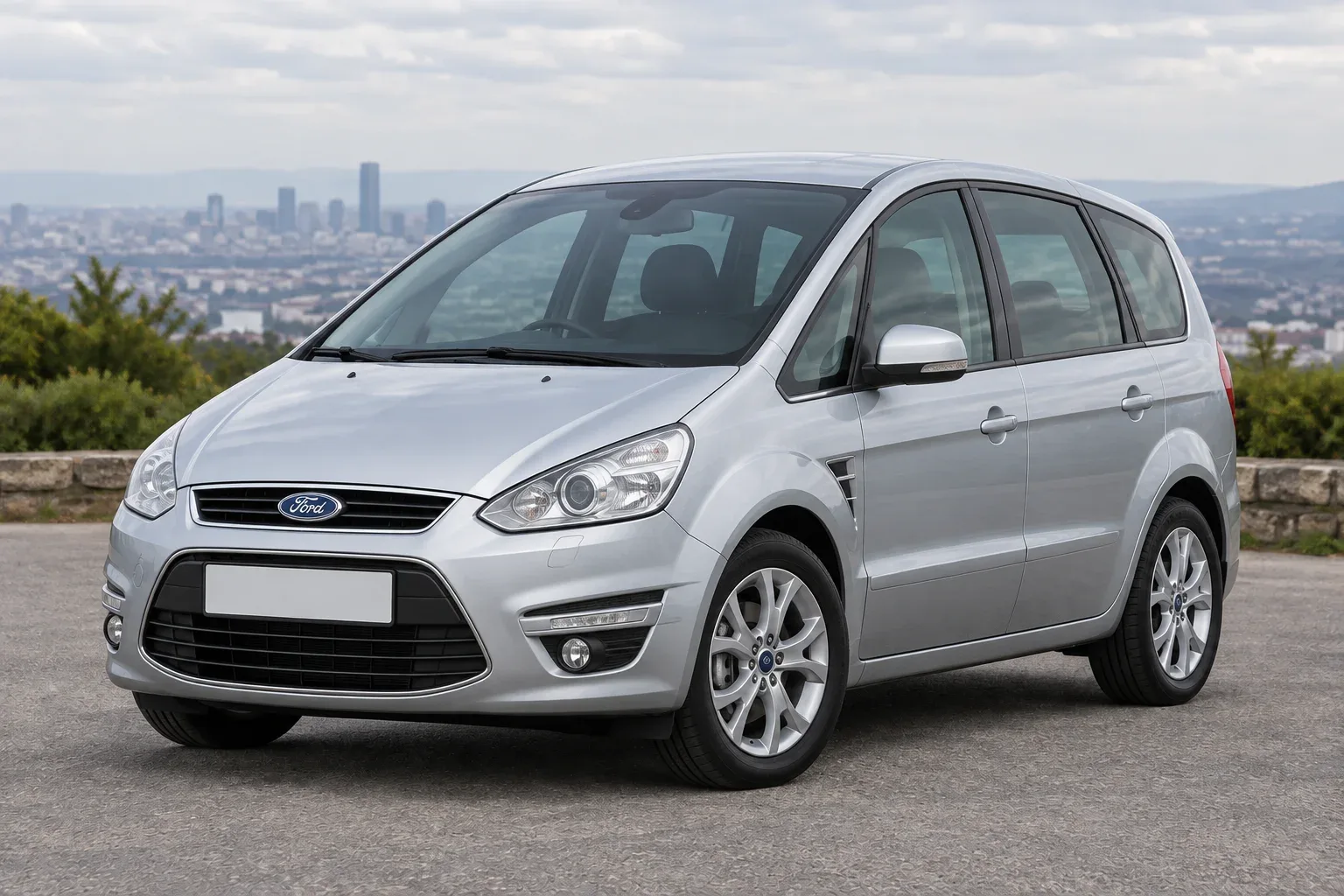
Ford Galaxy 2 / S-Max
Valuation of the Ford Galaxy 2 / S-Max (2006–2015): condition, paperwork, inspection and terms of sale.
Indicative purchase price
Below market value
Final price agreed after inspection.
Value my car1Why buyers choose this model
The second generation Galaxy has received completely new Ford technologies: from the platform, chassis components and ending with diesel engines. The gasoline engines were partly borrowed from the 3rd generation Ford Mondeo. The idea of creating two identical cars, but with different character, captivated the jury of the nomination “European Car of the Year”. In 2007, the honorary laurels went only to the sports version of the S-Max model. In 2015, the next generation of the “twin” came to the market, which technically repeated the next Mondeo. In any case, the S-Max/Galaxy still offers the best performance in the segment. At first glance, the S-Max is most noticeablely different from the Galaxy back. While the Galaxy has a nearly flat lower edge of the rear side windows, the S-Max line of windows has a more complex shape. The taillights and trunk cover are also different. For the sports profile of the Ford S-Max have to pay for a smaller height of the opening of the second pair of doors. Both cars are seven-seater with two additional seats in the trunk. But the Galaxy is more comfortable, as its flat roof provides more space over the head of third-row passengers than the elegantly sloping ceiling of the S-Max. The driver’s seat is almost identical. To make the owner of the S-Max get a more vivid driving experience, the front seats are located slightly lower than in the Galaxy. But in terms of convenience when landing, the priority is on the Galaxy side. Working on the identity of each model, Ford has adjusted the springs, shock absorbers and power steering differently. All versions use a hydraulic amplifier, except for 2.0 TDCi cars, where an electric amplifier is installed.
2What buyers check
Engines
From the very beginning, the S-Max/Galaxy was equipped with a 2-liter atmospheric Duratec-HE gasoline engine (145 hp), which also had an alternative version of FlexFuel, running on E85 bioethanol.
In addition, a 5-cylinder petrol turbo engine 2.5 ST, originally from Volvo, was offered.
Diesel versions were equipped with its own 1.8 TDCi (Lynx) unit with a capacity of 125 hp, as well as 2.0 TDCi 140 hp. developed by PSA.
In 2007, the 4-cylinder gasoline atmospheric 2.3 Duratec with a capacity of 160 hp was introduced.
In the same year, new diesel versions were released: 1.8 TDCi - 100 hp and 2.0 TDCi - 115 hp.
In July 2007, the 2.0 TDCi with a capacity of 130 hp appeared.
In 2008, the range was replenished with 2.2 TDCi 175 hp, and from the list of available 2.0 TDCi was withdrawn with 130 hp return.
In 2010, new engines complying with Euro-5 emission standards were introduced during the modernization. Among them, the turbocharged 2.0 EcoBoost 199 hp and 239 hp 2.0 TDCi of the new generation began to develop 163 hp, and the 2.2 TDCi – 200 hp. 1.8 TDCi, 2.3 Duratec and 2.5 ST have disappeared from the range.
In 2011, the range of units was replenished with 1.6 EcoBoost / 160 hp and 1.6 TDCi / 115 hp (from PSA), which replaced the weak version of 1.8 TDCi.
Diesel versions of Galaxy/S-Max are the most widely used abroad. In Russia, gasoline engines were traditionally preferred.
The 2.0 Duratec, 2.0 EcoBoost and 2.3 Duratec were equipped with a chain-type HRM drive, which usually does not cause problems. All other units were equipped with a temporary type of valve timing drive.
2.0 Duratec
The main was a 2-liter atmospheric unit with an aluminum Duratec HE unit, which is designated in the service documentation as MI5. It was developed in conjunction with Mazda and debuted under the hood of the third Mondeo. The S-Max/Galaxy uses an updated version.
Duratec is considered a reliable engine. Its impeccable reputation is sometimes overshadowed by increased oil consumption. In later versions of the engine, this problem practically does not arise.
Very rarely, but there are problems with vortex valves - the landing places of the valve wear out. The defect can lead to very unpleasant consequences - a complete replacement of the block head, pistons and even bent rods.
The flaps are electrically driven, so they can’t just be removed or replaced. According to the regulations, in case of malfunction, the collector in the collection changes - from 23 000 rubles. However, it is often enough to install fluoroplastic bushings made to order at the landing sites.
The problem will be informed by an extraneous sound at idle, reminiscent of the work of a sewing machine. With the repair it is better not to delay, otherwise events will develop according to the scenario outlined above.
2.0 TDCi
The 2.0 TDCi turbodiesel was developed by the French concern PSA and was designated DW10BTED. It has a temporary type valve timing drive and a Common Rail injection system with piezoelectric injectors VDO/Siemens. 2.0 TDCi complies with Euro-4 emission standards and has always been equipped with a particulate filter.
The most widespread was the 140-horsepower version of the engine. Between 2007 and 2008, a 130-horsepower version was offered, which was intended to work together with the Aisin automatic transmission. The feature of the latest modification is a much shorter interval for replacing the gear belt (60-12 thousand rubles per set).
One of the weaknesses of the 2.0 TDCi is the EGR exhaust gas recirculation system. Her valve quickly overgrown with sediments. The engine first goes into emergency mode, and then completely stops starting. The disease is accompanied by a large amount of smoke from the exhaust pipe. The cost of a new valve is from 11 000 rubles.
After 300,000 km, problems with the turbocharger (36,000 rubles for an analogue) are possible.
As part of the 2010 update, the engine was upgraded. There was a 163-horsepower version of the turbodiesel, and in the context of the transition to Euro 5 decreased the compression ratio from 17.9 to 16.0: 1. This step allowed to reduce the amount of nitric oxide in the exhaust.
The most important change is the new Delphi electromagnetic injector injection system. The latest fuel equipment proved to be more reliable than Siemens. The modified engine was designated DW10CTED.
1.8 TDCi (Lynx)
The 1.8 TDCi is Ford's own design, known as the Lynx or under the commercial name Duratorq. The engine was installed until restyling in 2010. It was removed from the list of available products because it did not meet Euro 5 emission standards.
The power unit has a cast iron head and a block. Unlike its older counterparts, it provided Euro-4 emission standards without a particulate filter. The design of the engine dates back to the days of the Ford Sierra, when it was equipped with the Endura-DI. Thanks to many years of evolution, atmospheric diesel has turned from an outsider into a successful turbodiesel.
The 1.8 TDCi was offered in two boost options: 100 and 125 hp. Both versions differ in fuel equipment. The weaker uses Delphi electromagnetic nozzles, and the more powerful ones use piezoelectric VDO/Siemens.
Among the disadvantages of the 1.8 TDCi is significant noise and slow warming. However, it pays off with a higher level of reliability than the 2-liter TDCi. One of the reasons is simple design.
Until October 2007, the engine had a pair of valve timing drive chains. The lower one drove the Common Rail high pressure pump, and the upper one – the camshaft (he is only one here). After that, the lower chain was replaced by a toothed belt bathing in an oil bath. The solution is similar to that used by Ford in the 1.0 EcoBoost. However, before ordering a set of valve timing, it should be clarified what is installed on a particular instance. This can only be done by removing the lid of the GRW. Whether a chain or belt is installed, a “bundle” must be replaced every 200,000 km or 10 years.
EcoBoost 1.6 / 160 hp
The small EcoBoost is based on the technical base of the Sigma series engines. So, it has a belt drive camshaft and aluminum block design. The engine, surprisingly, copes even with the heavy S-Max/Galaxy. And yet the 2-liter unit is more reliable.
1.6 EB is excessively heat-loaded and very sensitive to the slightest overheating, which inevitably ends in damage to the head of the block or block of cylinders (160-230 thousand rubles). To contribute to overheating can water pump, water cooling tube turbocharger or heat exchanger heater.
2.0 Ecoboost 199 hp / 239 hp
The turbo engine has good elasticity and its characteristics resemble a 6-cylinder atmospheric. Even the weaker version shows very good traction. It is based on Duratec-HE, which means chain-type valve timing drive.
Sometimes the exhaust manifold fails - it cracks and burns, and its fragments fall into the turbine, disabling it. The total cost of repairs will be about 40-50 thousand rubles.
A number of owners faced major repairs of the engine due to the destruction of the piston (150-180 thousand rubles).
2.3 Duratec 160 hp
The main disadvantage is the high fuel consumption (usually about 12 liters).
There is a more serious vulnerability - the teeth of the balance shaft. Fortunately, it's not a general affliction. In case of failure, you will have to pay more than 100,000 rubles for repairs.
2.5 ST 220 hp
Volvo’s 5-cylinder engine is well known for the “charged” Focus ST and RS. It provides excellent dynamics, but consumes a lot of fuel (at least 11 liters).
The gas distribution mechanism is driven by a gear belt (6-9 thousand rubles).
Serious malfunctions are rare and mainly with large runs. For example, after 250-300 thousand km, oil consumption may increase (replacement of oil caps is necessary). Some owners even had to deal with cracking of the cylinder sleeve.
1.6 TDCi 115 hp
The engine runs gently and consumes little fuel. The S-Max and Galaxy are too heavy for him.
2.2 TDCi 175 / 200 hp
The diesel engine is based on the DW series unit from PSA. 175-horsepower version meets the emission standards of Euro-4, 200-horsepower – Euro-5. As for reliability and durability, there are conflicting opinions.
Transmission
Gasoline versions with a 2-liter atmospheric aggregated 5-speed manual transmission MTX75.
The Swedish 2.5 engine along with the 2.2 TDCi was combined with the 6-speed mechanics of the M66 (also from Volvo), which proved itself not from the best side.
The 2.3 Duratec was equipped exclusively with a 6-speed automatic transmission Aisin F21. It was also offered in a pair of 2.0 TDCi. The machine is quite reliable and usually does not cause complaints.
In 2010, the six-speed PowerShift dual-clutch automatic transmission (MPS6) went to cars with 2-liter Ecoboost and 2.0 TDCI. Ford's robots are notoriously infamous. Observations are not long enough grip - 70 000 rubles plus 30 000 rubles for work.
The clutch of the manual transmission runs over 200-250 thousand km. The cost of updating the clutch set in the case of a 5-speed manual transmission will be about 30,000 rubles, and in the case of a 6-speed - will exceed 50-60 thousand rubles (together with a two-mass flywheel).
Walking
Factory Silentblocks and ball supports of the front levers are able to travel over 150,000 km. Analogues will serve 50-100 thousand km.
Silent blocks of rear levers nurse over 150-200 thousand km.
Factory shock absorbers also differed in enviable longevity. A number of cars were equipped with adaptive shock absorbers cost 30-35 thousand rubles per rack. Conventional shock absorbers are available for 3-7 thousand rubles.
Front stage bearings travel over 200-250 thousand km. They change in the collection with the hub (6-8 thousand rubles plus 2000 rubles for work).
After 200-300 thousand km of run can knock the steering rack. The original is available for 62 000 rubles, and the analogue - for 30 000 rubles. Repair of the rack with subsequent adjustment of the convergence will cost about 25 000 rubles.
There were problems with the pump GUR (16-21 thousand rubles). The tank of liquid GUR (2-5 thousand rubles) and is recommended to periodically update - every 60-80 thousand km.
After 150-250 thousand km, it is possible to change the internal SRUS - vibration or clicks appear. Part can be purchased for 3-7 thousand rubles, and for work will ask about 1-2 thousand rubles. The half-collection will cost 8-9 thousand rubles for an analogue.
Other problems and malfunctions
Problems in the operation of electrical equipment may arise due to the oxidation of the contacts of the comfort unit. The liquid from the glass washer tank enters the connector through the wire (capillary effect). In pre-restyling machines older than 14-15 years, the instrument panel begins to fail - the arrows stick, the tape recorder glitches, the on-board computer display goes out, etc. The panel can be soldered - up to 5000 rubles, or replaced with a more modern - 15 000 rubles per used. The navigation system is not functioning well.
Lag in displaying current movement parameters and changing location. The reason is moisture penetrating the antenna. Confluence of the valve of the vacuum brake booster. There was a service event. Lighting of the ABS malfunction signal
Usually, the sensors of the speed of rotation of wheels (from 1200 rubles) are to blame. But sometimes the electrohydraulic block ABS sins - the pump begins to work without stopping. The cost of the module is from 36 000 rubles. Overheating of the engine, disconnecting the air conditioner
The reason is the failure of the electric cooling fan. Most often involved a fan control system (2-6 thousand rubles) or damaged electrical wiring. Corrosion of the air conditioner radiator. The cost of a new one is from 13 000 rubles. The compressor clutch can also bring up - a little more than 5000 rubles for an analogue. The generator can be swayed after 200-250 thousand km. For its repair will have to pay about 5-7 thousand rubles. The fuel pump can recline after 200,000 km of run. There is no technology door for replacement. The new pump is available for 3-6 thousand rubles.
3Pre-purchase checklist
Engines
- 3 Duratec was equipped with a chain-type valve timing drive, which usually does not cause problems.
2.0 Duratec
- In later versions of the engine, this problem practically does not arise.
- Very rarely, but there are problems with vortex valves - the landing places of the valve wear out.
- According to the regulations, in case of malfunction, the collector in the collection changes - from 23 000 rubles.
- The problem will be informed by an extraneous sound at idle, reminiscent of the work of a sewing machine.
- With the repair it is better not to delay, otherwise events will develop according to the scenario outlined above.
2.0 TDCi
- After 300,000 km, problems with the turbocharger (36,000 rubles for an analogue) are possible.
- The most important change is the new Delphi electromagnetic injector injection system.
1.8 TDCi (Lynx)
- The weaker uses Delphi electromagnetic nozzles, and the more powerful ones use piezoelectric VDO/Siemens.
- 8 TDCi should be noted significant noise and slow warming.
- However, before ordering a set of valve timing, it should be clarified what is installed on a particular instance.
- Whether a chain or belt is installed, a “bundle” must be replaced every 200,000 km or 10 years.
2.0 Ecoboost 199 hp / 239 hp
- The total cost of repairs will be about 40-50 thousand rubles.
- A number of owners faced major repairs of the engine due to the destruction of the piston (150-180 thousand rubles).
2.3 Duratec 160 hp
- In case of failure, you will have to pay more than 100,000 rubles for repairs.
2.5 ST 220 hp
- Serious malfunctions are rare and mainly with large runs. For example, after 250-300 thousand.
- The oil consumption may increase (replacement of oil caps is necessary).
Walking
- Repair of the rack with subsequent adjustment of the convergence will cost about 25 000 rubles.
- There were problems with the pump GUR (16-21 thousand rubles). A tank of liquid GUR (2-5 thousand).
- It is recommended to periodically update - every 60-80 thousand km.
Other problems and malfunctions
- Problems in the operation of electrical equipment may arise due to the oxidation of the contacts of the comfort unit.
- In pre-restyling machines older than 14-15 years, the instrument panel begins to fail - the arrows stick, the tape recorder glitches, the on-board computer display goes out, etc.
- Lighting of the ABS malfunction signal
- The reason is the failure of the electric cooling fan.
- Corrosion of the air conditioner radiator. The cost of a new one is from 13 000 rubles.
- For its repair will have to pay about 5-7 thousand rubles.
4Challenges of selling privately
Despite some quirks, the S-Max/Galaxy is a pretty good car. Unlike some competitors, it is free from fatal defects, and the body is well protected from corrosion. The minivan’s assets include phenomenal handling (S-Max), comfortable chassis (Galaxy), spacious 7-seater cabin, a good level of passive safety and relatively inexpensive spare parts.
- Engines: 3 Duratec was equipped with a chain-type HRM drive, which usually does not cause problems.
- 2.0 Duratec: In later versions of the engine, this problem is almost non-existent.
- 2.0 TDCi: After 300,000 km, problems with the turbocharger (36,000 rubles per analogue) are possible.
- 1.8 TDCi (Lynx): The weaker uses Delphi electromagnetic nozzles, and the more powerful uses piezoelectric VDO/Siemens. Among the shortcomings is 1.
- EcoBoost 1.6 / 160 hp: The Small EcoBoost is based on the technical base of the Sigma series engines.
- 2.0 Ecoboost 199 hp / 239 hp: The total cost of repairs will be about 40-50 thousand rubles.
- 2.3 Duratec 160 hp: In case of failure, you will have to pay more than 100,000 rubles for repairs.
- 2.5 ST 220 hp: Serious malfunctions are rare and predominantly at high runs. For example, after 250-300 thousand.
Shows, bargaining and re-registration take time: buyers look, promise to think and disappear. Fair price after inspection closes the auction on the spot. If money is needed urgently, the purchase takes away waiting and repeat displays.
5How selling to us works
Leave a request with the car data. We will discuss the preliminary assessment and inspection. After checking the status and documents, we agree on the final price and terms of the transaction.