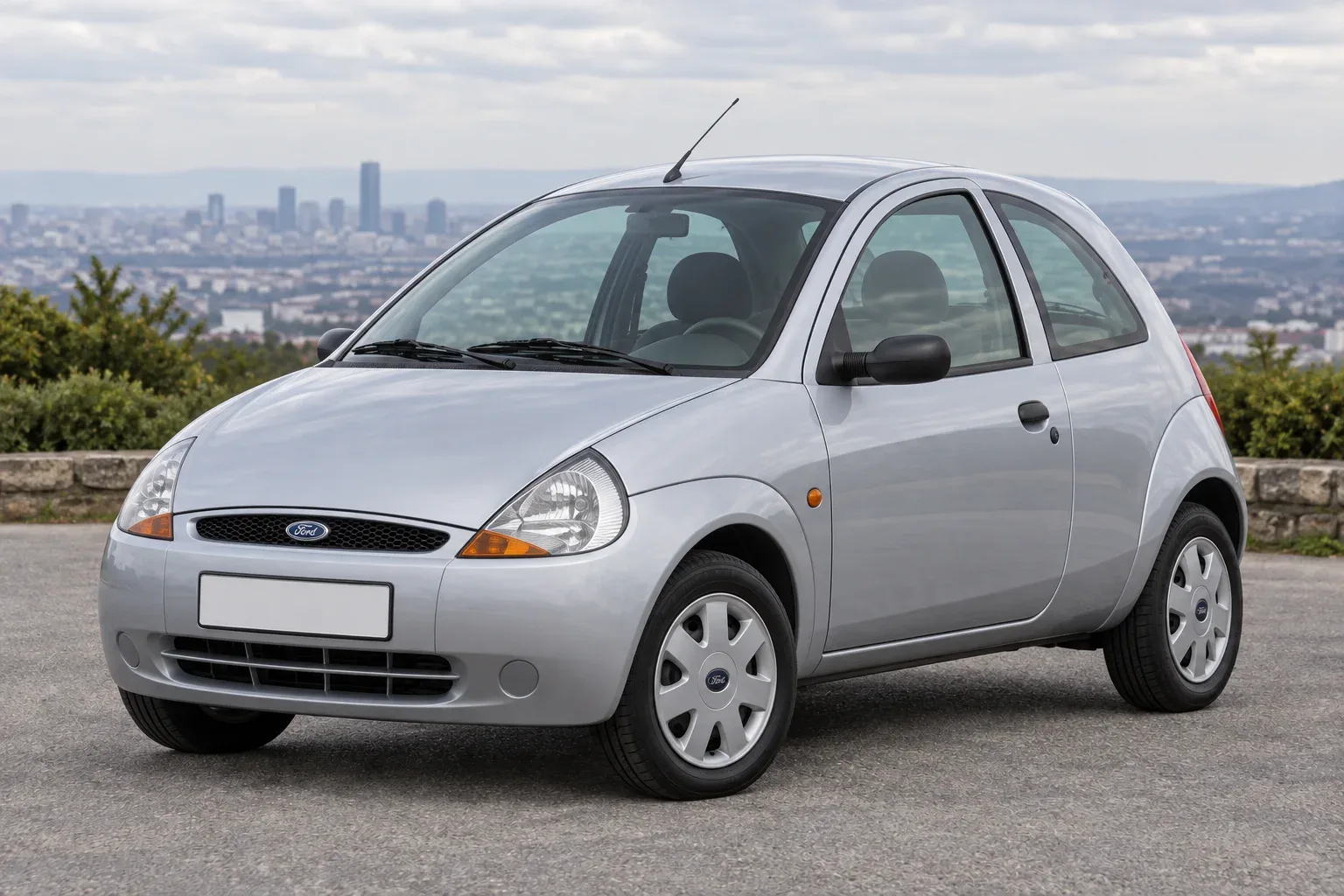
Ford Ka 1
Valuation of the Ford Ka 1 (1995–2008): condition, paperwork, inspection and terms of sale.
Indicative purchase price
Below market value
Final price agreed after inspection.
Value my car1Why buyers choose this model
The first generation Ford Ka was presented at the Geneva Motor Show in 1996. Its silhouette was designed by the Frenchman Claude Lobo, the same one who worked on the design of the first Focus.
2What buyers check
Model history
The first generation Ford Ka was presented at the Geneva Motor Show in 1996. Its silhouette was designed by the Frenchman Claude Lobo, the same one who worked on the design of the first Focus. The group was headed by Jack Telnak, Ford’s chief design officer from 1980 to 1997. The smallest Ford turned out to be controversial, but in originality it is not denied. The design of the model was based on the conceptual Ford Saetta – a small roadster, authored by Filippo Sapino. Where did the unusual name “Ka” come from? This word is borrowed from the religion of ancient Egypt. It denotes one of the parts of the human being, which, according to the Egyptians, consists of a body - Ba, a soul and a spiritual guide - Ka. Cheap marketing ploy? Yes, but Ford isn't the first manufacturer to put some philosophy into the car. Three years after the launch, the car received bumpers painted in body color. Previously, the small car was only available with bumpers made of black matte plastic. This unaesthetic look was very practical, because it allowed you to bravely carry contacts in parking lots, effectively masking any scratches and scuffs. This was not the only upgrade to the car. Before the end of production, Ford updated the model four times. The changes, though not revolutionary, were certainly in place. During this time, among other things, the interior was reworked, additional airbags were provided and the suspension was revised. In 2003, the range included a special version of Street Ka - a two-seat convertible with a soft roof, folded by hand.
Engines
For 12 years of production, Ford has not dared to offer a Ka with a diesel engine. It's a niche model, after all. In a car from the 90s, you do not have to rely on powerful engines. Modern motors certainly provide significantly better dynamics, but they are less enduring. During acceleration, the Ford Ka engine growls strongly, which enhances the sensation, but the real result is depressing. The most powerful of the 1.3-liter Duratec manages to disperse the baby to 100 km / h in 14-odd seconds. Only the 1.6 Duratec can handle acceleration well enough. Fuel consumption is not impressive. The weakest unit requires about 7.5-8 liters per 100 km. The top version at a fast pace can consume up to 11 liters per 100 km. It is worth noting that engines do not like long-term operation at high speeds: "at full gas" they overheat. The archaic 1.3 Endura-E was installed on the car for a long time. Even then, it was not considered modern. This is evidenced by the design of its gas distribution mechanism of the OHV type - the valves were located in a cast-iron head, and the camshaft in a cast-iron block. However, the engine attachments, electronic fuel injection and ignition system met the standards of the time. The undisputed advantage of the engine is almost eternal drive of the chain type HRM (4-5 thousand rubles for an analogue). Unfortunately, quite often (every 30,000 km) the valve gap is required to be adjusted. Neglect of service leads to wear of the camshaft, and later to damage to the head of the block. More modern 1.
Transmission
Ford Ka received a standard layout - a transverse engine in the front and drive to the front axle. The thrust is transmitted through a 5-speed manual transmission. There is no automatic transmission here. But maybe it’s for the best, because this type of box in urban compacts tends to be not durable.
The manual transmission is quite reliable, but sometimes the bushings in the gear selection mechanism wear out.
The clutch set will cost 15-20 thousand rubles plus 5000 rubles for replacement work.
Walking
You don't have to count on comfort. The suspension is set up quite rigidly. The front is Macpherson's racks, and the back is a twisting beam.
Among the suspension components, the bushings and stabilizer racks, ball levers (from 600 rubles) and support bearings of front shock pillars are most quickly handed over.
With age, replacement of shock absorbers and springs is inevitable.
Do not differ in particular durability and hub bearings of rear wheels (2-3 thousand rubles for bearing).
There were a lot of questions about the rear brakes of the drum type. Over time, they began to work unevenly, which was revealed during technical inspections.
During the inspection, it is necessary to assess the condition of the anthers of the SRUS and steering rods. Damage to protective covers leads to serious problems.
Over time, stains are found in the area of the steering rack - the upper omentum is handed over. The cost of the repair kit is 4-9 thousand rubles, and the new steering rack is more than 20 000 rubles.
Luft in the steering occurs due to wear of the cross of the steering shaft.
Other problems and malfunctions
Some cars from the 90s, despite the years, hold up well. The Ford Ka, unfortunately, does not fall into this category. However, most vulnerabilities are typical of older cars of other brands.
The Ford Ka was not too expensive, so the quality of the materials is not the best. First of all, the body is rented. Corrosion appears on the wings, rapids, doors, dash, in the area of the filling neck and on welds.
In age cars, even sometimes it tears off the rear beam due to a rotten spar at the mounting point.
The exhaust system is also corrosive: sometimes it had to be changed as early as the third year of operation. The replacements didn’t last much longer than the original.
Owners also complain of electrical problems (wiring insulation breaks down over time), a central lock and the creaking plastic of the front panel.
Failures in the operation of lighting equipment and windshield wipers are usually caused by a malfunction of the steering switch. It can often be repaired.
The list of age-related problems includes the heater crane - plastic connections break off, or the winding burns.
3Pre-purchase checklist
Model history
- This unaesthetic look was very practical, because it allowed you to bravely carry contacts in parking lots, effectively masking any scratches and scuffs.
Engines
- Neglect of service leads to wear of the camshaft, and later to damage to the head of the block.
- The engine received more reliable auxiliary equipment, but became more difficult to repair.
- However, it does not cause serious problems.
- Therefore, it should be borne in mind that replacements may require the components of the motor attachment equipment.
- Most often, the ignition module is denied (2-12 thousand).
- Cases of major repairs are quite rare, although they occur after 300-400 thousand km of mileage.
- Fortunately, there are many cheap components on the market and repairs are not complicated.
- If you like to do everything yourself, then there will be no problems with self-replacement of most parts.
Walking
- With age, replacement of shock absorbers and springs is inevitable.
- Over time, they began to work unevenly, which was revealed during technical inspections.
- During the inspection, it is necessary to assess the condition of the anthers of the SRUS and steering rods.
- Damage to protective covers leads to serious problems.
- The cost of the repair kit is 4-9 thousand.
- Luft in the steering occurs due to wear of the cross of the steering shaft.
Other problems and malfunctions
- Corrosion appears on the wings, rapids, doors, dash, in the area of the filling neck and on welds.
- In age cars, even sometimes it tears off the rear beam due to a rotten spar at the mounting point.
- The exhaust system is also corrosive: sometimes it had to be changed as early as the third year of operation.
- Owners also complain of electrical problems (wiring insulation breaks down over time), a central lock and the creaking plastic of the front panel.
- Failures in the operation of lighting equipment and windshield wipers are usually caused by a malfunction of the steering switch. It can often be repaired.
- The list of age-related problems includes the heater crane - plastic connections break off, or the winding burns.
4Challenges of selling privately
The original Ford Ka in the 90s looked good. However, those days are irrevocably gone, and the car is already noticeably old. On the other hand, the appearance is a matter of taste, and some still like the silhouette of the baby. Small cars are less time-sensitive than large ones, as the former must have an attractive cost, which can only be achieved by significantly reducing production costs.
The result of all this is rust throughout the body, regular overhaul of the suspension and a number of minor malfunctions. The biggest drawback is poor equipment.
But there are also positive aspects: decent driving performance and high maneuverability in the narrow city streets. Spare parts are inexpensive and maintenance costs are symbolic. This is one of the most interesting cars for female beginners. Men in Ka are likely to feel a little awkward.
- This unaesthetic look was very practical, because it allowed you to bravely carry contacts in parking lots, effectively masking any scratches and scuffs.
- Engines: Neglect of maintenance leads to wear of the camshaft and later damage to the block head. More modern 1.
- Transmission: Ford Ka received a standard layout - a transverse engine in the front and drive to the front axle.
- Driving: With age, replacement of shock absorbers and springs is inevitable.
- Other problems and malfunctions: Corrosion appears on the wings, sills, doors, snails, in the area of the filling neck and on welds.
Shows, bargaining and re-registration take time: buyers look, promise to think and disappear. Fair price after inspection closes the auction on the spot. If money is needed urgently, the purchase takes away waiting and repeat displays.
5How selling to us works
Leave a request with the car data. We will discuss the preliminary assessment and inspection. After checking the status and documents, we agree on the final price and terms of the transaction.