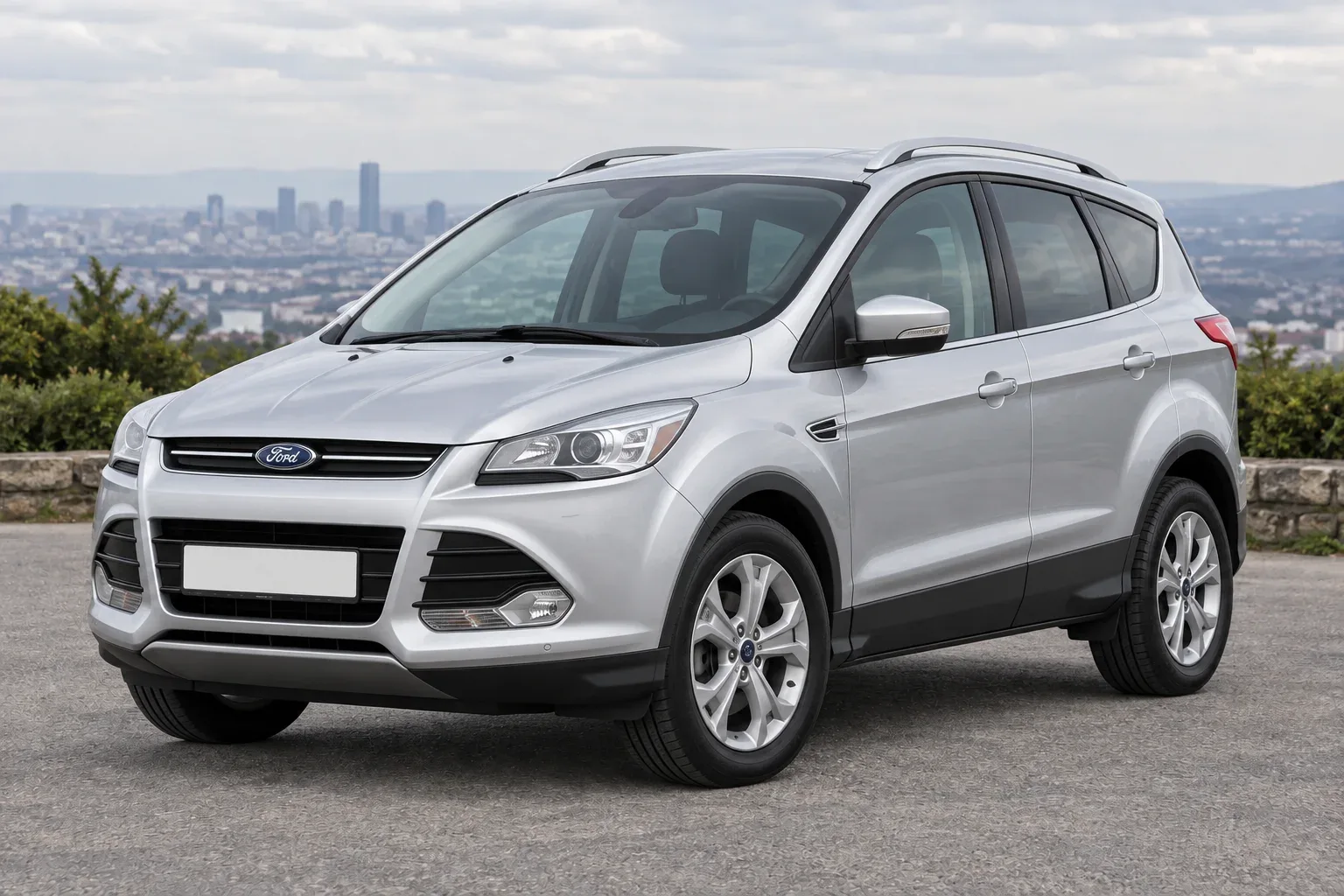
Ford Kuga 2
Valuation of the Ford Kuga 2 (2012–2019): condition, paperwork, inspection and terms of sale.
Indicative purchase price
Below market value
Final price agreed after inspection.
Value my car1Why buyers choose this model
Ford Kuga second generation debuted in 2012, and sales in Russia started in 2013. Stylistic and technical solutions overlap with the third focus, as both share a common platform - Global C. Compared to the first generation, the SUV has grown in length by 88 mm, but the wheelbase has remained the same. Despite the slight narrowing of the track, the width of the body has not changed. The interior width of the cabin increased by 3 cm. The next Kuga got rid of his biggest drawback - a small trunk. Its volume increased by 46 liters and amounted to 456 liters. With the rear seats folded, the space reserve increases to 1603 liters. Ford Kuga 2 is equipped with a number of modern technologies, such as traffic control system in the lane, blind spot monitoring, parking assistance, automatic driving beam switching and others. Mass production of the new SUV was organized at the Valencia plant (Spain). For the Russian market, the SUV was assembled in Elabuga (the Republic of Tatarstan). At the end of 2016, an updated version of the crossover came to the market. The main difference is the radiator grille, head optics and taillights. At the same time, the interior was refreshed. In the crash tests according to EuroNCAP in 2012 SUV earned 5 stars. The North American version of Escape failed the blows with a small overlap according to the IIHS testing method. The restyled Escape received improved protection only from the driver.
2What buyers check
Engines
Initially, the crossover was available with a gasoline turbo engine 1. 6 Ecoboost (150 and 182 hp) and a turbodiesel 2. 0 TDCi (140 hp). 163-horsepower diesel was not officially offered. After restyling, instead of 1. 6 Ecoboost, a turbocharged 1. 5 Ecoboost (150 and 182 hp) was installed. It is a smaller version of 1.6 EB. The volume change was achieved by reducing the stroke of the piston from 81.4 mm to 76.4 mm while maintaining the cylinder dimeter of 79 mm. The drive of the valve timing of both turbo engines is a belt. It should be updated every 90,000 km. The cost of the new set is 4-5 thousand rubles, and replacement work is about 8000 rubles. After 80-120 thousand km can fail electromagnetic valve turbine 1. 6 EB (6-8 thousand rubles). Ecoboost engines are excessively heat-loaded and are afraid of even a slight excess of the operating temperature. A slight deviation from the norm immediately results in damage to the head of the block or the block itself (cracks occur). The cost of the new short block is 160-230 thousand rubles. The most affected are the pre-reform 1.6 EB. With the cooling system 1.5 EB engineers have worked a little, but completely from the adversity and not got rid of. The problem was facilitated by leakage of antifreeze from the cooling system, resulting from cracking of the expansion tank, tubes or a failed valve of the tank cover. In 2018, the manufacturer conducted a recall campaign to replace potentially vulnerable parts. The new tank received a fluid level sensor, and the engine control program was updated to timely notify about antifreeze losses.
Transmission
The base was a 6-speed manual transmission (front-wheel drive versions). After the restyling, she disappeared from the list of offers. The gasoline engines were combined with the 6-band 6F35 automatic machine, a joint development of Ford and General Motors. Its design is close to the rather unsuccessful GM 6T30/40 box. Diesel cars with all-wheel drive were aggregated by a robotic transmission with dual clutch PowerShift 6DCT450. Six-speed PowerShift brand Getrag universal love did not find. The clutch, the so-called wet type, wore out to 100,000 km - the dampers sagged, and the plastic inserts (retainers) were destroyed. The fragments fell into the hydroblock and solenoids, which led to improper and rough operation of the box, and its accelerated wear. With timely access to the service, it was possible to get rid of a costly replacement of the clutch unit - 110,000 rubles for a restored clutch or 190,000 rubles for a new one. With prolonged ignoring of the symptoms, the box can become completely unusable. The cost of the new node is astronomical - 500,000 rubles. After 2014, the Power Shift box was finalized, and the clutch block was strengthened. The box was designated 6DCT451. Unfortunately, the upgraded clutch unit to the 6DCT450 is not suitable. There were cases among the classic machines installed on the cars of 2013-2015 release. Moreover, the mileage spread, which caused the malfunction, is quite large - from 20 to 250 thousand kilometers. Repair could require a hydraulic transformer, hydroblock, primary shaft, oil pump and gears of the differential (about 100,000 rubles).
All-wheel drive system
The all-wheel drive system uses Ford’s own development – the Active Torque Coupling (ATC) system. The same was installed in the fifth Explorer. When starting and passing corners, a certain part of the moment is transferred to the rear wheels. When driving on the highway, the interaxle coupling turns off the rear wheel drive.
In all-wheel drive versions, often after 50-100 thousand km, oil leakage through the right drive shaft (2600 rubles) is detected. Sometimes leaks are observed through the tail of the transfer case. Salnik changes in collection with flange (6000 rubles).
Walking
The suspension settings of the predecessor were unnecessarily rigid. In the second generation, the balance shifted towards comfort. But he did not lose his ability to drive fast. Obedient behavior in cornering is achieved, including thanks to the control system of the thrust vector TVC (slows down one of the driving wheels). It is an analogue of XDS from VAG.
On the front axle are installed Macpherson struts, and on the rear - a multi-link scheme. Silent blocks and ball supports of the front levers usually go at least 100-150 thousand km (6-8 thousand rubles per lever), but the rear levers are given earlier - at a distance of 50-100 thousand km.
A similar ratio of the resource of the front and rear shock absorbers (3-4 thousand rubles per rack).
The bearings can make noise after 60-120 thousand km. If the front ones are changed separately (1-4 thousand rubles for a bearing), the rear ones are assembled with a hub (6-7 thousand rubles).
There's an electric power in the steering. Owners note that over time, the steering rack begins to knock. Ford acknowledged the design defect, but justified the fact that the knocking is not a malfunction and does not affect safety. Even after the warranty replacement of the rake or its repair (about 15-18 thousand rubles), the knock after some time returned.
Other problems and malfunctions
The body of the Ford Kuga 2 is well protected from corrosion. However, many owners find paint swelling in the bottom of the interior of the doors.
During operation, the paint is wiped to metal under the hood (toad seal), from the inside of the doors (door panels), on the trunk door (overlay over the room). In restyled copies, the paint coating of the rear wing (far angle) and the bumper at the point of contact with the lamp may be damaged.
Discourage can be and rust stains coming from under the external mirrors. These are the consequences of corrosion of the metal frame of the mirrors.
The quality and quality of the interior materials is exemplary. Only a little embarrassing is the pile of buttons and displays.
The filler of the driver's seat pushes and loses elasticity already to 30-80 thousand km. It wears out against the metal frame of the chair.
Sometimes the screws of the brake tank attachment spontaneously unscrew.
3Pre-purchase checklist
Engines
- The drive of the valve timing of both turbo engines is a belt. It should be updated every 90,000 km. The cost of the new set is 4-5 thousand.
- The electromagnetic valve of the turbine 1. 6 EB (6-8 thousand rubles) can fail.
- A slight deviation from the norm immediately results in damage to the head of the block or the block itself (cracks occur).
- The most affected are the pre-reform 1.6 EB. Cooling system 1.
- The problem was facilitated by leakage of antifreeze from the cooling system, resulting from cracking of the expansion tank, tubes or a failed valve of the tank cover.
- In 2018, the manufacturer conducted a recall campaign to replace potentially vulnerable parts.
- The new tank received a fluid level sensor, and the engine control program was updated to timely notify about antifreeze losses.
- A number of 1.5-liter 150-horsepower engines in the Kugas of 2017 went through warranty repairs due to cracking of the piston.
Transmission
- The clutch, the so-called wet type, wore out to 100,000 km - the dampers sagged, and the plastic inserts (retainers) were destroyed.
- The fragments fell into the hydroblock and solenoids, which led to improper and rough operation of the box, and its accelerated wear.
- Moreover, the mileage spread, which caused the malfunction, is quite large - from 20 to 250 thousand kilometers.
- Repair could require a hydraulic transformer, hydroblock, primary shaft, oil pump and gears of the differential (about 100,000 rubles).
Walking
- Ford acknowledged the design defect, but justified the fact that the knocking is not a malfunction and does not affect safety.
- Even after warranty replacement of the rake or its repair (about 15-18 thousand).
- The squeak came back after a while.
Other problems and malfunctions
- The body of the Ford Kuga 2 is well protected from corrosion.
- Discourage can be and rust stains coming from under the external mirrors.
- These are the consequences of corrosion of the metal frame of the mirrors.
4Challenges of selling privately
Another Kuga surpassed its predecessor in attractiveness, spaciousness and driving qualities. Unfortunately, with reliability, things are a little different. In addition, the cost of spare parts and repair costs are not cheap. The safest choice is to have 2.5 atmospheric cars younger than 2015.
- Engines: km can fail electromagnetic valve turbine 1. 6 EB (6-8 thousand rubles).
- Transmission: The clutch, the so-called wet type, wore out to 100,000 km - the dampers sagged, and the plastic inserts (retainers) were destroyed.
- All-wheel drive system: The all-wheel drive system uses Ford’s own development – the ATC (Active Torque Coupling) system.
- Driving: Ford acknowledged the design defect but justified himself by saying the knocking was not a fault and did not affect safety.
- Other problems and malfunctions: The body of the Ford Kuga 2 is well protected from corrosion.
Shows, bargaining and re-registration take time: buyers look, promise to think and disappear. Fair price after inspection closes the auction on the spot. If money is needed urgently, the purchase takes away waiting and repeat displays.
5How selling to us works
Leave a request with the car data. We will discuss the preliminary assessment and inspection. After checking the status and documents, we agree on the final price and terms of the transaction.