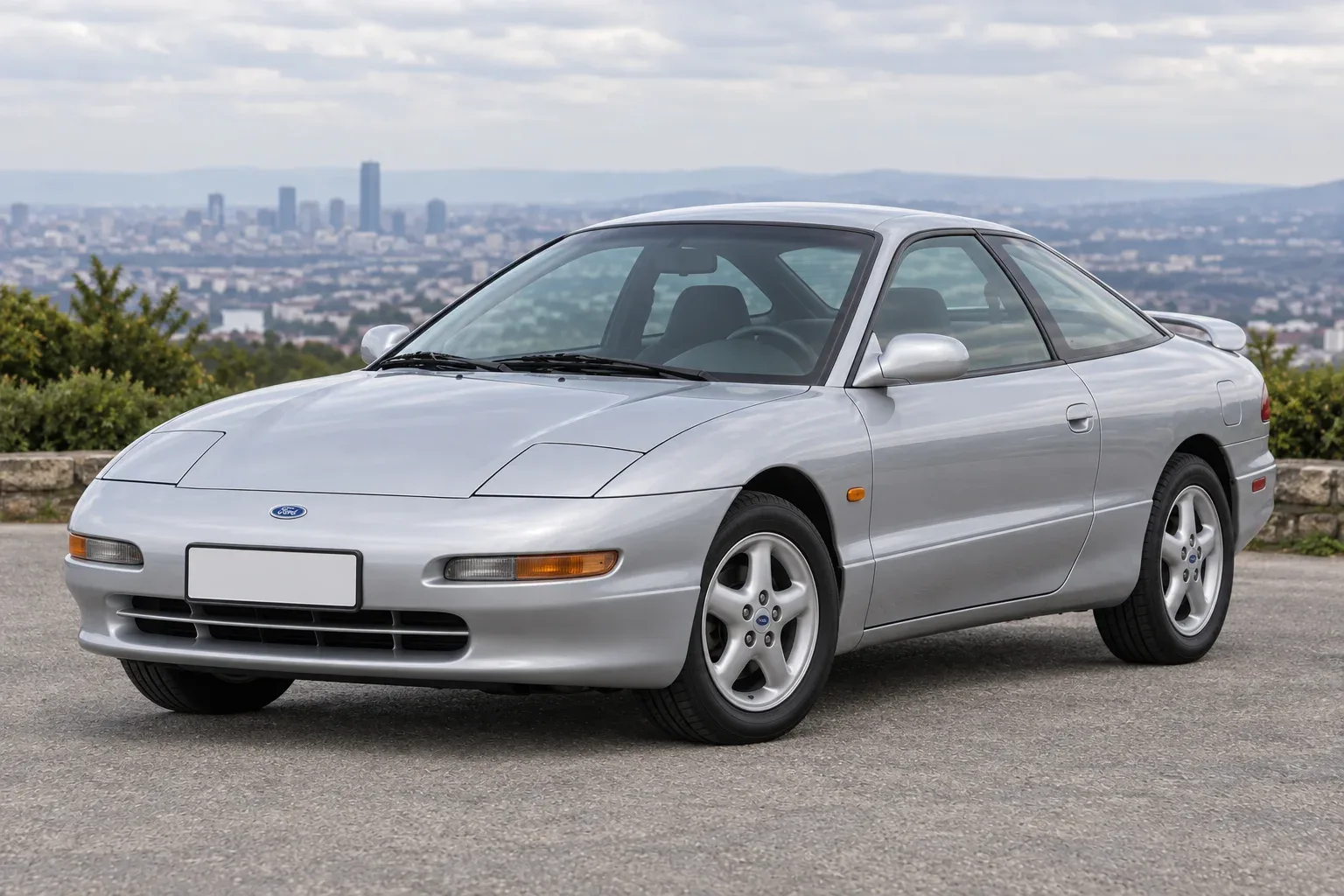
Ford Probe 2 / GE
Valuation of the Ford Probe 2 / GE (1993–1997): condition, paperwork, inspection and terms of sale.
Indicative purchase price
Below market value
Final price agreed after inspection.
Value my car1Why buyers choose this model
In the 90s, car manufacturers, with some exceptions, did not yet offer crossovers in Europe. Instead, they filled the niche of sports cars.
2What buyers check
Review
In the 90s, car manufacturers, with some exceptions, did not yet offer crossovers in Europe. Instead, they filled the niche of sports cars. However, these were not classic sports cars with rear-wheel drive and a powerful engine, but relatively affordable models using conventional technologies, packaged in attractive shapes. So was the Ford Probe. The second generation, like the first, is closely related to Mazda. By mutual agreement between the two manufacturers, Autoalliance International was established. It was based in Flat Rock, Michigan, USA. The first Probe was created here, as well as the Mazda 626 and MX-6. The MX-6 was technically based on the GE 626 series and had much in common with the Ford Probe 2. Mazda was responsible for the engine, transmission and running gear throughout the project. Ford took care of the body and interior. Thus, in technical terms, the Probe was a clone of the MX-6, but both cars looked different, including the interior. Few people knew they had about 60 percent of the parts in common. The main competitors for the Probe in Europe were the Opel Calibra, VW Corrado, Fiat Coupe, Alfa Romeo GTV and a number of Japanese cars - Toyota Celica, Honda Prelude and, of course, the technically unified Mazda MX-6. In general, the forms of the Probe are still interesting, and at the time of creation were considered progressive. Judging by the profile, it seems that the designers were inspired by the American F-16 fighter.
Running
Despite its American origins, the Ford Probe is fascinating with its road behavior. Compared to the first generation, the manners became more European. The car demonstrates fairly accurate steering and agile reactions to steering commands. In the curves, a good grip with the road of the external front wheel is found. Proba's going great on the smooth highway.
But not all roads in our country are smooth. On the broken areas, insufficient rigidity of the body is revealed, as well as uncoordinated work of springs and shock absorbers. Despite the multi-link scheme at the back, the wheels on bumps bounce, which does not contribute to safety.
Engines
As mentioned above, under the hood were units developed by Mazda. In addition to the basic 2-liter gasoline engine, a six-cylinder 2.5 series K-Line was also offered. It was only relying on the Probe GT. Unlike the four-cylinder engine, the 163 hp V6 is still impressive and truly sporty. With the growth of turnovers, there is an increase in strength. The K-series engines are powerful, surprisingly quiet, but somewhat delicate, and require knowledge and discipline in operation for long-term survival. Both units have a geared belt drive timing, requiring updating every 60,000 km. When the belt breaks, the pistons do not meet the valves. Valve gaps are regulated by hydraulics (hydrocompensators). 2-liter atmospheric is cheaper and easier to maintain. Common problems include failures of oxygen sensors and faulty high-voltage wires. The six-cylinder engine is prone to increased oil consumption. If you don’t check your V6 level regularly, you can kill it. Of course, its engine will be repaired, but it will not cost cheap. Another problem of the “six” is the occurrence of piston rings. This happens if you “twisted” the unheated engine or silence it, not allowing it to cool down after a fast ride. There are also problems that are difficult to prevent. We are talking about hydraulic valve pushers. The knock of hydraulic compensators indicates either neglect in service or the failure of the pressure regulator of the oil pump (pressure does not correspond to the speed). The disease can be recognized only by measuring pressure.
Transmission
All engines were combined with a 5-speed manual transmission or with an alternative 4-speed automatic.
Combating corrosion and components
The car of the past is now over 20 years old. Most of the instances in the ads are junk, which sometimes is not even able to move. Oddly enough, well-preserved specimens are not as expensive as competitors (VW Corrado, Opel Calibra). However, getting a Ford Probe in good condition is getting harder every year.
Despite being very good at protecting against corrosion for its time, rust is the biggest problem today. It can be found on the back wings, rapids and on the floor.
The parts situation is even worse. For example, some catalogs do not mention the Ford Probe as a separate model. Of course, this does not mean that spare parts cannot be found. It's just gonna take longer to look. The choice is limited to a couple of options. The eBay auction service can help in finding spare parts.
The problem is also with repairs. It is not a European Ford or a Mazda. However, if we take into account the Mazda filling, then in case of what it is better to seek help in the service specializing in Mazda maintenance.
Due to age, there are often problems with wiring, in particular due to the oxidation of contact connectors. From time to time, the return springs of the internal door handles break. For the manual transmission is characterized by leakage of brake fluid through the hydraulic traction.
3Pre-purchase checklist
Engines
- Common problems include failures of oxygen sensors and faulty high-voltage wires.
- If you don’t check your V6 level regularly, you can kill it.
- Of course, its engine will be repaired, but it will not cost cheap.
- Another problem of the “six” is the occurrence of piston rings.
- There are also problems that are difficult to prevent.
- The knock of hydraulic compensators indicates either neglect in service or the failure of the pressure regulator of the oil pump (pressure does not correspond to the speed).
- If the sensor fails, the engine will start, but will not be able to gain momentum.
Combating corrosion and components
- Despite being very good at protecting against corrosion for its time, rust is the biggest problem today.
- The problem is also with repairs.
- Due to age, there are often problems with wiring, in particular due to the oxidation of contact connectors.
4Challenges of selling privately
At the time, Ford Proba did not live up to expectations. It could not withstand the onslaught of European and Asian competitors. In the end, sales were much worse than expected, and production of the model had to stop.
Today, Probe 2 is not young, so you should not expect miracles from it. In terms of durability and potential problems, it is more profitable to purchase a version with a 2-liter engine.
- In the 90s, car manufacturers, with some exceptions, did not yet offer crossovers in Europe.
- On the go: Despite its American origins, the Ford Probe fascinates with its roadside behavior
- Engines: Common problems include oxygen sensor failures and faulty high-voltage wires.
- Transmission: All engines were combined with a 5-speed manual transmission or with an alternative 4-speed automatic.
- Corrosion control and components: Despite being very good corrosion protection for its time, rust is the biggest problem today.
Shows, bargaining and re-registration take time: buyers look, promise to think and disappear. Fair price after inspection closes the auction on the spot. If money is needed urgently, the purchase takes away waiting and repeat displays.
5How selling to us works
Leave a request with the car data. We will discuss the preliminary assessment and inspection. After checking the status and documents, we agree on the final price and terms of the transaction.