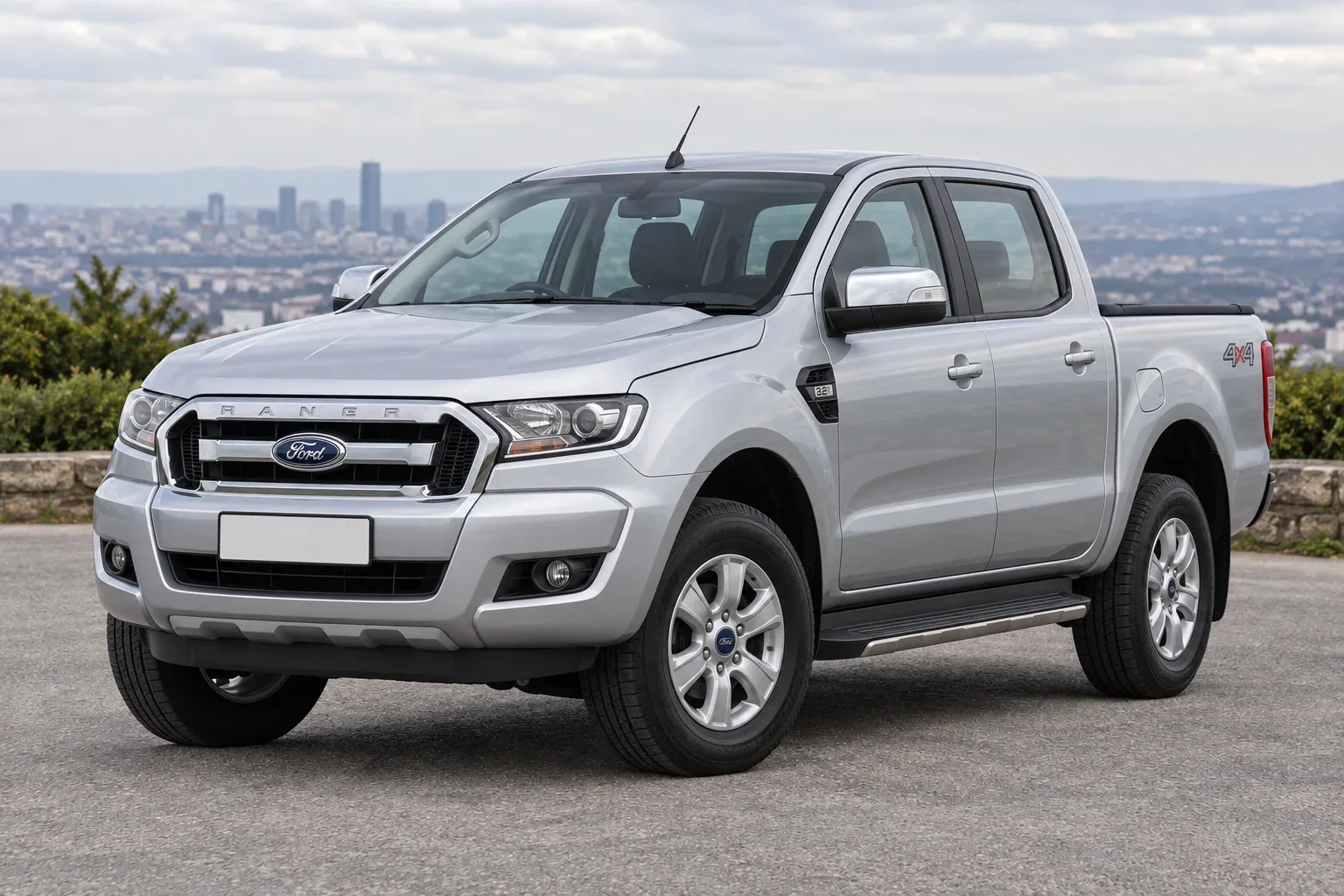
Ford Ranger 3 / T6
Valuation of the Ford Ranger 3 / T6 (2011–2023): condition, paperwork, inspection and terms of sale.
Indicative purchase price
Below market value
Final price agreed after inspection.
Value my car1Why buyers choose this model
Good cars are the ones that can stand in Asia or Africa. There, production deficiencies cannot be corrected, as after the sale the car will never see the official service again. If the car stops in the desert, it could cost the crew their lives. People are buying cars that won’t stand in the middle of the desert. You won’t find an Audi Q7 or a BMW X6 in the African or Asian wilderness. The Ford Ranger is not only sold, but also manufactured worldwide. In particular, in Thailand, South Africa, Argentina, Nigeria, Michigan and Vietnam. In markets where Mazda has a better reputation than Ford, the car is marketed as the Mazda BT-50. If in the past generation Ford Ranger was just a redesigned Mazda with Japanese engines and gearboxes, in the case of Ford Ranger 3, it is quite the opposite. Perfectly selected main mechanical units are the strength of the car. The four-cylinder 2.2 TDCi and five-cylinder 3.2 TDCi are engines from the Puma lineup, which appeared in 2000. They have never been lucky with fuel system equipment. First with the Bosch VP-44 pumps, where the control electronics failed. Then with Delphi's Common Rail system, where high-pressure pumps would throw sawdust into the nozzles. In the Transit versions of Euro 4, the pistons cracked and burned, but again Denso nozzles were to blame. What was lost behind the abundance of problems was that the mechanics of these engines were exemplary. No one has ever seen them with worn camshaft cams or twisted liners. Even the chains of the hydraulic artery here do not make noise up to 400,000 km.
2What buyers check
Engines
A reliable, non-engine-shattering injection system has only been available in Euro 5 variants since 2010. So far, the Continental system works flawlessly, there are no burnt pistons, and cars with a mileage of more than 200,000 km even have original injectors. The Ford Ranger T6 hit the market in 2012, so it has already received an improved version of the Puma engines. The five-cylinder 3.2 TDCi (200 hp) proved exclusive since it disappeared from Transit in 2010. So if someone tells you that “Ford engines are not good because my friend has already been killed on Transit,” they are guaranteed to be talking about versions after 2010. Puma engines are so good that they were left in the pickup after 2016, when the new 2.0 EcoBlue units appeared on Transit. The reduced volume was compensated by higher boost pressure. Especially for the Ranger, the old 2.2-liter four-cylinder engine and the charming 3.2-liter five-cylinder were retained, however, in the Euro 6 version with AdBlue urea injection. 20 liters of urea stock are enough for about 2400 km. The reduction in nitrogen oxides in the exhaust allowed diesel to be burned more efficiently (more pre-injection, less recycle gases, higher temperature and pressure). The appetite of the five-cylinder engine in the medium-tonnage car decreased from 10.8 to 9.2 l / 100 km.
Walking
The comfort of the suspension is perhaps the model’s biggest weakness. On rough roads, it is particularly uncomfortable in an empty pickup truck. The Volkswagen Amarok is much closer to a passenger car. In this he helps two variants of carrying capacity: 800 kg with three sheets of springs at the back and 1000 kg with five. Those with weaker springs travel with greater comfort.
Each Ford Ranger can carry a minimum of 1,024kg, with some variants up to 1,140kg. Very large five-leaf springs were installed behind. Their vibrations extinguish powerful shock absorbers, but they shake the frame. The unpleasant tremors disappear only with load. Even with a ton of cargo, the body behaves stably, does not heel or rock.Resors will never break on cars that have a rear installed, for example, a container for a thousand liters of diesel fuel, which they carry to the fields of harvesters. But in instances, often moving empty, to change the springs happened. Apparently, vibrations are harmful to them.
The behavior of empty cars was slightly adjusted after restyling, but it was really perfect only in the sports version of the Raptor, released in 2019. There, the manufacturer made unexpectedly large-scale technical changes - twisted springs instead of leaf springs at the back, lighter aluminum levers at the front and Fox shock absorbers in a circle. The curb weight decreased by 600 kg. It is a pity that Raptor did not get the old 3.2-liter five-cylinder engine, but only the modern EcoBlue. In 2023, the story of the old Puma engine line came to an end.
Reliability
On many used cars, two things are changed. One, the electric transfer motor. And after about 250,000 km, sometimes you have to update the diesel evaporator in front of the particulate filter. Nothing terrible is happening in the rest.
The clutch of mechanical boxes lasts a long time, and an honest hydrodynamic automaton is almost eternal.
The greatest risk to the buyer of a used car is not inherent defects or wear, but in the consequences of accidents. For reasonable money, you can repair only small impacts that affect the deformable front longitudinal elements of the frame. They can be cut and replaced with new ones.
More serious collisions result in the frame bend, usually at a point behind the front axle. In this case, the only quality repair is the replacement of the frame.
2.2 TDCi (R4, 16V/120, 130, 150 or 160 hp, 285, 330 or 400 Nm) 2012 - 2019
The basic four-cylinder engine from Transit is enough while the car is empty. Ranger's getting a decent run. If you take a tow 3-ton trailer, the solid diesel sound will remain, but on the rises, the speed will fall to the level of a loaded truck. At this point, you will regret not having a five-cylinder engine.
3.2 TDCi (R5, 20V/200 hp, 475 Nm) 2012 - 2020
The five-cylinder engine is available in Euro 5 and Euro 6 versions, which have never been installed on Transit. Thus, rumors about their unreliability due to Denso nozzles are false.
The engine doesn’t seem much stronger than the four-cylinder, but in practice it stoically and calmly produces more than 500 Newton meters in a wide range of revolutions – from 1500 to 3000. The five-cylinder engine will not notice the two-ton trailer, and with a 3.5-ton on the rises, Ranger overtakes the three-cylinder Fabia. This is the best engine in a pickup truck to work with. The fuel consumption is not small. Even in the more economical version of Euro 6, it doesn't drop below nine litres.
2.0 EcoBlue (R4, 16V, 170 or 213 hp, 420 or 500 Nm) 2012 - 2019
In 2019, the Ranger entered a new era and the old Puma engines were retired. The new Panther is still a two-litre engine, but in a more powerful twin-turbo form. A new 10-speed transmission helps keep it in its peak torque range. The oil-immersed timing belt and complex automatic transmission are two reservations: buyers with tighter budgets may prefer to let wealthier customers test their durability before spending their hard-earned savings.
Malfunctions and problems
The burst springs, paradoxically, are most often found on cars that move mainly empty. The original block of 5 leaf springs can be purchased for 106 000 rubles, and the analogue - from 47 000 rubles.
Screak springs: from the factory they have no anti-slip layer. The sheets can be lubricated, for example, with graphite vaseline.
The thunder of springs: wear of rubber stops (pucks) between the leaf springs. They are not sold separately, craftsmen can make something.
Punctured anther of the anterior semiaxis, wear of the SRUS: damage to the anther of the semi-axis is a common phenomenon on rough terrain. If you do not notice in time, the hinge will soon fail (about 9000 rubles).
Faulty evaporator (nozzle) of diesel fuel in the exhaust pipe (until 2016). It usually fails after 250,000 km. The new original injector element costs 68 000 rubles, the analogue - from 18 000 rubles. The replacement is simple.
The defective transfer box motor. It is easy to change, but here is the price of the original 156 000 rubles.
Rear side lock: not characterized by durability.
Fracking of the valve timing chain on engines 2.2 and 3.2 TDCi after start-up and idling after warming up. Usually after 400,000 km.
Broken particulate filter temperature sensor: wiring can jump out of the mounts and get damaged on rough terrain.
Diesel Oil Dilution (2.0 EcoBlue, from 2019): New engines have no nozzle in the exhaust pipe, and frequent short-distance trips get diesel into the engine oil.
Service recommendations
The service interval for the Ford Ranger is 20,000 km. It should be reduced to 10,000 km.
No replacement of the HRM chain is prescribed. The signs are the sound of the sound.
The oil in the differentials is changed after ten years or 150,000 km (depending on which comes first). It is better to reduce the period to 60,000 km. If the car periodically overcomes the ford, then it should be changed every year. Despite the fact that the ventilation holes are directed upwards, it is not necessary to count on the fact that nothing gets into the differentials.
The oil change in the automatic transmission is prescribed after 240,000 km. In fact, the oil needs to be updated every 60,000 km.
Pluses
Reliable and durable mechanics Long-term automatic transmission Solid range of used cars High load capacity Acceptable mass of trailer 3250 or 3500 kg Soot filter with evaporator (nozzle) in the exhaust pipe (until 2016) Powerful and durable five-cylinder engine 3.2 TDCi
Cons
Poor comfort of suspension without load (except Raptor) Very expensive repairs in serious accidents (frame replacement) Noise of Puma engines after cold start Slow operation of the old automatic transmission Ford 6R80 Full-wheel drive without center differential can only be used on slippery surfaces (not on dry road)
Model history
2012: The emergence of the model. Single cab versions (2 seats, 2 doors), Super Cab (2 + 2 seats, 2 doors) and Double Cab (5 seats, 4 doors). Diesel four-cylinder 2.2 TDCi (120 or 150 hp) and five-cylinder 3.2 TDCi (200 hp). Both options with a six-speed manual or automatic transmission and a two-speed downshift.
2015: Model update. A different front part and a completely redesigned interior. Multi-stage heating of the seats, large displays on the front panel. More comfortable suspension.
2016: Engines switched to Euro 6 standard, added AdBlue urea injection.
2019: Further minor front-end updates. The 2.2 TDCi engine is excluded from the model range. The new 2.0 EcoBlue engines have one (170 hp) or two (213 hp) turbochargers. Special sports model Raptor. Six-speed manual or ten-speed automatic transmission.
3Pre-purchase checklist
Engines
- A reliable, non-engine-shattering injection system has only been available in Euro 5 variants since 2010.
- Changes in the layout of the exhaust system, where the particulate filter was transferred immediately behind the turbine, and the catalytic converter took its former place, forced to abandon the Ford branded chip: an additional nozzle (or rather, the diesel evaporator) in the exhaust manifold.
- However, there are no serious problems with burning the particulate filter.
Reliability
- The greatest risk to the buyer of a used car is not inherent defects or wear, but in the consequences of accidents.
- For reasonable money, you can repair only small impacts that affect the deformable front longitudinal elements of the frame. They can be cut and replaced with new ones.
- In this case, the only quality repair is the replacement of the frame.
2.0 EcoBlue (R4, 16V, 170 or 213 hp, 420 or 500 Nm) 2012 - 2019
- The oil-soaked belt and the complex machine are two “buts” that better be tried out by wealthier customers before spending their hard-won money.
Malfunctions and problems
- The thunder of springs: wear of rubber stops (pucks) between the leaf springs.
- Punctured anther of the anterior semiaxis, wear of the SRUS: damage to the anther of the semi-axis is a common phenomenon on rough terrain.
- It usually fails after 250,000 km.
- The new original injector element costs 68 000 rubles, the analogue - from 18 000 rubles. The replacement is simple.
Service recommendations
- The service interval for the Ford Ranger is 20,000 km. It should be reduced to 10,000 km.
- No replacement of the HRM chain is prescribed.
- If the car periodically overcomes the ford, then it should be changed every year.
- The oil change in the automatic transmission is prescribed after 240,000 km.
- In fact, the oil needs to be updated every 60,000 km.
Cons
- Poor comfort of suspension without load (except Raptor) Very expensive repairs in serious accidents (frame replacement) Noise of Puma engines after cold start Slow operation of the old automatic transmission Ford 6R80 Full-wheel drive without center differential can only be used on slippery surfaces (not on dry road)
4Challenges of selling privately
Although the third-generation Ford Ranger is not a mass-market segment, it is very popular with used off-road pickups and is currently finding buyers as quickly as its main competitor, the Volkswagen Amarok. The oldest T6 cars, which are already 12 years old, are sold at a price not much higher than the cost of the same old and used Amarok.
At the secondary Ford Ranger is presented mainly in comfortable passenger versions.
The second plus of the Ford Ranger is robust technology wrapped in a rigorous modern design. The younger and less worn Ranger models are already cheaper than the Amarok, even with the top-end 3.2 TDCi engine. This Ranger variant has a higher price tag on the market, as opposed to the less powerful 2.2 TDCi, with the five-cylinder engine costing an average of ten percent more.
- Engines: A reliable, non-engine-shattering injection system has only been available in Euro 5 variants since 2010.
- Chasing: The suspension comfort is perhaps the model's biggest weakness.
- Reliability: The greatest risk to the buyer of a used car is not its inherent defects or wear, but the consequences of accidents.
- Faults and problems: The knock of springs: wear of rubber stops (pucks) between the spring sheets.
- Maintenance recommendations: The service interval for the Ford Ranger is 20,000 km. It should be reduced to 10,000 km. No replacement of the HRM chain is prescribed.
- Pros: Reliable and hardy mechanics Long-term automatic transmission Solid range of used cars High load capacity Acceptable mass of trailer 3250 or 3500 kg Soot filter with evaporator (nozzle) in the exhaust pipe (until 2016) Powerful and durable five-cylinder engine 3.
- Cons: Poor comfort of suspension without load (except Raptor) Very expensive repair in serious accidents (frame replacement) Noise of Puma engines after cold start Slow operation of the old automatic transmission Ford 6R80 Full-wheel drive without center differential can only be used on slippery surface (not on dry road)
- The history of the model: 2012: the emergence of the model.
Shows, bargaining and re-registration take time: buyers look, promise to think and disappear. Fair price after inspection closes the auction on the spot. If money is needed urgently, the purchase takes away waiting and repeat displays.
5How selling to us works
Leave a request with the car data. We will discuss the preliminary assessment and inspection. After checking the status and documents, we agree on the final price and terms of the transaction.