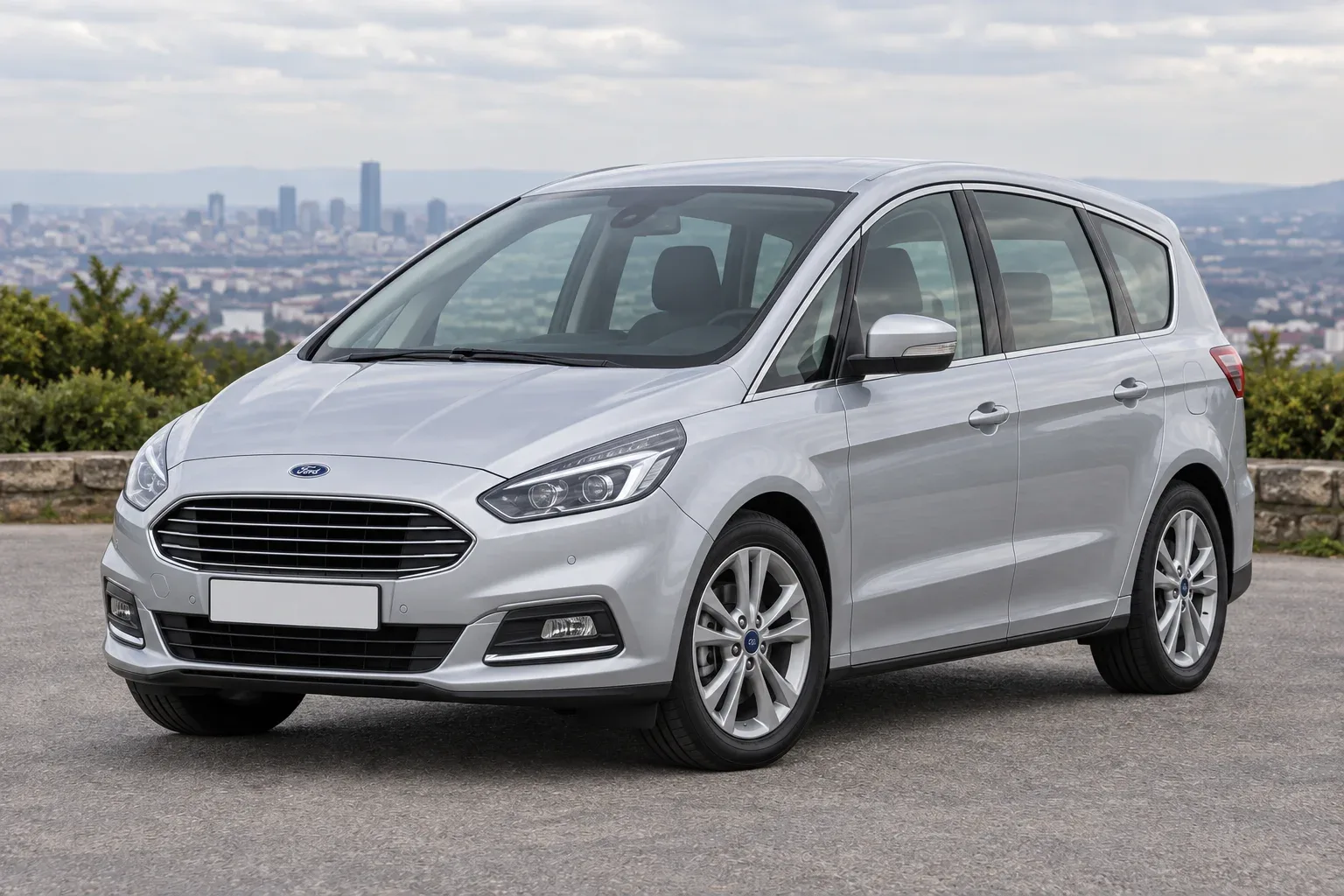
Ford S-Max 2
Valuation of the Ford S-Max 2 (2015–2023): condition, paperwork, inspection and terms of sale.
Indicative purchase price
Below market value
Final price agreed after inspection.
Value my car1Why buyers choose this model
The S-Max was and still is a derivative of Mondeo. It shares a platform with it, most engines and equipment. Therefore, due to the protracted appearance of the fifth version of the second generation Mondeo, S. Max had to wait until 2015. Ford decided that the days when cars for the New World were simple and large-sized are long gone. The American Fusion, introduced in 2012, is now so technically advanced that it could well become the fifth-generation European Mondeo. The unions at the plant in Genk, Belgium, where the trio of Mondeo IV, S-Max I and Galaxy II were assembled, were not thrilled with this. Ford had to leave more than 4,000 employees, and with them, the production of older models for at least a year longer than desired. However, the Fusion’s adaptation to European conditions and regulations took some time. Therefore, the fifth Mondeo appeared only in 2014, and another year passed before it was based on the large-scale derivatives of the S-Max and Galaxy.
2What buyers check
Walking
Externally, the second generation is quite similar to the first and even in the main dimensions of both models are similar. And when you see that the wheelbase of 2850 mm remained the same, you tend to think that the S-Max II is just a more significant facelift. Just looking at the lift will convince you otherwise. If the first generation had transverse levers made of sheet metal behind, the second generation had modern cast aluminum with spring cups that perceive not only transverse but also longitudinal forces. Longitudinal levers with large Silentblocks, because of the wear of which the feed began to swim, there are no more. The fifth-generation Mondeo rear suspension is more like a larger BMW than any previous Ford. The walker doesn't just seem solid. There are examples that have gone 300,000 kilometers, where the maximum that has changed is the attachment of the rear shock absorbers. The detail on the two bolts is the only thing that knocks here sometimes. However, the suspension with its massive elastokinematic Silent blocks has one unpleasant feature. After 200,000km, the car is no longer as stable in cornering as it was when it was young. For example, it is more likely to fall on a rut. Families with children usually have other concerns, but if someone wants to deal with it, they don’t know how to deal with it. No detail is clearly shaky and needs replacement. All the silencing blocks will soften over time. You can try to replace the two largest ones that are on the front levers behind (9000 rubles per analogue). # #
The extremely durable and expensive suspension design found its application in all-wheel drive versions, which became the main new feature. The previous model lacked all-wheel drive. It could be obtained with both a manual (2.0 TDCi / 150 hp) and an automated PowerShift dual-clutch transmission (2.0 TDCi / 179 hp). All-wheel drive cars are usually in high demand. The principle of operation of the multi-plate interaxial coupling is the same as that of Shkoda or Volkswagen. The clutch needs regular oil updates. For those who don’t change it, the wear products clog the suction basket of the pump, which is unable to create enough pressure to compress the discs when needed. As a result, the car rows on a loose surface only with the front wheels. The oil replacement recommendation is not in Ford’s service plan. So far, the fifth Mondeo or its derivatives have no problems with the all-wheel drive system. The system has a very complex control program, including torque transmission curves. The system is not supplied by third-party suppliers. It is manufactured directly at the Sterling Axle Plant, Ford’s Michigan plant. The oil inside is the usual SAE 80W-90 C2. It is designed for the rear axles of other Fords, such as the Ranger SUV. And since there is a drain and control bolt, it can be replaced without any problems. All this confirms the well-known truth about American cars. ## Painting
With the transfer of production from Belgium to Spain, the quality of paint coatings has significantly improved. This was the main aesthetic flaw of the predecessor - just a few passes through the brush wash, and the gloss disappeared forever. The black paintwork in the sun looked like it was being passed through by a grinder. However, the more durable paint coating of the second-generation Ford S-Max has a reverse side. A thicker paint coating is prone to peeling off during mechanical damage. Therefore, chips often appear on the hoods of the second-generation S-Max, which are recommended to be eliminated immediately with a paint pencil. ##
The optional six-speed automatic transmission (standard for 209 hp) is not a much-vaunted Ford hydrodynamic automatic (it was reserved only for the 240 hp 2.0 EcoBoost petrol until 2018), but the Getrag 6DCT450 with dual clutch. As with VW’s DSG, a prerequisite for its normal operation is to replace six litres of special oil every 60,000 km. It is worth noting that if the dual-clutch transmissions on the old Fords had a very bad reputation, then here they are configured in a way that is mostly not annoying. There are no big problems with the boxes yet. When the car mileage increases significantly, the situation may well change. The more durable and smooth eight-speed machine from Ford is put on versions 2.0 EcoBlue (120, 150, 190 and rarely 240 hp biturbo), offered since the summer of 2018.
Among the more affordable 2.0 TDCi units, single (150, 179 hp) or dual turbocharged (209 hp) variants make up the vast majority. EcoBlue 2.0 engines are more environmentally friendly, but less durable. If the previous TDCi was a multiple evolution of the highly successful two-liter Peugeot DW10 with reliable and maintainable Delphi injection, the EcoBlue is a completely new development of Ford’s European workshops. Problems with premature oil replacement were solved with the help of software. However, if in the service you see a motor without the cylinder head, in which the gasket burned out, and squeezes out antifreeze, it is EcoBlue. In addition, often on this engine had to update the nozzles. Many have already replaced several sets - the latest generation Continental injection system was unsuccessful. When these cars get into the village garages, even a belt of oil-moistened gas will give a lot of fun. Anyone who does not use the special oil Ford 0W-30 WSS-M2C950-A, will get a break of the belt and the meeting of the valves with the pistons. Simply put, for the second-generation Ford S-Max, there is an amazing recommendation – take older units. They're more reliable and even quieter. In fact, the EcoBlue engine is surprising with a loud grunt, which is probably the result of a strict setup of emissions with little ahead of the injection. ##1.5 EcoBoost (1.5, R4/16V, 160/166 hp, 240/242 Nm, 2015-2020)
It is a significantly upgraded 1.6 EcoBoost with a shorter piston stroke, a lighter block and a valve timing belt bathing in an oil bath. And, most importantly, with pistons resistant to detonation at low revs – LSPI. Their cracking was the biggest drawback of the 1.6 EcoBoost. Thanks to the water intercooler of compressed air, the engine instantly responds to the pressing of the gas pedal and pleases the smoothness of the ride, but noisier at revs. The consumption ranges from 6 to 9 liters, depending on the driving style. The optional 6F35 (GM/Ford) planetary automaton switches smoothly and fully conforms to American traditions. The 166 hp version (since 2018) was equipped with a GPF particulate filter. ## 2.0 Ecoboost (2.0, R4/16V, 203/239 hp, 345/345 Nm, 2014-2018)
Powerful and perhaps too fast in the city, but without a sporty flair. The exclusive pair with the unpretentious 6F35 machine promises mostly pleasant long-distance trips, where the consumption does not exceed 9 liters. Occasionally, there are cases of pistons cracking, but with unscheduled maintenance this is usually not a problem. Frequent driving around the city leads to the formation of soot. ## 2.0 TDCi (2.0, R4/16V, 120/150/179 hp, 350/400 Nm, 2015-2018)
Single-turbine versions of the modified “half-liter” 2-liter DW10 from PSA are the most common and come with all-wheel drive (150 hp with mechanics only, 179 hp with PowerShift only). They are Euro 6 standard (without AdBlue), consuming between 6 and 7.5 litres. These are some of the most reliable diesels in the modern automotive industry. ## 2.0 TDCi BiTurbo (2.0, R4/16V, 209 hp, 450 Nm, 2018-2018)
The Biturbo could be exclusively front-wheel drive and combined with an automated transmission PowerShift. BorgWarner’s tandem turbochargers are reliable and the dynamics are simply magnificent even under the highest load. The setup of the box with a dual clutch (2200 rpm at 130 km / h) is exemplary and while masking the fact that the robot is working at its limit. Perhaps, with the influx of imported cars with running maintenance, the situation will change. Consumption - 7-8 liters. ## 2.0 EcoBlue (2.0, R4/16V, 120/150/190/240 hp, 340-500 Nm, from 2018)
The engine has received AdBlue as part of the stricter requirements in WLTP and RDE cycles, and most importantly, it is all-new. So far, the engine seems quite average in reliability - the gasket under the head of the block and fuel injectors are handed over. Problems were observed during the warranty period, so let's hope that the repaired parts will last for a long time. ## Characteristic problems and malfunctions
Cooling system malfunction (2.0 TDCi). The expansion tank cover, which also serves as a pressure relief valve in the system, can fall apart inside. It breaks down and locks, so the pressure in the system increases until the weaker part surrenders. Overheating of the engine (2.0 TDCi, more than 200,000 km): failure of the pump. Oil leakage in the area of the plastic pan of the engine (2.0 TDCi): the software did not detect overheating, and the plastic began to melt. Removed by making changes to the software. Engine 2.0 TDCi goes into emergency mode: usually fails solenoid, controlling the performance of the oil pump. Stifling of the cooling system, oil in antifreeze (2. 0 EcoBlue): breakdown of the gasket under the cylinder head. Noise, triplets, vibration, difficulty starting (2.0 EcoBlue): failure of Continental nozzles. Knocking in the rear axle area: shock absorbers weakened. LED headlights: Failed control unit, mainly during warranty period. Acid leakage from the battery in the area of negative terminal: overheating of the cable of the battery charge control sensor. Maintenance was to strengthen the connection point to reduce resistance. Adaptive steering malfunctions: The variable gear ratio steering was new to this model (option). A warning message was displayed on the display. It was decided by installing a modified steering wheel. ## Maintenance recommendations
All engines except the 2.0 EcoBoost have HRM drive belts with very long replacement intervals – from 180,000 to 210,000 km. If the indicated limit is not reached, you should update the belt after ten years along with the pump. Regular replacement of transmission oil every 60,000 km is the key to the survival of both the PowerShift dual-clutch transmission and the automatic. For engines with plastic oil pallet, install a new drain plug every time you change oil. ## Model History
2015: The appearance of the model. Petrol engines 1. 5 EcoBoost (6MT) and 2. 0 EcoBoost (6AT), diesel engines 2. 0 TDCi with one turbine (6MT or 6DCT), biturbo (only 6DCT). 150 hp diesels with MT and 179 hp with DCT also with 4x4 all-wheel drive. 2016: the emergence of the new Sync3 multimedia system. It can mirror the phone. 2017: exclusive version of the Vignale interior trim. 2018: new diesel 2.0 EcoBlue with AdBlue urea injection. The engine 2.0 EcoBoost completes the line. The Getrag 6DCT transmissions have been replaced by Ford’s 8-speed automatics. Engine power 1. 5 EcoBoost increased to 166 hp 2019: a decent update of the appearance of the model, disappeared the basic version of the Trend, the headlights are always LED. 2020: the end of the production of engines 1. 5 EcoBoost and 2. 0 EcoBlue biturbo (240 hp). # # #
Unfortunately, the Trend base trim means two main limitations - halogen headlights that wouldn't matter if they were conventional with reflectors. But these are lensed headlights, but they do not shine very much. And most importantly, there are only five seats in the cabin. That Ford is offering two more seats for the higher trim levels is nothing short of approval and a desperate attempt to extort money. However, allowing children to spoil the beautiful skin of the Vignale version is already a superfluous thing.
3Pre-purchase checklist
Walking
- Longitudinal levers with large Silentblocks, because of the wear of which the feed began to swim, there are no more.
All-wheel drive system
- For those who don’t change it, the wear products clog the suction basket of the pump, which is unable to create enough pressure to compress the discs when needed.
- So far, the fifth Mondeo or its derivatives have no problems with the all-wheel drive system.
- And since there is a drain and control bolt, it can be replaced without any problems.
- They may not impress with the quality of the interior trim, but they do not have the systemic mechanical problems that have been observed in European cars in recent years.
- If in Europe, car companies are betting that most consumers will “get through” to the end of the warranty before the thing fails, then overseas even after the warranty in case of mass problems will have to buy huge batches of cars.
Painting
- Therefore, chips often appear on the hoods of the second generation S-Max, which are recommended to be immediately eliminated with a paint pencil.
Transmissions
- As with VW’s DSG, a prerequisite for its normal operation is to replace six litres of special oil every 60,000 km.
- There are no big problems with the boxes yet.
Engines
- If the previous TDCi was a multiple evolution of the highly successful two-liter Peugeot DW10 with reliable and maintainable Delphi injection, the EcoBlue is a completely new development of Ford’s European workshops.
- Problems with premature oil replacement were solved with the help of software.
2.0 Ecoboost (2.0, R4/16V, 203/239 hp, 345/345 Nm, 2014-2018)
- Occasionally, there are cases of pistons cracking, but with unscheduled maintenance this is usually not a problem.
2.0 EcoBlue (2.0, R4/16V, 120/150/190/240 hp, 340-500 Nm, as of 2018)
- The problems were observed during the warranty period, so let’s hope that the repaired parts will last for a long time.
Characteristic problems and malfunctions
- Cooling system malfunction (2.0 TDCi).
- It breaks down and locks, so the pressure in the system increases until the weaker part surrenders.
- 0 TDCi goes into emergency mode: usually fails solenoid, controlling the performance of the oil pump.
- Noise, triplets, vibration, difficulty starting (2.0 EcoBlue): failure of Continental nozzles.
- Knocking in the rear axle area: shock absorbers weakened.
- Adaptive steering malfunctions: The variable gear ratio steering was new to this model (option).
- Steering rattle: In accordance with the service repair procedure, was solved by installing a pad of felt tape between the airbag and the steering wheel.
Service recommendations
- If the indicated limit is not reached, you should update the belt after ten years along with the pump.
- Regular replacement of transmission oil every 60,000 km is the key to the survival of both the PowerShift dual-clutch transmission and the automatic.
Volkswagen Sharan II (since 2010)
- 0 TDIs offered from 2010 to 2015 often suffer from faults in the EGR valve, particulate filter and injectors.
- There are also a lot of issues with AdBlue, which, unlike the S-max, has been there since the start.
4Challenges of selling privately
The second generation S-max has just recently started its secondary career. There is no reason not to repeat the success of his predecessor. The latter has been very popular in the used car market for many years, along with the larger Galaxy model due to its excellent value for money and reliability. It also retains a reputation as one of the best managed MPVs.
The second generation, based on the current “global” Mondeo, is already more refined, with suspension tuned more to comfort than cornering. But that doesn't repel the target audience, and the S-max still remains the best in the segment.
The range in the European market has slowly started to expand more recently as rental cars have been introduced. While in Eastern Europe, S-max was bought mainly by private customers, in the West it was usually purchased for large corporate fleets. So it’s no surprise that, as with the first generation, the vast majority of used cars on the market are imported. On the other hand, it may surprise the predominance of used cars with automatic transmission, which, of course, was not the predecessor.
The advantage of the second generation is also the ability to find an all-wheel drive variant, but such cars are one in ten, while the average price for them is higher.
Price tags for the cheapest S-max have only recently dropped below the mark of 2,000,000 rubles. Cars with a small mileage (up to 100,000 km) are few.
In fact, there are fewer and fewer alternatives in the MPV segment, and it doesn’t get any better. After all, the comparable iconic Volkswagen Sharan is more expensive, and queues are lining up in the markets behind it.
- Driving: Longitudinal levers with large Silentblocks, because of the wear of which the feed began to swim, there are no longer at all.
- All-wheel drive system: For those who don’t change it, the wear products clog the suction basket of the pump, which is unable to create enough pressure to compress the discs when needed.
- Painting: With the transfer of production from Belgium to Spain, the quality of the paint coating has improved significantly.
- Transmissions: As with VW’s DSG, a prerequisite for its normal operation is to replace six liters of special oil every 60,000 km.
- Engines: If the previous TDCi was a multiple evolution of the highly successful two-liter Peugeot DW10 with reliable and maintainable Delphi injection, then the EcoBlue is a completely new development of Ford’s European workshops.
- Characteristic problems and malfunctions: Cooling system malfunction (2.0 TDCi).
- Maintenance recommendations: Regular replacement of transmission oil every 60,000 km is the key to the survival of both the PowerShift dual-clutch transmission and the automatic.
- The history of the model: 2015: the emergence of the model. Petrol engines 1. 5 EcoBoost (6MT) and 2. 0 EcoBoost (6AT), diesel engines 2.
Shows, bargaining and re-registration take time: buyers look, promise to think and disappear. Fair price after inspection closes the auction on the spot. If money is needed urgently, the purchase takes away waiting and repeat displays.
5How selling to us works
Leave a request with the car data. We will discuss the preliminary assessment and inspection. After checking the status and documents, we agree on the final price and terms of the transaction.