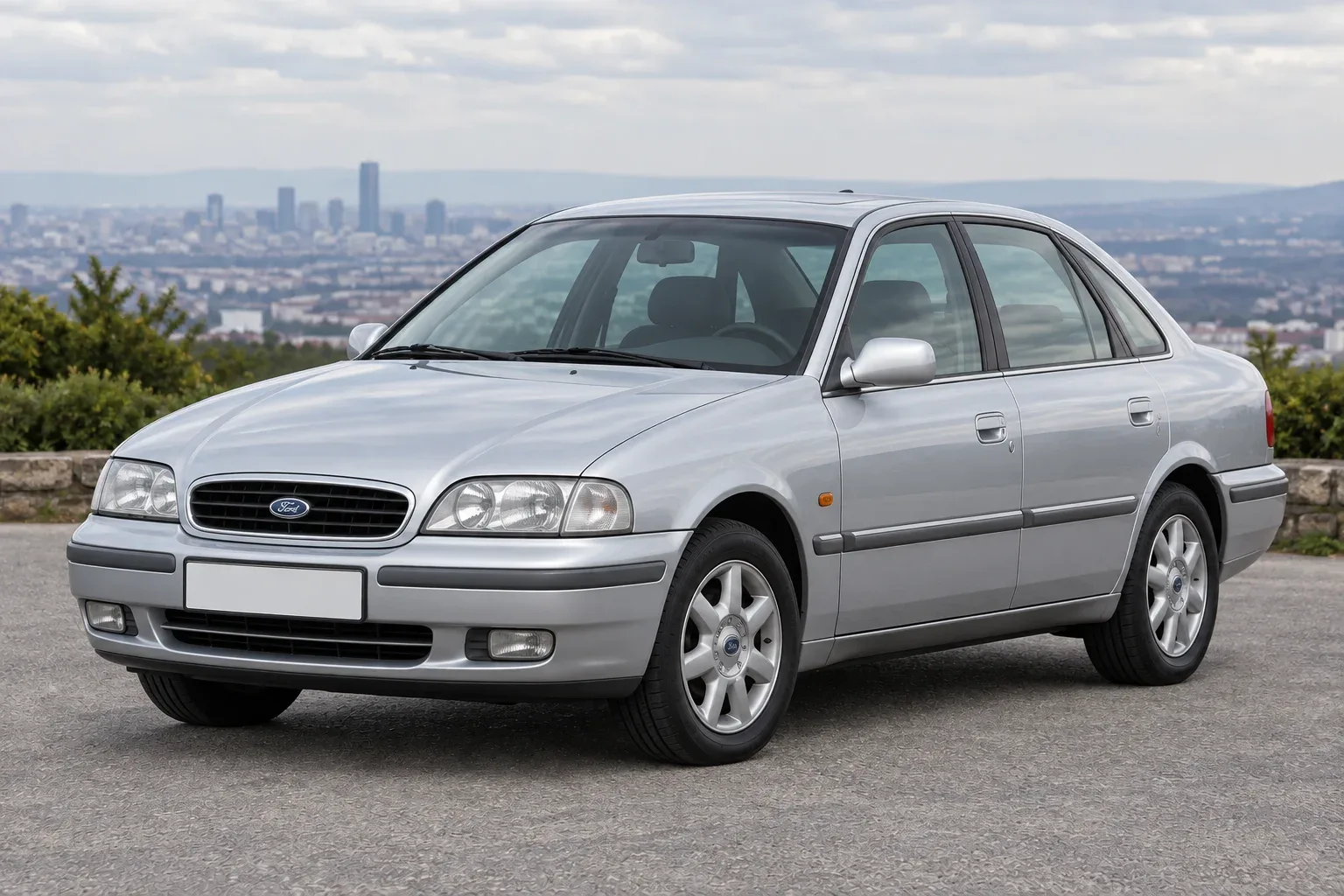
Ford Scorpio 2
Valuation of the Ford Scorpio 2 (1994–1998): condition, paperwork, inspection and terms of sale.
Indicative purchase price
Below market value
Final price agreed after inspection.
Value my car1Why buyers choose this model
In the eighties, European Ford had a lot of good things. He slowly but surely distanced himself from American influence and boldly embraced innovation.
2What buyers check
Review
In the eighties, European Ford had a lot of good things. He slowly but surely distanced himself from American influence and boldly embraced innovation. The culmination was the flagship Ford Scorpio, which debuted in 1985. By the time of the release of the second generation Scorpio, the equally popular Sierra gave way to the front-wheel drive Mondeo. The second Scorpio remained true to the classic drive-back circuit. To install front-wheel drive would have to develop a completely new platform. As an alternative, the option of refining the Mondeo platform was considered. But Ford didn’t make the best decision. For another Scorpio took the current platform, slightly modified it, and a new car. The all-wheel drive version has been removed from the list of offers. Similarity with the first generation is given by the shape of the arches of the front wheels, longitudinal elements in the engine compartment and body racks. As the requirements for the protection of passengers became stricter, the power structure of the body had to be strengthened. This is the most obvious work on the front doors. They've become noticeably heavier. But most of all, the model’s fans were shocked by the design. Reasonable confusion caused the front and rear of the car. The convex headlights, for which Scorpio earned the nickname “clown”, looked as unusual as the taillights, which are a solid strip directly above the bumper. It all looked too American. There's a lot of room in the cabin. Perhaps even more than in elongated premium limousines. And these aren't seats, they're real chairs.
Walking
The Scorpio is set for comfort. The car is just floating on irregularities. On the front axle of the first generation of the machine were installed simple or real Macpherson racks. That is, the wheel in the transverse direction was aligned with an unpretentious lever connected to the transverse stability stabilizer. The new generation has got more familiar triangular levers. It is worth noting that their rear support is a rod that is inserted into the Silentblock. Now the wheel was directed more precisely, not to mention a significant increase in the life of the suspension. The Scorpio levers were extremely strong. No stamping of sheet metal, as in modern cars, only honest ebb. Today, the front levers are supplied, including the Chinese. But such a product is better to avoid, because these levers are not of the best quality. Much better than the analogues from SRLine. They can be purchased for 7-8 thousand rubles. The biggest problem is with front shock absorbers, which are hard to find. The front brake discs are identical to those used in the first Mondeo with a 2.5-liter petrol V6. It seems that Ford was trying to unify conceptually similar models. There's less innovation on the back axis. As before, triangular oblique levers and a curved beam were installed. The rear axle levers differed depending on the body. The differences were in the places of attachment of shock absorbers and springs. Today, the rear levers are no longer available, you can only buy silenblocks. Shock absorbers can only be bought on a sedan.
Engines
Until 1996, the demand for four-cylinder gasoline engines was satisfied by a pair of 2-liter atmospheric units. The one that is weaker, with a capacity of 115 hp was borrowed from its predecessor. He made his debut back in 1989. Despite the two camshafts, it had 8 valves. Its 16-valve version developed 136 hp. Ford Scorpio 2, in comparison with its predecessor, slightly added weight. If in the previous edition 8-valve 2.0 had good dynamics, then here he had a hard time. Unfortunately, the 16-valve version did not solve the problem. One could even say that the situation was getting worse with him, as he lacked traction at low revs. The worst thing that could have been a combination of a prehistoric 4-speed machine. The most efficient engine in terms of driving and reliability was introduced in 1996. It was a 16-valve four-cylinder unit with a volume of 2.3 liters. It replaced the 16-valve 2.0 and its potential was much better. While the 2-liter engine was “square”, i.e. the stroke of the piston was equal to the diameter and was 86 mm, then in 2. 3 the piston had a diameter of 89.6 mm, and the stroke was 91 mm. 12-valve V6 volume of 2.9 liters Cologne is a six-cylinder dinosaur native to the 60s. This V6 managed to visit under the hood of Capri, Granada, Sierra and the first Scorpio. With the OHV gas distribution system (one camshaft) and a capacity of 145 hp, there could be no question of sports. However, the engine was not bad and could cover hundreds of thousands of kilometers without major repairs. Unlike the modern V6, it was offered with an ICPP.
Transmission
The engines were combined with a 5-speed manual transmission MT75, as well as with the archaic 4-speed automatic A4LDE (except for the 8-valve 2.0).
The machine is built on the basis of the old hydraulic box A4LD, which was created in the early 80s. The “E” index indicates the presence of electronic control using solenoids, of which there are a total of 6. The main disadvantages of this box are both mechanics and electronics. Here very often worn brake tapes - the machine towed or jerked when switching. Given that the control unit box is very stingy on information and has almost no diagnostic options, to search for the causes of malfunctions automatic transmission always have to disassemble. Fortunately, almost all of the spare parts are still available today.
The oil in the automatic transmission should be changed every 30-40 thousand km. In addition, it is necessary to regularly clean the oil radiator from dirt and down.
Owners' nightmare
If you ask Scorpio owners what problems they face today, you will most often hear mentions of corrosion and electricians.
Also, finding spare parts for the second generation model is quite difficult. It is also difficult to find a car in the secondary market. Copies on the go are offered for 60-70 thousand rubles, and the most well-groomed samples are estimated by the owners at 200 000 rubles.
Corrosion
The old Fords had mediocre corrosion protection. Scorpio was no exception. Rust usually attacks the rear wings first. Finding a sample that has no red spots is almost superhuman. Even well-preserved specimens are affected by the brown plague.
Thresholds are also susceptible to corrosion. In addition, corrodes the beams under the floor at the back and the floor amplifier at the point of attachment of the front seats rails. Brown plague and the doors in the welded seams area. The first generation didn't rot so much.
Electrician.
The second problem concerns electrics, and it affected, first of all, pre-reform machines. At the end of 1997, the situation changed radically. Until then, Siemens wiring was installed, the insulation of which was very often cracked. This led to short circuits, and electrical equipment literally lived its life. Today, the replacement of the wire harness for a new one can not be considered. You need to be a careful and patient electrician. The second reason for failures in the electrician is the ingress of moisture into the fuse block and relay. In all versions, they are located in the engine compartment. In the top versions there is another block of fuses located in the cabin. It houses fuses and relays of automatic dual-zone air conditioner, Servotronic power steering, windshield heating, electric drive and front seat heating. Sometimes the immobilizer relay installed in the dashboard also fails. It can be simply removed and replaced. Some manufacturers by the mid-90s began to switch to multiplex distribution networks. For example, PSA did this in 1994 when it upgraded the Citroen XM and Peugeot 605 with top-end 6-cylinder engines, which led to improved control reliability. The electrical network in Scorpio 2 is unique. Ford only made half the way to Scorpio. Multiplex distribution network, the so-called Multiplex, which includes a special SSM unit, is connected to the third block of fuses of top versions.
Model history
1994 - presentation. Gasoline engines: 2.0 8V and 16V, V6 2.9 12V Cologne and 24V Cosworth. Diesel engines VM Motori 2.5 TCI with a capacity of 115 hp and TDI 125 hp
1996 – The 16-valve 2.0 was replaced by 2.3 16V. Production of the 2.9 V6 12V has ceased.
1997 - restyling. The grille, hood and bumper have changed. The headlights got blacked out. For the first time, xenon headlights and side airbags were offered. The back and lights were slightly retouched. Quality and reliability have improved significantly, especially for electricians.
1998: The end of the proceedings without a successor. A total of 98,587 cars were sold, of which about 6000 are restyled.
Specifications of the Ford Scorpio 2.9 24V Cosworth
Engine - six-cylinder gasoline (cylinder collapse 60 degrees)
Maximum power - 207 hp at 6000 rpm
Torque - 281 Nm / min at 4200 rpm
Dimensions (length x width x height) - 4845 x 1760 x 1400 mm
3Pre-purchase checklist
Walking
- The biggest problem is with front shock absorbers, which are hard to find.
Engines
- Unfortunately, the 16-valve version did not solve the problem.
- It was a 16-valve four-cylinder unit with a volume of 2.3 liters. It replaced the 16-valve 2.0 and its potential was much better.
- However, the engine was not bad and could cover hundreds of thousands of kilometers without major repairs.
- The block head resisted wear poorly.
- In addition, wet shells eventually lowered, which led to the loss of coolant.
- As for the problems, in the best years they have been mainly about the catalyst.
- It happened that the ceramic filler was destroyed, which was accompanied by noise and sometimes a drop in dynamics.
Transmission
- Given that the control unit box is very stingy on information and has almost no diagnostic options, to search for the causes of malfunctions automatic transmission always have to disassemble.
- The oil in the automatic transmission should be changed every 30-40 thousand km.
- In addition, it is necessary to regularly clean the oil radiator from dirt and down.
Owners' nightmare
- If you ask Scorpio owners what problems they face today, you will most often hear mentions of corrosion and electricians.
Corrosion
- The old Fords had mediocre corrosion protection. Scorpio was no exception.
- Rust usually attacks the rear wings first.
- Brown plague and the doors in the welded seams area. The first generation didn't rot so much.
Electrician.
- The second problem concerns electrics, and it affected, first of all, pre-reform machines.
- Sometimes the immobilizer relay installed in the dashboard also fails. It can be simply removed and replaced.
4Challenges of selling privately
- In the eighties, European Ford had a lot of good things.
- Driving: The biggest problem is with front shock absorbers, which are hard to find.
- Engines: Unfortunately, the 16-valve version didn't solve the problem.
- Transmission: Given that the control unit box is very stingy on information and has almost no diagnostic options, then to search for the causes of malfunctions automatic transmission always have to disassemble.
- Owner’s Nightmare: If you ask Scorpio owners today what problems they face, you’ll hear references to corrosion and electricians.
- Corrosion: The old Fords had mediocre corrosion protection. Scorpio was no exception.
- Electricity: The second problem concerns electrics, and it affected, first of all, pre-reform machines.
- History of the model: 1994 - presentation. Gasoline engines: 2.0 8V and 16V, V6 2.9 12V Cologne and 24V Cosworth. Diesel engines VM Motori 2. 5 TCI with a capacity of 115 hp and TDI 125 hp 1996 - replaced by 16-valve 2.0 came 2. 3 16V. Production of 2.9 V6 12V was discontinued. 1997 – restyling.
Shows, bargaining and re-registration take time: buyers look, promise to think and disappear. Fair price after inspection closes the auction on the spot. If money is needed urgently, the purchase takes away waiting and repeat displays.
5How selling to us works
Leave a request with the car data. We will discuss the preliminary assessment and inspection. After checking the status and documents, we agree on the final price and terms of the transaction.