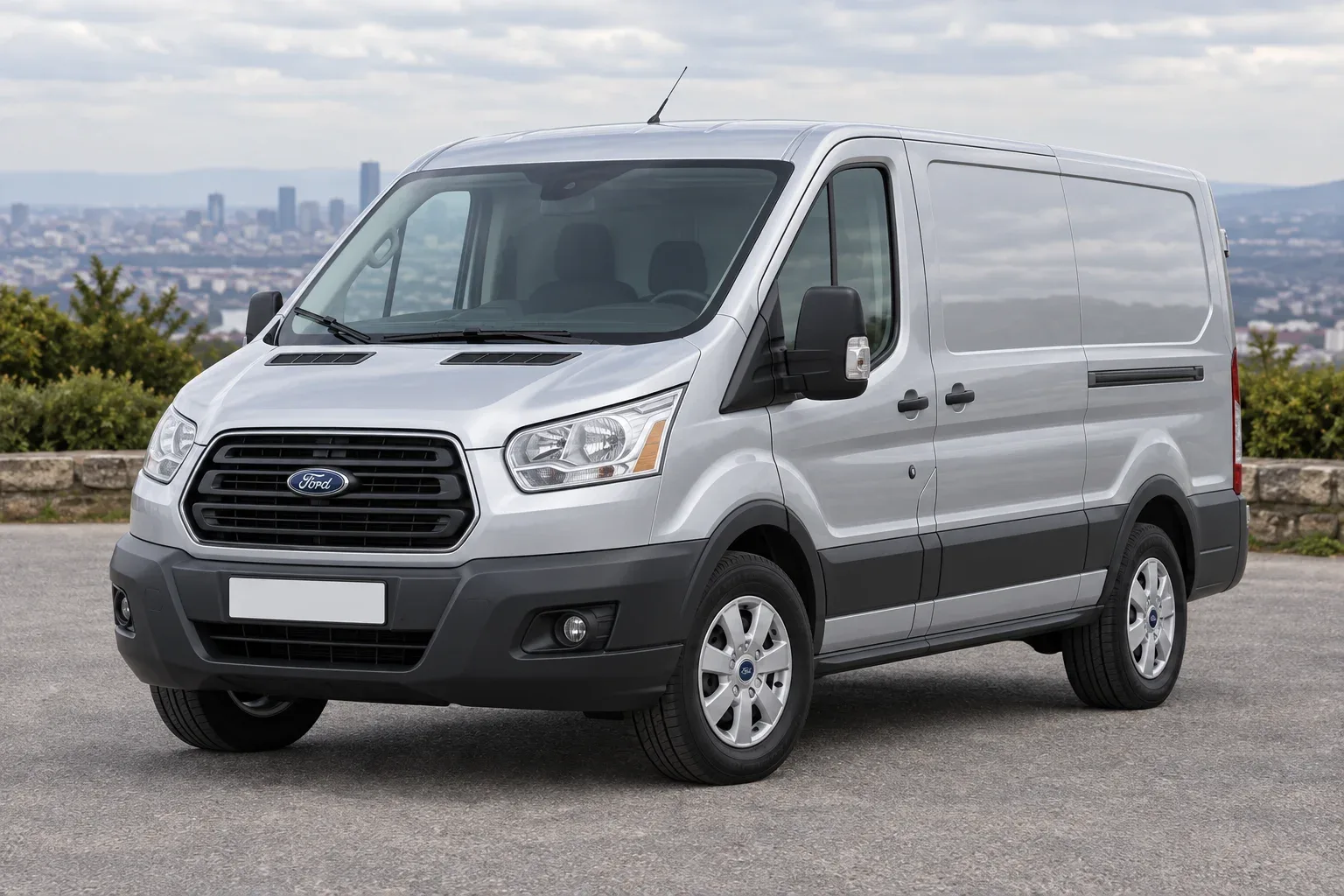
Ford Transit
Valuation of the Ford Transit (2012–2020): condition, paperwork, inspection and terms of sale.
Indicative purchase price
Below market value
Final price agreed after inspection.
Value my car1Why buyers choose this model
Over the past 15 years, large seven-seat MPVs have virtually disappeared from the passenger car market. In Europe, you can no longer buy a Peugeot 807, Fiat Ulysse, Mazda MPV or Toyota Previa. Renault Espace is a cross between the VW Sharan and the Ford Galaxy. Thus, the attention of large families and practical people is focused on passenger versions of small vans. The most famous is the Volkswagen Transporter, especially the passenger versions of the Caravelle and Multivan. They are good to manage and very practical, but at the same time expensive and expensive in the subsequent maintenance. The same can be said for the Mercedes V-Class (formerly Viano). Ford Custom was introduced in the passenger version of the Tourneo and the cargo Transit back in 2012. The oldest used copies are more than 10 years old, and prices for them are already falling below 1.5 million rubles.
2What buyers check
Design features
Buyers will have to accept that compared to VW Transporter/Multivan, these were obviously simpler cars. Instead of a rear independent suspension with springs, the classic vans are used here - a rigid beam with leaf springs. In the model range there is no all-wheel drive version, and such a familiar thing as an automatic transmission appeared only in 2017. On highways and on good roads, the Ford Custom is no worse than the Transporter or the Multiven. It is well soundproofed, and thanks to long gears of the manual transmission comfortably copes with the maximum permitted by law. At a speed of 130 km / h, even the weakest 100-horsepower version of the diesel engine spins up to only 2250 rpm. With precise steering and efficient brakes, Ford is steering confidently and drivers mostly praise him. The situation is worse on rough roads. The rigid rear axle on rigid cargo tires bounces on the road, and in a large interior space, even minor tremors are perceived by ear as blows. In the cars that traveled, the situation is aggravated by the creaking of seat mounting points, hinges of side sliding doors and the bulky rear door. So you feel like you're in a van on the ride. Optional air suspension solves this problem, but in this case, the installation of a farcope is not possible.
Puma - 2.2 TDCi (R4/16V; 100, 125 or 155 hp) 2012 - 2016
Ford Puma engines are very durable, and thanks to the fifth injector in the exhaust, they easily burn through the particulate filter. Often there is a basic version of 100 hp. The only difference between the 100-strong version and the more powerful ones is the turbocharger, clutch and flywheel are the same.
Panther - 2.0 EcoBlue (R4/16V; 105, 130, 170 or 185 hp) since 2016.
Panther’s range meets Euro 6 emission standards. Despite the small working volume thanks to modern technologies, new engines have higher performance.
Versions of different power no longer differ from each other even in turbocharging. So 105 hp is just a fine for those who didn't want to pay more.
As standard, these engines are equipped with the AdBlue system, but are deprived of a fifth injector in the exhaust. After a series of incomplete regenerations, the oil will be diluted with diesel fuel. After buying a used car, be sure to manually start the regeneration, so you can control the level of filter filling and avoid repeated attempts to burn during short trips.
It is too early to make a final verdict on engine reliability. Often fail nozzles of innovative design (36 000 rubles). Buyers of used cars will not go wrong if they prefer an older engine.
Malfunctions and problems
Power steering pipeline leak: usually the result of mechanical damage. It's 15,000 rubles.
Faulty diesel evaporator (nozzle) in exhaust manifold: it facilitates the burning of the particulate filter in Euro 5 engines. The nozzle can fail after 250,000 km. The new original detail costs 68 000 rubles, the analogue - from 14 000 rubles.
Premature oil change in 2.0 EcoBlue: In cars of 2016-2017 there was an error in the algorithm for assessing the dilution of oil with diesel fuel. It was decided by updating the software.
Diesel Dilution 2.0 EcoBlue: Euro 6 engines have lost a fifth injector, and frequent attempts to burn the particulate filter lead to dilution of the oil with diesel fuel.
Twitching and failure of cylinders in the 2.0 EcoBlue engine: this uses the new generation of the Continental injection system, which sometimes fails. Usually there are nozzle failures.
Breakdown of the cylinder head (2.0 EcoBlue): in the engines of 2016-2018 of release, operated at high loads, there is a pulling of the bolts of the cylinder head and, as a result, the gasket failure.
Service recommendations
The manufacturer’s recommended service interval for oil replacement is 50,000 km or two years, whichever comes first. Perhaps, it is not necessary to explain that this is dictated not so much by the durability of the engine, as by the reduction in the expected maintenance costs, which are requested by large customers. Therefore, responsible people change oil more often, even though the engine (2.0 EcoBlue) is filled with 9.8 liters of oil.
You should always use the oils of the prescribed specification, especially in the new 2.0 EcoBlue. If you pour oil that does not match the Ford WSS-M2C950-A, the belt will spoil. He's bathing in oil here. On the other hand, with the right oil, the belt will easily last the required 240,000 km.
The 12-volt battery is stored under the driver's seat. When replacing it, you should not try to “pick” it from behind. You need to unscrew four screws and remove the seat entirely. The seat belt does not need to be removed, it is long enough that the seat can be near the car.
Pluses
Reliable mechanical part Absolutely trouble-free 2.2 TDCi engine (2012-2016) Six to nine full-size seats Long gears suitable for motorway (except automatic) Profitable prices and growing range of used cars
Cons
No all-wheel drive version Low mass trailer with brakes (especially up to 10/2013) Short gear automatic transmission (already 2650 rpm at 130 km / h) Noise and vibrations from the rear axle Poorer interior variability compared to the VW Multivan - no system of floor rails
Model history
2012: Presentation of the model. Comfortable passenger version of the Tourneo Custom (8 seats), commercial - Transit Custom in the Van (2 or 3 seats), Estate Van (5 or 6 seats) and Estate Van (8 or 9 seats). Two wheelbases L1 and L2. 2.2 TDCi engines, only paired with a six-speed manual transmission.
2013: the maximum permissible mass of the trailer with brakes is increased.
2014: shortened from 1st to 3rd gear for versions with the stop-start system.
2016: introduction of new 2.0 EcoBlue engines with 105, 130 and 170 hp Compliance with Euro 6 standard with AdBlue
2017: For the first time, a 6-speed, hydrodynamic, Ford own-designed automatic was introduced.
2018: Model updates, new assistance systems
2019: new top version 2.0 EcoBlue/185 hp
2020: unique plug-in hybrid with 1.0 EcoBoost engine with 126 hp
Competitors
Renault Trafic (since 2014) The third generation Trafic was introduced in 2014 with a diesel 1.6 under the hood, with the top-end dual-turbocharged unit delivering up to 145 hp and 340 Nm. Even it lacks a bit of torque when the car is fully loaded. The best choice in terms of dynamics and reliability are the two-liter units presented in the restyled version of 2019.
Mercedes-Benz V-Class (since 2014): The fourth generation of the small utility car Mercedes received a unique combination of front or rear wheel drive for its class. Front-wheel drive versions were equipped with Renault engines of 1.6 liters with a capacity of 88 or 114 hp, rear-wheel drive - 2.2-liter four-cylinder engine Mercedes-Benz.
Main technical characteristics
Engine: turbocharged four-cylinder diesel. Displacement: 2198 cm3. Maximum power: 100 hp at 3500 rpm. Maximum torque: 310 Nm at 1300 rpm. Transmission: 6-speed manual. Luggage capacity: 280–2560 litres. Wheelbase: 2933 mm. Dimensions: 4973 x 2272 x 1959 mm. Top speed: 147 km/h*. Acceleration from 0 to 100 km/h: 17.2 seconds. Average fuel consumption: 6.4 l/100 km. *Even the 155 hp 2.2 TDCi is not much faster. Its top speed is electronically limited to 164 km/h because of tyre loading. Versions with the EcoBlue engine, available from 2016, can reach only 180 km/h.
3Pre-purchase checklist
Design features
- Optional air suspension solves this problem, but in this case, the installation of a farcope is not possible.
- Sometimes one curious malfunction is found - a damaged pipeline of the power steering.
- We have heard hundreds of times from the representatives of the brand at the presentation of the next new model about significantly improved corrosion protection.
Malfunctions and problems
- Power steering pipeline leak: usually the result of mechanical damage. It's 15,000 rubles.
- Premature oil change at 2.
- Twitches and failures of cylinders in the engine 2.
- 0 EcoBlue: This uses a new generation of Continental injection system, which sometimes fails. Usually there are nozzle failures.
Service recommendations
- The manufacturer’s recommended service interval for oil replacement is 50,000 km or two years, whichever comes first.
- You should always use the oils of the prescribed specification, especially in the new 2.0 EcoBlue.
- You need to unscrew four screws and remove the seat entirely.
Pluses
- Reliable mechanical part Absolutely fault-free engine 2.
4Challenges of selling privately
Since its introduction, the new generation of Transit and Tourneo has been buoyant with hopes that a solid alternative to the reigning Volkswagen T5 is finally coming. A decent and practical car with a more affordable price, it remains so today. The cheapest Tourneo Custom can be bought for about 1,500,000 rubles. Decent copies usually cost at least 500 thousand more. But it is still noticeably less than in the case of competing VW Caravelle, which at a comparable age and mileage costs at least 300 000 rubles more. However, unlike Volkswagen, the interior of Ford looks much cheaper, there is no option of all-wheel drive, and automatic transmission appeared not immediately. However, it is a very tempting choice among used passenger vans. After all, families with many children are left with fewer models to choose from due to the shrinking supply in the large MPV segment.
- Design features: Optional air rear suspension solves this problem, but in this case, the installation of a farcop is not possible.
- Faults and problems: Power steering pipeline leak: usually the result of mechanical damage. It's 15,000 rubles.
- Maintenance recommendations: The manufacturer's recommended service interval for oil replacement is 50,000 km or two years, whichever comes first.
- Pros: Reliable mechanical part Absolutely fault-free engine 2.
- Cons: No all-wheel drive version Low mass trailer with brakes (especially up to 10/2013) Short gear automatic transmission (already 2650 rpm at 130 km / h) Noise and vibrations from the rear axle Poorer interior variability compared to the VW Multivan - no system of floor rails
- The history of the model: 2012: presentation of the model.
- Competitors: Renault Trafic (since 2014)
- Main technical characteristics: Engine - turbocharged diesel four-cylinder Working volume - 2198 cm3 Maximum power - 100 hp.
Shows, bargaining and re-registration take time: buyers look, promise to think and disappear. Fair price after inspection closes the auction on the spot. If money is needed urgently, the purchase takes away waiting and repeat displays.
5How selling to us works
Leave a request with the car data. We will discuss the preliminary assessment and inspection. After checking the status and documents, we agree on the final price and terms of the transaction.