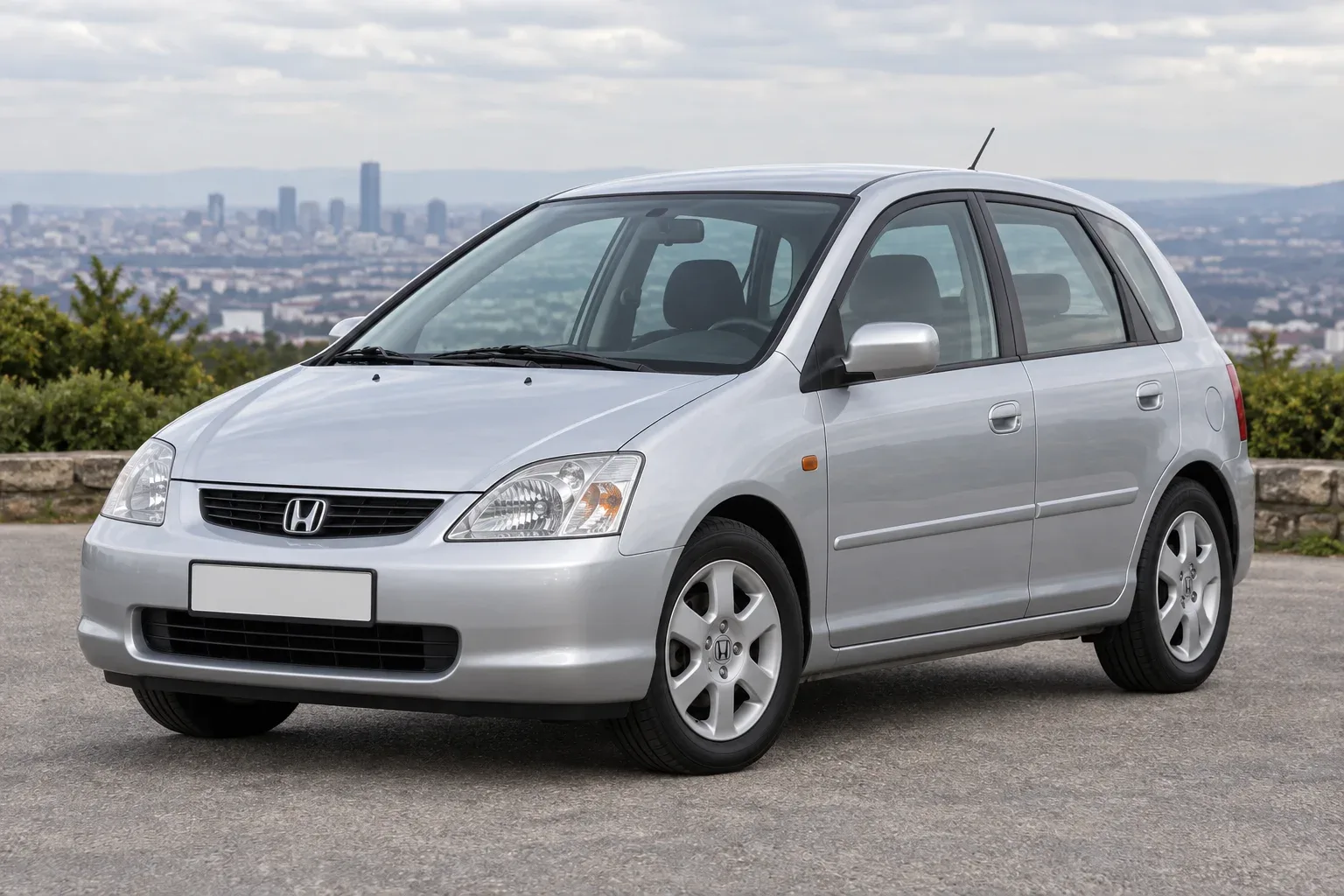
Honda Civic 7
Valuation of the Honda Civic 7 (2000–2006): condition, paperwork, inspection and terms of sale.
Indicative purchase price
Below market value
Final price agreed after inspection.
Value my car1Why buyers choose this model
The seventh generation Honda Civic was released in 2000. Compact hatchback, reminiscent of a minivan, greatly surprised Honda fans.
2What buyers check
Review
The seventh generation Honda Civic was released in 2000. Compact hatchback, reminiscent of a minivan, greatly surprised Honda fans. The traditional Civic always had a low sports silhouette, which made it a favorite of young drivers. The new one was boring and dull. In parallel, a sedan and a coupe were assembled, which had a more interesting appearance. Despite the different design, the filling of all the “designs” is identical. For example, the front panel of the hatchback and the sedan are interchangeable.
Two years later (in 2002) the 1.7 i-CDTi turbo diesel appeared in the engine line.
In 2003, under the hood of the model debuted 160-horsepower gasoline engine V-TEC.
A year later (in 2004) the car underwent a major facelift, and its production ended in 2005, when the next-generation Civic replaced it. This time, Honda made the right conclusions.
Engines
R4 1.3 VTEC (85 hp + 20 hp) - Hybrid version for Europe
All gasoline engines are worth the recommendations. None of these poses any serious problems (even 200-horsepower), provided that the oil is changed in a timely manner and the valve gap is adjusted every 40,000 km.
With large runs, gasoline units begin to consume oil.
Gasoline engines have a temporary type of valve timing drive, except for a 2-liter chain-driven valve timing.
The I-CDTi diesel is created by Isuzu and does not apply to excessively emergency. The engine received good reviews from the owners. Due to the lack of a particulate filter and a two-mass flywheel, it is one of the cheapest turbodiesels to operate. Its only serious drawback is the low resource of the turbocharger. To compensate for the inconvenience of the owners, the manufacturer extended the warranty for this unit to 6 years or 150,000 km (but only under the condition of service in official service).
Design features
The advantages of the seventh generation model are discovered after the occupation of the cabin. The car is very spacious and functional, especially the hatchback. Three adults will sit quietly on the back sofa, thanks to the lack of a tunnel on the floor. The trunk is 370 liters.
The driver’s workplace is ergonomic. The driving position, although not sporty, is very convenient for long routes.
On the front axle of the Civic run Mcpherson racks, and the rear – multi-peer scheme.
The rear wheels received drum brakes, and the steering - an electric amplifier. The diesel version uses a hydraulic amplifier.
Typical malfunctions
The most unreliable element of the seventh Civic is the transmission. Bearings wear out quickly. Symptoms: noise when switching and unpleasant howling. The problem affects cars with gasoline engines with a working volume of 1.4 and 1.6 liters. The box does not like when the driver in order to save or out of habit uses gears with a small gear ratio at low speeds. For example, moves on the "fifth" with revolutions in the range of 1500-2000 rpm. In this mode, vibrations occur, which lead to wear of the main shaft bearings. Removal of the box is required for repair, which increases costs. Another weakness is the steering rack, in which backlash appears over time. Signs of such a malfunction: loud clicks in the area of the front suspension. Due to the wear of the steering mechanism, vibrations may also appear during braking - provided that the brake discs are new and of good quality. Over time, the electric motor of the amplifier fails. The chassis components of many Japanese cars are considered practically non-killable. But this stereotype did not apply to the compact Honda. Why? Quite quickly, shock absorbers wore out - noticeable traces of leakage appeared on the body. The defect manifested itself before reaching 100,000 km of run. Over time, the manufacturer has eliminated the vulnerability. The front stabilizer rubber bands are not classified as durable. On the rear axle, a multi-link suspension is used, which requires periodic adjustment of the convergence angles. The paintwork of the body is quite delicate and thin.
3Pre-purchase checklist
Engines
- None of these poses any serious problems (even 200-horsepower), provided that the oil is changed in a timely manner and the valve gap is adjusted every 40,000 km.
Typical malfunctions
- The problem affects cars with gasoline engines with a working volume of 1.4 and 1.6 liters.
- In this mode, vibrations occur, which lead to wear of the main shaft bearings.
- Removal of the box is required for repair, which increases costs.
- Another weakness is the steering rack, in which backlash appears over time.
- Signs of such a malfunction: loud clicks in the area of the front suspension.
- Due to the wear of the steering mechanism, vibrations may also appear during braking - provided that the brake discs are new and of good quality.
- Over time, the electric motor of the amplifier fails.
- Corrosion protection is not exemplary either.
4Challenges of selling privately
Summing up, I want to note that the Honda Civic VII is one of the least problematic compacts. Fans of fast driving should pay attention to the version of the Type-R, which will certainly introduce many drivers to the euphoria.
- The seventh generation Honda Civic was released in 2000.
- Engines: None of them poses any serious problems (even 200 hp), provided that the oil is changed in a timely manner and the valve gap is adjusted every 40,000 km.
- Structural features: The advantages of the seventh generation model are discovered after the occupation of the cabin.
- Typical malfunctions: The problem affects cars with gasoline engines with a working volume of 1.4 and 1.6 liters.
Shows, bargaining and re-registration take time: buyers look, promise to think and disappear. Fair price after inspection closes the auction on the spot. If money is needed urgently, the purchase takes away waiting and repeat displays.
5How selling to us works
Leave a request with the car data. We will discuss the preliminary assessment and inspection. After checking the status and documents, we agree on the final price and terms of the transaction.