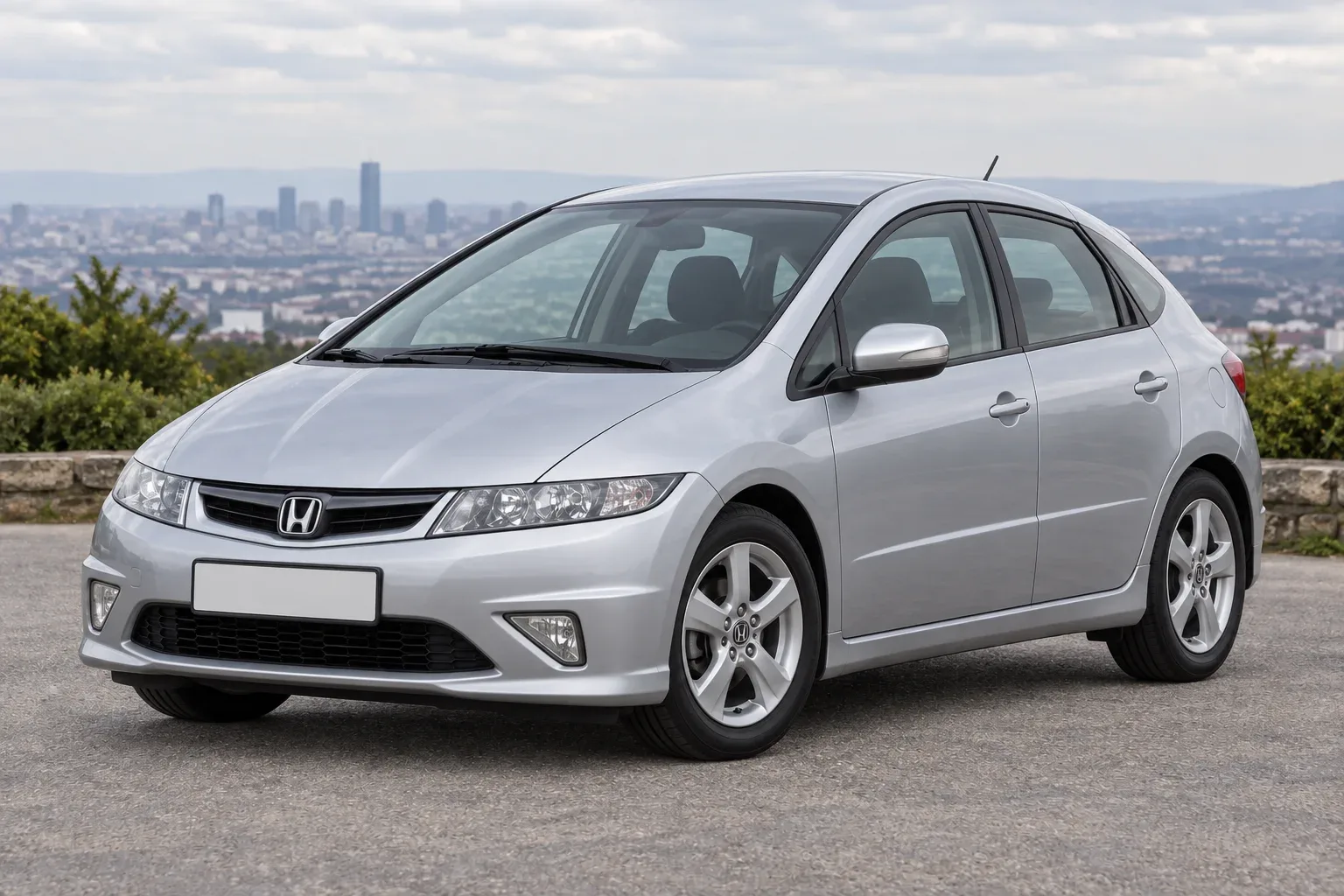
Honda Civic 8
Valuation of the Honda Civic 8 (2006–2011): condition, paperwork, inspection and terms of sale.
Indicative purchase price
Below market value
Final price agreed after inspection.
Value my car1Why buyers choose this model
The design of the compact Honda is not very shocking, and even pleasing to the eye. But until a certain time, it was different. The Civic VII (2001-2006) came under fire from even the most avid fans of the Japanese auto industry. The company decided to correct the mistake. In 2005, she presented the eighth-generation Civic prototype in Geneva. The car’s body was lined with bold lines. Many doubted that the futuristic prototype in unchanged form will reach the conveyor. However, Honda kept its promise. In 2006, she proposed a car that in Europe immediately received the nickname UFO (UFO). For the conservative part of the clientele, a less extravagant sedan was prepared. A few months later, the model range was replenished with a three-door Civic Type S with a stiffer suspension and an increased rear wheel track. In 2007, the 201-horsepower Civic Type R was introduced with rigid suspension, seats with developed support and a high-speed engine - an ideal choice for motorsport fans. They should especially like the limited version of Championship White with mechanical differential locking. The stylistic scope was not limited to the body. The designers’ fantasy also touched the interior. A large number of daring lines are present on the front panel and center console. Futuristic Honda Civic is different from the classic minicars. But not everything is perfect. Plastic elements of the interior finish creak on irregularities, and through the rear window little that is visible, especially in the rain (due to the lack of a wiper). It takes a while for the driver to get used to a specific workplace. To start the engine, you need not only to turn the key in the ignition lock, but also press the start button - an extra set of operations. Fortunately, these are some of the few drawbacks of the eighth Civic. In 2009, the hatchback underwent restyling. The most significant changes have been made to the front. Instead of a strip of transparent plastic on the grille was installed cladding with additional air intakes. Honda has improved the quality of the assembly and expanded the list of equipment.
2What buyers check
Design features
The team that worked on the Honda Civic 8 chassis made every effort to ensure that the driver would enjoy driving. The steering is accurate and responsive, and the tight suspension allows you to actively take turns. For those who prefer comfort, it is better to use 16-inch wheels. Larger wheels increase the number of tremors penetrating the cabin.
When designing the hatchback Honda decided to abandon the independent rear suspension in favor of a torsion beam. A simpler design less effectively absorbs irregularities and is less suitable for driving at the limit of wheel adhesion to the road. However, this scheme is more reliable and durable, cheaper to operate and helps to free up additional space for the trunk. 456 liters with the possibility of increasing to 1,352 liters – the result is unattainable for most recent compacts.
It's not all Sivik's cards. The system "Magic Seats" expands the practical capabilities of the cabin. The back seat can be lifted upright. As a result, an additional space is formed in which you can transport tall objects, for example, a bicycle or plant seedlings to the country.
In an effort to improve the functionality of the car, the designers were forced to place the fuel tank under the front seats. This inevitably led to an increase in landing height. Save a large range of adjustments to the position of the seats and steering wheel.
The Honda Civic VIII has a very spacious interior. Between the axes of 2.7 meters – so that the space for the legs is generally enough. The situation is worse with the reserve of space overhead. The second row will not be comfortable.
Engines
The engine range is modest, but at the same time allows you to choose the optimal version for yourself. Gasoline – 1. 4 i-DSI (83 and 99 hp), 1. 8 i-VTEC (140 hp), 2. 0 i-VTEC (201 hp). Turbodiesel one - 2. 2 i-CDTi (140 hp). There was also a hybrid version - 1. 3 i-DSI IMA (95 hp) with a CVT. The base 1.3-liter petrol engine (offered under the brand name 1.4) is more suitable for drivers with a calm temperament. the 83-horsepower Siwick with a 1.4 i-DSI accelerates to 100 km / h in almost 15 seconds. A good performance/economics ratio has the engine 1.8 i-VTEC. The version with this engine differs in two exhaust pipes. In weaker modifications, plastic plugs are installed instead of pipes. Engines 1. 4 were two. Until 2009, the 8-valve version with the unique i-DSI ignition was installed - two candles per cylinder. Candles, depending on the conditions, work sequentially or simultaneously. This unit with the designation L13A7 is known for the first generation Honda Jazz. Problems with the EGR valve, known for Jazz, did not arise here. The upgraded 1.4 L13Z1 is the best choice. It has already received 16 valves and conventional ignition with the i-VTEC system. The engine is a little more buoyant, but still weak for Sivik. 1.8 i-VTEC - received the most widespread. The R (R18A2) engine is quite reliable. Among the problems, we can mention interruptions in work and difficult start-up. The reason is low fuel pressure due to fuel pump failure or reduced efficiency. The culprit is corrosion of the terminal pad of the power supply unit.
Transmission
Honda could not please fans of automatic transmissions. The i-Shift automatic transmission provided for the hatchback works slowly and does not always select the optimal gears, which is annoying when trying to accelerate sharply.
In early 2009, the 5-door Civic received a classic 5-speed automatic, which was previously only available in the sedan. The hardware adjustments bypassed the 3-door Civic Type S, which remained with the i-Shift box.
The alternative automated i-Shift gearbox is best avoided, although the box itself is quite reliable. Just replacing the clutch will be a rather different procedure. It is necessary to train the control mechanism that combines the electric motor with hydraulic threshold control.
For many years, one of the weaknesses of Sivik is the manual transmission. Moving at too low revs kills the box bearings. Fast switching and careless operation of the clutch pedal annoy the synchronizers. Especially suffers the second transmission - there are difficulties with its inclusion. In addition, the return spring of the clutch pedal may break.
Walking
The chassis is well transported by Russian roads. On some instances, the front suspension taps, which is very annoying, but this does not affect safety. Others have to face the car pulling to the right. Official services unsuccessfully change the elements of the chassis and expose the geometry of the wheels. But this does not lead to noticeable improvements. Front shock absorbers can withstand a little more than 45-60 thousand km. There are knocks and the behavior of the car deteriorates. Unfortunately, shock absorbers have been a weakness of European Hondas for more than 10 years. Faulty shock absorbers accelerate wear of supporting bearings: outstanding shocks have to be taken on. Therefore, mechanics advise to change the faulty racks immediately with bearings, since the latter, most likely, is already running out, and re-repair is not far off. Due to faulty shock absorbers, the steering mechanism can also be knocked. Steering thrusts also take some of the outstanding impact energy, which leads to damage to the Teflon guide bushings inside the steering rack. Thus, faulty shock absorbers are able to pull a fairly long chain behind them. After 45-60 thousand km, the brakes often begin to creak. Both pads and discs must be replaced. Brake discs are worn too quickly, there is an edge that rubs against the metal part of the pad, which is why there is an acoustic effect. Rare trips lead to acidification of the rear brake mechanisms. Sometimes the electromechanical power steering was also failed. Cars produced before 2006 were at risk of failure. The control unit was to blame.
Bodywork
Sometimes water enters the trunk through the seals of the lid. Traces of corrosion can be found on the elements of the chassis, rear door and bottom. These are individual foci that do not have a high speed of spread and do not give cause for concern. But if you plan to operate the car for a very long time, then you need to think about additional corrosion protection.
A serious disadvantage of this model is also considered paint coating, which quickly overgrown chips and small scratches. Chipped chips most often appear on the hood and wings behind the wheels.
Other problems and malfunctions
Owners usually point to the following shortcomings: creaking of the plastic of the cabin, rubbing the velour upholstery of the seats, clutch pedal creaking, failures in the operation of the central lock and dashboard glitches. Electrical problems are often associated with poor mass contact. Honda likes the "good mass."
Under the futuristic body hides a relatively simple mechanics, which facilitates repair. Most parts and supplies have good substitutes. However, they are not always available, and many details are too expensive.
Reliability ratings
Sivik’s reliability was highly appreciated by DEKRA. The number of faults detected has never been higher than the average. The level of reliability at mileage of 0-50 thousand km and 50-100 thousand km was slightly better than that of competitors. But after 100,000 km, reliability was becoming increasingly apparent. DEKRA considered the only weakness of the car to be fast-wearing brake pads and discs. Defects related to lighting were also identified.
ADAC notes that the Civic 8 is inferior in reliability to Logan, Mazda 3, Astra and Focus. In the list of malfunctions: a discharged battery, spark plugs, engine electrics and lighting.
Recommended engine versions
The base engine is too weak to give pleasure to driving. Good performance is guaranteed by a 140-horsepower 1.8-liter engine. At a calm pace, it consumes about 6-7 l / 100 km - the same as the base 1.3 l. If the driver starts to use high speeds for more dynamic movement, then the flow rate jumps to 9-11 l / 100 km. Engine's reliable. Failures are caused by failure of additional equipment, sensors or loss of tightness of the radiator. With frequent movement at high speeds, oil consumption can exceed 0.5 l / 1000 km.
The 2.2 i-CDTi turbodiesel is economical and durable. Finding a copy with such an engine and a small mileage is not easy.
All engines have a chain drive of the valve timing, which simplifies operation and maintenance.
Dignities
- relatively simple design and good reliability;
- attractive design of the body and interior;
Security
EuroNCAP: 4 stars in 2006 and 5 stars in 2009.
3Pre-purchase checklist
Design features
- When designing the hatchback Honda decided to abandon the independent rear suspension in favor of a torsion beam.
Engines
- Problems with the EGR valve, known for Jazz, did not arise here.
- Among the problems, we can mention interruptions in work and difficult start-up.
- The reason is low fuel pressure due to fuel pump failure or reduced efficiency.
- The culprit is corrosion of the terminal pad of the power supply unit.
- Cleaning contacts or replacing the pump will help.
- However, the pocket can hit the possible faults.
- So far, the number of reports of problems with diesel is small, but time and kilometers do not stand still.
- You must be ready to replace the clutch and the two-mass flywheel.
Transmission
- Just replacing the clutch will be a rather different procedure.
- It is necessary to train the control mechanism that combines the electric motor with hydraulic threshold control.
Walking
- On some instances, the front suspension taps, which is very annoying, but this does not affect safety.
- There are knocks and the behavior of the car deteriorates.
- Faulty shock absorbers accelerate wear of supporting bearings: outstanding shocks have to be taken on.
- Therefore, mechanics advise to change the faulty racks immediately with bearings, since the latter, most likely, is already running out, and re-repair is not far off.
- After 45-60 thousand km, the brakes often begin to creak. Both pads and discs must be replaced.
- Cars produced before 2006 were at risk of failure. The control unit was to blame.
Bodywork
- Traces of corrosion can be found on the elements of the chassis, rear door and bottom.
- But if you plan to operate the car for a very long time, then you need to think about additional corrosion protection.
- Chipped chips most often appear on the hood and wings behind the wheels.
Other problems and malfunctions
- Electrical problems are often associated with poor mass contact. Honda likes the "good mass."
- Under the futuristic body hides a relatively simple mechanics, which facilitates repair.
Reliability ratings
- The number of faults detected has never been higher than the average.
- In the list of malfunctions: a discharged battery, spark plugs, engine electrics and lighting.
Recommended engine versions
- Failures are caused by failure of additional equipment, sensors or loss of tightness of the radiator.
4Challenges of selling privately
The secondary market is dominated by sedans. It is worth the effort to find a 5-door hatchback or a 3-door Civic Type S. Some coupes come from the United States. "American" versions differ in exterior and interior design, and the rear axle uses an independent suspension. Like its predecessor, Honda Civic 8 was assembled outside its homeland. The hatchback was supplied from the UK (Swindon), and sedans from Turkey (Gebze).
Despite the years that have passed, the Civic 8 remains one of the most attractive compacts. Futuristic lines of the body are not so shocking, but still pleasing to the eye. The volume and functionality of the trunk and cabin confuse even the latest models of competitors. The mechanical part was so good that after a few minor improvements, much migrated to the next generation of the model.
- Design features: When designing the hatchback Honda decided to abandon the independent rear suspension in favor of a torsion beam.
- Engines: The EGR valve problems known in Jazz did not occur here. The upgraded 1.4 L13Z1 is the best choice.
- Transmission: Simply replacing the clutch will prove to be a rather different procedure.
- Chasing: On some instances, the front suspension taps, which is very annoying, but this does not affect safety.
- Body: Traces of corrosion can be found on the chassis elements, the rear door and the bottom.
- Other problems and malfunctions: Electrical problems are often associated with poor mass contact. Honda likes the "good mass."
- Reliability ratings: The number of faults detected has never been above average.
- Recommended engine versions: Failures are due to failure of additional equipment, sensors or loss of leakage by the radiator.
Shows, bargaining and re-registration take time: buyers look, promise to think and disappear. Fair price after inspection closes the auction on the spot. If money is needed urgently, the purchase takes away waiting and repeat displays.
5How selling to us works
Leave a request with the car data. We will discuss the preliminary assessment and inspection. After checking the status and documents, we agree on the final price and terms of the transaction.