
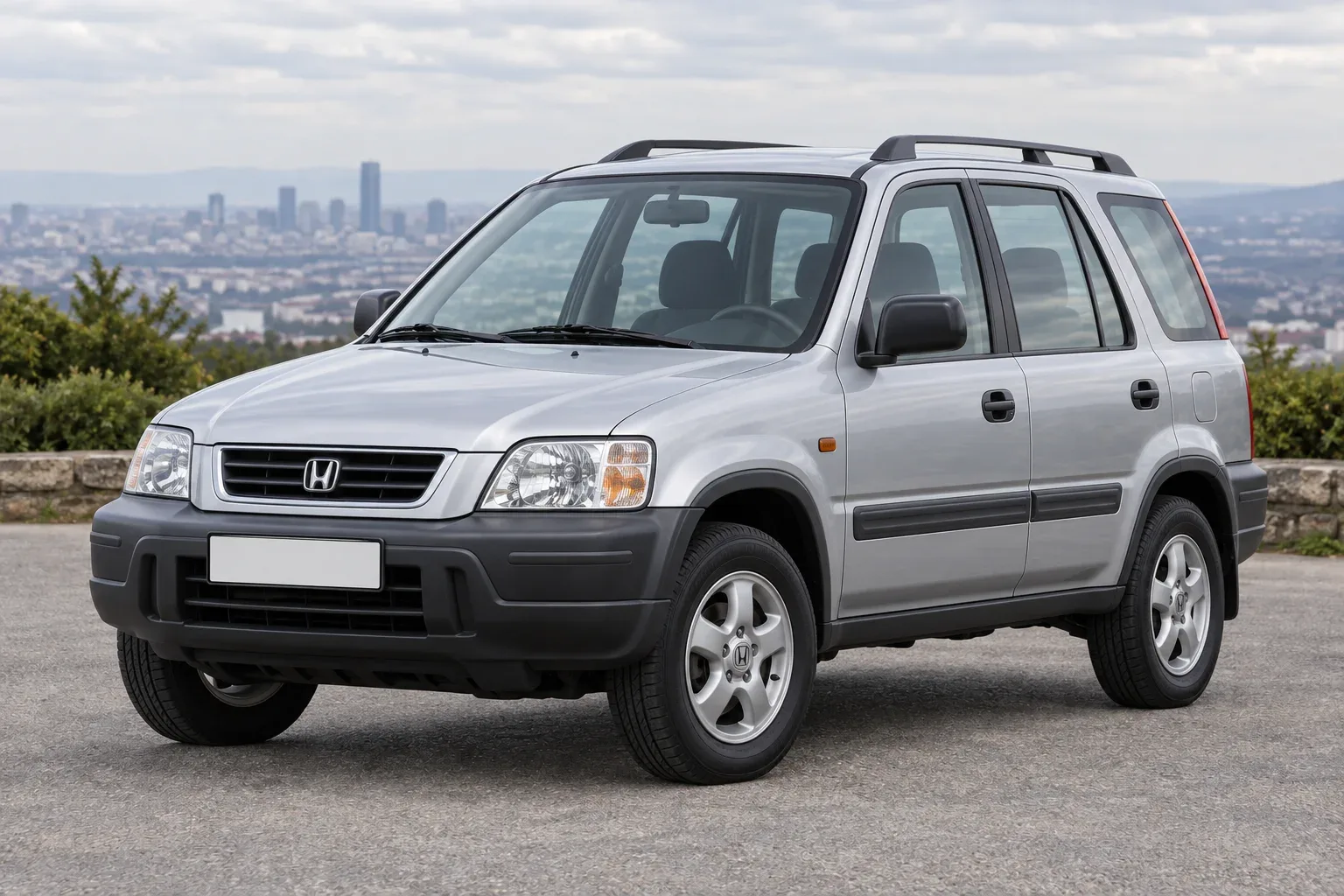
Honda CR-V 1
Valuation of the Honda CR-V 1 (1995–2001): condition, paperwork, inspection and terms of sale.
Indicative purchase price
Below market value
Final price agreed after inspection.
Value my car1Why buyers choose this model
This hands-on guide will help those who are choosing a second-hand Honda CR-V of the first generation or trying to figure out why the car started to crumble. We have collected honest technical statistics from specialized services: real breakdowns, at what mileage they get out, how to diagnose them, how much repairs in workshops cost and how to extend the life of nodes.
2What buyers check
A buyer's guide
This hands-on guide will help those who are choosing a second-hand Honda CR-V of the first generation or trying to figure out why the car started to crumble. We have collected honest technical statistics from specialized services: real breakdowns, at what mileage they get out, how to diagnose them, how much repairs in workshops cost and how to extend the life of nodes.
Specification:
• Model: First generation (1995-2001 years of release, body with indexes RD1-RD3). • Motor range: gasoline two-liter engines B20B (128 hp) and B20Z (147 hp, with VTEC system). Transmission and drive: Five-speed mechanics (5 manual transmission) or four-speed automatic (4 AKPP). Drive either front or connected full Real Time 4WD (the system is built on viscous). • Market: Prices on the secondary jump from 200 thousand rubles for pre-restyling options (1995-1997) to 500 thousand rubles for live copies of the last years of release (1999-2001).
Top 10 typical malfunctions Honda CR-V I by frequency of manifestation
The engine is tripled on idle, traction falls, Check Engine lights up. You can hear metal squeezing when the operating modes change. Clean: 2,000–5,000; Node replacement: 10,000–15,000. Change the engine oil every 7,000 to 10,000 km. Wash the valve mesh on the planned maintenance. 90-120 thousand km (factory regulations - 90 thousand km)
From under the hood there is a strange noise, the engine works unevenly. If the belt breaks, the pistons will collide with the valves. Replacement of the kit (belt + rollers): 5 000-30,000 (parts with work). Change the belt strictly every 60,000 km or every 3 years, even if the mileage is less. 100-150 thousand km (dies viscous coupling Real Time 4WD)
Deaf knocks in the stern, the front wheels are stalling, and the back does not pick up. 4WD lights up. Node repair: 20,000-40,000; Complete replacement: 40,000-70,000. Refresh the special fluid in the gearbox every 30,000-60,000 km. Do not rape the car with heavy off-road. The body begins to shake at speeds from 60 to 100 km / h. You can hear a smack of smack when you touch it. Replacement of cross: 5 000–10 000; Balancing of the shaft: 3000–5,000. Check the cardan backlashes on each TO. If there are serviced crosses - regularly update the lubricant in them. 100,000 km (or the age of the car in 15 years)
Rust climbs on the arches, rapids, floors and at the bottom of the trunk lid. Local body repair: 20 000-50,000; New arch welding: 30,000-60,000. Make a quality anticor. Timely paint chips and wash the road dirt from hidden cavities. 80-120 thousand km (wash brushes in the electric motor)
The windows of the doors jam or barely move.
Engines: Specifics of the B20B/B20Z series
In the engine compartment are two-liter four B20B (128 forces) or B20Z (147 forces, with VTEC system).
• Reliability index: ⁇ ⁇ ⁇ ⁇ ⁇ ⁇ 4 out of 5. • Fuel consumption: In the city, the car eats about 9-12 liters per hundred, on the highway appetite drops to 7-8 liters.
Key vulnerabilities of power units
• valve timing drive: The belt must be changed every 90,000 km or every 5 years. If you drive up to 120,000 km without replacement, the belt can burst at any time. Then the lottery will begin: valves are bent in about half of the cases. It all depends on how much stain has accumulated in the pistons ducts. If there is a lot of coke, the valves will not have free travel, and the pistons will hit them. • VTEC valve: Usually the knot nurses 100,000-150 thousand km without problems. If you rarely change the oil, the channels are clogged with sludge. The valve freezes, the electronics light up the Check Engine error, and the car stops driving. To solve the problem, the unit is removed and washed, or put a new. • Valve gap: Valve gaps must be checked and exposed every 40,000 km. On good oil adjustment does not go up to 80,000 km. But then the valves will inevitably knock, and the revolutions will begin to float.
The final verdict on the internal combustion engine: Both engines live very long, if maintenance is not saved. The basic B20B is simpler. The B20Z modification is more cheerful, but due to the VTEC system, it is more capricious about the quality of service.
The Real Time 4WD transmission
• Rear axle coupling: The native viscous coupling serves over 100-150 thousand km. When she dies, you will hear tangible kicks from the back when slipping, frictions will start to tow, and a 4WD lamp will light up on the panel. To make the clutch live longer, completely change the oil in the rear gearbox every 30,000-60,000 km and do not tow long in the mud. • Card transfer: Crossing breaks after 80-120 thousand km. On the body there is a fine itchy vibration at a speed of 60 to 100 km / h, and when you start from the place you can hear clicks. For prevention, check the back lifts at each inspection. If you have cruciferous oils, syringe them regularly.
Reliability of transmissions
5-speed manual transmission (5 MKP): ⁇ ⁇ ⁇ ⁇ ⁇ ⁇ ⁇ ⁇ ⁇ ⁇ ⁇ ⁇ ⁇ ⁇ 5 out of 5. The design turned out to be indestructible and cheap in content. Usually all costs are reduced to replacement of clutch after 100-150 thousand km. Spare parts together with the work will cost 30 000-50,000 rubles. • 4-speed automatic transmission (4 APP): ⁇ ⁇ ⁇ ⁇ ⁇ ⁇ ⁇ ⁇ ⁇ ⁇ 4 out of 5. Frictions during careful driving can withstand more than 120-180 thousand km. If the machine began to kick or delay transmissions, immediately take the car for diagnosis. The box will live long only in one case: if you partially change the oil in it every 60,000 km. The capital of the machine will cost 50 000-100,000 rubles.
Body and electrician
The main problem of the old Honda is the weak resistance to rust. The metal begins to rot after 15 years of operation or as soon as the actual mileage exceeds 100,000 km.
Areas of primary damage to the body by corrosion:
Rear wheel arches (rot climbs from the inside, under plastic lockers);
On the electrician serious systemic sore one - drives windows. The brushes inside the motors are washed after 80-120 thousand km. You can save and re-sweat the brush assembly yourself, or just buy a new motor assembled.
Checklist for comprehensive inspection of Honda CR-V I before purchase
1. Legal purity: Check the PTS, CTS and compare the VIN numbers on the body with databases. See the history of service in the service book 2. Engine check: Listen to the engine start to the cold. Evaluate the stability of the turns after warming up. Check if there is any noise from the valve timing.3 belt. Transmission test: The transmissions must be clearly and without crunch. Check the machine in all modes - there should be no kicks, slips and delays.4. All-wheel drive: Drive the car onto a slippery surface and check if the rear axle is picking up. The 4WD lamp on the instrumentation should not burn in motion. Look, is the gearbox humming 5? Cardshaft: Be sure to accelerate the car on flat asphalt to 60-100 km / h. If the body shivered, the crosses are over. On the lift, check the backlashes of the cardan with your hands.6. Body inspection: Carefully inspect the hidden cavities of the arches, look under the plastic rapids and assess the condition of the seams on the bottom.7. Onboard electric: Alternately lower and raise the windows on all four doors. The motors must be kept in good condition.8 Test Drive: Check how the car brakes, whether the steering wheel is pulling to the side at speed and whether there are no deaf knocks in the suspension at road joints.
Critical mistakes of owners, reducing the life of the car
• Drawing with oil replacement in the ICE: If you pour a cheap mineral water or change oil once every 15-20 thousand km, the channels will clog, and the VTEC system is guaranteed to die by 100-150 thousand km. • Ignoring the regulations of the GMT: If the belt left more than 120 thousand km, its cliff is only a matter of time. And this almost always means expensive overhaul of the head of the unit. • Forgotten rear gearbox: If you do not change the liquid in the 4WD coupling, the unit will begin to overheat and simply collapse. The new gearbox will cost at least 40 000 rubles. • Lack of body care: chips on arches and rapids in our winters for two to three years turn into through holes. You will have to give the car to welders and pay for the bodywork. • Riding with a vibrating cardan: If you ignore the tremor on the body for a long time, the cardan will break the seats in the trash. Refusal to adjust valves: Clamped valves lead to the drawdown of the seats, the engine begins to knock, loses compression and pulls worse.
Frequently Asked Questions (FAQ)
Q: What is the real probability that the valve will bend when the timing belt breaks on the B20B engine? A: The odds are exactly 50/50. There are technological notches in Honda's pistons. But if the pistons have grown a thick layer of soot, the valves simply do not have enough space, and the pistons will hit them. • V: Which gearbox demonstrates greater durability - a mechanic or a machine gun? A: Mechanics are unconditionally more reliable, durable and cheaper to repair. The four-stage machine is also not bad, but its life depends on the regularity of changing oil every 60,000 km. • V: How much is the body of the Honda CR-V I prone to rust? A: This is a systemic problem of the model. Given the age (cars are already over 20 years old) and salt on the roads, deep corrosion on the arches, sills and floors you will find on almost every copy with a real mileage of 100,000 km. A: You can, but only after a very careful check of the box on the move. Buy a machine only if the previous owner changed the oil in it every 60 thousand km and can confirm it. Q: What are the direct analogues in this price range? A: In the budget from 200 to 400 thousand rubles alternative will be Toyota RAV4 (first generation), Nissan X-Trail (T30), Mitsubishi Outlander I, as well as frame Suzuki Grand Vitara I and Kia Sportage I.
3Pre-purchase checklist
A buyer's guide
- We have collected honest technical statistics from specialized services: real breakdowns, at what mileage they get out, how to diagnose them, how much repairs in workshops cost and how to extend the life of nodes.
Top 10 typical malfunctions Honda CR-V I by frequency of manifestation
- Clean: 2,000–5,000; Node replacement: 10,000–15,000.
- Replacement of the kit (belt + rollers): 5 000-30,000 (parts with work).
- Deaf knocks in the stern, the front wheels are stalling, and the back does not pick up. 4WD lights up.
- Node repair: 20,000-40,000; Complete replacement: 40,000-70,000.
- Replacement of cross: 5 000–10 000; Balancing of the shaft: 3000–5,000.
- Check the cardan backlashes on each TO.
- Rust climbs on the arches, rapids, floors and at the bottom of the trunk lid.
- Local body repair: 20 000-50,000; New arch welding: 30,000-60,000.
- Check the chassis every six months. Do not overload the trunk beyond normal.
- mile (the plant requires inspection every 40,000)
Key vulnerabilities of power units
- VTEC valve: Usually the node has no problems caring for 100-150 thousand km.
- To solve the problem, the node is removed and washed, or put a new one.
- Valve gap: Valve gaps must be checked and exposed every 40,000 km.
The Real Time 4WD transmission
- For prevention, check the back lifts at each inspection.
Reliability of transmissions
- If the machine began to kick or delay transmissions, immediately take the car for diagnosis.
Body and electrician
- The main problem of the old Honda is the weak resistance to rust.
- The metal begins to rot after 15 years of operation or as soon as the actual mileage exceeds 100,000 km.
- Areas of primary damage to the body by corrosion:
- Rear wheel arches (rot climbs from the inside, under plastic lockers);
Checklist for comprehensive inspection of Honda CR-V I before purchase
- Legal purity: Check the PTS, CTS and compare the VIN numbers on the body with databases.
- Check out the service history in the service book. 2.
- Engine check: Listen to the engine start to the cold.
- Check if there is any noise from the belt of the valve timing. 3.
- Check the machine in all modes - there should be no kicks, slips and delays. 4.
- All-wheel drive: Drive the car onto a slippery surface and check if the rear axle is picking up.
- The 4WD lamp on the instrumentation should not burn in motion. Look, is the gearbox buzzing? 5.
- On the lift, check the back lifts of the cardan with your hands. 6.
Critical mistakes of owners, reducing the life of the car
- And that almost always means expensive overhaul of the block head.
- • Refusal to adjust valves: Clamped valves lead to saddle drawdown, the engine starts to knock, loses compression and pulls worse.
Frequently Asked Questions (FAQ)
- A: Mechanics are unconditionally more reliable, durable and cheaper to repair.
- Q: How much is the body of the Honda CR-V I rust-prone? A: This is a systemic problem of the model.
- Given the age (cars are already over 20 years old) and salt on the roads, deep corrosion on the arches, sills and floors you will find on almost every instance with a real mileage of 100,000 km.
- A: You can, but only after a very careful check of the box on the move.
4Challenges of selling privately
Buying a Honda CR-V of the first generation makes sense if your budget is strictly limited (200-400 thousand rubles), you need a roomy all-wheel drive hard worker and you are morally ready to invest another 30-70,000 rubles in the first year to bring the car to mind. Better look for the mechanics.
You should not take this car if you are looking for the option of “sit and go” without regular visits to the service. Also, refuse to buy if you live in a large city with damp winters and caustic reagents - the body and the cardan rot very quickly.
The best choice for purchase: A version with a simple B20B engine (128 hp), five-speed mechanics (5 MKP) and Real Time 4WD all-wheel drive. This bundle will require a minimum of money for maintenance and will save the residual resource longer than the rest.
- We have collected honest technical statistics from profile services: real breakdowns, at what mileage they get out, how to diagnose them, how much repairs cost in workshops and how to extend the life of nodes.
- Specification: • Model: First generation (1995-2001 years of release, body with RD1-RD3 indices.
- Top 10 typical Honda CR-V I malfunctions in frequency: Cleaning: 2,000–5,000; Node replacement: 10,000–15,000.
- Engines: Specifics of the B20B / B20Z series: In the engine compartment there are two-liter fours B20B (128 forces) or B20Z (147 forces, with VTEC system). • Reliability index: ⁇ ⁇ ⁇ ⁇ ⁇ ⁇ ⁇ ⁇ (4 out of 5).
- Real Time 4WD transmission elements: Check the lift lifts at every inspection for prevention.
- Reliability of transmissions: • 5-speed manual transmission (5 manual transmission): ⁇ ⁇ ⁇ ⁇ ⁇ ⁇ ⁇ ⁇ ⁇ ⁇ ⁇ ⁇ ⁇ 5 out of 5.
- Body and electrician: The main trouble of the old Honda is the weak resistance to rust.
- Checklist for comprehensive check Honda CR-V I before buying: On the lift check the back lifts of the cardan hands. 6.
Shows, bargaining and re-registration take time: buyers look, promise to think and disappear. Fair price after inspection closes the auction on the spot. If money is needed urgently, the purchase takes away waiting and repeat displays.
5How selling to us works
Leave a request with the car data. We will discuss the preliminary assessment and inspection. After checking the status and documents, we agree on the final price and terms of the transaction.