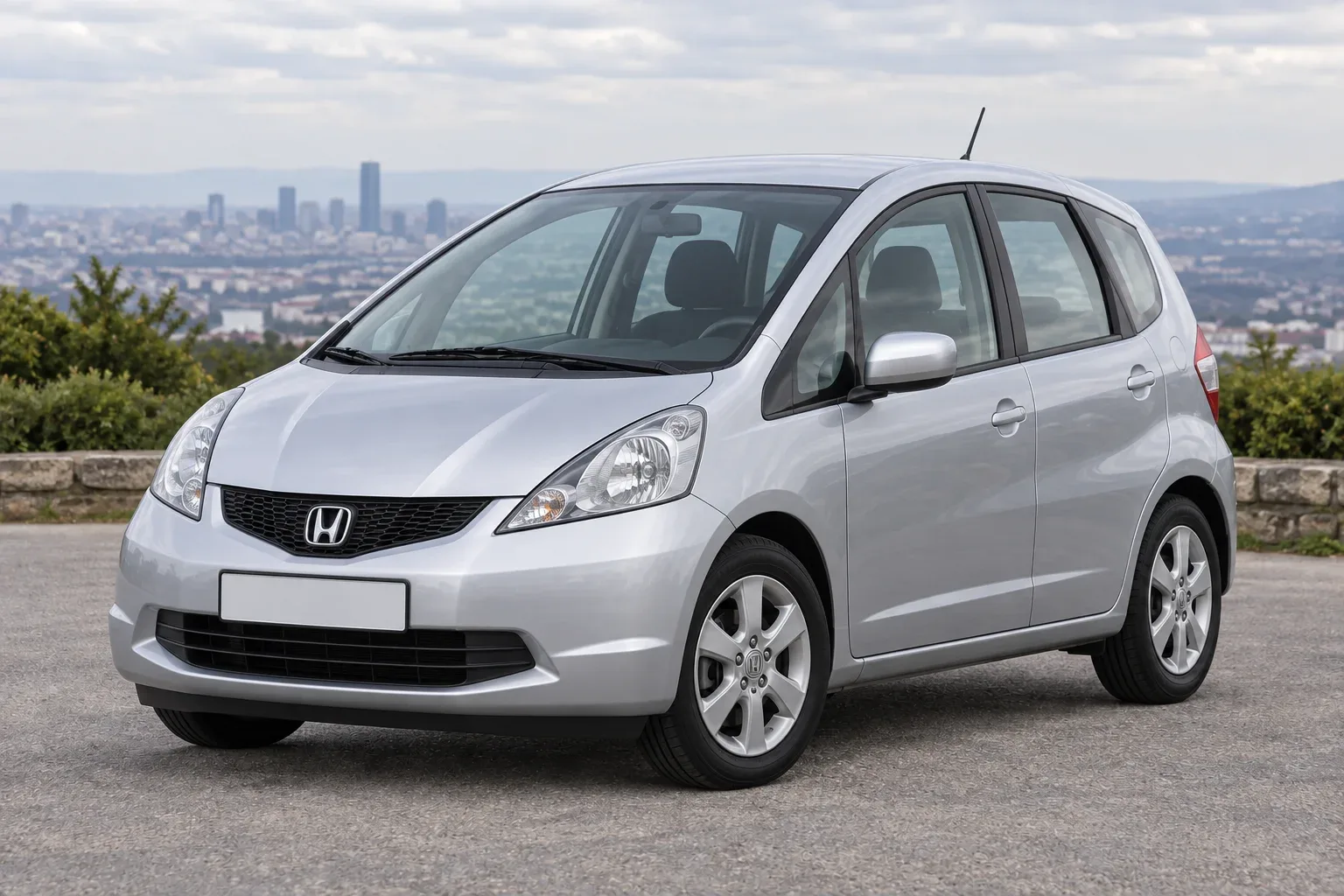
Honda Jazz 2
Valuation of the Honda Jazz 2 (2008–2015): condition, paperwork, inspection and terms of sale.
Indicative purchase price
Below market value
Final price agreed after inspection.
Value my car1Why buyers choose this model
The beginning of the history of Honda Jazz dates back to the eighties of the twentieth century. Then the company proposed the concept of an angular urban hatchback. Jazz returned to Honda in 2001. The car is located on the border between the B segment and the class of "mikravans". In 2007, the second generation of jazz was released. It has maintained a successful shape with a high roofline. One of the features of the Jazz is the back seat. Magic Seat technology allows you to fold it in a ratio of 40:60 without a threshold between the passenger compartment and the trunk, the volume of which increases from 399 to 892 liters. If there is a need to transport tall objects, for example, seedlings of trees, then you can set the sofa cushion in an upright position. The distance between the floor and the roof is 1.28 m. The folded front seat will allow you to place an object up to 2.4 meters long. It's not over yet. It also has a seating system called Refresh Mode. It allows you to get almost full-fledged places for short-term rest or sleep. To do this, you need to fully move the front seats, remove the head restraints and lower the backrests. Such functional interior space would not have been possible if the fuel tank had not fallen under the front seats. Plastic protection protects the tank from damage and at the same time reduces the coefficient of aerodynamic drag. The exhaust system also received an unusual design. It is laid bypassing the tank under the right threshold, and the first silencer is just behind the front right door. But there's a downside to the coin. The tank capacity had to be reduced to 42 liters. Its location forced the front seat cushions to be placed high, something some drivers like and others don't. The salon is decorated with a good look and well-fitted plastic. Pointers and controls, in comparison with the futuristic Honda Civic, have a more familiar look, which has a positive effect on ergonomics and ease of use. A big plus is the steering column adjustable in two planes. This attribute is still not mandatory for urban cars from Japan. The strength of Honda Jazz 2 is rich equipment.
2What buyers check
Engines
Under the hood of Jazz were only 16-valve units. They all belong to the L family. The smaller 1.2 i-VTEC has the designation L12B1 (90 hp, 114 Nm), and the 1.4 i-VTEC is L13Z1 (100 hp, 127 Nm). It is noteworthy that 1.4 i-VTEC has a working volume of 1339 cm3. The best choice is a 1.4-liter engine. The 1.2 i-VTEC jazz consumes almost as much fuel, but is less dynamic and generally less equipped. The i-VTEC system offers two cylinder filling modes. In the area of low and medium speeds, only one of the intake valves opens completely. The other opens only partially, which causes a noticeable rotation of the saturated combustible mixture. Both intake valves open completely only at high revs. To reduce fuel consumption at high loads, a cooled exhaust manifold built into the cylinder head is used. Both units are reliable, impressive elasticity and low fuel consumption with a calm ride. A reliable HRM chain drive reduces operating costs, as well as valves with a simple adjusting screw. A characteristic feature of the engines is a decent return mainly at high speeds. Therefore, to go dynamically, you need to turn the engine up to 5000-6000 rpm. Much less common 1.5-liter 120-horsepower gasoline atmospheric. Honda did not have diesel engines for its jazz. For a purely urban car, they are not necessary, since they often reach the final point of the route, even before having time to warm up properly.
IMA
Hybrid IMA technology is a bit easier than Toyota HSD. The IMA is essentially derived from the Insight model. Its feature is the connection of the electric motor to the internal combustion engine, the so-called rigid way. The drive clutch is behind the gearbox, i.e. at its output. The electric motor is designed primarily to support the gasoline unit. However, the car can be driven on electric power, but only in certain road conditions, such as on a long-long hill descent.
The ICE is a four-cylinder unit with a volume of 1339 cm3 with the LDA marking. Unlike other engines, it has only 8 valves and an i-DSI (intelligent dual and sequential ignition) ignition system, as in the old Jazz. There is also an i-VTEC system. The LDA engine has its own starter, but only as a backup. Under normal conditions, it is started by a traction electric motor.
The advantage of IMA over the Toyota HSD system is that it provides the possibility of emergency start of the engine from an external power source. What is missing is an alternator. The 12-volt battery is powered by a traction 100-volt battery. The warranty for the traction battery was 5 years, and currently it costs more than 160 000 rubles.
Jazz Hybrid can be recognized by a different grille and LED taillights with transparent optics. The interior lighting was a light green color, which was reserved only for the hybrid. The trunk of this version is smaller by 28 liters, and the folded seats form a step.
Transmission
Before the facelift, Honda offered the 1.4-litre version with a five-speed i-Shift automated manual transmission. It works reasonably well when the driver is relaxed and in no hurry, but shifts take too long and smoothness is disappointing. Upshifts with the accelerator pressed hard cause a jolt. Easing off the accelerator during a shift improves matters. After the 2011 facelift, a continuously variable transmission (CVT) replaced the automated manual.
The manual transmission and clutch are very durable and reliable. The variator is convenient, but like most similar devices, it has earned a terrible reputation. CVT is quite capricious: it does not like frost, and energetic driving and improper operation lead to breakdowns. Technical problems usually occur after 150,000 km.
The i-Shift robot is equipped with an electric motor for gear shifting and clutch control, but at the same time retained hydraulics. It's just the piston being pressed by the servo motor. As always, the replacement of the clutch in this box is more expensive than in conventional mechanics. The reason is that after the clutch is replaced, the robot needs to be “trained” again to switch.
Walking
A simple suspension (the Macpherson struts in the front and the torsion beam in the rear) firmly carries the Russian roads. Ball and suspension bushings can be replaced separately from the levers, which reduces the cost of maintenance.
The considerable height of the body Honda engineers tried to compensate for tight settings. As a result, a surprisingly docile car on the highway is not good enough and noisily filters irregularities. The side effect is particularly acutely felt by rear passengers. The Jazz II is much more comfortable than the Jazz I.
Typical problems and malfunctions
There was a lot of discussion about the place of Jazz production. For the first two years, cars assembled in China were imported to Europe. Which is better, Chinese or later British? Opinions were divided on this point. Some say there's no difference. Others believe that cars from China are not as carefully assembled and are less protected from corrosion. It is not difficult to identify the manufacturer. The VIN number of samples collected in the Middle Kingdom begins with LUC, in English Swindon - with SHH, and purebred Japanese - with JHM. Hybrid versions were made exclusively in Japan. However, after analyzing the fault reports, we can conclude that the assembly site did not affect reliability. However, the opinions of the technical experts about the quality of the Honda Jazz are divided. In the ADAC ranking, the little Honda was the most problematic model in the class! Sounds awful. But the details only strengthen confidence in the reliability of the Japanese car industry. ADAC experts have struggled with lighting problems, spark plugs and discharged batteries. There was no serious mechanical damage. In TUV reports, jazz looks more decent. Both ADAC and TUV rated the Jazz II more reliable than the Jazz I (2001-2008). DEKRA, which does not generate reports based on calls for help on the road, but on periodic technical inspections, recognized Jazz as a model with a significantly lower number of malfunctions than the average. Most often, corrosion and wear of brakes were found. The production of brake discs and pads accelerated the pecking brakes.
3Pre-purchase checklist
Engines
- Therefore, to go dynamically, you need to turn the engine up to 5000-6000 rpm.
- For a purely urban car, they are not necessary, since they often reach the final point of the route, even before having time to warm up properly.
- As a result, diesel engines do not survive short distances, consume a lot of fuel and cause problems with cleaning the DPF filter.
- However, in diesel engines, as in economical units, there is no special need.
Transmission
- Technical problems usually occur after 150,000 km.
- As always, the replacement of the clutch in this box is more expensive than in conventional mechanics.
- The reason is that after the clutch is replaced, the robot needs to be “trained” again to switch.
Typical problems and malfunctions
- Others believe that cars from China are not as carefully assembled and are less protected from corrosion. It is not difficult to identify the manufacturer.
- However, after analyzing the fault reports, we can conclude that the assembly site did not affect reliability.
- In the ADAC ranking, the little Honda was the most problematic model in the class! Sounds awful.
- ADAC experts have struggled with lighting problems, spark plugs and discharged batteries.
- DEKRA, which does not generate reports based on calls for help on the road, but on periodic technical inspections, recognized Jazz as a model with a significantly lower number of malfunctions than the average.
- Most often, corrosion and wear of brakes were found.
- DEKRA experts, like ADAC experts, have drawn attention to the problems with lighting.
- On the hood and front bumper of most specimens are found numerous chips.
4Challenges of selling privately
The used Honda Jazz is far from the cheapest car on the secondary market. But in return, you will get a spacious, functional, reliable and easy to use compact that will not fall rapidly in price and will quickly find its new owner when resold.
- Engines: As a result, diesels don’t survive short distances, consume a lot of fuel and cause problems with cleaning the DPF filter.
- IMA: Hybrid IMA technology is a little easier than Toyota HSD. The IMA is essentially derived from the Insight model.
- Transmission: Technical faults usually occur after 150,000 km.
- Driving: A simple suspension (Macpherson struts in the front and a torsion beam in the rear) firmly carries Russian roads.
- Typical problems and malfunctions: Others are convinced that cars from China are not as carefully assembled and are less protected from corrosion. It is not difficult to identify the manufacturer.
Shows, bargaining and re-registration take time: buyers look, promise to think and disappear. Fair price after inspection closes the auction on the spot. If money is needed urgently, the purchase takes away waiting and repeat displays.
5How selling to us works
Leave a request with the car data. We will discuss the preliminary assessment and inspection. After checking the status and documents, we agree on the final price and terms of the transaction.