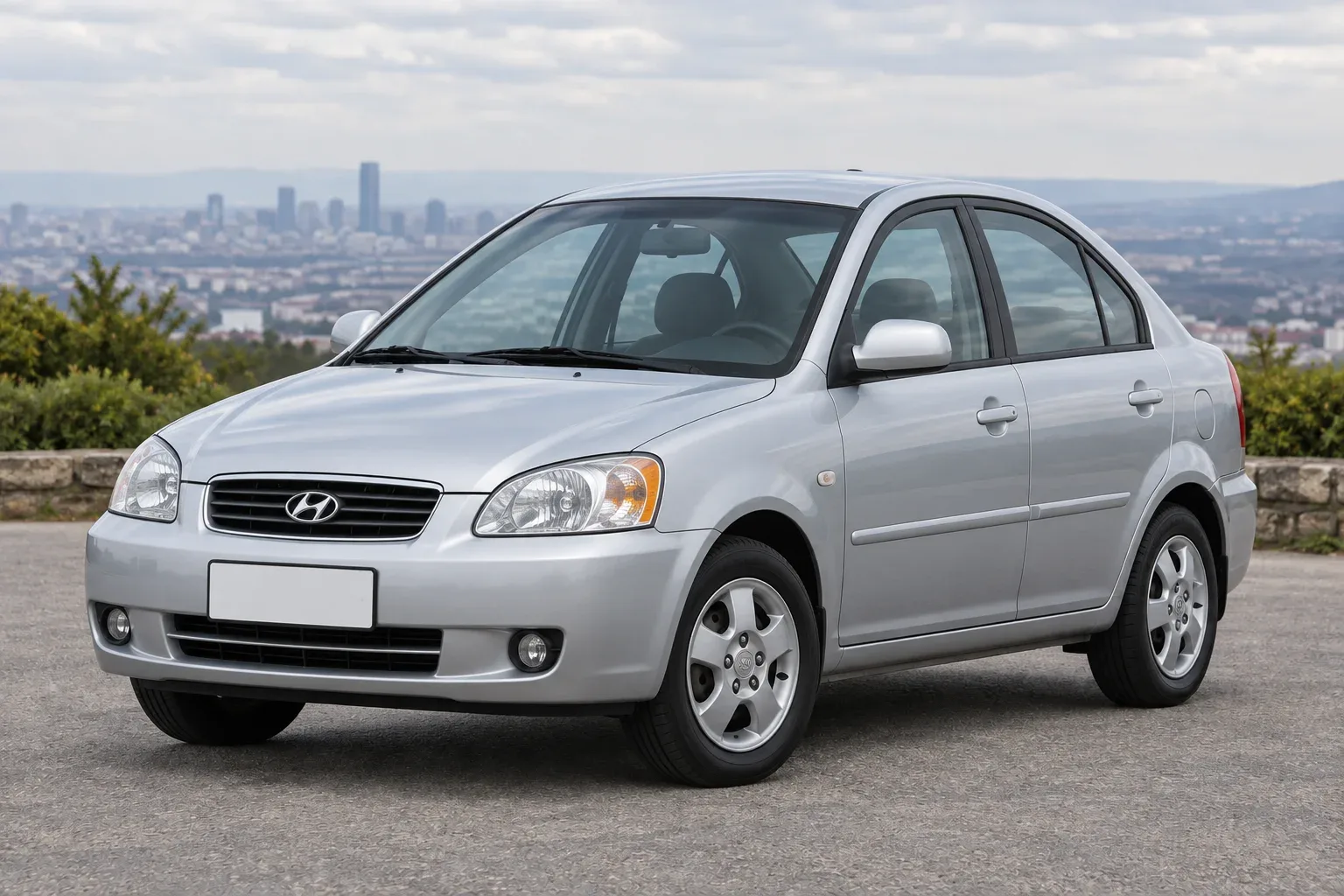
Hyundai Accent
Valuation of the Hyundai Accent (1999–2012): condition, paperwork, inspection and terms of sale.
Indicative purchase price
Below market value
Final price agreed after inspection.
Value my car1Why buyers choose this model
The second generation Hyundai Accent (LC index) debuted in 1999. The car was offered in the back hatchback and sedan.
2What buyers check
Review
The second generation Hyundai Accent (LC index) debuted in 1999. The car was offered in the back hatchback and sedan. In 2001, the assembly started in Taganrog. After 2 years (in 2003) the model has survived restyling, but the Russian market did not see it. From the gates of "TagAZ" still left sedans in pre-restyling appearance.
In 2005, the front part was slightly transformed - the predatory grille received softer rounded shapes. In 2006, there was a change of generations, but Tagaz continued production of the sedan until 2012.
There is enough space in the cabin Hyundai, however, the rear passengers will feel cramped. The trunk volume is only 375 liters (321 liters - hatchback). On the other hand, a small car is not worth waiting for miracles.
Sedan in the basic version of MT0 could boast only a power steering. Central lock, electric mirrors and glass, air conditioning and ABS were available in richer package trim levels. The airbag fell only to the driver, and even then, in the most expensive versions - MT3 and AT5 (with automatic transmission).
In the crash test according to the version of NHTSA (American National Association for Transportation Safety), Accent earned 4 stars in frontal and side impact. But that car was equipped with 4 airbags.
Engines
Initially, Hyundai Accent was equipped with atmospheric gasoline engines of 1. 3 liters and 1. 5 liters. The first was only set for a limited period of time. The last one, it became mass. In 2002, the line of power units was replenished with a 1.5-liter turbodiesel and a gasoline atmospheric with a capacity of 1.6 liters. None of these engines were officially offered in Russia. All gasoline engines are members of the Alpha family (1. 6 l - Alfa II). They are a licensed copy of Mitsubishi Orion series engines. the 1.3-liter engine (60 and 75 hp / G4EH) has one camshaft and 12 valves. the 1.5-liter was offered in two versions: 12-valve (91 hp / G4EB) and 16-valve (102 hp / G4EC). The first (with one camshaft) was not widely distributed. The market is absolutely leading the 16-valve unit with two camshafts. 1.6-liter engine (105 hp / G4ED) can be found in cars imported from the United States. All engines have a temporary type of drive. In units with a double-shaft DOHC distribution scheme (1. 5/102 hp and 1. 6/105 hp), the gear belt drives only the exhaust camshaft, and the intake is connected to the exhaust single-row chain. The belt is recommended to be changed every 50,000 km. In practice, there were many cases when the belt broke closer to 60,000 km. The cost of a new set is from 2 000 rubles. Chain drive camshafts (from 1000 rubles) many mechanics advise to change at the mileage of 100-120 thousand km. By this time, it is often stretched. Maintenance of the valve timing drive is not very difficult.
Transmission
The pair of engines were assigned either a 5-speed mechanics or a 4-speed automatic (A4AF3).
The mechanical box is very reliable. There are almost no problems with her. Enviable durability is also different and grip - more than 250 000 km. The new set is available for 4 000 rubles. But the squeezable bearing can make noise after 100-150 thousand km. Episodic difficulties with the inclusion of gears arise due to the souring of the gear selection mechanism.
The automatic transmission is not as durable as the manual transmission, but with proper care it will easily pass until the first repair of 200-250 thousand km. The main thing is not to forget to update the oil every 40-60 thousand km. For bulkheading will need about 50 000 rubles. Sometimes failures in the operation of the machine are caused by a break in the wiring of the contact connector.
Walking
The softly tuned suspension is able to absorb large irregularities without compromising the comfort of passengers. But there are downsides to this. The body in the corners is strongly tilted, and the handling deserves mediocre evaluations, as well as the brake system. On dry asphalt, it takes 43.3 meters to fully stop. The current standard is no more than 40 meters.
The weakest place in the suspension is the stabilizer sleeves. Sometimes they have to be changed after 20-40 thousand km. The levers of the front suspension (2-4 thousand rubles) will serve 100-150 thousand km, and the rear - more than 150-200 thousand km.
At a stretch of 100-150 thousand km, hub bearings may become unusable. On the front axle, only bearings change (1,000 rubles), and on the rear - a hub assembly (from 2000 rubles).
After 100-150 thousand km, the brake cylinders of the rear brake drums sometimes sour. Often it is enough to disassemble, clean and lubricate them. The new cylinder is available for 600 rubles.
In cars older than 10-12 years, you need to pay attention to the front brake tubes. They rust under a rubber seal - at the point of transition through the partition of the wheel arch. The cost of the new brake line is about 1,000 rubles.
Problems with ABS can occur due to oxidation of the motor. He quickly comes to his senses after cleaning.
The steering rack may require attention after 150-200 thousand km. In the worst case, it will have to be replaced – from 18 000 rubles.
Body and salon
The body iron of Hyundai is not prone to corrosion. Rust is more of a sign of poor quality repairs in the past. However, on individual specimens older than 10 years, you can find red spots in the area of the rear wheel arches and rapids. In addition, the bumpers often peel paint.
In the interior decoration, cheap plastic is used, which eventually begins to creak. It does not matter with noise insulation. It cannot be measured except below the average. In the cabin penetrate sounds from the engine compartment and wheel arches.
After 120-140 thousand km, the generator may fail. Often given to get rid of the replacement of the voltage regulator (1000 rubles). If you can not restore the generator, you will have to look for a new one – from 5 000 rubles.
Over time, the windshield wiper drive mechanism sours. There is a knock and creak, and the leashes move slowly and not at full speed. The new trapezoid will cost 2,000 rubles.
From time to time, the speed indicator arrow begins to twitch and buzz. It's easy to fix. Sometimes there are failures in the work of the central lock.
3Pre-purchase checklist
Engines
- The belt is recommended to be changed every 50,000 km.
- However, when replacing the belt, the pump should also be updated (from 2 000 rubles).
- It can flow or make noise after 80-110 thousand km.
- The cost of the spring is only 250 rubles, and to replace it, you need to remove the engine crankcase.
- Interruptions in the operation of the engine are sometimes caused by the failure of the pumping fuel pump (from 2,500 rubles) or the oxygen sensor (from 2,000 rubles).
- Over the years, they age and leak the nozzles of the cooling system and the radiator.
- The consequences are very sad - the autopsy and overhaul of the engine.
Transmission
- There are almost no problems with her.
- The automatic transmission is not as durable as the manual transmission, but with proper care it will easily pass until the first repair of 200-250 thousand km.
Walking
- In cars older than 10-12 years, you need to pay attention to the front brake tubes.
- Problems with ABS can occur due to oxidation of the motor.
Body and salon
- The body iron of Hyundai is not prone to corrosion.
- Rust is more of a sign of poor quality repairs in the past.
- In the interior decoration, cheap plastic is used, which eventually begins to creak. It does not matter with noise insulation.
- There is a knock and creak, and the leashes move slowly and not at full speed.
4Challenges of selling privately
Hyundai Accent is a simple and reliable car that can be serviced or repaired for a small amount of money in any service. The main thing is not to run into a run-down copy that worked in a taxi.
- The second generation Hyundai Accent (LC index) debuted in 1999.
- Engines: It can flow or make noise after 80-110 thousand km.
- Transmission: There are almost no problems with it.
- Driving: Problems with ABS can occur due to oxidation of the motor.
- Body and salon: Hundai body iron is not prone to corrosion.
Shows, bargaining and re-registration take time: buyers look, promise to think and disappear. Fair price after inspection closes the auction on the spot. If money is needed urgently, the purchase takes away waiting and repeat displays.
5How selling to us works
Leave a request with the car data. We will discuss the preliminary assessment and inspection. After checking the status and documents, we agree on the final price and terms of the transaction.