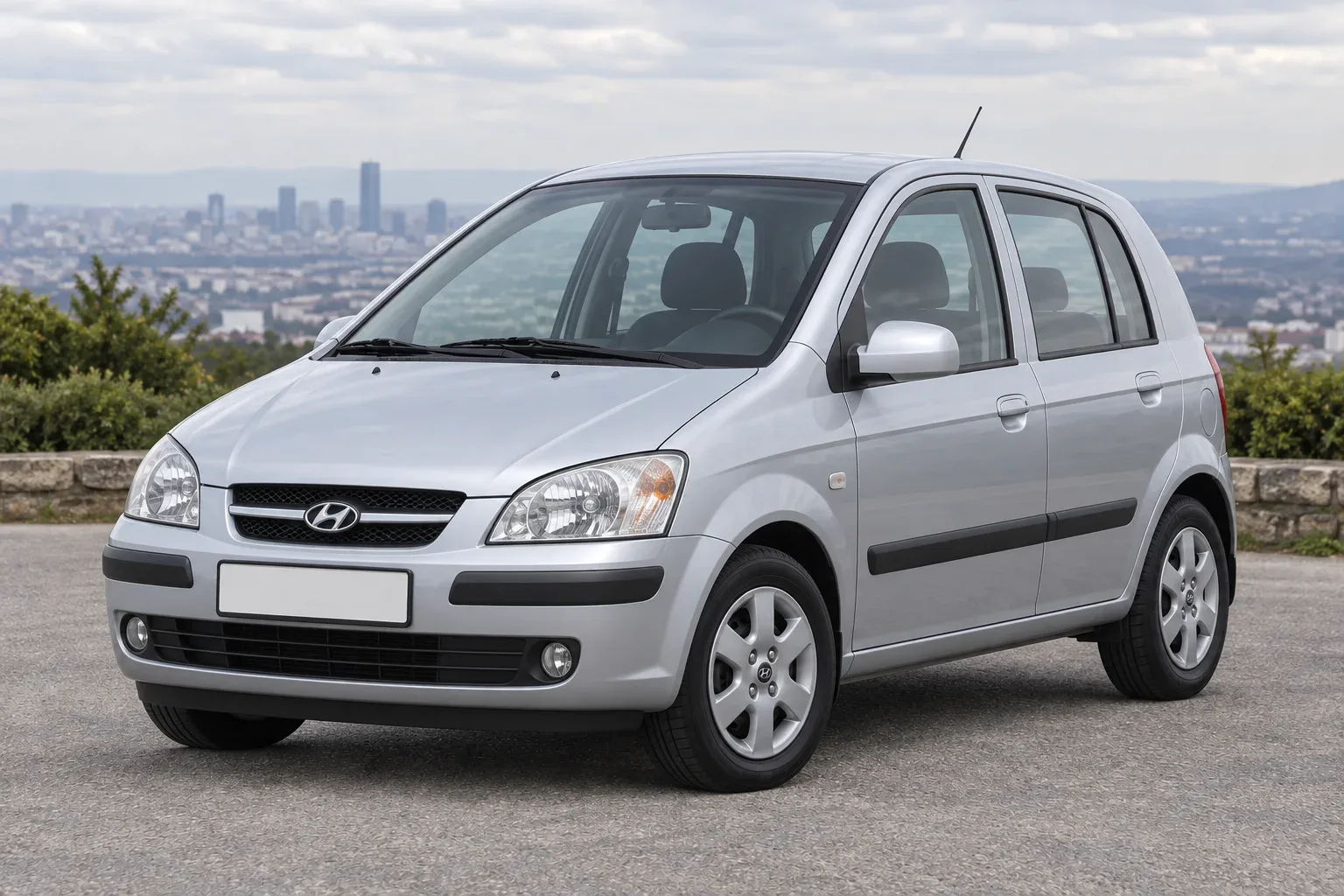
Hyundai Getz
Valuation of the Hyundai Getz (2002–2010): condition, paperwork, inspection and terms of sale.
Indicative purchase price
Below market value
Final price agreed after inspection.
Value my car1Why buyers choose this model
The appearance of the small Hyundai Getz does not make the heart beat harder, and many, passing by, do not even notice this car. But there are some advantages to this for those who are not used to standing out. The first serial Hyundai Getz was released in 2002. In addition to South Korea, the car was assembled in India, Malaysia and even Venezuela. The subcompact was offered in many markets and therefore had several names. For example, in Korea and Syria – Click, in India – Getz Prime, and in Japan – TV. In Venezuela, the baby was available under a false name – Dodge Brisa II. Three years after the world production of the model gained full steam, the Koreans decided to restyling. The car received more rounded front lights, updated grille and taillights. From that moment, the model was sold unchanged until 2009, when it was replaced by the Hyundai i20. However, in many countries, the production of the model continued, in particular, it was delivered to Russia until 2011. Hyundai Getz has two types of body: 3 and 5-door. The most popular, of course, 5-door versions. Unfortunately, many cars of the first years of production are equipped very poorly and do not even have air conditioning, ABS and power steering. The latter two were added to the list of serial equipment after an update in 2005. In cars of this class, there is almost never a place for the suspension of a complex scheme or technologically advanced transmission. The thesis holds true for Getz, too. According to the results of the crash tests EuroNCAP 5-door hatchback earned 4 stars.
2What buyers check
Engines
1.1-liter 12-valve gasoline engine. In the car of this segment, the choice of the right engine is determined, first of all, by the economy. For this reason, the basic gasoline engine immediately disappears. It only seems that a small unit will save on fuel. To accelerate the car a little, you will have to “twiste” the engine, and this will inevitably lead to an increase in fuel consumption. Although the appetite will not be too large, it will be commensurate with the level of consumption of engines with a capacity of 1.3 and 1.4 liters. The basic 1.1-liter unit has mechanical valve gap compensation, which requires periodic control (once in 30 000 km) and complex adjustment. the 1.3-liter engine is close to the basic unit in its design, but is equipped with hydraulic valve gap compensators. The remaining engines are also equipped with hydraulic compensators. the 1.6-liter engine has a system of changing the phases of gas distribution and two camshafts in the head of the block. Engines usually easily pass through the border of 300,000 km. Then oil consumption may increase, for the elimination of which it is necessary to update the oil caps (20 rubles for pieces and 10,000 rubles for work). Cases of major repairs occur after 400-500 thousand km (about 40 000 rubles). All petrol units are equipped with a temporary type of HRM drive, which is subject to replacement every 60,000 km. Hydrocompensators wear out after 200-250 thousand km, which leads to very noisy operation of the engine immediately after launch. With age, the flexible connection of the exhaust system burns out (corrugated - from 1200 rubles). After 200,000 to 250,000.
Transmission
The choice was offered 5-speed mechanics or 4-speed automatic.
Cases of repair of the manual are rare. Clutch usually goes over 150-200 thousand km (5-7 thousand rubles per set). Over time, the gear selection mechanism (the so-called “helicopter”) wears out.
The machine may need to be repaired only after 300,000 km. However, after 100-150 thousand km, sometimes the sensor of the speed of rotation of the shaft of the box (2-3 thousand rubles) is handed over. Replacing him is pretty easy. And because of the wiring break of the Over Drive button, the 4th gear stops turning on.
Walking
The front suspension is a classic Macpherson strut, and the rear is a twisting beam.
Front quite quickly drop out of the game racks and sleeves of the stabilizer. After 100-150 thousand km can come into disrepair the Silent blocks of the front levers (from 200 rubles for an analog). The more mileage, the less chance of a quick and easy replacement. Over the years, bolts in the inner metal bushes of the Silentblock have been soured. You have to cut the lever (from 1600 rubles) or subframe. Ball supports usually go longer than salent blocks.
Behind - prematurely wear shock absorbers (from 800 rubles per analog), and sometimes begin to knock anthers. Due to the separate arrangement of springs and shock absorbers, replacing the latter is cheaper and easier.
Front hub bearings (from 500 rubles per analog) can sound after 100-150 thousand km. External SRUS (from 1000 rubles per analog) usually go over 150-200 thousand km, and they are usually given up because of torn anthers.
After 200-250 thousand km can knock or leak the steering rack (from 8000 rubles for an analog).
Typical problems and malfunctions
Goetz in terms of reliability, perhaps one of the best cars in the history of Hyundai. But the notorious Japanese impeccability is far from him.
Owners complain of poor quality paintwork, which is vulnerable to the slightest scratches, and sometimes even peels off. However, thanks to 90% galvanizing of the body, there is no outbreak of corrosion epidemic. Otherwise, things are with the subframe and exhaust system, which often rust. In old cars, traces of corrosion can be found in the engine compartment, on the bottom, elements of the chassis and brake system.
Sometimes there are problems in the operation of the controller of the power plant, or high-voltage wires fail. Problems with the central lock, the lock of the trunk door and ABS sensors (contact oxidation) are another typical sore of this model.
With age, the door limiters wear out (re-set 1000 rubles), and the motor of the washer refuses (from 400 rubles). In addition, the insulation of the wiring located in the protective corrugated connecting the body and the trunk door is destroyed. Sometimes the device starts to "glutch" - you will need soldering. The new shield is too expensive - 31,000 rubles.
3Pre-purchase checklist
Engines
- Cases of major repairs occur after 400-500 thousand km (about 40 000 rubles).
- Diesel units of the CRDi family, especially at high mileage, are prone to malfunctions, expensive to eliminate.
- One of the common failures is the failure of the boost pressure sensor.
- However, the need to disassemble engines for serious repairs before 200-300 thousand km does not arise.
Transmission
- The machine may need to be repaired only after 300,000 km. However, after 100-150 thousand.
Walking
- Due to the separate arrangement of springs and shock absorbers, replacing the latter is cheaper and easier.
- km can knock or leak the steering rack (from 8000 rubles for an analogue).
Typical problems and malfunctions
- However, thanks to 90% galvanizing of the body, there is no outbreak of corrosion epidemic.
- In old cars, traces of corrosion can be found in the engine compartment, on the bottom, elements of the chassis and brake system.
- Sometimes there are problems in the operation of the controller of the power plant, or high-voltage wires fail.
- Problems with the central lock, the lock of the trunk door and ABS sensors (contact oxidation) are another typical sore of this model.
- With age, the door limiters wear out (re-set 1000 rubles), and the motor of the washer refuses (from 400 rubles).
- In addition, the insulation of the wiring located in the protective corrugated connecting the body and the trunk door is destroyed.
4Challenges of selling privately
The market is well stocked with spare parts: they are affordable and very cheap. Therefore, Hyundai can be recommended for novice drivers. Removing faults and consequences of possible accidents will be quick and easy.
Among the ads you can find a young and already inexpensive Hyundai Getz. In addition to the excellent ratio of cost to age, it provides a decent level of comfort and a fair amount of space for its class. But, unfortunately, the car has drawbacks, including rather poor equipment and finishing materials of not the best quality. However, the compact in terms of reliability surpasses much more authoritative rivals. Thus, it is a great choice for people with a rational approach who need a reliable, inexpensive and practical car.
1. Uneven engine operation is usually caused by faulty high-voltage wires.
2. Loud exhaust sound appears when the flexible connector of the exhaust pipes wears.
3. Short-lived rear shock absorbers are easy to change and have a wide range of inexpensive substitutes.
- Engines: Cases of major repairs occur after 400-500 thousand km (about 40 000 rubles).
- Transmission: A choice was offered with a 5-speed mechanics or a 4-speed automatic. Cases of repair of the manual are rare.
- Driving: Due to the separate arrangement of springs and shock absorbers, replacing the latter is cheaper and easier.
- Typical problems and malfunctions: However, thanks to a 90% galvanizing of the body, there is no outbreak of corrosion epidemic.
Shows, bargaining and re-registration take time: buyers look, promise to think and disappear. Fair price after inspection closes the auction on the spot. If money is needed urgently, the purchase takes away waiting and repeat displays.
5How selling to us works
Leave a request with the car data. We will discuss the preliminary assessment and inspection. After checking the status and documents, we agree on the final price and terms of the transaction.