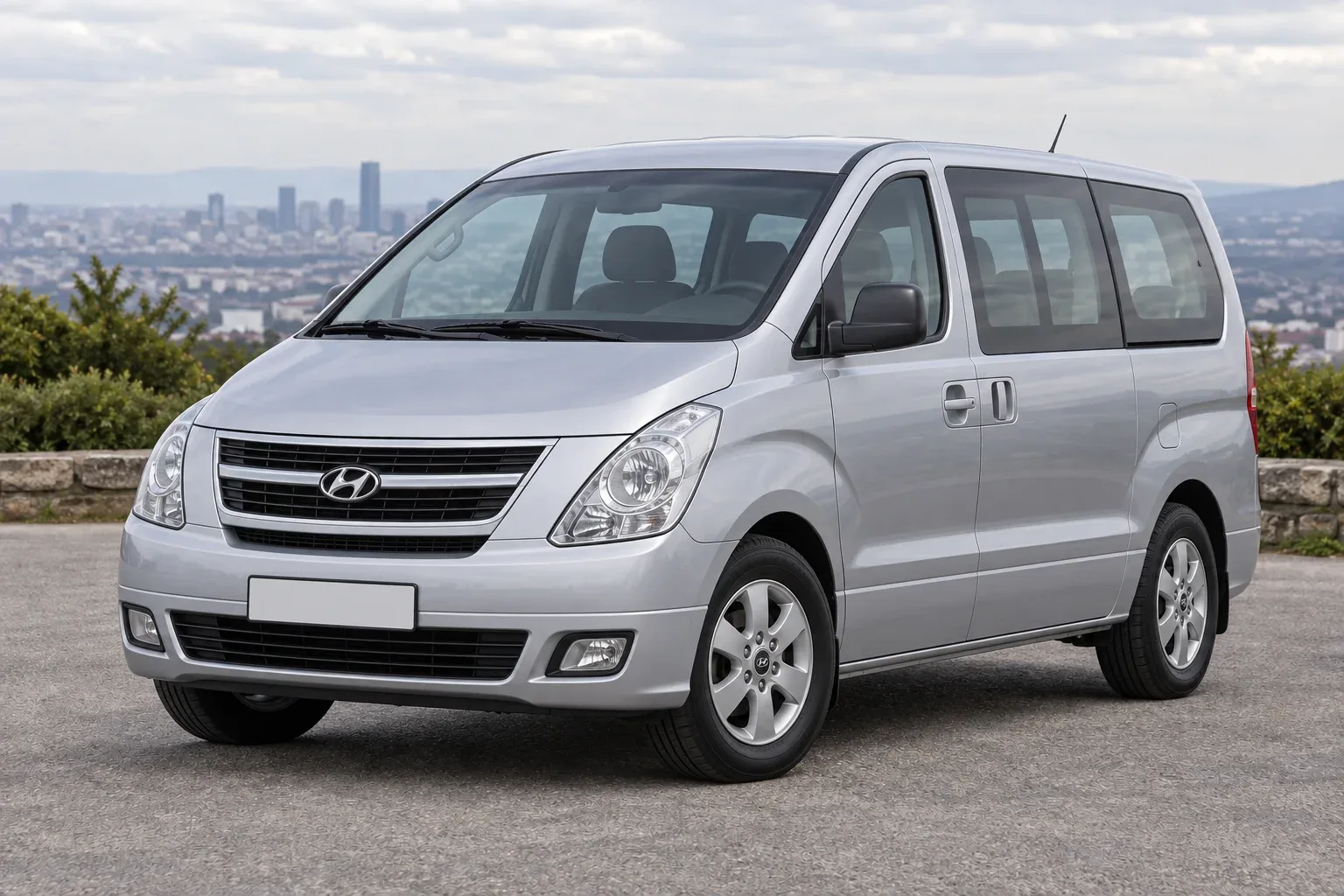
Hyundai H-1 / Grand Starex
Valuation of the Hyundai H-1 / Grand Starex (2007–2021): condition, paperwork, inspection and terms of sale.
Indicative purchase price
Below market value
Final price agreed after inspection.
Value my car1Why buyers choose this model
Production of the model began in 2007. At home, Van was introduced as Grand Starex. Export versions, in particular Russian and European, received the designation H-1. In 2012, the minivan experienced restyling. Hyundai has a load-bearing body, longitudinally located engine and rear-wheel drive. In total, there are three options - a 3-seater van, a 6-seater station wagon and a passenger minibus for 8/9 or 11/12 seats (only Grand Starex). The sizes of each are identical. With a length of 5.13 m, the H-1 competes with the Volkswagen T5 (5.29 m). The depth of the cargo compartment of the Korean van is 2375 mm, and the station wagon with two rows of seats is 1585 mm. In the three-row version, the trunk volume is 851 liters. The maximum load capacity is up to 1111 kg. In the cabin, among the features, it is worth noting the gear shift lever placed on the central panel. Thanks to this arrangement, moving from the driver's seat to the front passenger seat will not be a problem. In addition, here you can find electric drive and heating of exterior mirrors, parktronics, air conditioning system with an additional control unit for rear passengers. Cars from the domestic market of South Korea are more rich in equipment. Passenger modifications were serially equipped with the ESP stabilization system. The basic versions were equipped with ABS, EBD and two front airbags. In the crash tests according to Euro NCAP passenger version of the H-1 earned only three stars.
2What buyers check
Engines
The most widespread was a 2.5-liter turbodiesel (136-145 and 170-175 hp). This is the same unit that was installed in the first generation of Kia Sorento. Some modifications were equipped with a 2.5-liter turbodiesel recoil 101-116 hp. In the line of power units there is also a gasoline atmospheric 2.4 liters, developing 174 liters. with. In the secondary market, cars with such an engine are rare. All engines have a chain drive valve timing. Until 2012, diesel engines used the Bosch fuel system, and after that - Delphi. Turbodiesel with large runs sometimes presents surprises. For example, after 200,000 km, one of the chains of the valve timing can stretch - there are only three of them. For replacement along with work will have to pay 35-40 thousand rubles. In advanced cases, the stretched chain can be broken. When updating chains, attention should be paid to the balance shaft. Over time, it breaks up the seat in the block. If the wear is small, you can change the sleeve. If time is lost, the block will have to be replaced. Some mechanics just remove the shaft. At a segment of 150-250 thousand km often fails turbine (from 30 000 rubles). About the same are fuel injectors (from 15 000 rubles). Much earlier, copper sealing rings of nozzles are handed over. Certain difficulties may arise when replacing candles incandescent - they cling. Before extracting them, it is better to soak, otherwise the candle may break. Retrieving the debris is much more difficult – in some cases, even the cylinder head is required to be removed. Often gives a crack plastic valve cover.
Transmission
As standard, 6-th (only for 2.5/116 hp - after restyling) and 5-speed manual transmissions were offered. Optionally, a 5-speed machine could be ordered. Gasoline versions were combined with a 4-band automatic transmission. In November 2013, all-wheel drive versions appeared (not officially supplied).
In the transmission, crosses and a suspension bearing of the driveshaft are most often noticed - somewhere after 150-200 thousand km. Repair with balancing cardan will cost 9-10 thousand rubles. Due to the vibration of the faulty cardan, the tailing box or rear gearbox can wear and leak.
The 5-speed machine is a real long-lived. Under the Korean nomenclature A5SR2 hides the unkillable Japanese Jatco JR507E. With regular oil renewal (every 50-60 thousand km), automatic transmission easily overcomes the milestone of 300 000 km. After wear the hydraulic transformer, frictions, gaskets and glands. The cost of restoration repairs is about 80 000 rubles. Unfortunately, a little earlier solenoids can give up. There are also interruptions in the operation of the box caused by oxidation of contacts on the control board, or due to damage to the wiring or contact connector.
The manual transmission does not cause problems. The clutch serves more than 200-300 thousand km. The new set is available for 25 000 rubles.
Walking
Front suspension is independent - McPherson type, rear - dependent spring (for passenger cars) or spring (for freight cars).
Silent blocks of the front levers and ball supports often require replacement after 100-150 thousand km. A little later can be buzzing front hub bearings. They change in the collection with a hub and cost from 3,000 rubles.
The front springs break after 100-200 thousand km (from 5 000 rubles per piece). In the same period, front shock absorbers are also handed over (from 3,000 rubles). In the rear suspension, only shock absorbers and sifted springs have to be updated.
After 100-150 thousand km can flow or knock the steering rack (from 20 000 rubles for a new rack).
Bodywork
Hyundai imported from South Korea does not have additional corrosion protection, which is a concern among owners. The complex of works on processing the bottom, wheel arches and internal cavities will cost 10,000 rubles. Fortunately, body iron is not prone to corrosion. Red spots after 3-5 years can be found only on the back door - under the glazing.
But the tubes under the bottom corrosively. Replacement may be needed in 3-5 years. For a set of tubes of the rear heater will have to pay about 6 000 rubles, and the rear air conditioner - about 12 000 rubles.
For ease of boarding and loading, two practical side doors of a sliding type are provided. After 150-200 thousand km, rollers wear out - there is a knock on irregularities.
3Pre-purchase checklist
Engines
- When updating chains, attention should be paid to the balance shaft.
- If the wear is small, you can change the sleeve.
- The turbine often fails (from 30 000 rubles).
- Often gives a crack plastic valve cover.
- Owners of Hyundai H1 diesel engines sometimes have to deal with major engine repairs after about 200-300 thousand km.
- Major repairs will require about 100,000 rubles.
- In the hands of care, the need for capital does not arise so early.
Transmission
- Repair with balancing cardan will cost 9-10 thousand rubles.
- Due to the vibration of the faulty cardan, the tailing box or rear gearbox can wear and leak.
- The cost of restoration repairs is about 80 000 rubles.
- The manual transmission does not cause problems. The clutch serves more than 200-300 thousand km.
Walking
- km can flow or knock the steering rack (from 20 000 rubles for a new rack).
Bodywork
- Hyundai imported from South Korea does not have additional corrosion protection, which is a concern among owners.
- Fortunately, body iron is not prone to corrosion.
- But the tubes under the bottom corrosively.
- Replacement may be needed in 3-5 years.
- The rollers wear out km - there is a knock on irregularities.
4Challenges of selling privately
The vast majority of Hyundai H-1/Grand Starex in the secondary market have twisted runs. Fortunately, with a specialized diagnostic device, you can easily determine the true mileage. At the same time, it should be noted that many commercial minivans have traveled more than 500,000 km without serious problems with the engine and the box.
- Engines: If the wear is small, you can change the sleeve.
- Transmission: Repair with balancing cardan will cost 9-10 thousand rubles.
- Chasing: a km can flow or knock the steering rack (from 20 000 rubles for a new rack).
- Body: Hyundai imported from South Korea does not have additional corrosion protection, which is a concern among owners.
Shows, bargaining and re-registration take time: buyers look, promise to think and disappear. Fair price after inspection closes the auction on the spot. If money is needed urgently, the purchase takes away waiting and repeat displays.
5How selling to us works
Leave a request with the car data. We will discuss the preliminary assessment and inspection. After checking the status and documents, we agree on the final price and terms of the transaction.