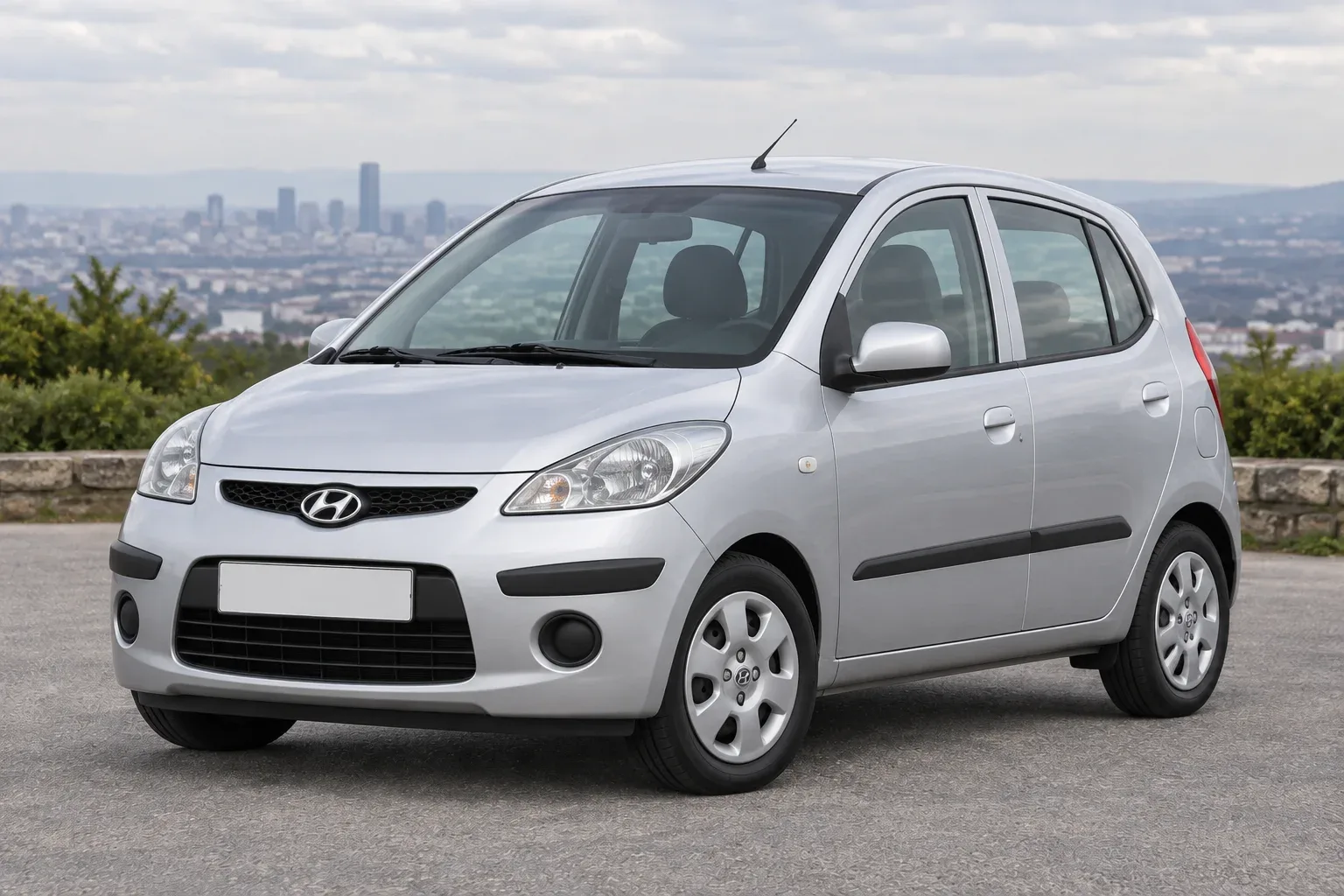
Hyundai i10 1
Valuation of the Hyundai i10 1 (2007–2013): condition, paperwork, inspection and terms of sale.
Indicative purchase price
Below market value
Final price agreed after inspection.
Value my car1Why buyers choose this model
In the twenty-first century, Hyundai entered into competition for European buyers. One of the models that opened a new chapter in the history of the brand was Getz.
2What buyers check
Review
In the twenty-first century, Hyundai entered into competition for European buyers. One of the models that opened a new chapter in the history of the brand was Getz. The car, produced since 2002, was successfully sold in Europe. Five years later, it’s time to get things straight in Segment A. The odd-looking baby Hyundai Atos has been replaced by the i10. Success. Sales statistics jumped and the new crumb attracted many customers who had never encountered the Korean brand before. The five-year guarantee was particularly attractive.
Hyundai didn't reinvent the bicycle. He drew on the experience of his colleague Kia, who introduced the Picanto in 2003. The i10 was built on its base. Another task force influenced the styling of the body and cabin, as well as the palette of engines and equipment.
In 2011, the Hyundai i10 underwent a restyling. It received a characteristic corporate “face” with a hexagonal grille. The modernization also touched the rear of the body, improved engines appeared, and the interior was updated.
The car was offered only in the five-door version. This is one of the main advantages of this model. An additional pair of doors facilitates access to the rear seats or the placement of child safety seats. In addition, the difficulties associated with landing and disembarking in cramped parking lots are minimized due to the wide front doors.
Engines
Under the hood of the Hyundai i10 engines, known by Picanto: gasoline displacement of 1.1 liters (67 and 69 hp) and 1.2 liters (77 and 86 hp), as well as diesel 1.1 liters (75 hp). In the secondary market, the most popular car with a gasoline engine of 1.1 liters. The base engine is best suited for the city, but if necessary, it will do well for the highway, where it consumes less than 6 l / 100 km. Fuel consumption in the city largely depends on the style of driving and traffic intensity, sometimes it can reach 9 l / 100 km. For fans of “fast driving” it is better to look at a more powerful 1.2-liter engine: a sprint to “hundreds” takes 12.2 seconds, against 15 with a 1.1-liter modification. At the same time, the average consumption does not differ much - about 6.3 l / 100 km. In addition, the engine has a chain drive of the HRM, which excludes one of the points of operating costs.
The three-cylinder 1.1 CRDi is a unique offer. Its main advantage is low fuel consumption - 4.2 l / 100 km. In case of failure of the diesel engine repair can be expensive. Usually, 1.1 CRDi does not shine with durability. The city car in most cases does not cover such long distances, and is not able, due to the relatively low fuel consumption, to compensate for the cost of repairs. Simple calculations show that the real savings are not noticeable until 160,000 km.
Interior
Those who have not encountered modern A-Class cars before will be pleasantly surprised at the large volumes of interior space they offer. the 3.56-meter Hyundai i10 is at the forefront of the segment. If necessary, it can carry four adult passengers. The space overhead and in the legs is good, but considering the fact that we are dealing with a car with a 2.38-meter wheelbase. In comparison tests, the i10 has earned a higher rating than the Panda and Picanto. However, the rear seats are vertically mounted, which on long trips will not allow passengers to feel comfortable. A 225 litre trunk is not a bad result. But, Volkswagen Up proved that the A-Class car can have a trunk and larger dimensions.
The interior of the Hyundai i10 has been carefully designed. The readings are easily readable and the gear lever is in the immediate vicinity of the driver's hand. The salon is decorated from hard plastic, most often in an unattractive color scheme - a combination of black and gray.
It is a pity that Hyundai has stinted on noise insulation materials. The noise in the cabin is more than in the sister Picanto. The hum starts to annoy at high speeds. In the city, the i10 provides reasonable comfort. Drivers praise the high landing behind the wheel, and large exterior mirrors that help control the situation around the car. In dense traffic and in cramped parking lots, the small size of the body and small turning radius (less than 5 m) become a serious advantage.
Walking
On the front axle there is a suspension of the McPherson type, on the rear - a torsion beam. It is a reliable and cheap solution in terms of operation. The baby's body is tall and narrow. To protect the car from rolling over in corners, engineers had to install stiffer shock absorbers and springs. This has had a negative impact on the level of comfort. Competitors absorb irregularities with greater virtuosity. In addition, the steering too much isolates the driver from information about the state of the road and the reserve of adhesion of the wheels to the surface.
Equipment
The equipment, depending on the configuration, is very different. The base i10 will have only two airbags and ABS. “Climate”, side airbags, curtains, fog lights, adjusting the height of the driver’s seat, power steering, central lock, audio system and electric windows are already luxury items reserved for more expensive versions. It is better to pay attention to the higher trim levels, as such i10 more comfortable and better looking.
Bumpers, mirrors and door handles, painted in body color – the prerogative of the Comfort, Style and Premium trim levels. In addition, these cars are equipped with wheels size 165/60 R14, providing better handling compared to the base 155/70 R13. Gasoline engines can be combined with a 4-speed automatic transmission. It works sluggishly, limits dynamics and increases fuel consumption.
But finding a well-equipped i10 is not an easy task. In addition, the cold calculation suggests that it is better to choose a larger and more comfortable Hyundai i20, despite the fact that for the same money it will be equipped with a simpler.
Characteristic problems and malfunctions
Is a small car a small problem? In the case of the Hyundai i10, this rule works. There are no failures that would immobilize the car. Owners note oil leaks, failures of ABS sensors and power steering, problems with the gear selection mechanism, poorly closing the trunk door, detachment of side moldings, malfunctions of the headlight control system and screeching of belts. The least durable in the suspension were the hub bearings and front transverse levers. The first foci of corrosion appear most often on the trunk door.
The Hyundai i10 owners’ observations are confirmed by reliability reports. German car club DECRA has a positive opinion of the model. It should be noted that the number of faults detected in all categories is below average. The most common defects include: failures of the light control system, problems with the stop light switch and brake pads that wear too quickly.
The position of the model in another German report of the Association of technical supervision TUV – average, but in the ranking of the German automotive club ADAC car has earned high marks. Typical malfunctions: battery discharge, problems with the immobilizer, leaks in the cooling system, contamination of spark plugs and improper operation of internal lighting.
Spare parts for small cars are among the cheapest. In the case of the Hyundai i10, even original spare parts that can be found easily will not significantly unload the wallet. The number of alternative substitutes is also increasing year by year.
3Pre-purchase checklist
Engines
- The base engine is best suited for the city, but if necessary, it will do well for the highway, where it consumes less than 6 l / 100 km.
- In case of failure of the diesel engine repair can be expensive.
- The city car in most cases does not cover such long distances, and is not able, due to the relatively low fuel consumption, to compensate for the cost of repairs.
Interior
- If necessary, it can carry four adult passengers.
Characteristic problems and malfunctions
- Is a small car a small problem?
- There are no failures that would immobilize the car.
- Owners note oil leaks, failures of ABS sensors and power steering, problems with the gear selection mechanism, poorly closing the trunk door, detachment of side moldings, malfunctions of the headlight control system and screeching of belts.
- The first foci of corrosion appear most often on the trunk door.
- It should be noted that the number of faults detected in all categories is below average.
- The most common defects include: failures of the light control system, problems with the stop light switch and brake pads that wear too quickly.
- Typical malfunctions: battery discharge, problems with the immobilizer, leaks in the cooling system, contamination of spark plugs and improper operation of internal lighting.
4Challenges of selling privately
Hyundai i10 is not breathtaking – style, noise, performance, handling. In addition, in the secondary market it is difficult to find a car with a small mileage.
- Functionality and a sufficiently free interior space
- In the twenty-first century, Hyundai entered into competition for European buyers.
- Engines: In case of diesel failure, repairs can be expensive.
- Interior: Anyone who has not encountered modern A-Class cars before will be pleasantly surprised at the large volumes of interior space they offer.
- Driving: On the front axle there is a McPherson suspension, on the rear - a torsion beam.
- Equipment: The equipment, depending on the configuration, is very different.
- Characteristic problems and malfunctions: Small car – small problems?
Shows, bargaining and re-registration take time: buyers look, promise to think and disappear. Fair price after inspection closes the auction on the spot. If money is needed urgently, the purchase takes away waiting and repeat displays.
5How selling to us works
Leave a request with the car data. We will discuss the preliminary assessment and inspection. After checking the status and documents, we agree on the final price and terms of the transaction.