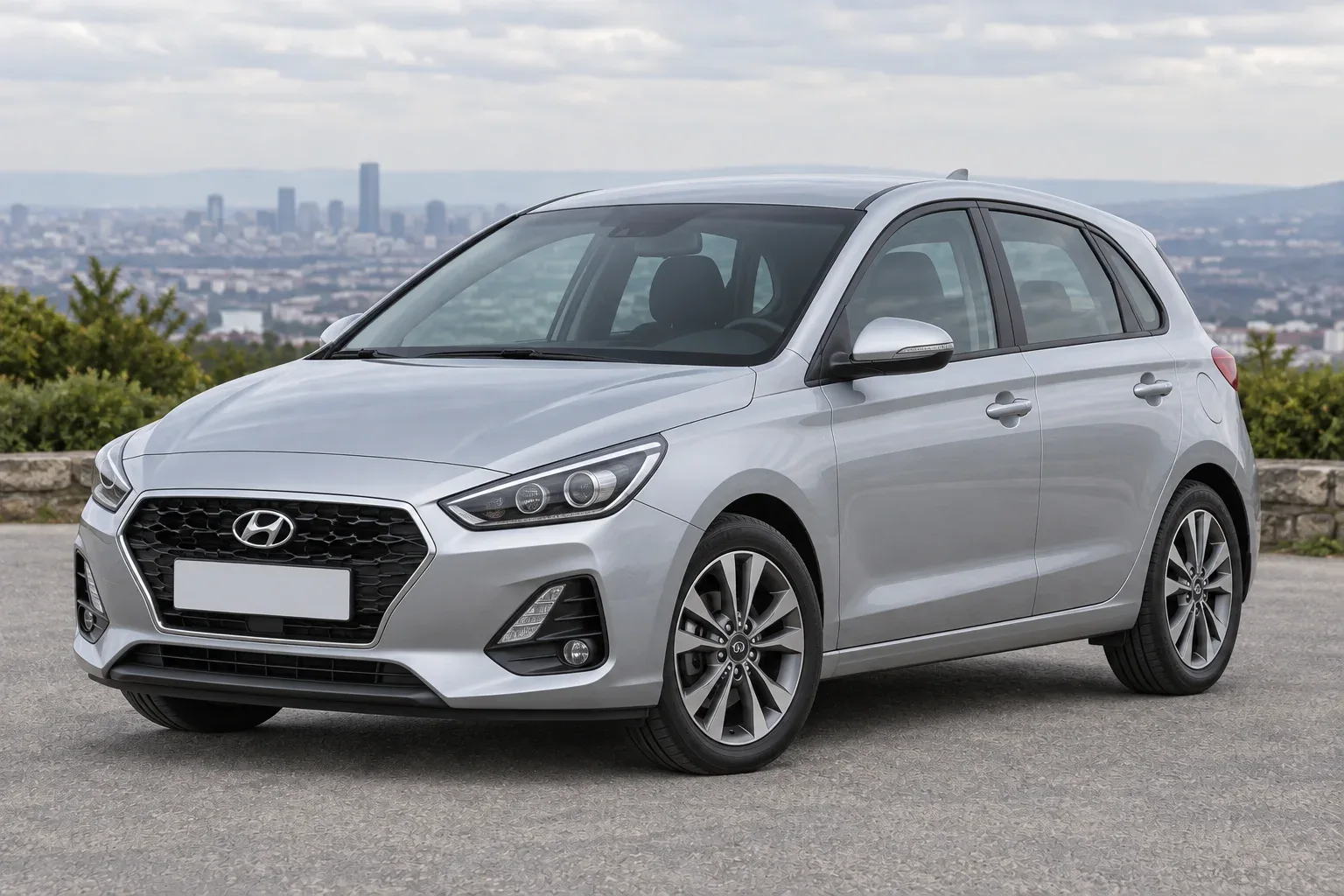
Hyundai i30 3
Valuation of the Hyundai i30 3 (2017–2026): condition, paperwork, inspection and terms of sale.
Indicative purchase price
Below market value
Final price agreed after inspection.
Value my car1Why buyers choose this model
Hyundai has been surprised by its progressive debuts in the past. On the eve of the presentation of the third generation i30, many believed that there would be another breakthrough, and the Korean dragon will burn competitors to the ground. For starters, Škodu. A normal car came out. Pretty, with an excellent ratio of price and quality, but without the previous bonuses in the form of space in the cabin and a pleasant chassis. It still has a little comfort, but in general the model exuded tasteless fashion for "sport" - a squat body with a landing closer to the ground. There is an even more dynamic Fastback and a sportier i30 N, which Hyundai has put a lot of effort into building. However, the backbone of sales is usually in the lower half of the price range, where buyers are more important than practicality than dynamics. If the cabin is smaller, at least the trunk has increased. The wagon occupies one of the first places in the compact class with a trunk volume of 602 liters. The advantages of multi-link rear suspension are known to many. Since April 2019, Hyundai has started installing a rigid axle with a torsion beam on the younger versions of the i30, following the example of economical competitors. Oddly enough, the version with a beam is perceived by many as more comfortable. It can be found in the CVVT 100 hp (1.4 MPI), T-GDI 120 hp (1.0 T-GDI) and T-GDI 140 hp (1.4 T-GDI) versions.
2What buyers check
1.0 T-GDI (1.0 L, R3/12V, 120 HP, as of 2017)
A three-cylinder supercharged engine from the Kappa 3 family. He shakes a little at low revs and calms down only in the area of 2,000 rpm, after which he pulls decently. On the highway, it's even quieter than the 1.4 T-GDI, but consumes no less - at best as much. There are no problems with it, but because of the sensitivity of the flow to the load, it is more suitable for less busy tasks. Starting from the 2019 model year, the engine was equipped with a GPF filter.
Thanks to the heavy flywheel, the three-cylinder engine resets very slowly, so smooth gear shifting is possible only in the case of moving the lever with the ease of the bus driver. The slower the better.
1.4 CVVT MPI (1.37 litres, R4/16V, 100 hp, until 2020)
The atmospheric engine from the Kappa family with distributed injection requires a chase for short gears. It is not well suited for highways but ideal for the city - long traffic jams with numerous starts do not harm it. Unlike the older Gamma series engines, the 1.4 CVVT does not suffer from fatal catalyst failure. The average fuel consumption is about 7 liters. The engine was available only in the initial configurations of the hatchback and wagon. It was later replaced by a new 1.5 CVVT with dual DPi injection.
1.4 T-GDI (1.35 L, R4/16V, 140 HP, until 2020).
Technically, it is the older brother of the liter turbo engine. The engine is pleasant, elastic, energetic at medium speeds, designed for dynamic driving. His only problem is the rattling of the turbocharging control mechanism. A number of cars came under warranty repair - the entire turbocharging was changed entirely or only the control element, but this did not always help. After a while, the problem returned, as the element has a design flaw.
Less often, some owners complain of periodic thud in the engine and short-term loss of traction at full acceleration, which may indicate some susceptibility to the phenomenon of LSPI (low-speed knock). However, no mechanical damage to the engine has been detected so far, so hopefully it will remain so.
As with the three-cylinder, the GPF has been installed since the 2019 model year (assembly from autumn 2018).
2.0 T-GDI (2.0 L, R4/16V, 250 or 275 HP, as of 2017)
The 2-liter engine of the top-end version of the i30 N is available in two versions, with the more powerful (for N Performance) combined with a more complex robotic transmission. Both versions pull powerfully, but the main strength of the model is in the exquisitely tuned running room. The exclusive combination with the manual transmission is impressive, as are the thoughtfully shortened service intervals.
1.6 CRDi "U2" (1.58 liters, R4/16V, 95/110/135 hp, through 2018)
The old version of the diesel engine with a chain of HRM and cast-iron block, familiar from its predecessor. The weakest option was only available for the hatchback, but thanks to long gears it is the quietest and most economical on the highway. the 135-horsepower variant features a manual transmission for better dynamics. The engine is reliable and still relatively simple. His karma is spoiled only by the expensive DPF particulate filter.
1.6 CRDi SCR "U3" (1.58 R4/16V, 115/135 hp, since September 2018)
A completely new diesel with a HRM belt, an aluminum block and already with the AdBlue system. It is quieter, half a liter more economical, but equipped with more expensive original injectors and a rather complex emission control system, which with age is likely to require significant costs. It includes a DPF filter, a catalytic converter SCR and a dozen sensors in the exhaust. All these components are unlikely to last forever.
DCT
Turbocharged four-cylinder engines were often combined with a dual-clutch DCT automatic transmission. It smoothly switches and has a well-thought-out electromechanical control system, which still does not mean the prospect of cheap repairs. On some models with DCT (in particular, on the i40), where due to vibration at start-up it was necessary to change the clutch set, repair in the post-warranty period was quite expensive - materials alone cost more than 60 000 rubles.
Childhood diseases
On the technical side of the problems, as a rule, does not arise, and the quality of the assembly at height. The number of reviews and technical events is much lower than the usual average level. The wire is also reliable. The interruptions and reports of some assistance systems being disabled (autonomous emergency braking, frontal collision warning, lane assistance) in the simpler versions of the i30 are more related to the features of the systems where they are controlled exclusively by a multifunction camera. It all depends on the lighting conditions, the pollutedness of the camera, etc.
A more advanced system, which operates with a remote radar in the front, does not suffer from interruptions. But it is not very common - was an option in the trim levels of Technology (which already has emergency braking with pedestrian detection) and Ultimate, available only in the top-end configuration of Style.
It’s a pity that almost all of the most interesting hardware features (LED headlights, keyless access, automatic wipers, an 8-inch screen with Android Auto/Apple CarPlay navigation and support, wireless phone charging, and more) were usually only available in an expensive super package available only for top-end models. It is part of the philosophy of Asian brands.
Brake pads last on average about 50,000 km, discs - twice as long. Updating maps in navigation is free for 10 years.
Malfunctions and problems
Knocking in the rear axle area (versions with multilink rear suspension, most often wagons of the first year of release): is solved by a stronger tightening of the bolt holding the stabilizer rack in the lever.
Clogged valve EGR (CRDI "U2" at high mileage): can be cleaned.
Slipper clutch (very rare): If the cause was oil leakage through the shaft bearing (a fault more familiar from its predecessor, but rare here), then the repair was carried out under warranty.
Service recommendations
All petrol versions and old 1.6 CRDi diesel engines of the U2 generation use the HRM drive chain. The new 1.6 CRDi U3 diesel engines (since September 2018) use a valve timing drive belt with a replacement interval of 240,000 km/16 years.
Schedule of scheduled maintenance prescribed by the manufacturer: warranty inspections after 15,000 km / 1 year, with the replacement of engine oil for gasoline engines (10,000 km for i30 N sports). For diesel engines, it all depends on the annual mileage - the oil changes annually, regardless of mileage. The manufacturer’s limit for mileage within a year is 30,000 km, which is too much.
The air filter changes no later than 30 000 km / 2 years (officially - after 60 000 km), spark plugs - after 75 000 km / 5 years, fuel filter for diesel engines - after 60 000 km / 4 years. Oil replacement in mechanical and automated DCT transmissions is recommended after 120,000 km (better to reduce to 60,000 km).
Pluses
Reliable mechanical part Exemplary ergonomics, still lots of physical buttons Very interesting sporty version of i30 N Roomy trunk wagon
Cons
Tight policy for additional options Predecessor had a more spacious cabin and higher seating Fragile trunk cover (estate) High prices for some parts (engine parts, electronics) Complex exhaust system of new diesels 1.6 CRDi "U3" (from 9/2018), which threatens big investments in the future
Model history
2017: The start of hatchback sales at the beginning of the year. Engine variants 1.0 T-GDI (6MT transmission), 1.4 MPI (6MT), 1.4 T-GDI (6MT or 7AMT), 1.6 CRDi (95 hp/6MT), 1.6 CRDi (115 hp and 135 hp/6TM or 7AMT). There are versions of the body Estate (wagon) and Fastback. The Sport i30 N with a 2.0 T-GDI (250 or 280 hp / 6MT) is initially only in the hatchback body.
2018: i30 N with Fastback bodywork. In autumn, new diesels "U3" 1.6 CRDi SCR (with AdBlue) were introduced. The T-GDI gasoline now has a particulate filter. New front bumper for hatchback and wagon (based on fastback).
2019: From April, a simplified rear suspension for some hatchback and wagon options. Limited Series i30 N Project C (275 hp / 6MT). From the list of proposals disappeared basic diesel capacity of 95 hp.
2020: Facelifting in the spring. The new 1.5 CVVT (6MT) and 1.5 T-GDI (6MT or 7AMT) engines are available. The mild-hybrid 48V hybrid system is standard for 1.5 T-GDI and 1.6 CRDi (135 hp), optional for 1.0 T-GDI (120 hp).
Seat Leon 3 (2012-2020)
An interesting feature of this model line is the ultra-modern three-door hatchback Leon SC with a shorter wheelbase and lower roof. Another notable option is the station wagon in the “road” version of the X-Perience, offering the most comfortable suspension in addition to the mandatory all-wheel drive.
Opel Astra K (since 2015)
Opel invested the money saved on sheet metal in modern technologies, such as LED matrix headlights. They are out of service in a few years and cost a lot of money. The most interesting engine is a modest 100-horsepower atmospheric unit with a volume of 1.4 liters (B14XE, 2015-2018). The basic three-cylinder 1.0 surprises with good balance and smoothness.
3Pre-purchase checklist
1.0 T-GDI (1.0 L, R3/12V, 120 HP, as of 2017)
- There are no problems with it, but because of the sensitivity of the flow to the load, it is more suitable for less busy tasks.
1.4 T-GDI (1.35 L, R4/16V, 140 HP, until 2020).
- His only problem is the rattling of the turbocharging control mechanism.
- A number of cars came under warranty repair - the entire turbocharging was changed entirely or only the control element, but this did not always help.
- After a while, the problem returned, as the element has a design flaw.
- Less often, some owners complain of periodic thud in the engine and short-term loss of traction at full acceleration, which may indicate some susceptibility to the phenomenon of LSPI (low-speed knock).
DCT
- It smoothly switches and has a well-thought-out electromechanical control system, which still does not mean the prospect of cheap repairs.
- On some models with DCT (in particular, on the i40), where due to vibration at start-up it was necessary to change the clutch set, repair in the post-warranty period was quite expensive - materials alone cost more than 60 000 rubles.
Childhood diseases
- On the technical side of the problems, as a rule, does not arise, and the quality of the assembly at height.
Malfunctions and problems
- Knocking in the rear axle area (versions with multilink rear suspension, most often wagons of the first year of release): is solved by a stronger tightening of the bolt holding the stabilizer rack in the lever.
- Slipper clutch (very rare): If the cause was oil leakage through the shaft bearing (a fault more familiar from its predecessor, but rare here), then the repair was carried out under warranty.
Service recommendations
- Schedule of scheduled maintenance prescribed by the manufacturer: warranty inspections after 15,000 km / 1 year, with the replacement of engine oil for gasoline engines (10,000 km for i30 N sports).
- Oil replacement in mechanical and automated DCT transmissions is recommended after 120,000 km (better to reduce to 60,000 km).
4Challenges of selling privately
The cost of the cheapest copies has already fallen below a million and a half, and this is not the hottest product on the secondary. Fastback is a rather interesting version, designed to play the role of a youth stiletog and managed to fill a gap in the market in its segment.
For connoisseurs, there is a hot version of the N that even the most optimistic fans probably wouldn't have expected from Hyundai just a few years ago. Time is moving forward and Hyundai has undergone a decent evolution over the past decade.
- DCT: It switches smoothly and has a sophisticated electromechanical control system, which doesn’t mean the prospect of cheap repairs.
- Children's diseases: On the technical side of the problems, as a rule, does not arise, and the quality of the assembly at height.
- Faults and problems: Knocking in the rear axle area (versions with multilink rear suspension, most often wagons of the first year of release): is solved by a stronger tightening of the bolt holding the stabilizer rack in the lever.
- Maintenance recommendations: Oil replacement in manual and automated DCT gearboxes is recommended after 120,000 km (better cut to 60,000 km).
- Pros: Reliable mechanical part Exemplary ergonomics, still lots of physical buttons Very interesting sporty version of i30 N Roomy trunk wagon
- Cons: Tough policy regarding additional options The predecessor had a more spacious interior and a higher seating Fragile trunk lid (estate) High prices for some parts (engine parts, electronics) Complex exhaust system of new diesels 1.
- Model history: 2017: hatchback sales start at the beginning of the year. Engine options 1.0 T-GDI (6MT transmission), 1.4 MPI (6MT), 1.4 T-GDI (6MT or 7AMT), 1.6 CRDi (95 hp/6MT), 1.6 CRDi (115 hp and 135 hp /6TM or 7AMT).
Shows, bargaining and re-registration take time: buyers look, promise to think and disappear. Fair price after inspection closes the auction on the spot. If money is needed urgently, the purchase takes away waiting and repeat displays.
5How selling to us works
Leave a request with the car data. We will discuss the preliminary assessment and inspection. After checking the status and documents, we agree on the final price and terms of the transaction.