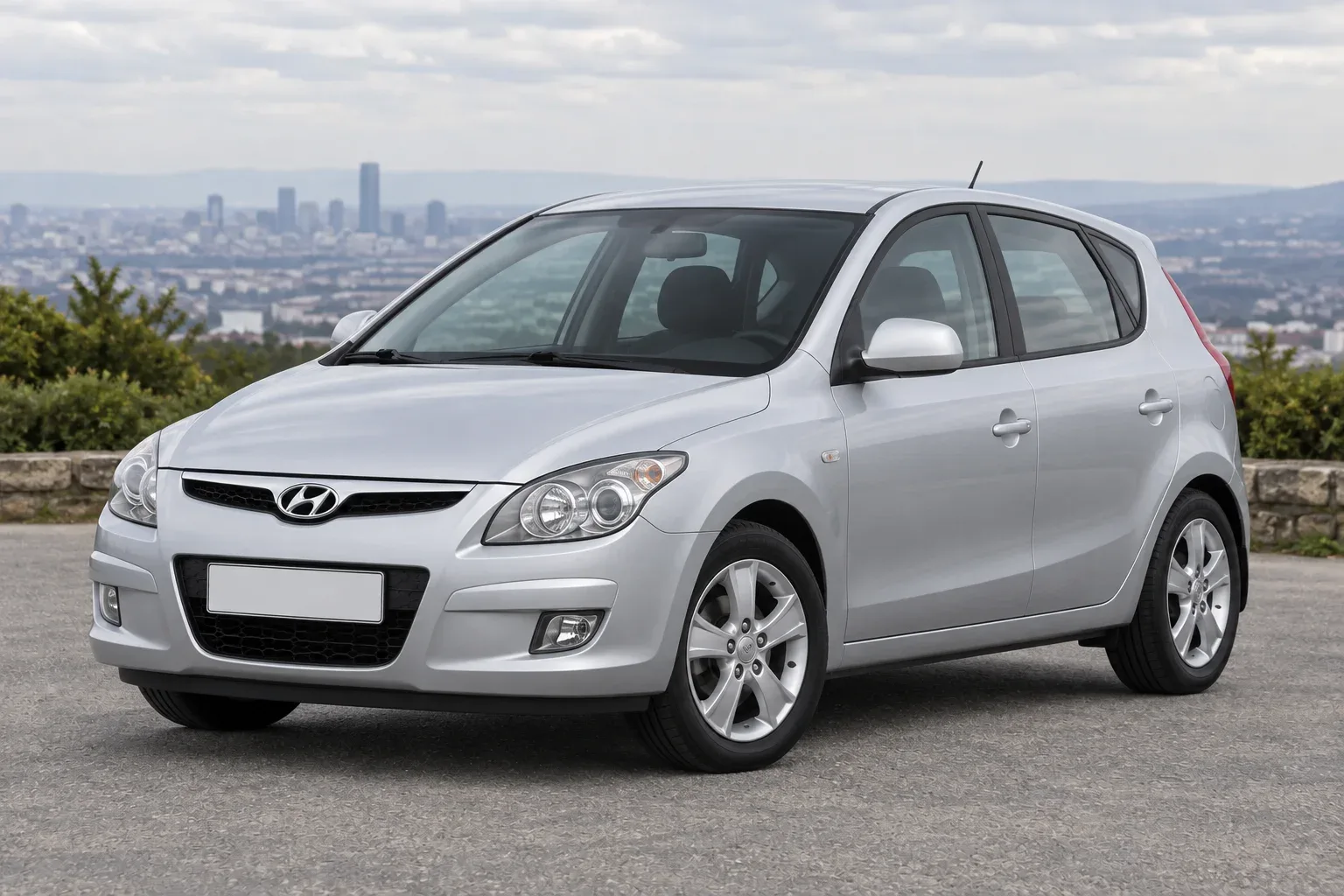
Hyundai i30
Valuation of the Hyundai i30 (2007–2012): condition, paperwork, inspection and terms of sale.
Indicative purchase price
Below market value
Final price agreed after inspection.
Value my car1Why buyers choose this model
Hyundai has come a long way. The current cars of this brand are increasingly popular. However, in the process of promoting their products, mistakes were not avoided. In particular, this was felt by the owners of the first Hyundai Ai 30. The i30 is highly regarded today, but the market has been very difficult to get started due to a number of minor ailments.
2What buyers check
Bodywork
The body lines were created primarily for European tastes. i30 is one of the first models of the Korean brand that looks so good. Simple features appealed to a wide range of motorists who prefer a restrained style. Hyundai offered two body options - wagon and hatchback. In 2010, the i30 underwent a barely noticeable restyling.
Interior
Let the Korean car and not the champion in the interior, but ready to accommodate even tall passengers. The most comfortable on the back sofa in the station wagon - thanks to the wheelbase, increased by 5 cm. However, the capacity of the trunk of the station wagon can disappoint many – only 415 liters. For comparison, the luggage compartment of the Renault Megane Grandtour wagon is 524 liters.
The ergonomics of the driver’s workplace are flawless. The spacious interior is finished with medium-quality plastic and in many instances it begins to creak over time. Sometimes they make strange sounds and front seats. In addition, in motion, the already saturated acoustic background is complemented by the noisy work of the suspension.
Engines
Engines are one of the strengths of the Korean compact. Both petrol and diesel powertrains do not have any major issues, but are very sensitive to quality and timing of oil change. Gasoline atmospherics with a working volume of 1.4 liters (109 hp), 1.6 liters (122-126 hp) and 2.0 liters (143 hp) are equipped with a phase change system for gas distribution. With proper operation and timely maintenance, these engines serve faultlessly for several hundred thousand kilometers. However, all gasoline engines are considered "comparatively" voracious. Japanese competitors have a reputation for being more economical. Thus, the 1.4-liter engine in the city consumes at least 9 liters per 100 km. In gasoline engines, there are only a little more than 3 liters of oil, so it is very important to change it at least once every 10,000 km. Problems with starting a hot engine may occur due to a faulty sensor position crankshaft (500-1200 rubles). The ignition coils can fail after 130-180 thousand km (1500-2000 rubles). Over time, on the lid of the HRM chain (behind the engine from the passenger side), oil fogging is detected. This is a childhood disease, eliminated after the cover is sealed. Some owners resort to replacing the chain of the fuel and gas after 100-150 thousand km (9000 rubles plus 5000 rubles for work). However, it usually serves more than 250-300 thousand km. After 150-200 thousand km, the starter may require attention.
Transmission
Transmissions, usually, do not cause trouble to their owners, regardless of the fact that it is a 4-speed "automatic", or 5 or 6-speed "mechanics". However, automatic transmission works relatively slowly, and both manual transmissions are considered not sufficiently clear. However, these shortcomings do not affect the durability of the boxes.
Sometimes the mechanism of selection of gears of mechanics requires intervention. Fortunately, this does not require dismantling and disassembling the box, and repairs are inexpensive.
The clutch of the manual transmission usually serves more than 150-200 thousand km. The new set will cost about 6-9 thousand rubles and the replacement work - about 4000 rubles.
Walking
Front suspension Hyundai i30 type McPherson, rear – independent multi-link. This combination makes it easy to overcome corners at high speed without worrying about losing wheel grip. However, the suspension elements are not durable. So the bushings and racks of the stabilizer of transverse stability rarely withstand more than 40 000 km in our conditions. About the same served and the Silentblocks of the front levers of the first copies. They were later upgraded and the problem disappeared. Since then, the Silentblocks (200-700 rubles) reach 100-150 thousand km. Ball supports are given a little earlier - after 80-130 thousand km (600 rubles for an analogue). Support bearings of front shock absorbers (500-800 rubles) can knock after 120-150 thousand km. A similar resource has and front shock absorbers (3-5 thousand rubles). Shock absorbers and sailent blocks of the rear suspension reach up to 150-200 thousand km. The rear springs (2,000 rubles per piece) are noticeably sagging after 8-10 years. The front wheels' hub bearings become unusable through 120-180 thousand km. They are changed separately (1300-2000 rubles). Before buying, you should definitely check the operation of the electric power steering, as it is prone to malfunctions. On cars before 2008, due to a defect in the electric amplifier, a knock in the steering often appeared. There are also failures in the operation of the steering wheel angle sensor. Knocking in the steering when running more than 150-200 thousand km usually occurs due to wear of the steering rack. The new original rake will cost 18 000 rubles, and an analogue can be found for 10-14 thousand rubles.
Typical problems and malfunctions
One of the problems of Hyundai i30 is the corrosion of the body. Weak paint coating over time overgrown chips, and bare metal soon begins to “bloom”. Particular attention should be paid to the area of the trunk door. Attract attention to complaints about the “fogging” of headlights and the “stubbornness” of the central lock.
Common defects: peeled paint on the steering wheel and corrosion of doors.
Owners of copies older than 6-7 years have to deal with the replacement of a leaky radiator air conditioner. The cost of a new one is from 4000 rubles. Approximately the same amount will be asked for a replacement.
Another common breakdown is a severance of the driver's door lock cable. A few years ago I had to buy a castle. Today, you can find and replace only a cable (500 rubles). However, this procedure is quite complicated and expensive.
Another ailment is the flickering of the dashboard after turning off the ignition. This leads to the discharge of the battery.
Sometimes the electric motor of the rear windshield wiper is also handed over. It is often impossible to disassemble because of rusted screws. You will have to buy a new one (about 2 000 rubles).
Over time, the gas filling neck can leak (2500 rubles), which causes the smell of gasoline. Sometimes there is a leakage of gasoline due to cracking of the tank. Usually this is the faulty absorber (2000 rubles).
Gasoline versions
*** Fuel consumption in the EU: city / highway / medium
Diesel versions
*** Fuel consumption in the EU: city / highway / medium
3Pre-purchase checklist
Engines
- Both petrol and diesel powertrains do not have any major issues, but are very sensitive to quality and timing of oil change.
- With proper operation and timely maintenance, these engines serve faultlessly for several hundred thousand kilometers.
- In gasoline engines, there are only a little more than 3 liters of oil, so it is very important to change it at least once every 10,000 km.
- Problems with starting a hot engine may occur due to a faulty sensor position crankshaft (500-1200 rubles).
- Over time, on the lid of the HRM chain (behind the engine from the passenger side), oil fogging is detected.
- If you decide to install gas equipment, it is worth bearing in mind that approximately every 60,000 km should be monitored gaps valves and if necessary correct.
- Both diesel units use the Common Rail injection system with Bosch nozzles, which are amenable to recovery repair.
- It does not have a two-mass flywheel, so replacing the clutch here is no more expensive than in gasoline versions.
Transmission
- Fortunately, this does not require dismantling and disassembling the box, and repairs are inexpensive.
Walking
- This combination makes it easy to overcome corners at high speed without worrying about losing wheel grip.
- They were later upgraded and the problem disappeared.
- Before buying, you should definitely check the operation of the electric power steering, as it is prone to malfunctions.
- On cars before 2008, due to a defect in the electric amplifier, a knock in the steering often appeared.
- Knock in the steering when running more than 150-200 thousand.
- The km usually occurs due to wear of the steering rack.
- Therefore, repairs for 13,000 rubles are not always financially feasible, given that, in the most optimistic case, it will last for 100,000 km.
Typical problems and malfunctions
- One of the problems of Hyundai i30 is the corrosion of the body.
- Particular attention should be paid to the area of the trunk door.
- Attract attention to complaints about the “fogging” of headlights and the “stubbornness” of the central lock.
- Common defects: peeled paint on the steering wheel and corrosion of doors.
4Challenges of selling privately
Hyundai i30 is a very interesting offer in the secondary market among compact cars. For reasonable money, you can get a spacious car with a modern design. There are not many replacements for the original spare parts, but they are cheaper compared to similar parts for German cars, similar in size and age.
- Body lines were created primarily for European tastes.
- The Korean car is not a champion in the interior, but it is ready to accommodate even tall passengers.
- Engines: Both petrol and diesel powertrains do not have any major issues, but are very sensitive to quality and oil change timing.
- Transmission: Fortunately, this does not require dismantling and disassembling the box, and repairs are inexpensive.
- Driving: This combination makes it easy to overcome corners at high speed without worrying about losing wheel grip.
- Typical problems and malfunctions: One of the problems of Hyundai i30 is body corrosion.
Shows, bargaining and re-registration take time: buyers look, promise to think and disappear. Fair price after inspection closes the auction on the spot. If money is needed urgently, the purchase takes away waiting and repeat displays.
5How selling to us works
Leave a request with the car data. We will discuss the preliminary assessment and inspection. After checking the status and documents, we agree on the final price and terms of the transaction.