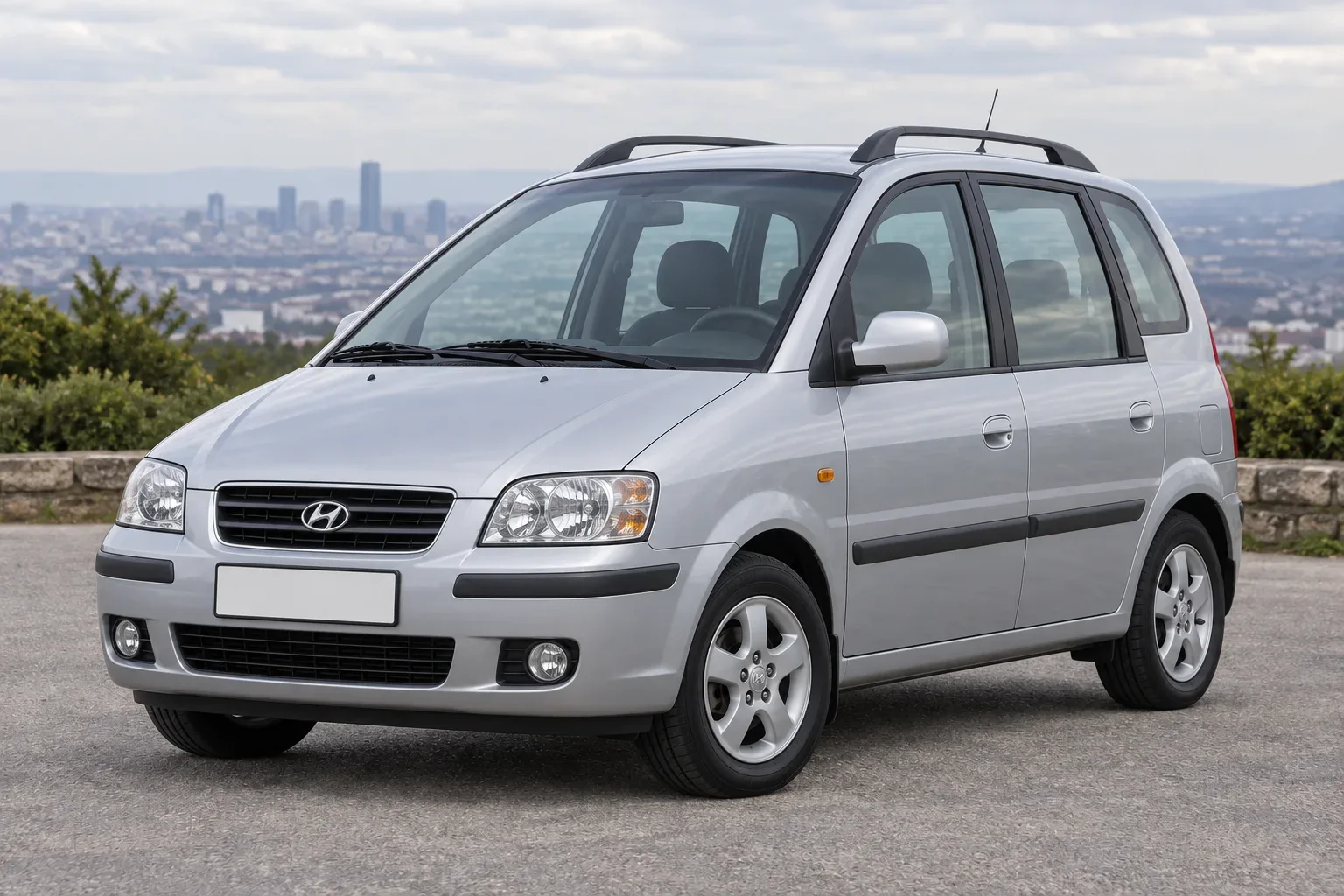
Hyundai Matrix
Valuation of the Hyundai Matrix (2001–2010): condition, paperwork, inspection and terms of sale.
Indicative purchase price
Below market value
Final price agreed after inspection.
Value my car1Why buyers choose this model
At the beginning of the XXI century, the Korean brand began to court customers from the Old World. The launch of the Matrix coincided with the opening of Hyundai’s European headquarters near Frankfurt. The Korean van is developed on the compact platform Elantra. The specific style of the body was created in the studio Pinifarina. Not entirely consistent lines evoke mixed feelings. The owners claim that there is a twist to this madness. The understated line of side windows combined with a high landing give a sense of space and provide a good view. This is confirmed by maneuvering. It is a pity that the diameter of the turn exceeds 11 meters. Fortunately, finding a parking spot is not a problem. The Hyundai Matrix is only 4.03 m long. In its size, it is comparable to Opel Meriva – a classic representative of the microvan segment. The Hyundai Matrix has been upgraded twice. In 2005, the grille increased, the headlights changed, and a new diesel engine appeared. The time for the next facelift came in 2008. The converted front end and dark plastic in the cabin changed the car for the better. The optional ESP has improved safety and the diesel particulate filter has made the engine more environmentally friendly.
2What buyers check
Interior
There is no shortage of space in the cabin. The front seats are spacious and properly profiled. The steering column is adjustable only in height, but it is not difficult to find a comfortable position behind the wheel. Most of the Matrix on the secondary market is represented by dorestyling instances with hard and gray plastic. Hyundai could have done better. The family car allows you to come to terms with many aesthetic shortcomings. Especially when there are a lot of practical solutions. The rear seat is asymmetrically divided into two parts and changes its longitudinal position in the range of 19 centimeters. The back has an adjustment on the angle of inclination and a hidden armrest. Passengers have folding tables and cup holders at the back of the central tunnel. The space above the head and in the legs is sufficient. The lack of a tunnel on the floor will be appreciated by the passenger in the middle. The dashboard hit the very top of the center console. In the field of view of the driver left only the main alarms - direction indicator, minimum fuel level and oil pressure, included parking brake and driving beam, open doors and others. The simple look of the icons clearly confirms that until recently Hyundai paid attention exclusively to functionality. The location of the instrument panel is the only extravagance. It's very trivial inside. In addition to the comfortable air conditioning control panel and the classic audio system head unit, there are several compartments for small items. the 354-litre trunk does not disappoint.
Engines
For Hyundai Matrix, gasoline engines with a working volume of 1.6 liters (103 hp, 141 Nm) and 1.8 liters (122 hp, 162 Nm) were provided. The lineup also had a diesel unit - 1.5 liters (82 hp, 187 Nm; since 2005, 102 hp, 235 Nm and 110 hp, 235 Nm).
Gasoline engines require periodic renewal of the gear belt. Replacement is made every 60,000 km. The cost of a new set of valve timing 3-4 thousand rubles, and work on replacement - 5-8 thousand rubles.
Supports of power units (2-4 thousand rubles) reach 150-200 thousand km. At this stage, it may be necessary to replace the radiator (9-15 thousand rubles). From time to time there is leakage of oil from under the valve cover.
Among diesels, turbodiesel, used after 2005, deserves positive recommendations. Then the three-cylinder engine of the Italian company VM Motori with a belt of the HRM gave way to a four-cylinder diesel engine of Hyundai's own design with a chain-type valve timing drive. The new turbodiesel works quieter and has a high torque. The latter is very lacking in gasoline engines. Good traction could be achieved only by spinning the gasoline engine up to 4500 rpm. Therefore, overtaking on a loaded car makes you seriously strain.
Transmission
Any of the gasoline engines for an additional fee could be combined with a 4-speed automatic. In general, the automatic box is considered reliable. However, a number of owners faced repair automatic transmission after 200-250 thousand km of run due to the destruction of the bearing of the 4th gear. The cost of repairs is 30-50 thousand rubles.
Diesel units were combined exclusively with a manual transmission. The clutch of the ICS usually serves more than 200,000 km. The new set will cost 5-8 thousand rubles.
Walking
Independent suspension on both axles provides good comfort, absorbing most irregularities. The situation changes when the driver decides to push the gas harder. With rapid movements in corners, the body begins to heel, and the characteristics of the steering do not allow you to assess the margin of adhesion of the wheels with the road. From dynamic driving scares away even the noise of the engine, clearly audible from both gasoline and diesel units.
Ball supports and silentblocks of the front levers wear out to 100-130 thousand km. Rear suspension silenticulars usually withstand more than 150,000 km.
Front hub bearings can make noise after 100-150 thousand km. The bearing changes separately from the hub. The cost of work will be about 2000 rubles.
External SRUS are usually surrendered after 150-200 thousand km. The new part is available for 1400 rubles, and for the work you will have to pay 1000 rubles.
Other problems and malfunctions
Hyundai Matrix in the ratings of DEKRA took not the best lines. During technical inspections, loss of tightness by the power steering system was relatively often found. Repeatedly revealed corrosion of the brake tubes. DEKRA experts also noted the rapid wear of brake discs and pads, as well as the appearance of cracks on the anthers of the SRUS. When running more than 100,000 km, backlash appeared in ball supports and suspension bushes.
At first glance, the list of faults may seem long. However, most of the problems are the result of negligent exploitation. Serious failures that can immobilize the car are rare.
After 200-250 thousand km there are problems with an immobilizer, a starter or a generator (from 7000 rubles for an analog). In some instances, the thermostat was handed over.
Owners most often complain of corrosion attacking the front and rear wings, wheel arches and edges of body elements. It also gets a subframe (18 000 rubles for an analogue plus 5000 rubles for work).
With age, the windshield wiper of the trunk door ceases to work due to the acidification of the leash axis.
Finding parts is not a difficult task, especially if you use the Internet for this. All thanks to the technical affinity with other models of the Korean brand. Equally important, the prices of branded substitutes are quite affordable.
Dignities:
- Affordable cost of used copies;
3Pre-purchase checklist
Interior
- If necessary, the back of the sofa can be folded.
Engines
- Gasoline engines require periodic renewal of the gear belt. Replacement is made every 60,000 km. The cost of a new set of valve timing 3-4 thousand.
- At this stage, it may be necessary to replace the radiator (9-15 thousand rubles).
Transmission
- However, a number of owners faced repair of automatic transmission after 200-250 thousand.
- The cost of repairs is 30-50 thousand rubles.
Other problems and malfunctions
- During technical inspections, loss of tightness by the power steering system was relatively often found.
- Repeatedly revealed corrosion of the brake tubes.
- DEKRA experts also noted the rapid wear of brake discs and pads, as well as the appearance of cracks on the anthers of the SRUS.
- When running more than 100,000 km, backlash appeared in ball supports and suspension bushes.
- At first glance, the list of faults may seem long.
- However, most of the problems are the result of negligent exploitation.
- km there are problems with an immobilizer, starter or generator (from 7000 rubles for an analogue).
- Owners most often complain of corrosion attacking the front and rear wings, wheel arches and edges of body elements.
4Challenges of selling privately
Hyundai Matrix is an undervalued car and therefore loses in value quite quickly. Yes, its appearance and interior are not impressive, but the technical part and the internal volume do not give cause for disappointment. If the budget is limited, but you need a moderately fresh family car, then the Hyundai Matrix is worth your attention.
Interested in buying diesel versions can be recommended 102 and 110-strong modifications. Earlier diesel engines had problems with the injection system.
- Interior: There is no shortage of space in the cabin.
- Engines: Gasoline engines require periodic renewal of the gear belt. Replacement is made every 60,000 km. The cost of a new set of valve timing 3-4 thousand.
- Transmission: However, a number of owners faced automatic transmission repair after 200-250 thousand.
- Driving: Independent suspension on both axles provides good comfort, absorbing most irregularities.
- Other problems and malfunctions: During technical inspections, loss of tightness by the steering amplifier system was relatively often detected.
- Advantages: - Affordable cost of used copies;
Shows, bargaining and re-registration take time: buyers look, promise to think and disappear. Fair price after inspection closes the auction on the spot. If money is needed urgently, the purchase takes away waiting and repeat displays.
5How selling to us works
Leave a request with the car data. We will discuss the preliminary assessment and inspection. After checking the status and documents, we agree on the final price and terms of the transaction.