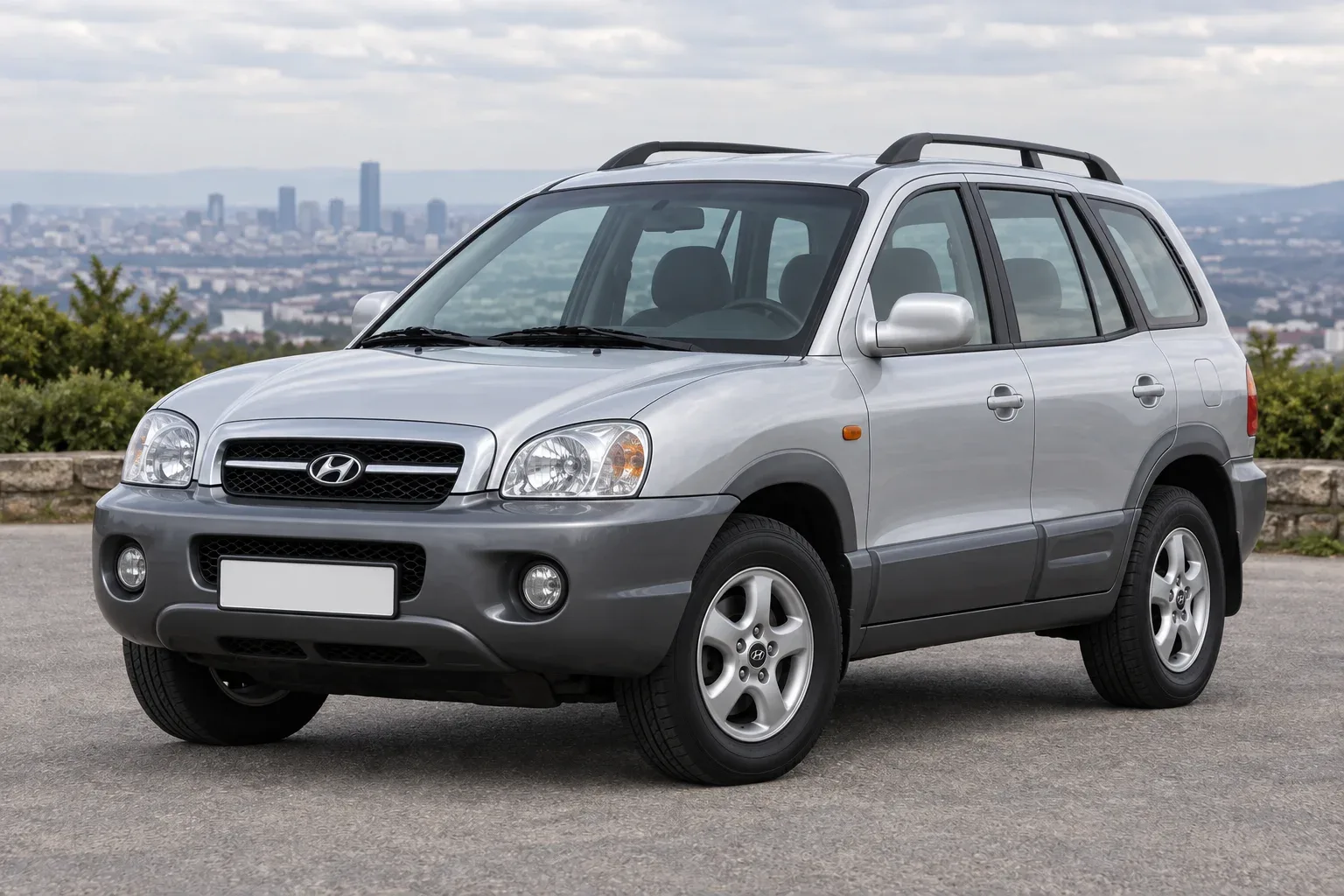
Hyundai Santa Fe / Classic
Valuation of the Hyundai Santa Fe / Classic (2000–2006): condition, paperwork, inspection and terms of sale.
Indicative purchase price
Below market value
Final price agreed after inspection.
Value my car1Why buyers choose this model
Hyundai Santa Fe I is the first SUV from the South Korean manufacturer. Despite criticism of journalists for ambiguous appearance, the crossover became a hit in the American continent. It was specifically designed for the US market. The basis of the SUV was the Hyundai Sonata EF platform. In 2004, a restyling was carried out, and in 2006 there was a change of generations. But the original Santa Fe in our market got a second life under the name Santa Fe Classic. In 2007, the production of the model was organized at the enterprise "TagAZ". The car of Taganrog assembly was distinguished by painted in body color plastic linings and a Classic nameplate on the rear door. The cabin has enough space for front and rear passengers, and the trunk capacity is 469 liters. If necessary, the rear seats fold, forming a flat platform. The volume of cargo space is increased to 2100 liters. In cramped parking lots, you can take advantage of the opportunity to access the trunk through the glass of the fifth door. In 2002, Santa Fe was tested by Euro NCAP. The result is four stars out of five possible stars, and for a collision with a pedestrian – only one star out of four.
2What buyers check
Engines
2.0 R4 G4JP / 147 hp was supplied only to the European market. 2.4 R4 G4JS / 150 hp - base for the US and Russian markets. Both Sigma series engines have hydraulic valve pushers and a geared belt drive of the gas distribution mechanism. 2.7 V6 G6BA / 173 hp belongs to the Delta family. The distribution shafts of the intake and exhaust valves of each of the heads are connected by a chain. The knee shaft is connected to the intake shafts by a geared belt. The chain runs more than 250-300 thousand km. The gaps of the valves are adjusted by means of hydraulic pushers. A 2.7-liter V6 with the L6BA index, powered by gas, was sold only in South Korea. However, in the secondary market there are cars with this engine, but converted to work on gasoline. As a rule, after such artisanal modernization, owners regularly face various failures in the operation of the engine. The V6 3.5 G6CU / 197-200 hp is a representative of the Sigma series and has been available only in the United States since 2003. 2.0 CRDi D4EA with the Common Rail injection system was offered exclusively outside the states. The engine was created by the Italian company VM Motori and received a belt drive valve timing. In February 2002, a more powerful version of the VGT appeared with a variable geometry turbocharger and more productive Bosch nozzles. The engine output increased from 112 to 125 hp, and torque - from 250 to 285 Nm. The Russian market officially supplied cars with a 2.4-liter four and a 2.7-liter V-shaped six. And since 2001 - and with a diesel engine.
Transmission
The 2-liter gasoline atmospheric was equipped exclusively with 5-speed mechanics. the 2.4-liter unit and 2.0 CRDI were mated either with a 4-speed automatic or with a 5-speed mechanics. The 2.7-liter V6 was available with only a 4-band machine, and the 3.5-liter machine was available with only a 5-band one.
The clutch of manual transmissions has a short service life, especially in diesel versions. It can wear out after 50-100 thousand km. Together with the clutch (from 6000 rubles per set) can go and two-mass flywheel (from 11 000 rubles).
The manual transmission itself sometimes forces you to contact the service for 150-200 thousand km of mileage. By this time, bearings, gears or synchronizers are worn out. The cost of repair will be about 30 000 rubles.
The automatic transmissions are designed by Mitsubishi. The boxes are reliable, but not eternal. The first episodes with repairs are observed after 250-300 thousand km. For the restoration of efficiency in a specialized service will ask about 70 000 rubles.
All-wheel drive system
The petrol versions of the 2.0 and 2.7 LBA (designed for gas) were exclusively front-wheel drive. Basic versions of the Santa Fe with 2.4, as well as with a 2-liter turbodiesel, could also be front-wheel drive. The remaining modifications had a permanent all-wheel drive. The transmission was developed by Austrian specialists from Steyr-Daimler-Puch. It is based on an interaxial differential with a viscosity clutch. Under normal conditions, the clutch distributes the moment between the axles in a ratio of 60:40 in favor of the front wheels. Due to this, the nature of the handling of the car is neutral and very close to the passenger car. In a critical situation, the clutch is able to transfer to the rear axle up to 90% of the power. For an additional fee, an all-wheel drive modification was installed rear interwheel differential of increased friction LSD. Top versions with gasoline 3.5 and the most powerful turbodiesel (since 2004) received an all-wheel drive system with electronic control. It works a little faster. Under normal conditions, all thrust is transferred to the front axle. The rear wheels are connected on demand by an electromagnetic coupling built into the rear differential. Such cars were not officially offered in Russia. However, the Santa Fe is just a crossover, not designed for serious off-road. A viscous compression is a series of discs immersed in a thixotropic silicone liquid. The fluid changes the viscosity coefficient when heated, which happens when one of the wheels loses traction and the discs begin to rotate at different speeds.
Walking
On the front axle are Macpherson struts, and on the rear - longitudinal and transverse levers. Energy-intensive and soft suspension literally absorbs irregularities. However, in corners, the body is strongly tilted, and there is an acute lack of lateral support in the seats.
A well-known problem is the walking front stabilizer of transverse stability. He's starting to bang on the spanger. For the cure, it is enough to replace the sleeves and racks of the stabilizer. Unfortunately, some desperate owners resort to unacceptable measures. They use a hammer to deform the spangeron.
Ball supports of the front levers (300-500 rubles) are surrendered after 80-120 thousand km. Silentblocks live over 150-200 thousand km. The cost of the lever in the collection is from 3,000 rubles.
The rear suspension levers will serve more than 150-200 thousand km. Sometimes there are difficulties when updating the longitudinal levers - the bolt sticks to the inner sleeve.
Stage bearings pass, bypassing the mark of 150-250 thousand km. They change separately from the hub and cost from 600 rubles.
The steering rack can knock or leak after 150-200 thousand km. The price tag for the new rack starts at 13,000 rubles.
Other problems and malfunctions
Body iron of the first Santa Fe, although not prone to corrosion, but when inspected it is better to pay attention to the rear wheel arches and wings.
The interior of the model is typical Korean at the time. The front panel is made of rigid plastic, which resists the influence of time. It deserves praise and quality of assembly. Even after many years, in most cases, foreign creaks and cracks do not occur during the movement.
Electrical equipment is generally reliable, but sometimes there are failures in the operation of the electric drive of mirrors, lighting equipment or a central lock. The culprit is the ETACS comfort block. A good electrician will easily restore his performance.
Problems with charging are observed after 150-200 thousand km. Attention will require a generator (from 5 000 rubles per analogue) or burnt-out terminal on it.
After 200-300 thousand km, a compressor (from 10 000 rubles), an electromagnetic clutch, or a pulley bearing of a clutch can fail.
The ventilation system can attract attention because of the burnt power transistor of the heater (400-600 rubles) or the heater motor (from 2,500 rubles).
3Pre-purchase checklist
Engines
- Replacing oil caps does not always solve the problem, since the cause of oil is the underlying oil-removable rings.
- You may need to replace the TNVD (from 28 000 rubles).
Transmission
- It can wear out after 50-100 thousand km.
- The cost of repair will be about 30 000 rubles.
- The first episodes with repairs are observed after 250-300 thousand km.
All-wheel drive system
- The rear wheels are connected on demand by an electromagnetic coupling built into the rear differential.
- Then in the transmission fluid will appear characteristic white impurities. The clutch is indissoluble and unrepairable. The cost of the new node is 60-80 thousand rubles. The ailment is not critical, though.
- If there is a hum or howl, then you should prepare for repair (from 10 000 rubles). The disease occurs after 200-250 thousand km.
- By this time, the suspension bearing of the driveshaft (1-3 thousand rubles) can also wear out.
- There are also problems with the distribution (hum, flow).
- After repair, the main thing is that the distribution is correctly installed.
Walking
- A well-known problem is the walking front stabilizer of transverse stability. He's starting to bang on the spanger.
- The steering rack can knock or leak after 150-200 thousand km.
Other problems and malfunctions
- Body iron of the first Santa Fe, although not prone to corrosion, but when inspected it is better to pay attention to the rear wheel arches and wings.
- Problems with charging are observed after 150-200 thousand km.
- km can fail compressor (from 10 000 rubles), electromagnetic clutch, or bearing pulley clutch.
4Challenges of selling privately
The Hyundai Santa Fe I is a very successful model. Hardy suspension and a solid trunk allow you to make a worthy competition to family wagons and compact vans. It is better to avoid a car with a diesel engine, and the version with a 2.7-liter petrol V6 is considered the least problematic.
- Engines: Replacing oil caps does not always solve the problem, since the cause of oil glut is the underlying oil removable rings.
- Transmission: It can wear after 50-100 thousand km.
- All-wheel drive system: The rear wheels are connected on demand by an electromagnetic coupling built into the rear differential.
- Driving: A well-known problem is the walking front stabilizer of transverse stability. He's starting to bang on the spanger.
- Other problems and malfunctions: Body iron of the first Santa Fe, although not prone to corrosion, but when inspected it is better to pay attention to the rear wheel arches and wings.
Shows, bargaining and re-registration take time: buyers look, promise to think and disappear. Fair price after inspection closes the auction on the spot. If money is needed urgently, the purchase takes away waiting and repeat displays.
5How selling to us works
Leave a request with the car data. We will discuss the preliminary assessment and inspection. After checking the status and documents, we agree on the final price and terms of the transaction.