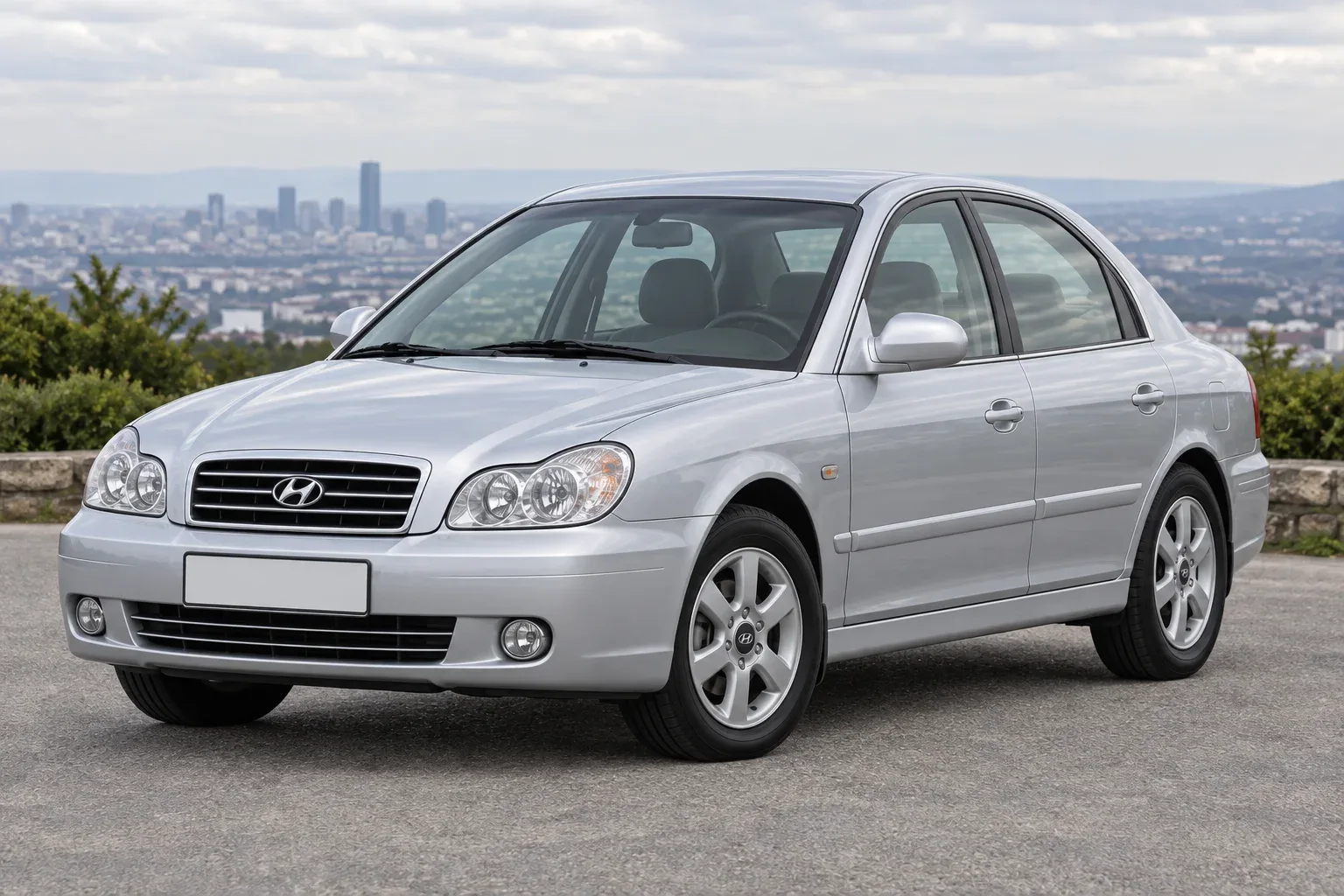
Hyundai Sonata 4 / New EF
Valuation of the Hyundai Sonata 4 / New EF (2002–2011): condition, paperwork, inspection and terms of sale.
Indicative purchase price
Below market value
Final price agreed after inspection.
Value my car1Why buyers choose this model
The fourth generation Hyundai Sonata (EF) debuted in August 1998. It is built on a single platform with Kia Magentis.
2What buyers check
Review
The fourth generation Hyundai Sonata (EF) debuted in August 1998. It is built on a single platform with Kia Magentis. This platform was the basis of the first Hyundai Santa Fe.
The car was offered only in one version of the bodywork – a sedan. In 2002, the model was seriously updated (New EF): increased dimensions, changed the front and rear parts.
In 2005, the next generation model, the NF, was introduced. But the New EF isn't dead. Its production was established in Taganrog. The last copies left the conveyor in 2011. In the Tagazov versions on the grille there was no nameplate Hyundai.
Hyundai Sonata was designed primarily for the markets of South Korea and the United States. There comfort is valued much more than technical sophistication and sport handling. For this reason, the model did not enjoy much success in Europe. But our customers liked Sonata due to the relatively low price, roominess and a good level of comfort.
Engines
Initially, the engine line was represented by 4-cylinder atmospheric engines with a volume of 2.0 liters (131 hp) and 2.4 liters (138 hp), as well as a 6-cylinder V6 2. 7 liters (172 hp). The first two are Sirius series members, the largest is Delta. The Sirius units are a copy of the engines of the Mitsubishi Surius series of the same name. the 2-liter G4JP is an analogue of the 4G63, and the 2.4-liter G4JS is 4G64 (only offered in the US market). Both motors have a belt-driven valve timing and hydraulic valve pushers. Since mid-2006, the 2-liter Sirius has been replaced by the new Beta II (G4GC) with a return of 137 hp. The fundamental differences are few: the balancing shafts and hydraulic compensators disappeared. The valve gap is adjusted by washers. The valve timing belt only acts on the exhaust camshaft, which is connected to the intake short chain. Instead of rubber supports of the engine began to use hydraulic. The Delta G6BA series is the result of a deep modernization of the Mitsubishi Cyclone (6G7) series engine. The valve timing drive here is also of a combined type: a belt on the intake camshafts, which are connected to the exhaust chain. The valve clearance is adjusted by means of hydraulic pushers. One of the common problems of all units is the break of the belt of the timing. The consequences are trivial. At best - flexing valves, at worst - damage to the head of the block, pistons and bullies in the cylinders. Many owners of Sonata found themselves in an unpleasant situation, and did not wait for the scheduled 60,000 km. Causes: high loads on the drive elements and low quality of components.
Transmission
In a pair of engines were installed 5-speed mechanics or 4-speed automatic.
The mechanical box is quite reliable. However, with large runs, sometimes there is a need for repair due to wear of the gears of the differential and bearings. To restore the efficiency of the manual transmission will need about 15 000 rubles.
Clutch of mechanical boxes, working in pair with 2.0-liter engines, runs more than 120-180 thousand km. The cost of the new set is about 6 000 rubles, and work on replacement is 4 000 rubles.
The clutch of boxes that function with the 2.7-liter V6 has a shorter lifespan. The stalling clutch is better to be replaced immediately, otherwise premature wear of the two-mass flywheel is inevitable. Mechanics recommend to replace the faulty flywheel to install an analogue from Santa Fe - it is more reliable. The flywheel is available for 8,000 rubles, and a new clutch kit is available for 7,000 rubles.
The machine was developed by Mitsubishi and is designated F4A42. Under normal operating conditions and regular oil change, the box is quite capable of traveling 300,000 km without repair. However, in practice, serious malfunctions occur after 200,000 km. You have to change the hydroblock or eliminate the consequences of the differential destruction. The cost of repairs from 40 to 80 thousand rubles.
In a pair with a 2.4-liter engine, automatic transmission was installed, which differed in gear ratios. When it fails, it is possible to replace it with an analogue from machines with a 2.0 Sirius engine.
Walking
The suspension settings are shifted towards comfort. The steering wheel is light and low-information, and the reactions to the steering wheel are restrained. When active driving, the feed begins to swim. But passengers almost do not notice the seams and road patches.
On the front axle, double transverse levers are used, and on the rear - a multi-link scheme with the effect of steering. Silent blocks of the front levers run more than 120-160 thousand km. Silentblock rear upper lever is surrendered after 80-120 thousand km. The same will serve ball supports of the front lower levers, and the upper - 150-200 thousand km. The design of the lower levers provides for the replacement of the ball (from 500 rubles). The upper support changes only with the lever (from 2 000 rubles).
Shock absorbers retain efficiency up to 100-150 thousand km. The cost of depreciation rack - from 4000 rubles.
The rear stage bearings wear out after 100,000 km, and the front ones after 150,000 km. If the front hubs allow you to get rid of the replacement of the bearing (from 1000 rubles), the rear ones change only in the collection (from 4000 rubles). External SRUS (2,000 rubles) fail after 100-150 thousand km.
The steering rack can knock or flow through 80-100 thousand km. The cost of a new reiki is from 19 000 rubles. The pump GUR (8 000 rubles) sometimes begins to make noise or leak closer to 200 000 km.
Problems with ABS can occur due to a bursting of the serrated ring. It's changing with the SRUS. But you can pick up an analogue: 1300 rubles plus 1500 rubles. for installation.
Bodywork
Body iron is not prone to corrosion. Red spots are found 9-10 years later on wheel arches, rapids or at the bottom of doors. Sometimes corrosion actively attacks the cups of the front shock absorbers.
In cars of 2004-2005, assembled on Tagaz, sometimes there is a swelling of paint on the front doors. This is through corrosion, developing under the lining on the inside of the door. The slap was later removed and the problem did not arise.
Water in the trunk appears due to thin taillight seals.
Heating and ventilation system
The radiator of the heater can flow after 100-120 thousand km. Then there are problems with the inflow fan - begins to thresh at maximum speed. The culprit is a burned-out thermostat (from 600 rubles). The fan itself wears out after 200,000 km. For a new one will have to pay at least 3,000 rubles.
Problems with the air conditioning system are observed after 150,000 km. Loses tightness radiator air conditioner (from 4 thousand rubles), fails electromagnetic clutch (from 2000 rubles) or the compressor itself (from 12 000 rubles).
Other problems and malfunctions
After 40-100 thousand km, sometimes a leak of a fuel tank filled with more than half is detected. The whole thing is in the deterioration of the patency of the adsorber valve or tubes connecting it to the tank. Discharge leads to deformation and cracking of the “fragile” tank – more often in the upper right corner. For a new tank will have to pay more than 10 000 rubles.
After 100-150 thousand km, the fuel pump loses its efficiency. The entire knot in the collection costs about 7 000 rubles. But you can only replace the pump itself - from 1,500 rubles.
After 150-200 thousand km, the windshield wiper drive mechanism often sours. The wipers begin to work intermittently, jam, and an unpleasant creak appears. The mechanism can be resuscitated by thoroughly cleaning and lubricating. The electric motor can also refuse - from 4000 rubles.
The generator may require attention in 150-200 thousand km. The voltage regulator fails, bearings and brushes wear out. The cost of a new generator is from 6000 rubles.
"Bad mass" leads to fluctuations in the temperature readings of the coolant. And when you turn on the headlights or air conditioner, the shooter creeps up eerily. The solution is simple – to install an additional mass wire between the engine and the body.
3Pre-purchase checklist
Engines
- One of the common problems of all units is the break of the belt of the timing. The consequences are trivial.
- The way out is to replace the toothed belt once in 40-50 thousand km.
- It is worth noting that replacing the timing belt on Sirius engines requires some experience.
- The need for major repairs arises only with the most sad consequences of the break of the belt of the timing.
- Attention should be paid to the idle regulator or the throttle position sensor.
- After some time, gaskets can flow in candle wells and under the valve lid.
- The starter may fail after 150-200 thousand.
- km - due to wear of the retractable or brush.
Transmission
- However, with large runs, sometimes there is a need for repair due to wear of the gears of the differential and bearings.
- The stalling clutch is better to be replaced immediately, otherwise premature wear of the two-mass flywheel is inevitable.
- Mechanics recommend to replace the faulty flywheel to install an analogue from Santa Fe - it is more reliable.
- Under normal operating conditions and regular oil change, the box is quite capable of traveling 300,000 km without repair.
- However, in practice, serious malfunctions occur after 200,000 km.
- You have to change the hydroblock or eliminate the consequences of the differential destruction. The cost of repairs from 40 to 80 thousand rubles.
- When it fails, it is possible to replace it with an analogue from machines with a 2.0 Sirius engine.
Walking
- The steering rack can knock or flow through 80-100 thousand km.
- Problems with ABS can occur due to a bursting of the serrated ring. It's changing with the SRUS.
Bodywork
- Body iron is not prone to corrosion.
- Sometimes corrosion actively attacks the cups of the front shock absorbers.
- This is through corrosion, developing under the lining on the inside of the door.
- The slap was later removed and the problem did not arise.
Heating and ventilation system
- The radiator of the heater can flow after 100-120 thousand km.
- Then there are problems with the inflow fan - begins to thresh at maximum speed.
- Problems with the air conditioning system are observed after 150,000 km.
- rub), the electromagnetic clutch (from 2 000 rubles) or the compressor itself (from 12 000 rubles) fails.
Other problems and malfunctions
- Sometimes a leak of a fuel tank filled with more than half is detected.
- The electric motor can also refuse - from 4000 rubles.
- The voltage regulator fails, bearings and brushes wear out.
4Challenges of selling privately
From the statistics of malfunctions, we can conclude that the Hyundai Sonata is a fairly reliable car. Most of the faults are related to age and impressive mileage. Fortunately, all the problems are well-studied, the market is full of spare parts, and repairs are not complicated.
- The fourth generation Hyundai Sonata (EF) debuted in August 1998.
- Engines: One of the common problems of all units is the break of the belt of the timing. The consequences are trivial.
- Transmission: However, with large runs, sometimes there is a need for repair due to wear of the gears of the differential and bearings.
- Driving: The steering rack can knock or leak through 80-100 thousand km.
- Body: Body iron is not prone to corrosion.
- Heating and ventilation system: The heater radiator can flow after 100-120 thousand km.
- Other problems and malfunctions: sometimes a leak of a fuel tank, fueled more than half, is detected.
Shows, bargaining and re-registration take time: buyers look, promise to think and disappear. Fair price after inspection closes the auction on the spot. If money is needed urgently, the purchase takes away waiting and repeat displays.
5How selling to us works
Leave a request with the car data. We will discuss the preliminary assessment and inspection. After checking the status and documents, we agree on the final price and terms of the transaction.