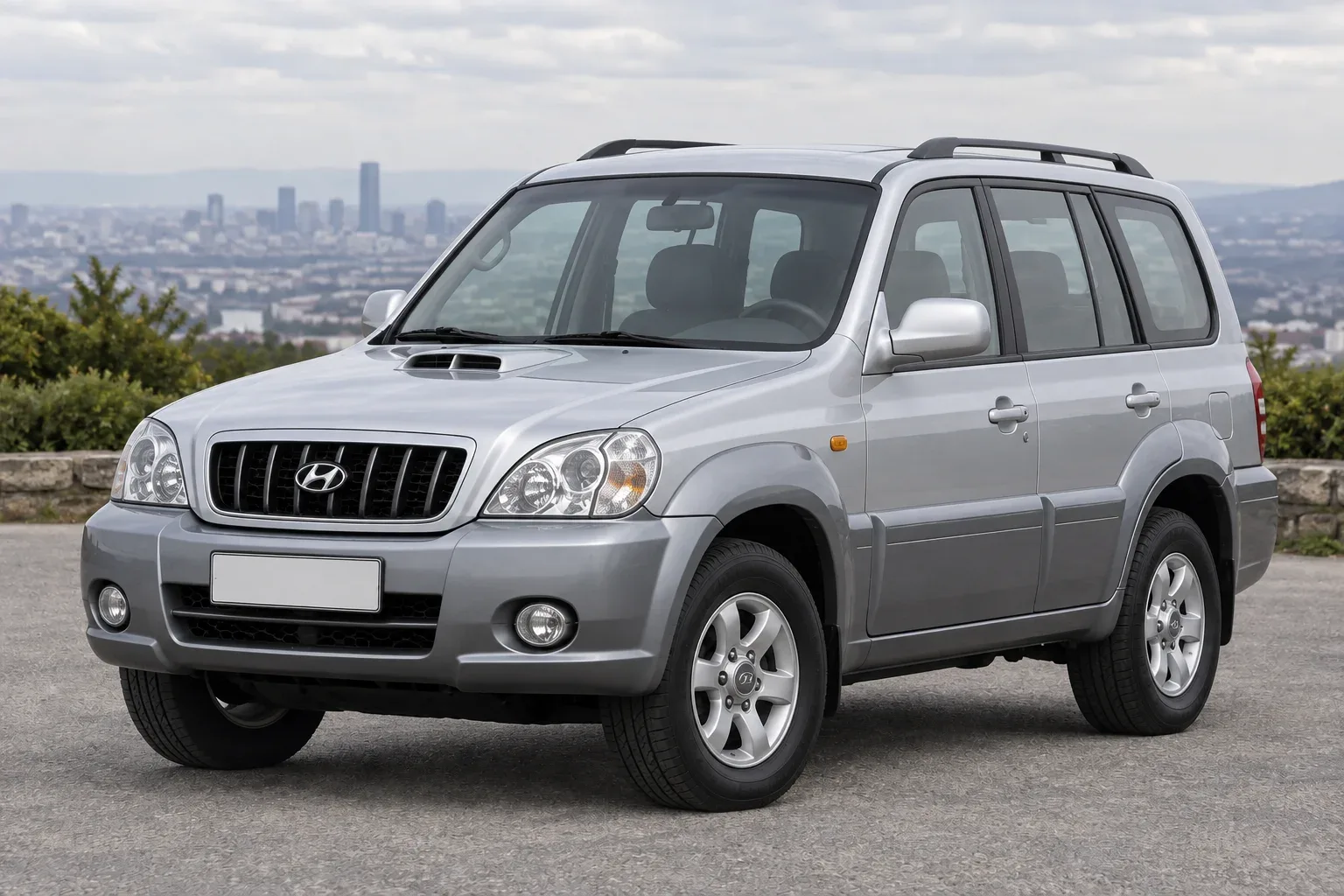
Hyundai Terracan
Valuation of the Hyundai Terracan (2001–2006): condition, paperwork, inspection and terms of sale.
Indicative purchase price
Below market value
Final price agreed after inspection.
Value my car1Why buyers choose this model
The Hyundai Terracan has never been in high demand. He lacked prestige, which in the class of large SUVs is no less important than a powerful engine and good equipment. In the secondary market, Hyundai Terracan is also not very popular, despite the fact that it has a more attractive price tag than Japanese competitors. However, the frame Korean SUV can carry up to 7 people and is able to take a trailer weighing up to 2.8 tons tow. In addition, even the basic Terracan received good equipment: air conditioning, ABS with a brake force distribution system EBD, airbags for the driver and front passenger. The Terracan combines the comfort of a luxury sedan with the properties of an SUV. It is more suitable not so much for off-road, as for roads of very poor quality. Low ground clearance and large overhangs limit opportunities on difficult-to-cross terrain. The model is based on the second generation Mitsubishi Pajero design. Terracan was assembled in South Korea until the fall of 2006. The car survived the restyling in 2004. The updated version can be recognized by a different grille, fog and taillights.
2What buyers check
Engines
Terracan has two diesel engines and one gasoline engine. All of them are a licensed copy of Mitsubishi units and have a temporary type of valve timing drive. The secondary market is dominated by models with a 2.5-liter turbodiesel (D4BH) return of 103 hp. This engine is not officially offered in Europe and Russia. In the West, the 4-cylinder 2.9 CRDi (J3 CR) was in demand, developing 150 hp, and after restyling - 163 hp. The top 3.5-liter distributed fuel injection V6 (G6CU) produced 194 hp and was available in almost all markets. 2.5 TD uses a vortex chamber injection system. The engine is considered reliable and omnivorous, but too weak for such a large car. Acceleration to 100 km / h takes 20 seconds! So it's often got to be twisted. Ultimately, this has a detrimental effect on the durability of turbodiesel. So, with large runs, the engine often begins to eat up oil. Replacement of rings and liners will be required. In addition, there are episodes with the twisting of the liners, the destruction of the crankshaft, and even cracks in the cylinders are found. The cost of a complete overhaul is about 100-150 thousand rubles, the contract engine is more than 150 thousand rubles, and the new one is about 300 thousand rubles! Often there is also overheating - due to the failure of the fan viscous, thermostat or the bursting of the cooling system pipe. As a result, a crack occurs in the head of the block. The cost of the new head is about 37 000 rubles. After 200-300 thousand km, the laying of the block head can be surrendered.
Transmission
In a pair, the engine was assigned either a 5-speed mechanics or a 4-speed automatic. Gasoline versions were completed exclusively by automatic transmission.
The manual transmission is very reliable. But the two-mass flywheel Terracan with manual transmission and 2.9 CRDI sometimes requires replacement after 100-150 thousand km. The new node in the original will cost 50 000 rubles. Many prefer to install a cheaper single-mass analogue - for 8000 rubles. The clutch serves more than 150,000 km. The cost of the new set is 6-8 thousand rubles.
The automatic transmission is presented by a simple and reliable Japanese Aisin 30-40 LE. Problems occur only after 200-250 thousand km. Attention may require solenoids, hydrotransformer, oil pump or frictions. For repairs will have to pay 40-60 thousand rubles.
All-wheel drive system
The front-wheel drive in most Hyundai Cockroach is forced to connect – the EST transmission. An automatic transmission TOD was also available. Here, the front wheels were connected when the rear wheels were slipped using an electronically controlled multi-disc clutch. It can throw up to 50% of the thrust on the front axle, and if necessary, the clutch can be blocked. The type of transmission is easy to determine by the switch modes of operation. In EST models, you will find a three-position switch – 4L-4H-2H, and in the presence of TOD, a two-position switch – AUTO and LOW. Some of the models are equipped with an optional self-locking rear axle differential (LSD). We also offered rear-wheel drive versions – only with diesel engines. In these modifications on the frame there is no cross with the brackets of the front axle fastening. Faults of the all-wheel drive system after 150-200 thousand km are quite common, especially if you regularly knead dirt. For example, the valve connecting the front axle fails, or the electric drive of the gearbox begins to strike. In addition, the drive circuit is stretched (13,000 rubles), and in the automatic TOD transmission, in addition, the electromagnetic clutch and frictions may need to be replaced. The cost of repair will be about 40 000 rubles. After 200-250 thousand km, most likely, a bulkhead of the driveshafts will be required. Wear crosses (1,000 rubles) shafts and the SRUS of the front cardan (3000 rubles). It is worth noting that to prolong the life of the drive shafts will help regular updating of lubricant - syringe. There are tavotniks here for that.
Walking
The suspension of the Hundai Terracan in its design repeats the one used in the second Pajero. On the front axle are double transverse arms with torsion, and on the rear - a non-cut bridge on springs.
The elements of the chassis are quite strong and have a good resource. Periodically, adjustment of torsion is required, and after 150-200 thousand km they “sink” (15,000 rubles per pair). After a while, the rear springs are also handed over (from 3000 rubles).
A gearbox is used in steering. The pendulum lever of the steering mechanism often has to be changed after 20,000 km. The bushings break and there's a knock. The cost of the sleeve is about 300 rubles, and the lever is 3,000 rubles. After 200-250 thousand km, sometimes a leak of the upper ossicle of the gearbox or a critical backlash in the mechanism is detected. For the new gearbox will have to pay almost 30 000 rubles.
After 150-200 thousand km can be buzzing bearings pump GUR, or there are extraneous efforts on the steering wheel. The cost of the new pump is about 7 000 rubles.
After 7-10 years, the brake system has to be changed. The tubes rust and the hoses break. The cost of a full set of tubes is about 5 000 rubles.
Typical problems and malfunctions
In many instances, you can already find traces of corrosion on the frame and body. Particular attention is required by the VIN number, which is applied to the frame behind the rear right wheel. If corrosion destroys it, re-registration of the SUV will become impossible. Favorite places of rust on the body: trunk door, bottom of doors and hood, windscreen frame, rapids, wheel arches and bumper mounting points. Red spots can hide under various linings and moldings. The paintwork of the body is very sensitive to scratches. It is worth noting that the degree of protection against corrosion depended on the destination market. The maximum level is provided for the countries of northern Europe, and for Russia and Korea – the average. To determine the depth of factory processing can be deciphered by VIN. Do not differ in durability and materials of interior decoration. In addition, the illumination of the instrument panel and its alarms burn out. With age, failures in the work of ABS are inevitable. Most often, sensors and wiring are to blame. In the pre-restyling versions, due to a software error, the ABS block was often let down (42,000 rubles). Many owners, not wanting to buy an expensive new unit, preferred to turn it off. To do this, the fuse was removed, and the ABS malfunction signaler was either powered by neighboring indicators, or simply turned off. Problems with cabin cooling arise due to leaks in the air conditioning system, failure of the electromagnetic clutch or jamming of the compressor (14,000 rubles). The generator (from 14 000 rubles) in the Terracan c 2.5-liter turbodiesel, unlike the other versions of the SUV, is located at the bottom.
3Pre-purchase checklist
Engines
- So, with large runs, the engine often begins to eat up oil. Replacement of rings and liners will be required.
- In addition, there are episodes with the twisting of the liners, the destruction of the crankshaft, and even cracks in the cylinders are found.
- The cost of a complete overhaul is about 100-150 thousand.
- Often there is also overheating - due to the failure of the fan viscous, thermostat or the bursting of the cooling system pipe.
- As a result, a crack occurs in the head of the block.
- When refueling at proven gas stations, the fuel system is capable of passing 200-250 thousand km.
Transmission
- Problems occur only after 200-250 thousand km.
- Attention may require solenoids, hydrotransformer, oil pump or frictions. For repairs will have to pay 40-60 thousand rubles.
All-wheel drive system
- It can throw up to 50% of the thrust on the front axle, and if necessary, the clutch can be blocked.
- Failures of the all-wheel drive system after 150-200 thousand
- For example, the valve connecting the front axle fails, or the electric drive of the gearbox begins to strike.
- In addition, the drive circuit is stretched (13,000 rubles), and in the automatic TOD transmission, in addition, the electromagnetic clutch and frictions may need to be replaced.
- The cost of repair will be about 40 000 rubles.
Walking
- The pendulum lever of the steering mechanism often has to be changed after 20,000 km. The bushings break and there's a knock.
- Sometimes the upper ossicle of the gearbox or a critical backlash in the mechanism is detected.
Typical problems and malfunctions
- In many instances, you can already find traces of corrosion on the frame and body.
- If corrosion destroys it, re-registration of the SUV will become impossible.
- Favorite places of rust on the body: trunk door, bottom of doors and hood, windscreen frame, rapids, wheel arches and bumper mounting points.
- It is worth noting that the degree of protection against corrosion depended on the destination market.
- To do this, the fuse was removed, and the ABS malfunction signaler was either powered by neighboring indicators, or simply turned off.
- Problems with cabin cooling arise due to leaks in the air conditioning system, failure of the electromagnetic clutch or jamming of the compressor (14,000 rubles).
4Challenges of selling privately
Unfortunately, not all parts have substitutes, and some originals are too expensive. However, many owners are happy with their purchase. Hyundai Terrakan is the choice of those who value practicality more than image and dynamics.
- Engines: So, with large mileage, the engine often begins to eat up oil. Replacement of rings and liners will be required.
- Transmission: Problems occur only after 200-250 thousand km.
- All-wheel drive system: malfunctions of the all-wheel drive system after 150-200 thousand
- The pendulum lever of the steering mechanism often has to be changed after 20,000 km. The bushings break and there's a knock.
- Typical problems and malfunctions: In many instances, you can already find traces of corrosion on the frame and body.
Shows, bargaining and re-registration take time: buyers look, promise to think and disappear. Fair price after inspection closes the auction on the spot. If money is needed urgently, the purchase takes away waiting and repeat displays.
5How selling to us works
Leave a request with the car data. We will discuss the preliminary assessment and inspection. After checking the status and documents, we agree on the final price and terms of the transaction.