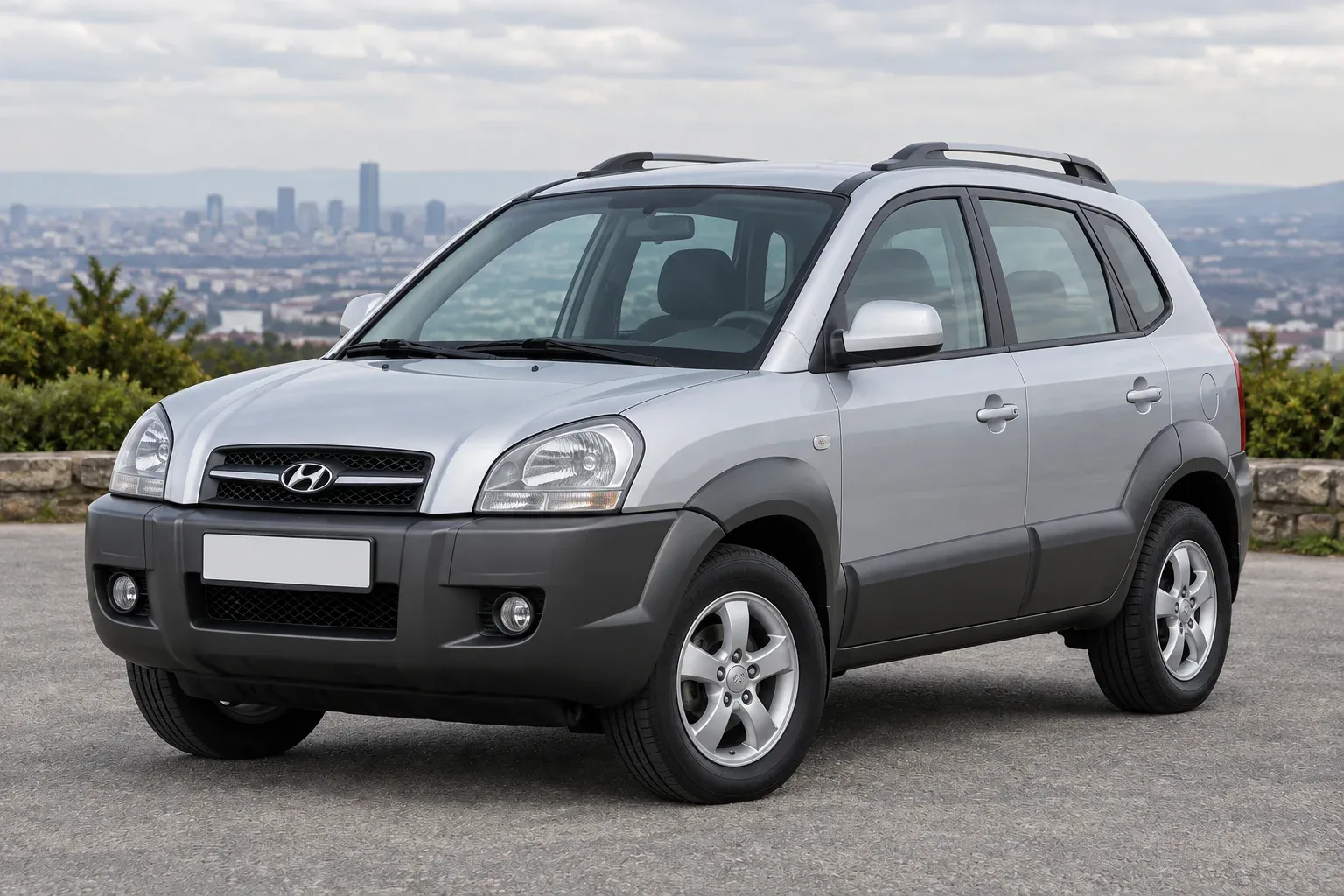
Hyundai Tucson
Valuation of the Hyundai Tucson (2004–2010): condition, paperwork, inspection and terms of sale.
Indicative purchase price
Below market value
Final price agreed after inspection.
Value my car1Why buyers choose this model
Hyundai Tucson is a very important car in the history of the Korean brand. Tussan helped Hyundai enter the segment of modern SUVs and topped sales lists in many countries around the world. The crossover appeared simultaneously with the release of the second generation Kia Sportage. Technically, the cars are identical. They have a common body design, chassis, engines and transmission. Each of them has its own original design. In 2008, Tucson went through restyling, during which the range of power units and appearance were adjusted. Engineers have also worked on some components. First of all, the settings of the chassis and steering were improved, as well as the efficiency of the brakes was increased - by increasing the diameter of the brake discs. In 2010, the production of the crossover was completed.
2What buyers check
Interior
Hyundai Tucson shows good capacity. Four adults will not complain about lack of space. Three people on the back of the couch can sit, except that very slim people. Conveniently accommodate will help a generous amount of leg space and a variable angle of inclination of the back of the second row of seats.
The trunk is worse. The 320-litre kofr lags far behind the competition. The fifth door opens, providing quick and easy access to the luggage compartment.
About the quality of the assembly and materials of flattering words can not be picked up. Interior decoration is typical for Korean cars of that period – materials of average quality and mediocre design.
Powertrains and transmission
The line of power units Hyundai Tussan, although a familial, but fully satisfies the needs. One of the most common engines was a 2-liter gasoline atmospheric power of 140-142 hp and torque of 184 Nm. This engine is well suited for operating the car in the city, as well as for installing gas equipment. This unit is perhaps the most reliable and cheapest to operate.
The top of the range is occupied by a large V6 with a volume of 2.7 liters and a power of 175 hp. Contrary to popular belief, it does not provide proper dynamics, as it works in pairs only with a 4-speed automatic machine native to the 90s. However, after installing the gas equipment, the engine becomes relatively economical and quite attractive in terms of operating costs.
4-speed automatic could be installed and with the most powerful turbodiesel recoil 140 hp. The same 2-liter diesel with a lower degree of forcing developed 112 hp. After restyling, the power of the 140-horsepower diesel engine increased to 150 hp.
All versions of the SUV could be both front-wheel drive and all-wheel drive, except for the modification with a gasoline V6, which was always equipped with an all-wheel drive transmission.
Petrol engines
The 2-liter engine with the designation G4GC has a belt drive valve timing and a chain connecting camshafts. The cost of a temporary drive is about 6400 rubles, and a chain drive is 2700 rubles. The belt should be renewed every 60,000 km, and the chain usually tends over 250,000 km.
Adjustment of the valve gap may be necessary after 200,000 km. It is carried out by selecting washers (9000 rubles for work).
Late oil replacement or poor quality threatens to lay rings and increase oil consumption after 250-350 thousand km.
Gasoline V6 with index G6BA, as well as 2-liter unit, received a combined drive of the gas distribution mechanism - a belt and a chain connecting camshafts. The cost of a set of temporary drive - 9000 rubles, and work on replacement - about 3000 rubles. The belt must be changed every 60,000 km, and the chain usually serves over 250,000 km.
Diesel engine
The 2-liter turbodiesel, marked with the code D4EA, for that time had a new and modern design. The engine with the Commn Rail injection system of the RA420 series was developed by the Italian company VM. This acronym is terrifying among people who have had experience owning the "old" diesel models of Jeep and Chrysler. Don't worry! This time the engine turned out to be successful and quite simple (by today's standards). The power unit has a cast-iron unit, one camshaft, a belt-driven valve timing and 16 valves. the 112-horsepower version works with a lower injection pressure and a constant geometry turbocharger. Modifications of the recoil of 140 and 150 hp are equipped with a variable geometry turbocharger, so that the torque value increased from 245 Nm to 305 and 310 Nm, respectively. Some cars with the most powerful diesel engine use a particulate filter. The engine marked CRDI does not have any weaknesses or common malfunctions. However, in cars older than 10 years is unlikely to avoid problems with nozzles (15,000 rubles), turbocharger and two-mass flywheel. But this is the norm for a large age and mileage, as well as malfunctions of the exhaust gas recirculation system. However, all of the above elements are relatively cheap and not overly expensive to repair. What is remarkable, the two-mass flywheel of the 112-horsepower diesel wears out faster. It is all about the curve of the moment, which almost never falls and grows rapidly. Motorists who are used to driving at low speeds should consider this point.
Transmissions
The manual transmission usually does not cause any problems. However, after 250 000 km there are episodes with its repair due to wear of the primary shaft and gear 5 gear. In this case, you can hear the noise and noise. The cost of elimination with replacement of worn-out parts is 35-45 thousand rubles.
Clutch in most cases passes at least 150-200 thousand km (7-10 thousand rubles per set). Sometimes premature replacement of the clutch is forced by a failed squeezable bearing.
The machine will last a long time if you regularly change the oil - every 40-60 thousand km. However, a number of owners still faced repair box (60-100 thousand rubles) after 250 000 km. In most cases, the malfunction of the automatic transmission affected cars with gasoline V6.
All-wheel drive system
The Borg Warner multi-disc clutch is quite reliable. However, after 200-250 thousand km, it may need a bulkhead due to wear of the glands and bearings. The service for the procedure will ask about 11 000 rubles. However, many people manage to repair it on their own.
It's a little different with the driveshaft. The design until 2006 required the replacement of the driveshaft in the assembly with a support when any backlashes appeared. An alternative option was the possibility of repair in the informal service. After 2006, the design changed, allowing the shaft and support to be changed separately, which significantly reduced the cost of repairs. The new bearing will cost 3000 rubles, and for the work on replacement will ask about 2000 rubles. Over time, the cross of the driveshaft wears out (630 rubles for an analog).
The rear gearbox rarely needs repair. Usually it is necessary to eliminate leaks through the semi-axis coils. The right hand can also be turned on by the right hand.
Walking
The suspension was quite strong. The transverse arm of the front axle has removable Silent blocks and a ball support. On the rear axle there are only two simple levers for each of the wheels and a rack resembling the design of Macpherson.
Silent blocks and ball supports of the front levers reach 100-150 thousand km, and the rear Silent blocks - up to 150-200 thousand km. The front lever is available for 3-5 thousand rubles, and the ball support is for 800-1500 rubles.
The service life of mortar bearings is about 100-150 thousand km (1300-2000 rubles).
After 200-250 thousand km can knock or leak the steering rack (26,000 rubles for the original). In the future, the pump GUR may become unusable (6-9 thousand rubles plus 3000 rubles for replacement).
Factory brake hoses and wheel tubes can burst after 11-13 years of operation.
Other problems and malfunctions
The body iron of the Korean SUV begins to bloom after 13-15 years. Rust progresses on wheel arches, rapids and at the bottom of doors. In age-old instances, corrosion sometimes destroys even subframes (13-22 thousand rubles).
After 250-300 thousand km can fail the rear wiper - soured shaft, and the electric motor fails. The cost of the new node is 5200 rubles.
The Hyundai Tucson has no major electrical problems, although some sensor may fail at times. And the unsuccessful location of the fuse block in the engine compartment (near the technological hole for supplying electrical wiring) leads to moisture. As a result, the contacts of the relay are oxidized, and the wiring rots, which causes failures in the operation of the electrician. The most common is the problem of starting the engine.
Faults in the electrical equipment of the rear door (lock, glass heating, wiper, third stop light) usually occur due to damage to the wiring in the protective corrugated between the body and the trunk door.
After 200-250 thousand km of attention, the generator may require due to wear of the relay regulator, bearings or burned diode space. For repairs will need about 5000 rubles.
The decrease in the efficiency of the heater is usually caused by a clogged radiator of the stove (2-3 thousand rubles). There are problems and servo-driven heater valve (wear plastic gears).
Operational costs
Hyundai Tussan can be considered one of the cheapest to operate in its class. All thanks to the relatively high reliability and low cost of repair. There are quite a lot of substitutes, and the cost of original spare parts at dealers is much lower than similar components in Toyota or Mitsubishi services.
3Pre-purchase checklist
Petrol engines
- The belt should be renewed every 60,000 km, and the chain usually tends over 250,000 km.
- Late oil replacement or poor quality threatens to lay rings and increase oil consumption after 250-350 thousand km.
- The belt must be changed every 60,000 km, and the chain usually serves over 250,000 km.
Diesel engine
- The engine marked CRDI does not have any weaknesses or common malfunctions.
- However, in cars older than 10 years is unlikely to avoid problems with nozzles (15,000 rubles), turbocharger and two-mass flywheel.
- But this is the norm for a large age and mileage, as well as malfunctions of the exhaust gas recirculation system.
- However, all of the above elements are relatively cheap and not overly expensive to repair.
- The only element that you should pay attention to is the control system of the intake manifold valves.
- Its malfunction is manifested by a decrease in power and sluggish acceleration in the middle and upper speed range.
- Among the common problems of power units, we can distinguish the wear of supports after 200-250 thousand km (2-3 thousand).
- ruble for one of the three supports) and loss of tightness of the cooling radiator (7000 rubles for an analogue).
Transmissions
- The manual transmission usually does not cause any problems.
- However, after 250 000 km there are episodes with its repair due to wear of the primary shaft and gear 5 gear.
- However, a number of owners still faced repair box (60-100 thousand rubles) after 250 000 km.
- In most cases, the malfunction of the automatic transmission affected cars with gasoline V6.
All-wheel drive system
- km may need its bulkhead due to wear of the glands and bearings.
- However, many people manage to repair it on their own.
- The design until 2006 required the replacement of the driveshaft in the assembly with a support when any backlashes appeared.
- An alternative option was the possibility of repair in the informal service.
- After 2006, the design changed, allowing the shaft and support to be changed separately, which significantly reduced the cost of repairs.
- The rear gearbox rarely needs repair.
- Usually it is necessary to eliminate leaks through the semi-axis coils.
- The right hand can also be turned on by the right hand.
Walking
- A steering rack can knock or leak (26,000 rubles for the original).
Other problems and malfunctions
- Rust progresses on wheel arches, rapids and at the bottom of doors.
- In age-old instances, corrosion sometimes destroys even subframes (13-22 thousand rubles).
- The back wiper can fail km - the shaft sours, and the electric motor fails. The cost of the new node is 5200 rubles.
- The Hyundai Tucson has no major electrical problems, although some sensor may fail at times.
- As a result, the contacts of the relay are oxidized, and the wiring rots, which causes failures in the operation of the electrician.
- The most common is the problem of starting the engine.
- Faults in the electrical equipment of the rear door (lock, glass heating, wiper, third stop light) usually occur due to damage to the wiring in the protective corrugated between the body and the trunk door.
- A generator may require a kilometer of attention due to wear of the relay controller, bearings or a burned diode space.
Operational costs
- All thanks to the relatively high reliability and low cost of repair.
4Challenges of selling privately
Hyundai Tucson is a very successful car, which has the only drawback - a small trunk. Although some may seem a serious disadvantage and the lack of a really strong engine. In general, the Korean crossover is quite reliable and cheap to operate.
- Interior: Hyundai Tucson demonstrates good roominess.
- Powertrains and transmission: The Hyundai Tussan powertrain line, although a rapid one, fully satisfies the needs.
- Gasoline engines: Untimely oil change or poor quality threatens to lay the rings and increase oil consumption after 250-350 thousand km.
- Diesel engine: The engine marked CRDI has no weaknesses or common faults.
- Transmissions: The manual transmission usually does not cause any problems.
- All-wheel drive system: km may need its bulkhead due to wear of the glands and bearing.
- Chasing: a steering rack can knock or leak (26,000 rubles for the original).
- Other problems and malfunctions: Rust progresses on wheel arches, sills and at the bottom of doors.
Shows, bargaining and re-registration take time: buyers look, promise to think and disappear. Fair price after inspection closes the auction on the spot. If money is needed urgently, the purchase takes away waiting and repeat displays.
5How selling to us works
Leave a request with the car data. We will discuss the preliminary assessment and inspection. After checking the status and documents, we agree on the final price and terms of the transaction.