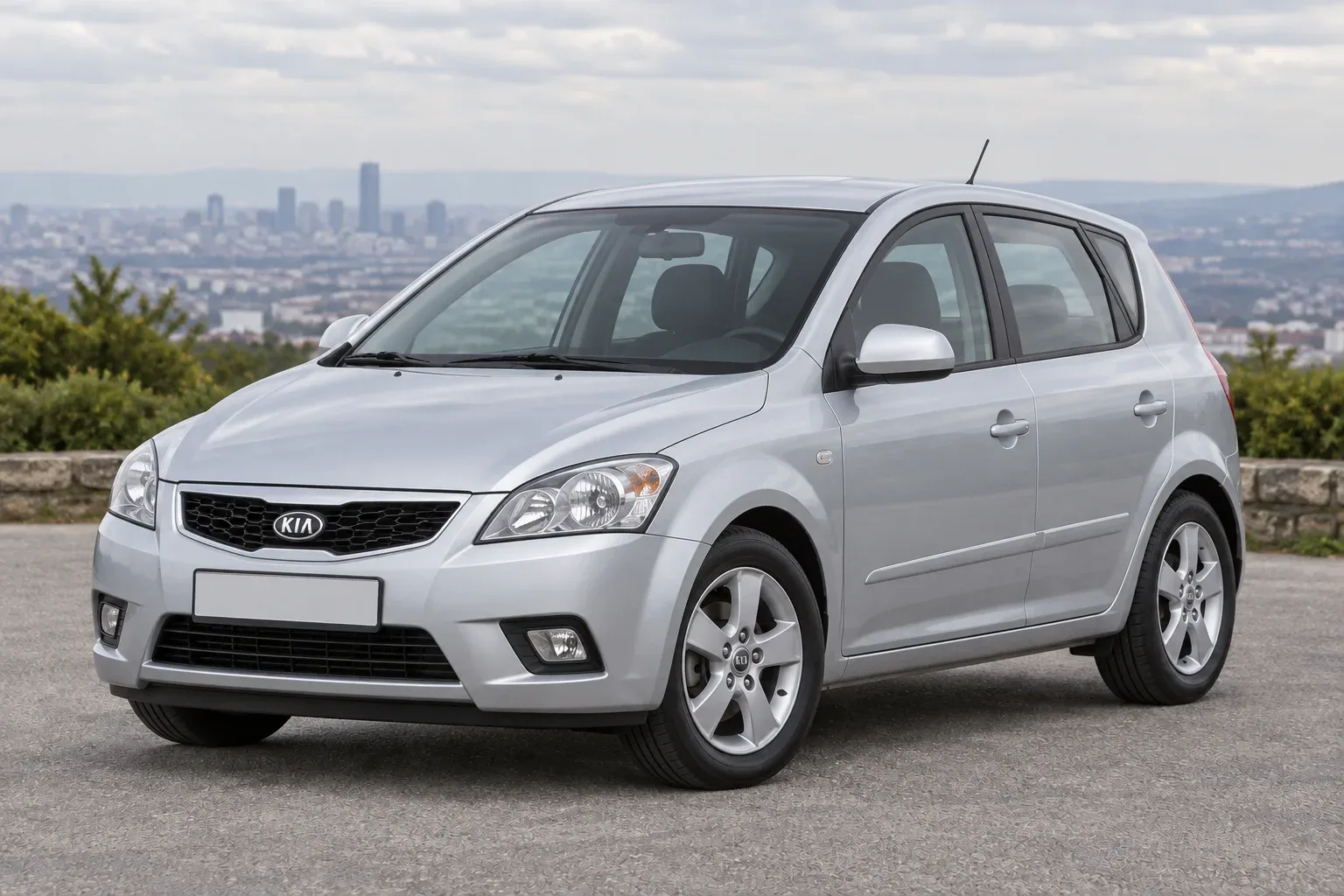
Kia Ceed 1 / ED
Valuation of the Kia Ceed 1 / ED (2006–2012): condition, paperwork, inspection and terms of sale.
Indicative purchase price
Below market value
Final price agreed after inspection.
Value my car1Why buyers choose this model
After years of producing cheap, reliable but carelessly assembled and rusting cars, the Korean manufacturer has finally unveiled an attractive, modern, well-equipped and perfect in every way car – Kia Sid. This immediately affected his commercial success. The Sid was specially designed for the European market at Kia’s design centre in Rüsselsheim near Frankfurt. Production of cars for Europe was established in Slovakia, in Žilina. Kia Sid ED has an ageless stylization and does not cause the slightest feeling of disharmony. The compact has three body options: a 5-door hatchback, a wagon and a sports 3-door hatchback Pro_cee’d. After restyling in 2009, the shape of the front of the body and the interior changed. The list of serial equipment and engine range were also updated. The quality and functionality of the interior are admirable. Given the price of Sid, the cabin pleasantly surprises with the quality of plastic and the quality of the assembly. The front panel is made of soft plastic. One of the main advantages of Kia Ceed is its good equipment. All cars are equipped with power steering, air conditioning and front electric windows. The factory audio system has a good sound.
2What buyers check
Petrol engines
The base engine of the Kia Ceed is a petrol 1.4-liter 16-valve unit (G4FA). Initially, it had a capacity of 109 hp. In Europe, after restyling, the engine's output was reduced to 90 hp for environmental reasons. The difference in power was palpable. Fortunately, the thrust deficit was manifested mainly when driving at high speeds. The most popular was the 1.6-liter gasoline 16-valve unit with a capacity of 126 hp (G4FC). Both 1.4 and 1.6 have a chain-type valve timing drive. As practice shows, the chain is reliable and usually does not require maintenance up to 200-300 thousand km. The cost of replacement with work is about 17 000 rubles. The opportunity to check the condition of the chain falls after 120-150 thousand km during the renovation of the valve cover (200-700 rubles). A few cases of major repairs of the engine due to excessive oil and gas and extraneous noise occur after 200-250 thousand km. The cost of major repairs is about 80-140 thousand rubles. In restyled samples, a catalytic converter can provoke a oily due to the appearance of bullies. It sometimes begins to collapse after 120-150 thousand km. For the removal of the catalyst with a squirrel ECU of the engine will ask in the area of 11-13 thousand rubles. The role of the flagship engine was assigned to a 2-liter gasoline engine with a capacity of 143 hp (G4GC). It is most commonly found in the 3-door Pro_cee’d. Unfortunately, its technical and operational characteristics cannot compete with 2-liter units from manufacturers such as Honda and Toyota.
Diesel engines
The most common diesel engine received 1.6 CRDi (D4FB). It is a modern engine with a chain of HRM and a system of direct injection Common Rail.
It exists in two versions - 90 and 115 hp. The weaker version does not have a dual-mass flywheel and particulate filter, which means minimal problems and operating costs.
Unfortunately, after 250,000 km of run, there are cases of premature wear of the crankshaft liners.
An alternative turbo diesel is the 2-liter 2.0 CRDi (D4EA) unit. It has a temporary type valve timing drive and a two-mass flywheel. This engine is well suited for long-distance routes. In the city, 1.6 CRDi is enough.
ISG
Just before the update, in March 2009, a version equipped with ISG – Idle Stop & Go – appeared. This system automatically shuts down the engine when it is idling, after the car has stopped, or when the car is moving “half-heartedly” with the clutch pedal pressed and speeds less than 4 km/h. In urban driving conditions, when the car often stops, the ISG reduces fuel consumption by 15%. The ISG stops working when the remaining battery charge drops less than 75%, meaning there is insufficient power reserve for the next run.
In Kia Sid, the ISG system wears out the starter quickly. To restore the starter will need about 6000 rubles.
Transmission
In weaker versions of the Sid, a 5-speed manual transmission was installed, and in stronger versions, a 6-speed one. After restyling, the 6-speed manual transmission got to all turbodiesels and gasoline engines with a working volume of 1.6 and 2.0 liters.
The clutch of the ICPP runs over 150-250 thousand km. The cost of the newoko kit is 6-8 thousand rubles, and replacement works are 5-6 thousand rubles.
Many cars are equipped with a 4-speed automatic transmission. The machine is almost perfect. Only in the pre-restyling versions, failures in the operation of the box after 150-250 thousand km arose due to a faulty plume. The cost of repairs will be about 9-12 thousand rubles.
Walking
All versions of the Kia Sid have the same suspension design, which, depending on the type of body and engine, can have different settings.
Macpherson struts are mounted on the front axle. The lever device allows you to update both ball supports (1-3 thousand rubles), and Silentblocks (400-800 rubles), which significantly reduces repair costs. The cost of the front lever is 4-5 thousand rubles.
Owners praise the chassis for durability. Silent blocks of the front and rear levers wear out after 100-150 thousand km. A similar resource has ball supports of the front levers.
Front hub bearings can make noise after 100-150 thousand km. They change separately from the hub (1-2 thousand rubles for a bearing).
Rear stage bearings usually run more than 150-200 thousand km. They are assembled with a hub (5-6 thousand rubles).
Vibrations that appear after 150,000 km of run can be caused by wear of the internal SRUS (about 5000 rubles per analog). The problem is also facilitated by the short-lived anther SRUS, tearing in the area of the clamour.
An electric amplifier is used in steering. After the update, its performance characteristics have significantly improved - the steering wheel has become a little lighter, and at the same time, feedback from the road has increased. The most important thing is that the amplifier is quite reliable.
Owners occasionally encounter knocking in the steering rack. Sometimes it is possible to get rid of the replacement of the right support sleeve (300-1000 rubles). In other cases, the rack is to be repaired (5-7 thousand rubles) or replaced (from 8000 rubles for an analogue or 20,000 rubles for the original).
Body and corrosion
The body is well protected from corrosion, but, unfortunately, has a number of drawbacks.
The first is a sandblast of paintwork in the lower part of the rear wheel arches and rear doors.
The second is the quality problems of the paint coating, which was often peeled on copies of the first years of production. The problem was mainly with red cars. Most of them were repainted under warranty. This should not be forgotten, checking the thickness of the paint coating with the help of the device.
The third drawback is the appearance of signs of corrosion on the trunk door. The last problem affected most of the cars.
With age, rust can be found on the back door windows under door seals.
Corrosion can destroy even the front or rear levers. Such cases were observed among a small number of cars older than 10-14 years.
Red plague does not spare and mounting the fuel tank (800 rubles per clamour).
Other problems and malfunctions
With age, the soft part of the front panel begins to peel off. To eliminate the defect, you will need to remove the front panel. In a specialized service for repair with a stretch panel will ask about 10 000 rubles.
After 200,000 km, the generator can be swayed. For the bulkhead will take about 6000 rubles.
Sometimes in the trunk (in the niche of the spare wheel and in the side niches) water begins to accumulate. It gets there through the joints between the rear wing and the roof or the rear wing and the side panel of the body. After treatment of seams with sealant, the problem goes away.
After 10 to 13 years, one of the door locks often begins to fail. Usually the fault of this electric motor (600 rubles). But there are also cases of destruction of plastic parts of the lock mechanism (9,000 rubles for the lock collection).
To 200-250 thousand km, problems with the trapezoid wiper are almost inevitable - the mechanism sours, the traction wears out and flies. For a new trapezoid will ask 3-6 thousand rubles.
In age instances, sometimes there are failures in the dashboard (due to condensation), and the tape recorder control buttons may fail (sweeping of contacts on the board is necessary).
Failure of the air conditioner can be caused by a malfunction of the electromagnetic clutch of the compressor (6-8 thousand rubles).
3Pre-purchase checklist
Petrol engines
- The opportunity to check the state of the chain falls after 120-150 thousand.
- A few cases of major repairs of the engine due to excessive oil and gas and extraneous noise occur after 200-250 thousand km.
- The cost of major repairs is about 80-140 thousand rubles.
- It sometimes begins to collapse after 120-150 thousand km.
- The 2-liter engine has a temporary type of HRM drive, which should be updated every 60,000 km of run (7000 rubles plus 4000 rubles for work).
Diesel engines
- The weaker version does not have a dual-mass flywheel and particulate filter, which means minimal problems and operating costs.
- Unfortunately, after 250,000 km of run, there are cases of premature wear of the crankshaft liners.
Transmission
- The cost of repairs will be about 9-12 thousand rubles.
Walking
- RUB), and Silentblocks (400-800 rubles), which significantly reduces the cost of repairs.
- Vibrations that appear after 150,000 km of run can be caused by wear of the internal SRUS (about 5000 rubles per analog).
- The problem is also facilitated by the short-lived anther SRUS, tearing in the area of the clamour.
- Owners occasionally encounter knocking in the steering rack.
- In other cases, the reiki is to be repaired (5-7 thousand).
- RUB) or its replacement (from 8000 rubles for an analog or 20 000 rubles for the original).
Body and corrosion
- The body is well protected from corrosion, but, unfortunately, has a number of drawbacks.
- The second is the quality problems of the paint coating, which was often peeled on copies of the first years of production.
- The problem was mainly with red cars.
- This should not be forgotten, checking the thickness of the paint coating with the help of the device.
- The third drawback is the appearance of signs of corrosion on the trunk door.
- The last problem affected most of the cars.
- With age, rust can be found on the back door windows under door seals.
- Corrosion can destroy even the front or rear levers.
Other problems and malfunctions
- In a specialized service for repair with a stretch panel will ask about 10 000 rubles.
- After treatment of seams with sealant, the problem goes away.
- km almost inevitable and problems with trapezoid wiper - sour the mechanism, wears out and flies traction. For a new trapezoid will ask 3-6 thousand rubles.
- In age instances, sometimes there are failures in the dashboard (due to condensation), and the tape recorder control buttons may fail (sweeping of contacts on the board is necessary).
- Failure of the air conditioner can be caused by a malfunction of the electromagnetic clutch of the compressor (6-8 thousand rubles).
4Challenges of selling privately
Definitely, Kia Sid first generation deserves attention due to the unpretentiousness and relatively inexpensive cost of spare parts and repairs. As for corrosion, in fact, it’s not that bad. At least there are no holes in the body.
There are some concerns about the possibility of major repairs of the engine with a volume of 1.6 liters. But again, such incidents do not happen often. The future owner from expensive repairs will be spared by a thorough diagnosis with the control of the condition of the cylinders and the catalytic converter using a video endoscope.
- Petrol engines: A few cases of major repairs of the engine due to excessive oil and gas and extraneous noise occur after 200-250 thousand km.
- Diesel engines: The weaker version does not have a dual-mass flywheel and particulate filter, which means minimal problems and operating costs.
- ISG: Just before the update, in March 2009, a version equipped with ISG – Idle Stop & Go – appeared.
- Transmission: The cost of repairs will be about 9-12 thousand rubles.
- Chassis: rubles), and Silentblocks (400-800 rubles), which significantly reduces the cost of repairs.
- Body and corrosion: The body is well protected from corrosion, but unfortunately has a number of drawbacks.
- Other problems and malfunctions: In a specialized service for repairs with a stretch panel will ask about 10 000 rubles.
Shows, bargaining and re-registration take time: buyers look, promise to think and disappear. Fair price after inspection closes the auction on the spot. If money is needed urgently, the purchase takes away waiting and repeat displays.
5How selling to us works
Leave a request with the car data. We will discuss the preliminary assessment and inspection. After checking the status and documents, we agree on the final price and terms of the transaction.