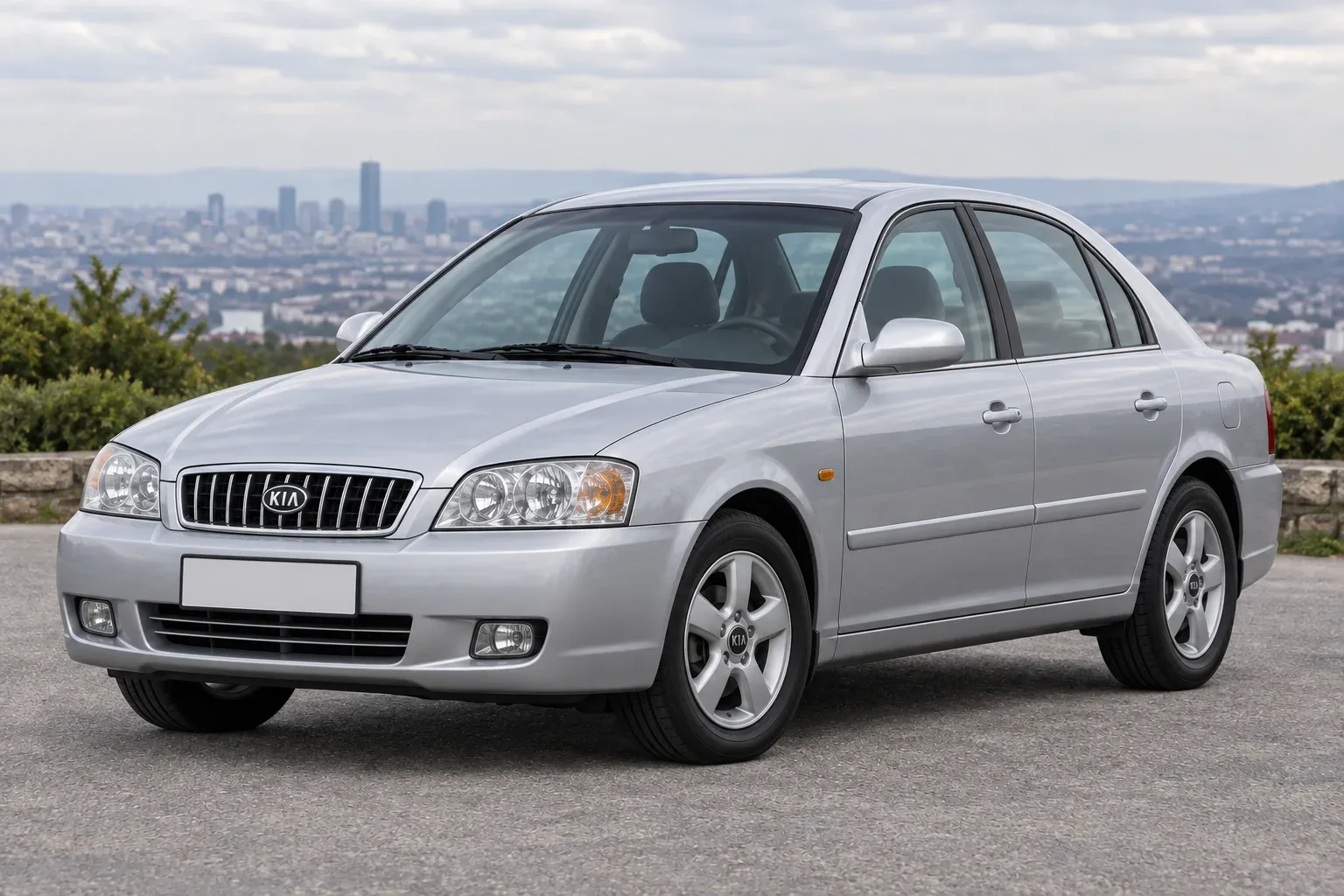
Kia Magentis 1
Valuation of the Kia Magentis 1 (2000–2005): condition, paperwork, inspection and terms of sale.
Indicative purchase price
Below market value
Final price agreed after inspection.
Value my car1Why buyers choose this model
Kia Magentis is a mid-size D-class sedan. It is a close relative of the fourth-generation Hyundai Sonata. Machines differ only in details of exterior design and equipment. The appearance at that time was reasonable and attractive, but today the rear optics look old-fashioned. In the US and Korean markets, the car was called Optima. Since 2001, the sedan for Russia was assembled in Kaliningrad at the Avtotor enterprise. In 2003, the model survived the restyling. The most characteristic changes are front optics with separate headlights, a new front bumper and a radiator grille. Magentis offered a number of standard equipment along with optional. All cars were equipped with air conditioning, electrically controlled mirrors, glass and locks. Basic fabric seats for a fee could become leather. Richer configurations boast cruise control, ABS with brake force distribution, a clutch control system with an expensive TSC, electric driver's seat, climate control, wooden inserts and even a hatch. In 2001, the “American” Optima in the crash tests according to the IIHS version earned only one star.
2What buyers check
Engines
Kia Magentis Kaliningrad assembly was offered with gasoline engines of 2.0 l / 136 hp and 2.5 l / 168 hp. These units are the most common in the secondary market (more than 90%). The remaining engine options in the ads are unlikely to be more than a couple of dozen. And these are the Korean basic versions with a four-cylinder 1.8 liters (the Betta / G4GB / 131 hp series and the Sirius II / G4JN / 125 and 134 hp series). In the American market, the palette began with a row four with a capacity of 2.4 liters (138-149 hp). Six-cylinder 2.7 l / 170 hp appeared in the American Optima after restyling. The gas distribution mechanism of the inline quadruples of 2.0 liters (Sirius II / G4JP) and 2.4 liters (Sirius II / G4JS) is driven by a geared belt. It should be changed every 40,000-50,000 km. Cheap analogues often break after 20-30 thousand km. As a result, the pistons and valves are damaged. In case of trouble, you should prepare for repairs in the amount of about 50 000 rubles. Approximately the same amount will be asked for a contract engine. Keep in mind that replacing the timing belt on Sirius series engines requires some experience. The presence of a balance shaft complicates the exact exhibition of marks. When the labels mismatch, vibration appears, and the motor loses traction. The V-shaped sixes - 2.5-liter (Delta / G6BV) and 2.7-liter (Delta / G6BA) - use a combined type of valve timing drive: belt plus chain. The tooth belt drives the intake camshafts, which are connected to the exhaust shafts by a chain. The service life of the chain is more than 250-300 thousand km. Trouble with the belt of the HRM here are much less common.
Transmission
The engines were combined with a 5-speed mechanics or a 4-speed automatic. The automatic transmission is a Japanese F4A42 developed by Mitsubishi. The box is reliable and durable. The first complaints about work occur after 200-300 thousand km and more often in cars with powerful V6. Failures can occur due to failure of the speed sensor, as well as oxidation or damage to the contacts and wiring. To serious repairs, it comes after 300,000 km, which will require about 50,000 rubles.
There are no known problems with mechanics. Unless you have to change the clutch (11,000 rubles with work), and in cars with a 2.5-liter unit, there is also an expensive two-mass flywheel. The cost of the original node is almost 50 000 rubles. Fortunately, you can find an analogue for 9-10 thousand rubles.
Walking
On the front axle, a scheme is used on double transverse levers, and on the rear - a multi-link system with the effect of steering. The suspension is quite soft, the body in turns strongly tilts and swings on gentle waves. Reactions to the steering wheel are slow and smeared.
Stage bearings run more than 100-150 thousand km (1-2 thousand rubles). No less will serve shock absorbers, Silentblocks and ball supports. After a while, the back springs may sink.
The steering rack can knock or leak after 200-250 thousand km. For a new rake will have to pay more than 9000 rubles.
Other problems and malfunctions
Traces of corrosion on the body of an already elderly Magentis can often be found in the area of the rear wheel arches and rapids.
A crack in the top of a metal fuel tank is a common phenomenon. The defect is facilitated by a faulty adsorber. The cost of a new fuel tank is from 8 000 rubles, and the adsorber from 3 000 rubles.
Sometimes the air conditioner compressor clutch (from 2000 rubles) or the compressor itself (from 9000 rubles for an analogue) is brought up. And after 200-250 thousand km of attention can require a generator (from 5 000 rubles).
Violations in the work of the climate installation occur as a result of unscrewing the screws of the fastening of the motor drive of the valve, wear of the motor itself (1000 rubles) or disconnection of the pipe connecting the stove with the climate control unit.
3Pre-purchase checklist
Engines
- It should be changed every 40,000-50,000 km.
- In case of trouble, you should prepare for repairs in the amount of about 50 000 rubles.
- Keep in mind that replacing the timing belt on Sirius series engines requires some experience.
- Cases of major repairs of the engine are observed after 200-300 thousand km.
- Reasons for opening - an increase in oil consumption and loss of compression in it from the cylinders.
- For repairs will need about 50 000 rubles.
- Interruptions in the work of the 2-liter unit are often caused by a failed sensor of the crankshaft position (2,500 rubles).
- It should be borne in mind that with age, the number of problems with gas equipment inevitably increases.
Transmission
- Failures can occur due to failure of the speed sensor, as well as oxidation or damage to the contacts and wiring.
- To serious repairs, it comes after 300,000 km, which will require about 50,000 rubles.
- There are no known problems with mechanics.
Walking
- The steering rack can knock or leak after 200-250 thousand km.
Other problems and malfunctions
- Traces of corrosion on the body of an already elderly Magentis can often be found in the area of the rear wheel arches and rapids.
- A crack in the top of a metal fuel tank is a common phenomenon.
- Violations in the work of the climate installation occur as a result of unscrewing the screws of the fastening of the motor drive of the valve, wear of the motor itself (1000 rubles) or disconnection of the pipe connecting the stove with the climate control unit.
4Challenges of selling privately
There is no doubt that the first generation Kia Magentis is a reliable car. Most of the problems and malfunctions are due to a solid mileage and a decent age. Fortunately, all the faults are easily remedied and do not require large costs... unless you take into account the possible repair of the machine or engine (after the severance of the belt).
- Engines: In case of trouble, you should prepare for repairs in the amount of about 50 000 rubles.
- Transmission: Failures may occur due to a failure of the speed sensor, as well as oxidation or damage to the contacts and wiring.
- Driving: The steering rack can knock or leak after 200-250 thousand km.
- Other problems and malfunctions: Traces of corrosion on the body of an already elderly Magentis can often be found in the area of the rear wheel arches and rapids.
Shows, bargaining and re-registration take time: buyers look, promise to think and disappear. Fair price after inspection closes the auction on the spot. If money is needed urgently, the purchase takes away waiting and repeat displays.
5How selling to us works
Leave a request with the car data. We will discuss the preliminary assessment and inspection. After checking the status and documents, we agree on the final price and terms of the transaction.