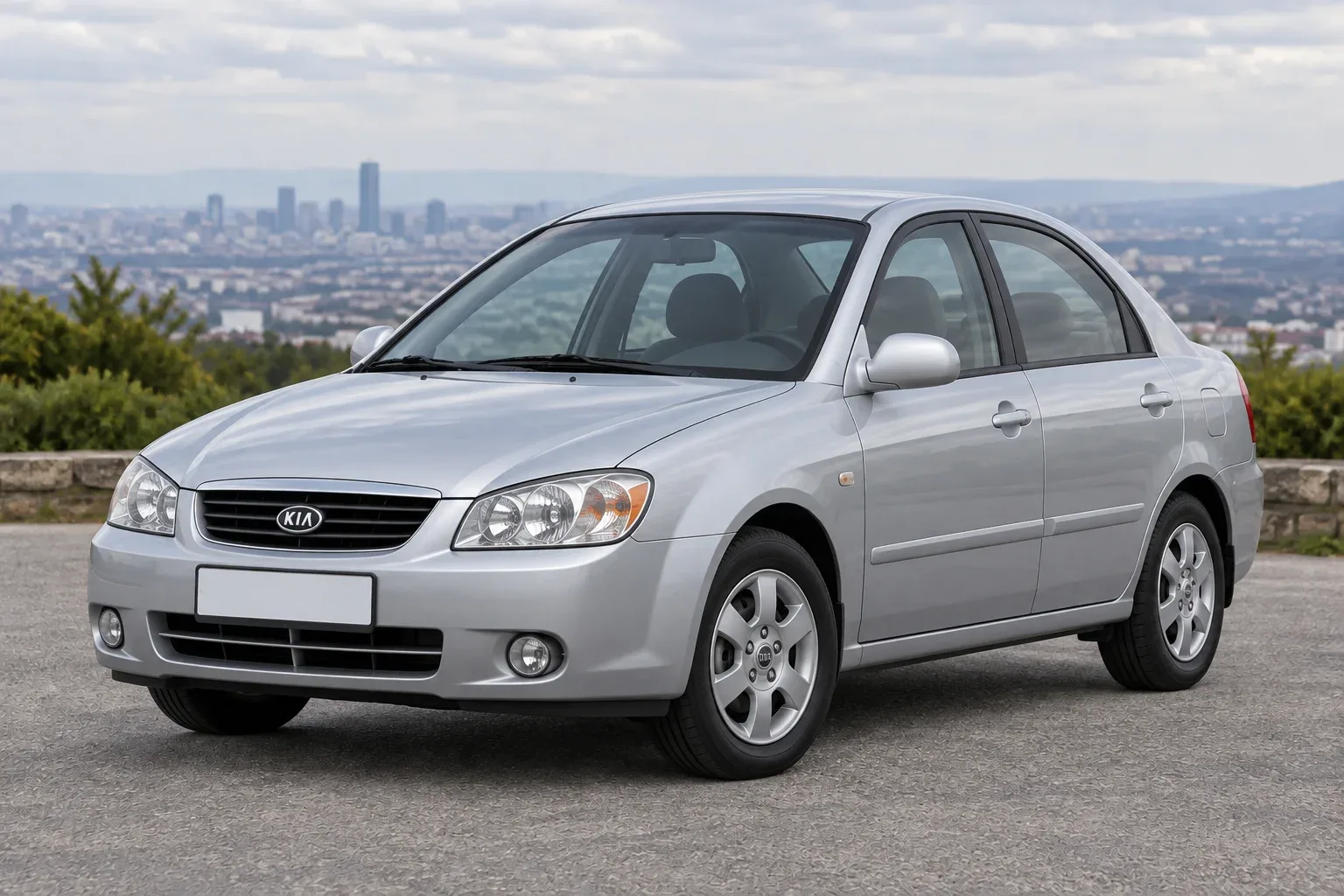
Kia Spectra
Valuation of the Kia Spectra (2000–2011): condition, paperwork, inspection and terms of sale.
Indicative purchase price
Below market value
Final price agreed after inspection.
Value my car1Why buyers choose this model
Kia Spectra appeared in 1997. At that time, the sedan was called Kia Sephia and was built on a redesigned Mazda 323 platform. In addition to the South Korean market, the car was offered in Europe (Shuma), America, Asia, Australia (Mentor) and the Middle East (Spectra). In 2000, the sedan underwent a restyling, and the Sephia logo was replaced by the inscription Spectra. In Europe and Australia, the name remains the same. Production of the model was stopped in 2004, but in Russia its life was just beginning. Industrial assembly in Izhevsk started in 2004 and ended in 2010. In the summer of 2011, as part of obligations to Kia Motors, a limited batch of 1,700 units descended from the IzhAvto conveyor. Let's look inside. The interior does not make a pleasant impression. In the interior decoration, cheap, rough and hard plastic of gray shades is used. The advantages include comfortable, wide chairs with a long cushion, which allows you to comfortably travel long distances. You can't blame the sedan for the back sofa. A 440-liter trunk is enough for everyday needs. Most of the copies have rather poor equipment. The standard equipment included an airbag, an immobilizer and audio preparation. The hydraulic amp, central lock, power windows, ABS, front passenger airbag and air conditioning required additional payment. The car did not take part in crash tests according to EuroNCAP, but this was taken care of by Americans from the national Institute of safety IIHS in 1999. Of the four possible gradations, the sedan earned the lowest “Poor” – poor safety. The driver suffered injuries to the neck and head incompatible with life.
2What buyers check
Engines
Korean was equipped with atmospheric gasoline engines with a capacity of 1. 5, 1. 6, 1. 8 and 2. 0 liters. Hinting at the time of the debut, Spectre engines have acquired the “Millenium Technology”, as the inscription on the lid “Mi-Tech” eloquently reports. All units are the result of the modernization of Mazda engines. They have a temporary type of valve timing drive. The most widespread was the 16-valve 1.6-liter S6D engine. This is nothing more than a modified engine Mazda B6. Korean engineers have reduced the heating time and installed a highly efficient catalyst. The valves are equipped with hydraulic pushers, the block is cast from cast iron, and the head is made of aluminum. Among the disadvantages are the noisy operation of hydraulic compensators and the low service life of high-voltage wires, candles and ignition coils - about 50-100 thousand km. After 150-200 thousand km will require repair starter and generator. In addition, engine failures may occur due to failure of the mass air flow sensor. DMRV was introduced in 2008. Before it, a more reliable MAP sensor (measuring pressure) was used. Many owners of Izhevsk-assembly cars “came on the capital” of the engine, having traveled only 45 000 km. When assembly was installed belt of too low quality. He broke off and the valves "meet" the pistons. Today, many mechanics in the old-fashioned way recommend not to tempt fate and change the timing every 40,000 km. After 100-150 thousand km, sometimes the oil gasket of the valve cover begins to poison. Oil also appears in candle wells.
Transmission
The sedan was equipped with either a 5-speed mechanics or a 4-speed automatic. Both boxes have their flaws.
Mechanics often require bulkheads to 150-200 thousand km. In addition to the flow of the primary shaft, over time, howls or hums increase. However, howling on the first and rear gears is common, and some owners pass without repair 250-300 thousand km. For bulkheading will need about 20 000 rubles.
In the history of Spectre, several automatic transmissions were used. The F-4EAT and F4A-EL are a joint development of Mazda and Jatco. It was installed only with a 1.8-liter engine. In addition, the A4AF3, F4A42 and A4CF2 boxes were developed by Mitsubishi. The first two could be combined, with engines with a capacity of 1.5 and 1.8 liters. But the latter just got only sedans of Russian assembly.
It is believed that reliable machines ended in 2007. According to some sources, this is when the boxes began to be collected in China. They suffer from premature wear of frictions and solenoids. For repairs should be prepared closer to 100,000 km, which will require at least 30 000 rubles.
Characteristic symptoms: tremors when switching from 1st to 2nd and gassing / slipping when switching from 2nd to 3rd. If you pull with repair, then after a while there is a crunch when touching and during a stop.
The condition of the SRUS anthers should be monitored regularly. They either fly off because of flimsy clamps, or break from old age by 100,000 km. As a result, dust and dirt disable the SRUS, which changes in the assembly with the drive.
Walking
Ball supports run more than 60-100 thousand km. Silent blocks of levers are layered after 100-150 thousand km. The same is true of shock absorbers. By this time, factory springs may have sat down or burst, especially in those who use interturning passages.
After 100,000 km, the steering rack can flow or rattle. The cost of a new reiki is from 16 000 rubles.
Closer to 100,000 km, the ABS block often fails. It's all about the electric motor. Moisture enters the inside, which leads to corrosion of the bearing and oxidation of the contacts of the rotor winding. The unit is amenable to simple restoration repair. After 2009, they began to use an upgraded unit with improved protection from moisture.
Body and salon
The coating is not highly durable. The hood and bumper are quickly covered with chips. Body iron is not prone to corrosion. Foci of rust, as a rule, occur in places of poor-quality body repair.
Water in the cabin may appear due to clogged drains under the external plastic lining at the bottom of the windshield. In addition, water can penetrate into the cabin due to clogged drain holes in the rapids. Water in the sills accelerates the corrosion process.
Of minor malfunctions, it is possible to note the failure of the fuel level sensor and problems with the furnace engine (the engine itself or the mode switch fails). After 150-200 thousand km, you should be ready to replace the air conditioner compressor clutch or its bearings.
3Pre-purchase checklist
Engines
- The starter and generator will need repair.
- In addition, engine failures may occur due to failure of the mass air flow sensor. DMRV was introduced in 2008.
- Today, many mechanics in the old-fashioned way recommend not to tempt fate and change the timing every 40,000 km.
- If there was antifreeze, or leaked gasket of the head of the block, then most likely, the HBC burst, and it will have to be replaced.
Transmission
- However, howling on the first and rear gears is common, and some owners pass without repair 250-300 thousand km.
- They suffer from premature wear of frictions and solenoids.
- For repairs should be prepared closer to 100,000 km, which will require at least 30 000 rubles.
- If you pull with repair, then after a while there is a crunch when touching and during a stop.
- The condition of the SRUS anthers should be monitored regularly.
Walking
- After 100,000 km, the steering rack can flow or rattle.
- Closer to 100,000 km, the ABS block often fails. It's all about the electric motor.
- Moisture enters the inside, which leads to corrosion of the bearing and oxidation of the contacts of the rotor winding.
- The unit is amenable to simple restoration repair.
Body and salon
- The coating is not highly durable.
- The hood and bumper are quickly covered with chips. Body iron is not prone to corrosion.
- Foci of rust, as a rule, occur in places of poor-quality body repair.
- Water in the sills accelerates the corrosion process.
- Of minor malfunctions, it is possible to note the failure of the fuel level sensor and problems with the furnace engine (the engine itself or the mode switch fails). After 150,000 to 200,000.
- km should be ready to replace the air conditioner compressor coupling or its bearings.
4Challenges of selling privately
Tired sedan on the go can be purchased for 130 000 rubles. For well-groomed cars ask almost 300 000 rubles. Among the proposals, more than 90% are cars of Russian assembly. It is generally accepted that younger copies released after 2008 are less reliable.
Kia Spectra is a typical budget sedan, not distinguished by high reliability. However, the cost of repair against the background of modern technologically complex machines can not but please. All common ailments are well studied and easily eliminated. Any garage mechanic can repair it. There are no problems with the availability of spare parts. Kia Spectra is an offer for those who want to buy an inexpensive and easy-to-use sedan.
- Engines: km will require repair of the starter and generator.
- However, howling on the first and rear gears is common, and some owners pass without repair 250-300 thousand km.
- Driver: After 100,000 km, the steering rack can leak or rattle.
- Body and salon: Painting is not characterized by high wear resistance.
Shows, bargaining and re-registration take time: buyers look, promise to think and disappear. Fair price after inspection closes the auction on the spot. If money is needed urgently, the purchase takes away waiting and repeat displays.
5How selling to us works
Leave a request with the car data. We will discuss the preliminary assessment and inspection. After checking the status and documents, we agree on the final price and terms of the transaction.