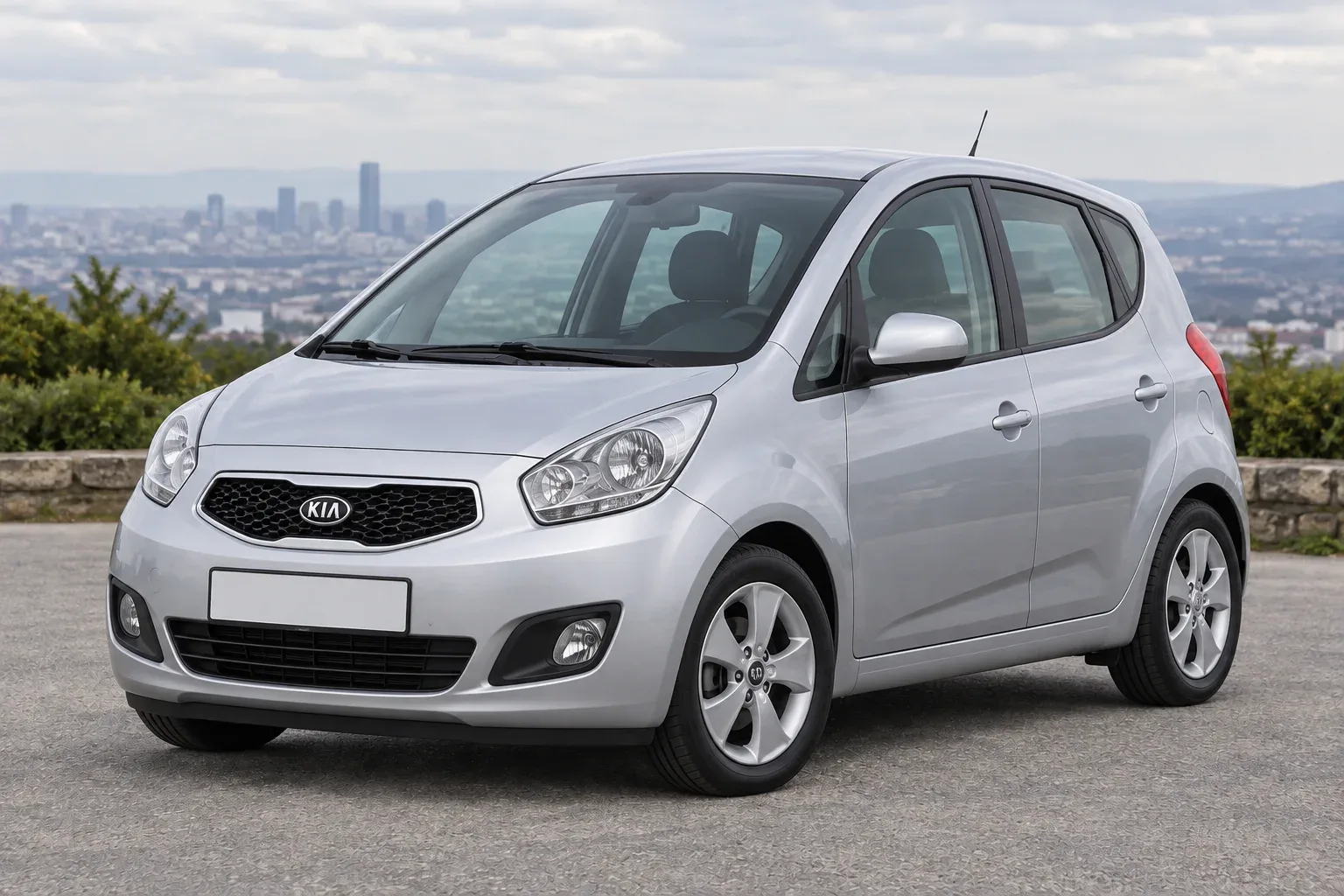
Kia Venga
Valuation of the Kia Venga (2009–2018): condition, paperwork, inspection and terms of sale.
Indicative purchase price
Below market value
Final price agreed after inspection.
Value my car1Why buyers choose this model
Kia Venga, being developed by European stylists, was also going there - in the Czech Republic and Slovakia. It was not offered outside Europe. Korean customers’ preferences were not taken into account, the main goal is to perfectly meet the needs of Europeans. Did it work? Absolutely, yes! Cars for the Russian market after Slovakia "completed" on the Kaliningrad "Avtotor". Although Kia classifies the Venga as a representative of the B-Class segment, its body height (1.6 m) allows it to be considered a small minivan. Despite the modest dimensions (4075x1765 mm), it was possible to get a really spacious interior. This was facilitated by a large wheelbase of 2615 mm: more than in the Polo and even in the Golf. Interestingly, the trunk was not injured. Its useful volume exceeds 400 liters. Functionality of the subcompactvan enhances the possibility of longitudinal displacement of the rear sofa (by 130 mm) with an adjustable back angle (serial equipment), as well as a double trunk floor (except for the basic versions). Folding the rear seats, you can get a trunk of 1253 liters. At the time of its debut in our market (2010), the base compact vein had two airbags (six in the richest configuration). However, air conditioning was not included in the list of standard equipment. There are many differences between the entry and rich levels. Having climate control means you have a rich version. But plastic, regardless of the configuration, is of medium quality.
2What buyers check
Engines
The engine range includes gasoline and diesel units (the latter in Russia were not officially offered) with a volume of 1.4 liters and 1.6 liters with a capacity of 75 to 128 hp.
Kia Venga is quite dynamic even with a 1.4-liter 90-horsepower gasoline engine. But on the highway, such a car is clearly lacking in 6th gear. At speeds over 120 km/h, the engine becomes unbearably noisy and greedy for fuel. In a calm manner, the engine consumes about 7 liters of gasoline per 100 km.
The gasoline engines are quite reliable. Handra after 70-100 thousand km is usually associated with failed ignition coils (600-1600 rubles). The chain of the drive of the valve timing as usual does not need to be replaced before 200,000 km (6,000 rubles for the original set).
Sometimes there are oil leaks at the junction of the engine and gearbox. The fault is the crankshaft ointment.
In Europe, one of the most popular options in the secondary market is the 1.4-liter D4FC turbodiesel with a capacity of 75 and 90 hp. Dynamics of both versions in the city is quite enough, but on the track even the strongest variation lacks power reserve.
A 90-horsepower diesel paired with a 6-speed automatic transmission consumes less fuel than with the manual transmission. So on the highway Wenga with a driver and 4 passengers without problems you can fit into 5 liters. The city will need 1.5 liters more.
Turbodiesel is quite reliable, including due to the unregulated turbine and the absence of a two-mass flywheel.
Sometimes there are leaks from the TNVD. European dealers offer customers a replacement of the entire pump, the cost of which is almost 40 000 rubles. However, it can be repaired, which is much cheaper.
Transmission
In pair with gasoline engines worked 5-speed mechanics. Atmospheric 1.6 before restyling, in addition to the manual transmission, was combined with a 4-speed automatic, and then with a 6-speed automatic.
The clutch of a manual transmission lasts a long time. The cost of a new clutch set is 4-9 thousand rubles.
Walking
Kia Wenga is getting very nervous at high speeds. On the transverse irregularities and waves, he jumps like a ball. Drivers who prefer a dynamic driving style complain of steering, too soft grip and difficulties with the rapid inclusion of the third gear manual transmission, which is sometimes accompanied by grinding.
The suspension is set up quite rigidly. In addition, it too loudly works out irregularities, which further reduces the level of comfort.
Short-lived bushings and front stabilizer racks (700 rubles per piece) will require certain costs.
Front shock absorbers (3-6 thousand rubles) and bearings (200-400 rubles) serve more than 60-90 thousand km. Rear shock absorbers (1-2 thousand rubles) are a little more durable - will work over 70-100 thousand km.
Ball supports (300-900 rubles) can be surrendered at a distance of 60-100 thousand km. Silentblocks will travel at least 100-150 thousand km.
The front step bearings wear out after 80-120 thousand km, and the rear - after 150-200 thousand km. Front are changed separately (1-2 thousand rubles), and rear - in the collection with a hub (4-6 thousand rubles).
The external SRUS can make noise after 150-200 thousand km. The original hinge is only assembled with a semi-axle costing about 27 000 rubles. Fortunately, you can find an analogue for 3300 rubles.
After 120-150 thousand km can knock the steering rack.
Other problems and malfunctions
There are no particular reliability problems, but some road faults are in trouble. For example, when the steering angle sensor stops working, the steering malfunction signal lights up - sometimes supplemented with ABS and ESP indicators, and the steering power is turned off. In this case, unfortunately, you will need to replace the entire steering column, the cost of which exceeds 60 000 rubles. Fortunately, such cases are isolated. If only ESP errors appear in the system, it is enough to check the electrical connections. After 5-8 years of operation, paint swellings are often found on the roof and windscreen racks, less often on the trunk lid. The inner cavities of the sills are abundantly watered with wax, which guarantees long-term protection against corrosion. Sometimes it tires the creaking of the front panel (especially in winter). Plastic cleaning is required to eliminate noise. Another drawback is the spontaneous reset of the on-board computer readings about fuel consumption (should be reset immediately after refueling). The condition of the door handles after 100,000 km of intensive operation, for example, as a taxi. The scuffs on the steering wheel become noticeable on cars older than 4-6 years. It is worth noting that the air conditioning is not efficient enough. It takes quite a long time to cool the “sun-warmed” cabin. Some inconveniences are caused by the absence of ambient temperature indicator. Invaluable assistants in the parking lot will be parking sensors – poor rear view complicates maneuvering. Over time, the trapezoid mechanism of wipers sours - the brushes slowly move.
3Pre-purchase checklist
Engines
- km is usually associated with failed ignition coils (600-1600 rubles).
- So on the highway Wenga with a driver and 4 passengers without problems you can fit into 5 liters.
- However, it can be repaired, which is much cheaper.
Other problems and malfunctions
- There are no particular reliability problems, but some road faults are in trouble.
- For example, when the steering angle sensor stops working, the steering malfunction signal lights up - sometimes supplemented with ABS and ESP indicators, and the steering power is turned off.
- In this case, unfortunately, you will need to replace the entire steering column, the cost of which exceeds 60 000 rubles. Fortunately, such cases are isolated.
- If only ESP errors appear in the system, it is enough to check the electrical connections.
- The inner cavities of the sills are abundantly watered with wax, which guarantees long-term protection against corrosion.
- The scuffs on the steering wheel become noticeable on cars older than 4-6 years.
- Sometimes after dismantling and cleaning the trapezoid, backlash appears in the places where the leashes are fastened.
4Challenges of selling privately
The Kia Venga is an interesting model, but requires a pre-purchase check to ensure there are no costly faults that fortunately are rare.
- Engines: km is usually associated with failed ignition coils (600-1600 rubles).
- Transmission: In pair with gasoline engines worked 5-speed mechanics. Atmospheric 1.
- Kia Wenga at high speeds begins to get very nervous.
- Other problems and malfunctions: There are no particular reliability problems, but some road faults are in troubleshooting.
Shows, bargaining and re-registration take time: buyers look, promise to think and disappear. Fair price after inspection closes the auction on the spot. If money is needed urgently, the purchase takes away waiting and repeat displays.
5How selling to us works
Leave a request with the car data. We will discuss the preliminary assessment and inspection. After checking the status and documents, we agree on the final price and terms of the transaction.