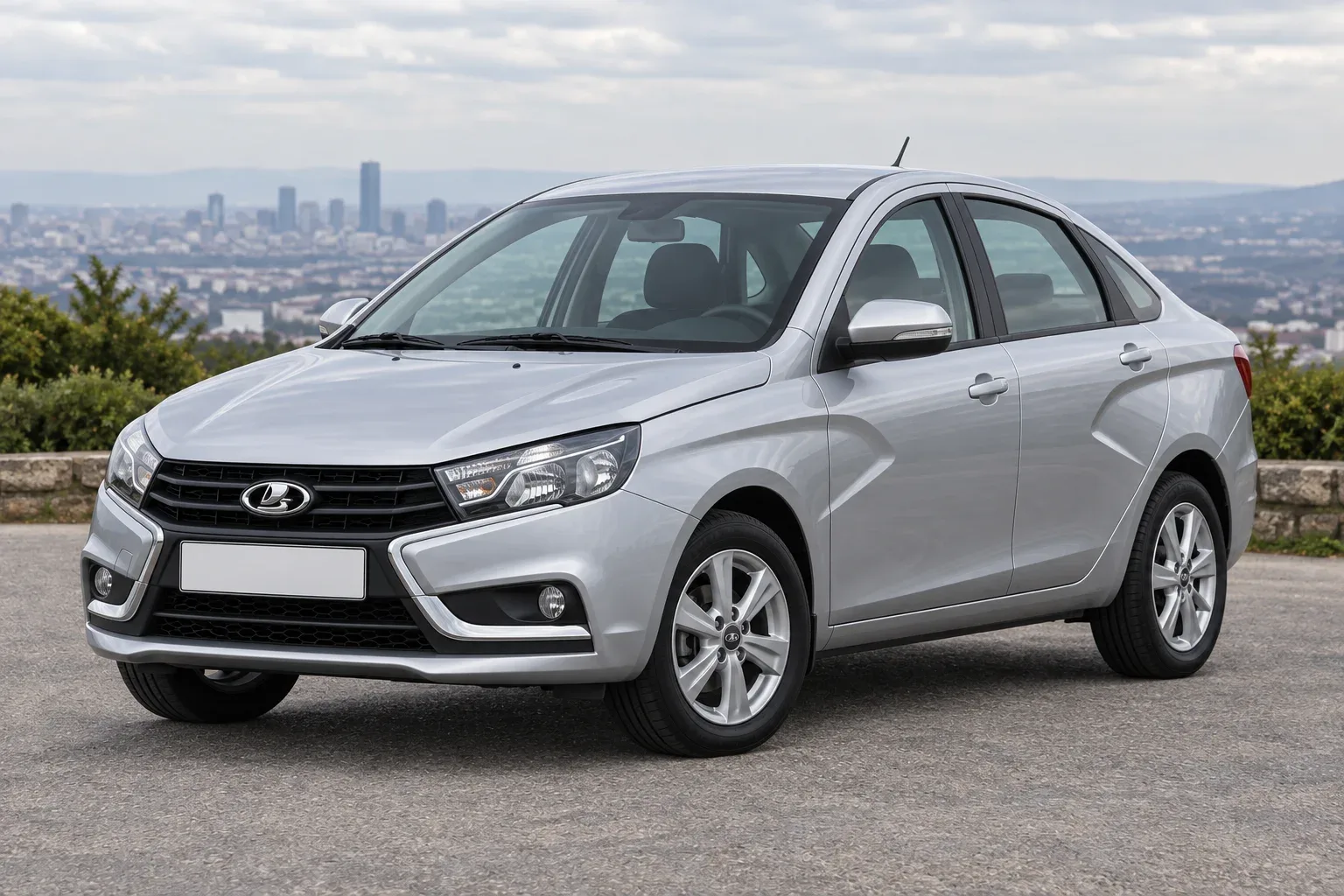
Lada Vesta GFL / GFK
Valuation of the Lada Vesta GFL / GFK (2015–2022): condition, paperwork, inspection and terms of sale.
Indicative purchase price
Below market value
Final price agreed after inspection.
Value my car1Why buyers choose this model
Serial production of Vesta started in September 2015, and the first copies appeared in the salons at the end of November. Assembly of the model until the end of 2022 was carried out in Izhevsk.
2What buyers check
Review
Serial production of Vesta started in September 2015, and the first copies appeared in the salons at the end of November. Assembly of the model until the end of 2022 was carried out in Izhevsk. The new Lada B/C platform was developed specifically for Vesta in collaboration with Renault-Nissan engineers. According to some reports, it has a lot in common with the platform of the second Logan. The most tangible correspondences can be given as an example wheelbase - 2635 mm are very close to the Logan base of 2634 mm. The suspension schemes are similar, but the track of the Russian car is wider. On the rear axle is installed stretched by 50 mm beam from the electric car Renault ZOE. From Renault borrowed an electric amplifier, radiator, climate control and electrician. Lada Vesta offered two body options - a sedan and a wagon. The version of the wagon with increased ground clearance (170 mm against the standard 144 mm to the metal protection of the engine crankcase) and plastic linings was designated SW Vesta Cross. She was put on the conveyor line along with the SW wagon in September 2017. In April 2018, the Vesta Cross series was replenished with a sedan. The basic variations included front airbags, ABS and ESP, a central lock with remote control and an onboard computer. I had to pay extra for the air conditioner. As an option, even heating the windshield was provided. The sedan underwent a safety test in 2016. In the crash test, the Autoevu Lada Vesta proved to be good. It was the safest among domestic cars, surpassing even the Polo Sedan.
Engines
Under the hood you can find only 4-cylinder 16-valve gasoline atmospherics.
1.6/106bhp
The first went into the series unit with the internal designation VAZ 21129, developing 106 hp. It is based on the older VAZ 21127 used in Grant, Kalin and Priore. The updated version is distinguished by modernized intake, exhaust and lubrication systems. Electronics and other catalysts have made it possible to meet stricter European toxicity standards. The cylinder block is cast-iron, and the camshafts are driven by a gear belt. The valve gap is regulated by hydraulic pushers. The Bosch system is responsible for fuel supply. The belt should be updated after 90,000 km. Until the summer of 2021, the manufacturer promised a very ambitious resource of the gear belt - 180,000 km. Unfortunately, sometimes this has had unfortunate consequences. And the pump, hanging on the belt of the valve timing, could surrender after 100,000 km (about 2000 rubles plus 3000 rubles for a replacement). The cost of a new set of gas-engineering equipment with a pump is 11-21 thousand rubles, and replacement work is 3-6 thousand rubles. When the belt breaks, as a rule, only bent valves (over 30,000 rubles) are changed. However, sometimes the rods are deformed, which subsequently leads to increased wear and tear of the engine and overhaul, which is already going to one of the subsequent owners (50-60 thousand rubles). After 15.08.2018 due to the recesses in the pistons, the possibility of contact of the piston with the valves during the break of the belt of the timing is excluded. Let's go through the typical malfunctions. The ignition coils could fail after 50-100 thousand km of run (1000-2000 rubles). After 100,000 km could make noise hydraulic compensators (10 000 rubles for replacement with work).
1.8
The most powerful in the range of 122-horsepower 1.8 with the VAZ index 21179. In the list of available it appeared in October 2016.
The demand for the engine was low, so from April 2021 it was left only in the raised Cross version.
1.8 is also made on the basis of 1.6 VAZ 21127. The increase in volume is achieved by increasing the stroke of the piston.
Design features - cast-iron cylinder block, temporary type valve timing drive and phase rotator on the intake shaft. Fuel equipment was provided by Continental.
Pistons, unlike the younger 1.6 liters, and did not finish, leaving the docking. But if you have to climb inside, you can install non-stick pistons. These options are offered by third-party manufacturers.
1.8 is prone to oily, which could appear in the first 50,000 km. Since the end of 2019, the manufacturer in several stages made small improvements aimed at reducing oil and gas. The oil caps, the oil reflector design, the valve sleeves were changed and the transition to a thicker oil was recommended - from 5W-30 to 5W-40.
1.6/113bhp.
1.6/113 hp with the H4M index developed by Renault (HR16DE in Nissan nomenclature) became available in the fall of 2019. It has an aluminum block with thin-walled cast iron shells, a chain drive of the valve timing and a phase rotator on the intake shaft. Adjustment of the gap of valves mechanical - selection of pushers (cylindrical cups). The engine has been manufactured in Togliatti since 2016.
Some mass problems are not observed even in the age cars of other brands (Renaud Capture, Renault Fluence and Duster). However, oily jelly is also found here, but much less often.
CNG
There were even bifuel versions that could work on both gasoline and compressed methane. The engine was created by modifying the basic 1.6 VAZ 21129.
The fuel stock was placed in two tanks: gasoline - in a standard 55-liter, and gas - in a 90-liter cylinder installed in the trunk.
Sport
The so-called sports version received a modified 1.8 VAZ 21179. There are other camshafts, gas distribution phases, more productive fuel injectors, a new intake manifold and an exhaust gas system are reconfigured.
General engine problems
The corrugated exhaust system is perhaps the most common defect. This usually happened at a distance of 50 to 100,000 km. The original is only assembled with a resonator - 16 000 rubles, but the market is full of substitutes - about 5 000 rubles.
The power unit supports were updated after 50-100 thousand km of run (2-4 thousand rubles per piece).
After 100,000 km, the oil pressure sensor sometimes failed – it started to fail or let oil through.
Soon could refuse the thermostat (300 rubles) or radiator fan (from 2000 rubles for an analog or 9000 rubles for the original).
After 100-150 thousand km of run it was the turn of a tank of cooling liquid (500 rubles for an analog).
ICSW
The first Vestas came with 5-speed French manual transmission: JH3 with 1.6/106 hp and JR5 with 1.8. Since the end of 2016, instead of the JH3, they began to use their own 5-band transmission.
Clutch usually serves more than 100-150 thousand km. The cost of the new set is 4-8 thousand rubles, and replacement works are 6-8 thousand rubles.
After 50-100 thousand km of run often fell the rod of attachment of the clutch pedal, due to the destruction of the plastic latch. As a result, there were difficulties with gear shifts, or switching was impossible. Fortunately, the problem could be solved relatively quickly and inexpensively.
After 100-200 thousand km of run there are cases of destruction of gears of shafts. The VAZ boxes are affected. The cost of repairs will be about 20 000 rubles.
In addition, the glands of the drive shafts can flow (about 2000 rubles with work).
AMT
The 5-speed single-disc clutch robotic transmission was developed in collaboration with Germany’s ZF. It's based on the Vaz box. Due to low demand for versions with AMT in 2019, the robot was abandoned.
One of the disadvantages faced by the first owners is the low clutch resource. It had to be updated after 30-50 thousand km of run. A couple of years later, the clutch was strengthened, and it began to travel over 80-100 thousand km. The cost of the new set is 4-13 thousand rubles, and for the replacement work will ask about 6-8 thousand rubles.
From time to time, attention is required by the clutch compressor - a creak appears, or a gear lights up on the scoreboard, and the engine does not start. At runs up to 100,000 km, it is possible to get rid of prevention - actuator lubricant. After 100-150 thousand km, it may already be necessary to replace the actuator - 25-30 thousand rubles.
Among the owners of the AMT are often reproached. First of all, they are associated with the jiggy work of the box, which lacks smoothness and coherence. Flashing the ECU of the engine and robot with unofficial software helps to eliminate the drawback (5-7 thousand rubles).
CVT
AMT was replaced by the Japanese Jatco JF015E variator in the autumn of 2019. However, it went exclusively to versions with French 1.6 returns 113 hp.
This variator was used by many car manufacturers. With regular update of the transmission fluid (about 8 000 rubles), it is able to overcome without repair more than 150-200 thousand km. In case of failure, it will have to spend more than 100,000 rubles to restore efficiency.
Walking
Factory ball supports (500-1500 rubles) serve more than 50-100 thousand km. Silent blocks of front levers (200-1500 rubles) capable of passing 100-150 thousand km. Silent blocks of the rear beam usually hold longer (700-1400 rubles).
Front and rear shock absorbers were updated after 50-100 thousand km (3-4 thousand rubles for the front and 2-3 thousand rubles for the rear).
Support bearings of front shock absorbers become unusable after 100-150 thousand km (1-2 thousand rubles).
The knock from the back often comes from the supports of the rear shock absorbers. The modernized supports appeared in the winter of 2021 (2-3 thousand rubles).
The source of knocking or creaking in the front suspension is often the hubs of the transverse stability stabilizer. It is noteworthy that analogues from Toyota Avensis (from 300 rubles) in most cases solve the problem.
Since 2018, a stabilizer with boiled bushes has been used. It costs 4000 rubles. This option serves for a long time and is guaranteed to solve the problem of creaking the bushings of the stabilizer when installed on Vesta of the first years of release.
After 100-150 thousand km, front step bearings can wear out. They vary separately: 2-3 thousand rubles plus 1000 rubles for work.
Many complain about the rattling of calipers on irregularities. Get rid of noise helps to replace the guides with analogues with a duct under the rubber band. For a set of 2 calipers will have to pay a little less than 3000 rubles.
Steering control
In the steering wheel, an electromechanical amplifier is used with a motor located on the steering column. The amplifier came from Renault Meghan.
With age, there is often a knock in the steering. The reason is the backlash in the slats connection of the steering shaft.
The steering rack can also catch. Usually after 100-150 thousand km of run.
Other problems and malfunctions
Body iron is not prone to corrosion, but vulnerabilities are present. After 4-7 years, paint swelling was found on the rear wheel arch - in the area of the junction with the bumper or under the door.
After 50-100 thousand km, one of the buttons of the driver's control unit of windows often broke, less often - the front passenger. Buttons are sold only in the collection with a block cost 2-3 thousand rubles. However, you can buy a front passenger unit (400 rubles) and simply move the button.
After 100,000 km, from time to time the steering switch of light modes starts to fail (2-4 thousand rubles). The disease is accompanied by the loss of the passing light.
After 150-200 thousand kilometers of attention could require a generator. Usually worn brushes (2-4 thousand rubles for the voltage regulator).
We had to face the destruction of the mounting of the body of the combined antenna, fixed on the roof (1.5-2.5 thousand rubles). Due to the broken tightness of the body, water could penetrate into the cabin.
3Pre-purchase checklist
1.6/106bhp
- The belt should be updated after 90,000 km.
- However, sometimes the rods are deformed, which subsequently leads to increased wear and tear of the engine and overhaul, which is already going to one of the subsequent owners (50-60 thousand rubles).
- Let's go through the typical malfunctions.
- The ignition coils could fail after 50-100 thousand km of run (1000-2000 rubles).
- The oxygen sensor (often the first) could fail after 80-120 thousand km.
- In return, it is better to install a new catalyst or repair replacement.
1.6/113bhp.
- Some mass problems are not observed even in the age cars of other brands (Renaud Capture, Renault Fluence and Duster).
General engine problems
- Soon could refuse the thermostat (300 rubles) or radiator fan (from 2000 rubles for an analog or 9000 rubles for the original).
ICSW
- Fortunately, the problem could be solved relatively quickly and inexpensively.
- The cost of repairs will be about 20 000 rubles.
- In addition, the glands of the drive shafts can flow (about 2000 rubles with work).
AMT
- Due to low demand for versions with AMT in 2019, the robot was abandoned.
- The actuator may already need to be replaced – 25-30 thousand rubles.
CVT
- With regular update of the transmission fluid (about 8 000 rubles), it is able to overcome without repair more than 150-200 thousand km.
Walking
- The knock from the back often comes from the supports of the rear shock absorbers.
- The source of knocking or creaking in the front suspension is often the hubs of the transverse stability stabilizer.
- It is noteworthy that analogues from Toyota Avensis (from 300 rubles) in most cases solve the problem.
- This option serves for a long time and is guaranteed to solve the problem of creaking the bushings of the stabilizer when installed on Vesta of the first years of release.
- The front bearings may be worn for km. They vary separately: 2-3 thousand rubles plus 1000 rubles for work.
- Get rid of noise helps to replace the guides with analogues with a duct under the rubber band.
Steering control
- With age, there is often a knock in the steering.
- The reason is the backlash in the slats connection of the steering shaft.
Other problems and malfunctions
- Body iron is not prone to corrosion, but vulnerabilities are present.
4Challenges of selling privately
If you leave aside prejudices, the Lada Vesta will be surprisingly good car, which is ready to compete with inexpensive compact sedans. Vesta is an interesting alternative to more famous brands. The resource of parts is largely comparable, and the cost of repairs and spare parts is much cheaper. Only Vazov engines, prone to oil-sweetening, are upset. However, Vesta, at least up to 200,000 km, does not exhaust endless and ruinous malfunctions.
- Serial production of Vesta started in September 2015, and the first copies appeared in the salons at the end of November.
- Engines: Under the hood you can find only 4-cylinder 16-valve gasoline atmospherics.
- Driving: The knock from the back often comes from the supports of the rear shock absorbers.
- Other problems and malfunctions: Body iron is not prone to corrosion, but vulnerabilities are present.
Shows, bargaining and re-registration take time: buyers look, promise to think and disappear. Fair price after inspection closes the auction on the spot. If money is needed urgently, the purchase takes away waiting and repeat displays.
5How selling to us works
Leave a request with the car data. We will discuss the preliminary assessment and inspection. After checking the status and documents, we agree on the final price and terms of the transaction.