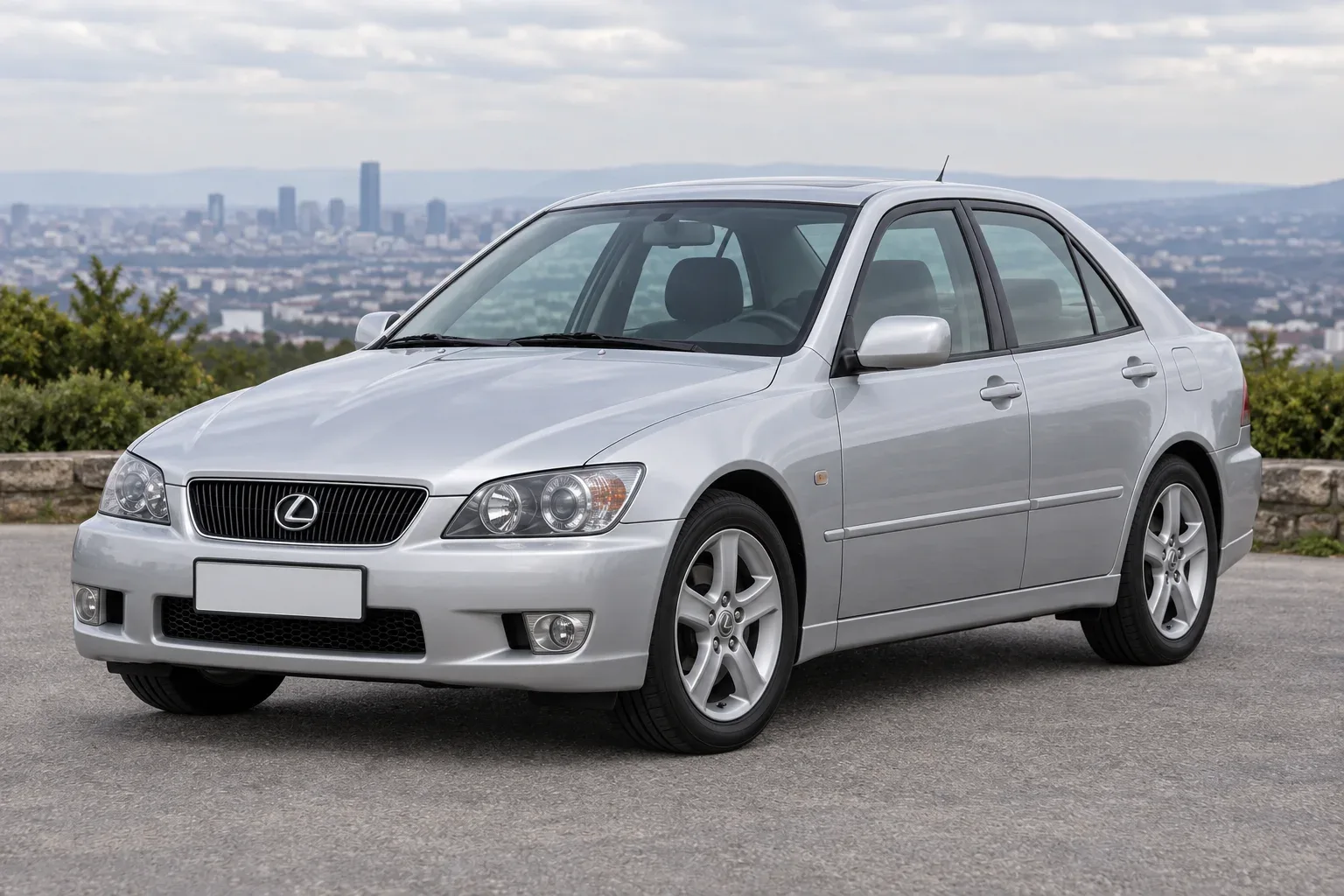
Lexus IS / XE10
Valuation of the Lexus IS / XE10 (1999–2005): condition, paperwork, inspection and terms of sale.
Indicative purchase price
Below market value
Final price agreed after inspection.
Value my car1Why buyers choose this model
Lexus is one of the youngest brands in the automotive market. It all started when Mr. Eiji Toyoda, the head of Toyota, realized in 1983 that mass-market cars were not enough to make a good portfolio, but something more prestigious was needed.
2What buyers check
Review
Lexus is one of the youngest brands in the automotive market. It all started when Mr. Eiji Toyoda, the head of Toyota, realized in 1983 that mass-market cars were not enough to make a good portfolio, but something more prestigious was needed. He then gathered a circle of specialists who worked for several years on a new project called F1, which later resulted in a luxury sedan LS 400. That is how Lexus was born, and LS from the very beginning became the flagship of the premium brand of the Japanese concern. The luxury sedan had to challenge German competitors and managed to please customers from the United States. Already in the early 90s it became quite obvious that one LS all the peaks can not conquer, and even more so will not oust the Germans. So a little later appeared ES, which was nothing more than a more perfect form of Toyota Camry in the body of the SC coupe. After a while, the range was replenished with GS - a potential rival to the BMW 5, Audi A6 and Mercedes C-class. After the appearance in the mid-90s of SUVs LX, Lexus took on a more “popular” segment. The result of these works was the market debut of the IS model, which was in the salons in 1998. The first generation IS was produced between 1998 and 2005 and was a variation of the Toyota Altezza. The first IS 200 cars were equipped with an inline 6-cylinder 2-liter engine. In pair with him worked 6-speed mechanics or 4-speed machine. In 2001, a more powerful version of the IS 300 was introduced with an inline 3-liter 6-cylinder engine and a 5-band automatic. In the summer of the same year, a restyling was carried out.
Characteristics
The car looks attractive even today. The front part turned out to be “dynamic” thanks to expressive headlights. The picture is even more interesting in the back. In this model, the rear lights with transparent glazing were first used. Later, this solution became widely used in the world of tuning.
It's no less curious inside. True, there is not too much space in the cabin, but thanks to the wide range of seat adjustments, it is not difficult to find a comfortable position behind the wheel. The situation is a little worse on the second row. The disadvantages of the model can be attributed to the trunk. Its volume is only 400 liters, and part of the usable space is eaten by the loops of the cover.
In addition to the sedan body, there was also a SportCross station wagon in the list of proposals. The trunk is even smaller – 365 liters, but the car will appeal to those who appreciate originality and individuality. However, such copies are very rare.
The combination of devices draws attention to itself, the pointers of which resemble a luxurious wristwatch, with the readability of which there are no problems. The interior is made of materials of decent quality, and the level of equipment is quite rich. Climate control, leather, electric and seat heating, CD changer, and even voice-controlled satellite navigation are often found in used instances. On the other hand, climate control has no display and can only be single-zone. There's no onboard computer here.
Engines
Under the hood of the model you can find one of two inline 6-cylinder gasoline units. The IS200 installed 2-liter engine 1G-FE with a phase change system VVT-i power 155 hp and torque 195 Nm. In conjunction with the manual transmission, the engine allowed to accelerate to 100 km / h in 9.5 seconds and reach a maximum speed of 215 km / h. In the version with a mechanical compressor, the power increased to 186 hp, and the maximum torque - up to 225 Nm. Stronger inline 6-cylinder 3-liter engine 2JZ-GE modification IS300 had a return of 214 hp and a maximum torque of 288 Nm. The sprint to 100 km/h took just over 8 seconds, and the top speed increased to 230 km/h. Unfortunately, higher power and dynamics have affected fuel consumption. If the IS200 needs about 9-10 l / 100 km, for the IS300 - about 13-15 l / 100 km. 2-liter engine sometimes makes you worry about the serviceability of the oil pump and requires regular checks of its condition. The pump often "leaves the leak." The defect leads to a drop in oil pressure in the system, premature wear of the moving parts of the engine or even jamming. Power losses and engine shutdowns may occur due to failure of the VVT-i electromagnetic valve or ignition coils. Both engines have a temporary type of HRM drive, which should be changed every 60-90 thousand km. Mechanics advise using only original components. When replacing, a new water pump (resource up to 120,000 km) should be installed, as well as new camshaft and crankshaft glands.
Transmission
The IS 200 was by default associated with a 6-speed manual transmission. It is distinguished by clear and accurate switching. Alternatively, a 4-speed A45DE/Aisin AW 03-70 automatic was available. Technically, it is a fairly simple device without the possibility of manual transmissions.
The IS 300 was aggregated exclusively with a 5-speed automatic with the ability to manually switch - A650E / Aisin AW 35-50LS. Manual selection of gears is implemented using the buttons on the steering wheel, but first the selector must be transferred to the appropriate position. In D mode, the box does not respond to the buttons.
Lexus machines are considered durable and durable, but require regular maintenance. At large runs, the belt brake wears out, and sometimes the hydrotransformer fails. The oil in the box is recommended to be updated every 40-50 thousand km.
In aggressively exploited instances, the clutch of the manual transmission serves about 120-140 thousand km, besides, the resource of the rear differential is significantly reduced.
Walking
Thanks to the rear-wheel drive, weight of just over 1,300 kg, tight suspension and precise steering, the car behaves on the road really great. Even more stable version with a 3-liter engine and a self-locking differential type Torsen (optional). The IS is a worthy competitor to the BMW 3, Audi A4 and Mercedes C-Class.
The suspension is technically more complex than the BMW 3 with modified Macpherson racks. But do not worry that the final bill for the repair of the running gear will be higher than the residual value of the entire car. The most expensive item in the chassis repair is the replacement of the upper lever in the shape of a triangle on the rear axle (from 7000 rubles).
The front is the fastest worn steering tips, bushings and stabilizer racks (after 40-60 thousand km). A little later, the Silentblock of the front lower lever is handed over. The remaining components of the running easily live up to 150,000 km.
Typical problems and malfunctions
The Lexus is a reliable car that is not a frequent guest in the services. However, a decent age makes you pay attention to corrosion. It can be found on the thresholds in front of the rear wheels. Some corrosion is so strong that the threshold can be pierced from the bottom with a screwdriver. The reason is the accumulation of dirt. To keep the body safe, you should remove plastic linings from time to time and clean the affected areas.
The front edge of the hood is also corrosive. It's not as serious as rusting in front of the wheel arches in the engine bay. Here two sheets of metal are joined, and corrosion sometimes flourishes inside.
Lexus IS owners also complain about a malfunction of a CD changer that refuses to accept discs. In this case, the sensor responsible for this operation is changed. Unfortunately, the problem is coming back soon.
In addition, some instances are small electrical malfunctions, such as non-working seat adjustment buttons or electric windows. And because of the melting of the cartridge, sometimes there are difficulties with replacing the light bulbs in fog lamps.
3Pre-purchase checklist
Review
- It all started when Mr. Eiji Toyoda, the head of Toyota, realized in 1983 that mass-market cars were not enough to make a good portfolio, but something more prestigious was needed.
- Already in the early 90s it became quite obvious that one LS all the peaks can not conquer, and even more so will not oust the Germans.
- After a while, the range was replenished with GS - a potential rival to the BMW 5, Audi A6 and Mercedes C-class.
Characteristics
- The combination of devices draws attention to itself, the pointers of which resemble a luxurious wristwatch, with the readability of which there are no problems.
Engines
- If the IS200 requires about 9-10 l/100 km, then the IS300 needs about 13-15 l/100 km.
- The 2-liter engine sometimes makes you worry about the serviceability of the oil pump and requires regular checks of its condition. The pump often "leaves the leak."
- The defect leads to a drop in oil pressure in the system, premature wear of the moving parts of the engine or even jamming.
- Power losses and engine shutdowns may occur due to failure of the VVT-i electromagnetic valve or ignition coils.
- Both engines have a temporary type of HRM drive, which should be changed every 60-90 thousand km.
- When replacing, a new water pump (resource up to 120,000 km) should be installed, as well as new camshaft and crankshaft glands.
- It is recommended that inspection and adjustment be carried out every 150,000 km.
Transmission
- Manual selection of gears is implemented using the buttons on the steering wheel, but first the selector must be transferred to the appropriate position.
- At large runs, the belt brake wears out, and sometimes the hydrotransformer fails.
- The oil in the box is recommended to be updated every 40-50 thousand km.
Walking
- But do not worry that the final bill for the repair of the running gear will be higher than the residual value of the entire car.
- The most expensive item in the chassis repair is the replacement of the upper lever in the shape of a triangle on the rear axle (from 7000 rubles).
Typical problems and malfunctions
- However, a decent age makes you pay attention to corrosion.
- Some corrosion is so strong that the threshold can be pierced from the bottom with a screwdriver. The reason is the accumulation of dirt.
- To keep the body safe, you should remove plastic linings from time to time and clean the affected areas.
- The front edge of the hood is also corrosive.
- It's not as serious as rusting in front of the wheel arches in the engine bay.
- Here two sheets of metal are joined, and corrosion sometimes flourishes inside.
- Lexus IS owners also complain about a malfunction of a CD changer that refuses to accept discs.
- Unfortunately, the problem is coming back soon.
4Challenges of selling privately
The Lexus IS series is a very successful car that is quite beautiful and well assembled. If the prices of gas stations do not scare you, then it is better to look for a 3-liter version. In this case, you will have to consider options from the United States, but among them there are many copies, with a dark and not always serene past.
- In the early 90s it became quite obvious that one LS all the peaks can not conquer, and even more so will not oust the Germans.
- Characteristic features: The combination of devices draws attention, the pointers of which resemble a luxurious wristwatch, with the readability of which there are no problems.
- Engines: A 2-liter engine sometimes makes you worry about the oil pump and requires regular checks. The pump often "leaves the leak."
- Transmission: At large runs, the belt brake wears out, and sometimes the hydrotransformer fails.
- But do not worry that the final bill for the repair of the running gear will be higher than the residual value of the entire car.
- Typical problems and malfunctions: However, a decent age makes you pay attention to corrosion.
Shows, bargaining and re-registration take time: buyers look, promise to think and disappear. Fair price after inspection closes the auction on the spot. If money is needed urgently, the purchase takes away waiting and repeat displays.
5How selling to us works
Leave a request with the car data. We will discuss the preliminary assessment and inspection. After checking the status and documents, we agree on the final price and terms of the transaction.