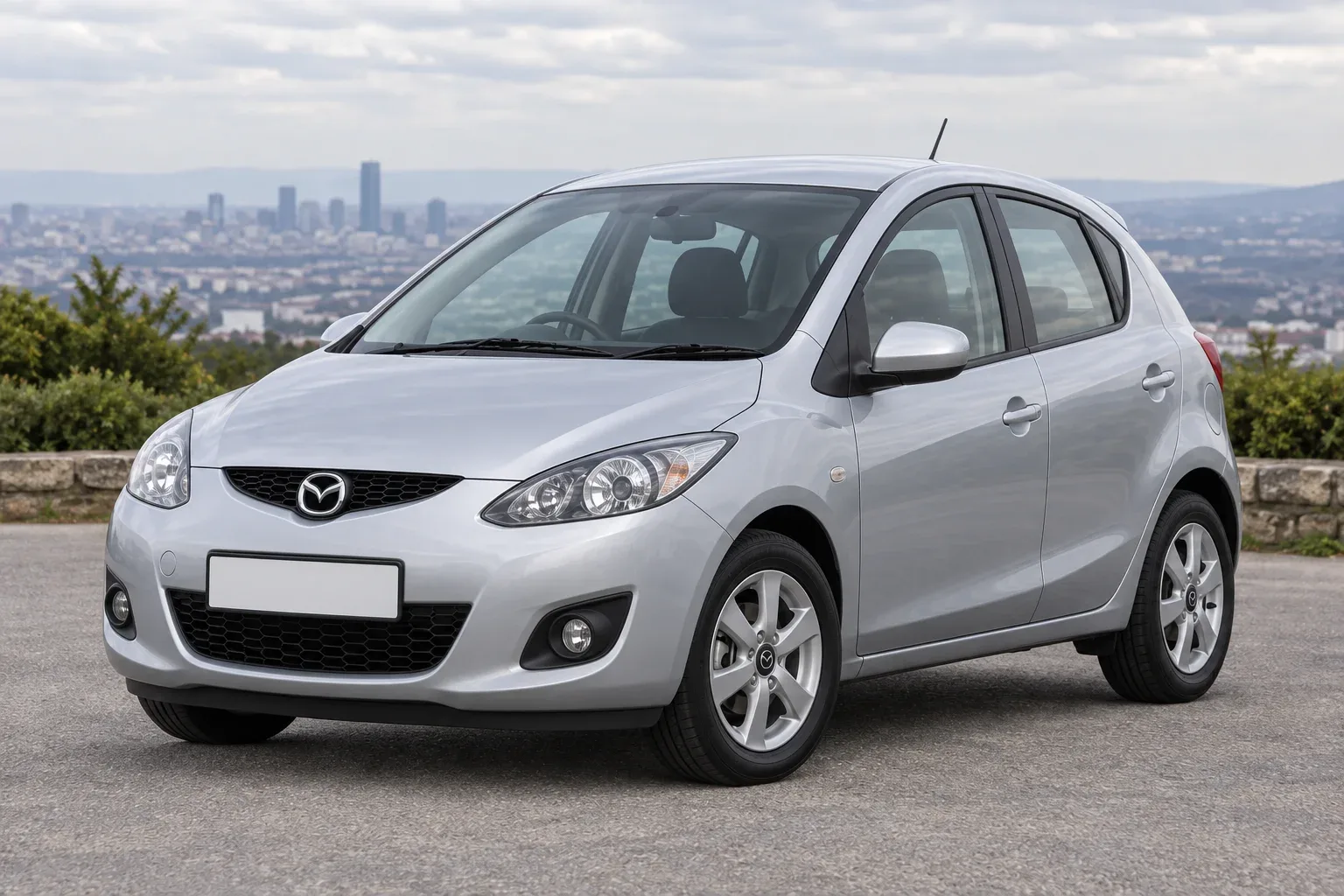
Mazda 2 DE
Valuation of the Mazda 2 DE (2007–2014): condition, paperwork, inspection and terms of sale.
Indicative purchase price
Below market value
Final price agreed after inspection.
Value my car1Why buyers choose this model
There is no doubt about the durability of the Mazda 2. The second generation of the two has become even more reliable. The first model looked too conservative. With its shape and unusually high body, it resembled a small minivan. The next generation car has become fully compliant with the standards of the class.
2What buyers check
Model history
The second generation Mazda 2 was officially unveiled at the 2007 Geneva Motor Show. In the summer of the same year, the car went into series. The car was offered in the back of a 5-door hatchback. A year later, in 2008, the “two” won the main prize in the prestigious competition “Car of the Year”. At the same time, a modification with a 3-door body was presented. In 2010, Mazda underwent modernization. In 2014, there was another generational change.
Despite the strong competition in the compact segment, the Mazda 2 was a huge success, which is eloquently confirmed by the sales figures of about two and a half million copies. Success was largely due to a very attractive appearance.
Design features
If the first generation of Mazda 2 in addition to the platform used and transmission from Ford Fiesta, the second edition became more independent. However, the platform was again borrowed from the little Ford, but the petrol engines from Fiesta had nothing in common. In addition to 5-speed mechanics, the car could be equipped with a 4-speed automatic Activematic. In the crash tests EuroNCAP for the protection of passengers Mazda earned five stars.
Engines
The first generation Mazda 2 used Zetec-Sigma gasoline engines, developed in the nineties by Ford in collaboration with Yamaha. In the second generation, their place was taken by 4-cylinder units of their own production with the marking MZR, which means MaZda Responsive. In fact, we are talking about three engines of the Z series. Two of them had the same working volume, but differed in the degree of forcing. All of them were equipped with a chain drive of HRM, distributed fuel injection, two upper camshafts and 16 valves. The base was assigned a 1.3-liter unit of the ZJ series, offered in two power options. In terms of mechanics, both versions are completely identical. The difference should be looked for in the engine control unit program. There are almost no differences in dynamics. The engines are highly efficient due to their relatively high compression ratio of 10:1. In addition, they were equipped with a system of phase change of the intake valves S-VT (Sequence Variable Timing). Its main task is to create the effect of the so-called internal recycling of exhaust gases in partial load modes in order to combat nitrogen oxide emissions. These units were combined with a 5-speed manual transmission F35M-R. Due to the lack of a synchronizer for reversing transmission, sometimes difficulties arise with its inclusion. Front gears, on the contrary, "stick" easily and accurately. The MZR 1.5 liter is the second gasoline unit that can be found under the hood of Mazda 2.
Diesel engines
Unlike gasoline engines, all diesel units are borrowed from the French - in the PSA concern. The first two years of production used 1.4 MZ-CD with the designation Y4, which was nothing more than the well-known 1.4 HDI (DV4). It is quite economical, but unlike gasoline engines requires regular replacement of the belt of the timing system - every 120,000 km or 6 years of operation. PSA is optimistic that the valve timing drive is capable of withstanding 240,000 km or 10 years. But the Japanese decided not to take the risk. The engine itself is quite reliable, thanks to a durable flywheel and the absence of a particulate filter. However, sometimes a filter of solid particles occurs, but extremely rare. However, despite good reviews from owners and services to buy a Mazda 2 with such a motor is not worth it. Among the common problems, it is necessary to note the difficulties with the launch. The culprit is a clogged fuel filter. It is quite expensive (about 2500 rubles) due to the indissoluble bulky plastic case, which changes entirely - together with the filter element. In some cases, there is a need to replace the seals of the Common Rail nozzles of the Siemens brand. This will tell the smell of the diesel in the cabin. Ignoring the defect is not worth it. Too much fuel in extreme cases leads to burnout of the cylinder head. In 2009, the 1.4 MZ-CD was replaced by the 1.6 MZ-CD of the DV series, also a native of PSA. It was in compliance with Euro 4 emissions standards before 2010 and Euro 5 after.
Corrosion?
Mazda of the first decade of the XXI century - it is excellent driving performance, high reliability and, unfortunately, weak noise insulation, and poor protection against corrosion. In the late 90s, it seemed that cars had finally got rid of the “brown plague” as manufacturers began to use more and more galvanized metal. So in the Mazda Xedos 9 galvanizing received almost 90% of the body. Even the budget models of the 323 VA and 626 GE resisted corrosion well. However, the next 323 BJs and 626 GFs were slowly being taken over. The problem escalated after restyling in 2000-2001. It was during this period that the “epidemic” broke out: Mazda 3 and 6, MPV 5. It is strange, but the Mazda 2 managed to avoid the “contagion”. There are no traces of corrosion even after 6 years of operation and 100,000 km of mileage.
Typical problems and malfunctions
Fatal failures of Mazda 2 have not yet been recorded. But there are little things and mostly acoustic. Most often the source is the suspension.
It manifests itself during rotation with the steering wheel in place or when moving at a small speed. The reason is the lack of lubrication between the inner and outer sliding surface of the steering column pipe. No steering column replacement is required to resolve the problem. Official services are aware of the defect and know how to eliminate it. Since September 2010, a modified node has been installed.
The disease is rather episodic and is observed only in some cars. The cost of the rear shock absorber is about 4500 rubles.
It's more common than knocking. You get rid of the banal lubricant.
The tips themselves are relatively cheap (from 1000 rubles per piece), but after repair you will need to adjust the geometry of the wheels, which will cost more.
A common problem with any car. Repairs won't seem expensive.
Failure of the remote control of the central lock.
The problem is typical for Mazda 2 of the initial production period. It is usually the recipient who lives his own life. The defect was later corrected by the manufacturer.
3Pre-purchase checklist
Engines
- The difference should be looked for in the engine control unit program. There are almost no differences in dynamics.
- Valve clearance check is recommended every 120,000 km.
- In this case, an experienced mechanic will be able to determine the need for adjustment by ear. But the process itself is not easy.
- Otherwise, you risk damaging the camshaft, and then repairs will cost more.
- The oil level should be checked periodically.
Diesel engines
- Among the common problems, it is necessary to note the difficulties with the launch. The culprit is a clogged fuel filter.
- In some cases, there is a need to replace the seals of the Common Rail nozzles of the Siemens brand.
- The reliability of the engine is a lot of controversy. The range of problems is quite wide.
- From the turbocharger and the hung EGR, to complete wear of the head of the block due to a drop in pressure in the lubrication system.
Corrosion?
- Mazda of the first decade of the XXI century - it is excellent driving performance, high reliability and, unfortunately, weak noise insulation, and poor protection against corrosion.
- Even the budget models of the 323 VA and 626 GE resisted corrosion well.
- The problem escalated after restyling in 2000-2001.
- There are no traces of corrosion even after 6 years of operation and 100,000 km of mileage.
Typical problems and malfunctions
- No steering column replacement is required to resolve the problem.
- It's more common than knocking. You get rid of the banal lubricant.
- The tips themselves are relatively cheap (from 1000 rubles per piece), but after repair you will need to adjust the geometry of the wheels, which will cost more.
- A common problem with any car. Repairs won't seem expensive.
- Failure of the remote control of the central lock.
- The problem is typical for Mazda 2 of the initial production period.
4Challenges of selling privately
The Mazda 2 is a pretty tough car. This is confirmed by numerous reliability ratings, including TUV. Despite the relatively poor equipment of the basic versions, in the market of used cars there are mainly decently equipped copies. The interior looks modern. To blame the car, perhaps, only for a small amount of space in the low rear seats.
- The second generation Mazda 2 was officially presented at the 2007 Geneva Motor Show.
- Design features: If the first generation of Mazda 2 in addition to the platform used the transmission from Ford Fiesta, the second edition became more independent.
- Engines: Otherwise, you risk damaging the camshaft, and then repairs will cost more.
- Diesel engines: Among the common problems to note are difficulties with starting. The culprit is a clogged fuel filter.
- Mazda of the first decade of the XXI century - it is excellent driving performance, high reliability and, unfortunately, weak noise insulation, and poor protection against corrosion.
- Typical problems and malfunctions: No steering column replacement problem is required.
Shows, bargaining and re-registration take time: buyers look, promise to think and disappear. Fair price after inspection closes the auction on the spot. If money is needed urgently, the purchase takes away waiting and repeat displays.
5How selling to us works
Leave a request with the car data. We will discuss the preliminary assessment and inspection. After checking the status and documents, we agree on the final price and terms of the transaction.