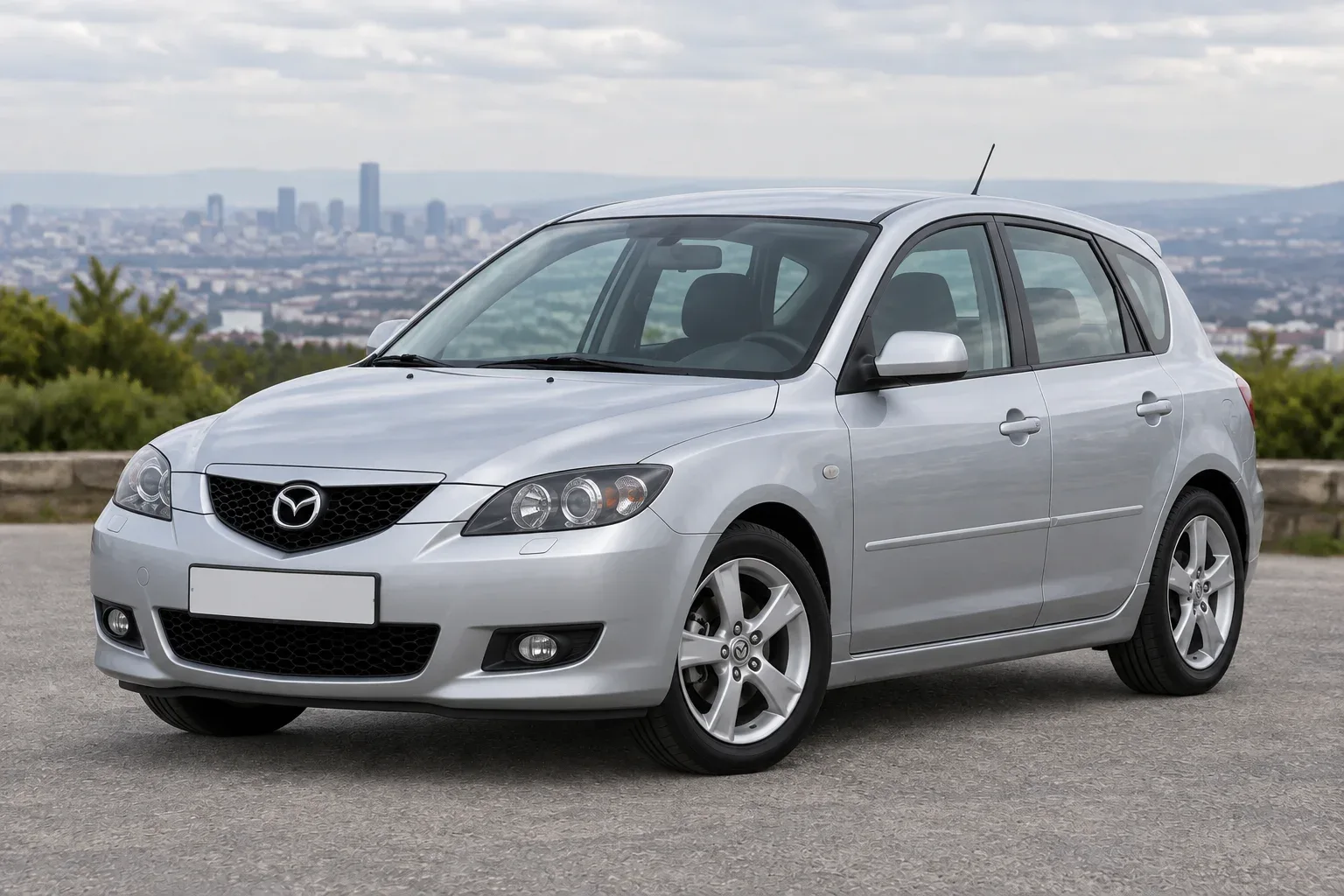
Mazda 3 BK
Valuation of the Mazda 3 BK (2003–2009): condition, paperwork, inspection and terms of sale.
Indicative purchase price
Below market value
Final price agreed after inspection.
Value my car1Why buyers choose this model
The first generation of Mazda 3 has won the love of many motorists around the world. The Mazda 3 was first introduced at the Geneva Motor Show in 2003, and a few months later its mass production began. In 2006, the car underwent restyling, as a result of which the noise insulation was modified, the bumper, radiator lining, instrument panel and interior upholstery were changed. ABS and EBD systems were added to the base equipment list after the upgrade. The sporty MPS and Flash Edition were also introduced. In 2009, Mazda 3 of the second generation came to replace.
2What buyers check
Engines
Mazda 3 of the first generation was offered with two types of bodies – hatchback and sedan. For the Russian market Mazda 3-series completed gasoline engines Z6 1.6 liters (105 hp) and LF 2.0 liters (150 hp). The sports version of the MPS car received a gasoline turbocharged MZR DISI Turbo 2.3 liters (260 hp). Mazda 3 "American origin" was installed atmospheric 2.0 and 2.3 liters. All engines with a valve timing driven into rotation by a plate chain, the tension of which is provided by an automatic tensioner. The valves on all motors are driven directly from the camshafts through cylindrical pushers, serving simultaneously as adjusting elements of the gap, i.e. without hydraulic compensators. All engines had a number of common minor problems. This is the chirping of the intake manifold, which appears when running more than 120 - 140 thousand km. The knock is issued by plastic valve actuators due to the gap increasing over time. Another more serious problem arises with rod liners when running more than 110 – 130 thousand km. Mostly this disease affects the engines of 2005-2006 years of release. On the liners, the bobbit is detached, which covers the inner surface, as a result, a backlash of the rod appears, and when the “gas” increases, you hear “babbling” or “cracking” in the engine. A set of new inserts will cost 4-5 thousand rubles for the original and 2-3 thousand rubles for the non-original. When running more than 60 – 100 thousand km, the engine support may fail (2.5 – 3.5 thousand rubles – not the original and 4.5 – 5 thousand rubles – the original).
Transmission
Initially, the five-speed G35M-R mechanics were installed on the “treshka” with all types of engines. And Mazda 3 in the Touring configuration with a 1.6-liter engine on request could be equipped with a 4-speed “automatic” Activematic FN4A-EL. Since 2006, 2.0-liter engines have already been running with a 6-speed “mechanics”, and since 2008, even with a 5-speed automatic transmission FS5A-EL.
Automatic transmissions serve faith and truth without complaints. A characteristic feature of cars with automatic transmission is a characteristic metal ringing when starting the engine.
There are no problems with the ICU as well. When running more than 200 thousand km, synchronizers begin to “tire”. The clutch survives far beyond a hundred, as a rule, 130 - 180 thousand km. The only unpleasant thing is leakage of the main clutch cylinder due to the “weakened” cuffs. They will not change their hearts, and they will be replaced even earlier. The output is the replacement of the main cylinder entirely (2 thousand rubles + 4 thousand rubles - work).
Walking
The suspension can hardly be called unkillable. The supports of the front shock absorbers begin to knock when running more than 60 - 70 thousand km, and the shock absorbers themselves - 60 - 90 thousand km. Rear shock absorbers last longer – 90 – 120 thousand km. The queue of the front and rear stabilizers stands is 70-90 thousand km. Front stage bearings are often surrendered when running 90 - 110 thousand km (2 - 3 thousand rubles). Ball supports in the front levers go more than 100 - 140 thousand km (4-6 thousand rubles). Silent blocks in levers live up to 100 - 150 thousand km. The first, as a rule, are suitable on longitudinal levers and rear small ones, a little later on the convergence-disruption.
Knocking in the rake is a disease of “threes”, however, as well as many other foreign cars. Do not rush to change it entirely (30 – 35 thousand rubles – new, 15 – 20 thousand rubles – used + 5 thousand rubles work). Remake of "dry", springs and nuts with a counternut will cure the rack and will cost less, only about 2 thousand rubles.
On 2 liters, often with a run of more than 60 - 80 thousand km, the electric power steering fails due to overheating in traffic jams. Manufacturers even carried out a recall campaign due to amplifier issues.
The front brake discs are in operation up to 90 – 110 thousand km (5-6 thousand rubles), the rear ones are much longer. The front brake pads require replacement every 40 – 50 thousand km. One of the features of the brakes is a hum, which occurs when reversing in wet weather.
Other problems and malfunctions
Body iron Mazda 3 is not subject to corrosion, in places of chipped paint is in no hurry to swell. On Mazda 3 until 2006, one of the problems is the impact of the sandjet on the rear arches, which then began to bloom. On cars with a sedan body, the rear shelf often flies away for welding and creaking appears. Over time, a rubber wire seal begins to leak in the trunk lid. Just treat it with silicone lubricant, and it again begins to cope with its task. Many have faced an unpleasant phenomenon, such as the melting of taillights. Glasses "fog" often burst in wet weather - heated glass can not withstand temperature changes when cool water hits its surface. If you want to prolong their life, use "fogs" only in dry weather. In winter, the end of the driver’s door lock is often “clinic”. As a result, when the doors are closed, the alarm system shows that they are open, the light in the cabin does not go out and it is impossible to close the locks from the remote alarm "remote": "Crickets" in the cabin appear at the bottom of the windshield (plastic lining outside), behind (plastic supports in the carport lid awnings). Sometimes the trunk locking handle starts to rattle. On Mazda 3 until 2006 release often break off contacts on the handle of the regulator of climate control. Many were faced with a buzzing that appeared at the bottom of the dashboard to the right of the steering wheel. Its source is a stepping motor (motor), after cleaning and lubricating which the noise subsides. Windshield wipers can stop working when running 40 - 60 thousand km.
3Pre-purchase checklist
Engines
- All engines had a number of common minor problems.
- The knock is issued by plastic valve actuators due to the gap increasing over time.
- Another more serious problem arises with rod liners when running more than 110 – 130 thousand km.
- On the liners, the bobbit is detached, which covers the inner surface, as a result, a backlash of the rod appears, and when the “gas” increases, you hear “babbling” or “cracking” in the engine.
- Loss of its working capacity will cost the engine a leak from under the front cover of the engine, which has lost its tightness due to the vibrations that have arisen.
- Together with them, it is necessary to replace the pretensioners and bearings of the drive belt.
- The first problems associated with unstable work and "troeny" appeared when running more than 60 - 80 thousand km.
- The reason for this was the opaque sealing rings of the intake manifold that lost elasticity, causing air suction.
Transmission
- There are no problems with the ICU as well. When running more than 200 thousand km, synchronizers begin to “tire”.
- They will not change their hearts, and they will be replaced even earlier.
- The output is the replacement of the main cylinder entirely (2 thousand rubles + 4 thousand rubles - work).
Walking
- Knocking in the rake is a disease of “threes”, however, as well as many other foreign cars.
- km, the electric power steering fails due to overheating in traffic jams.
- Manufacturers even carried out a recall campaign due to amplifier issues.
Other problems and malfunctions
- Body iron Mazda 3 is not subject to corrosion, in places of chipped paint is in no hurry to swell.
- On Mazda 3 until 2006, one of the problems is the impact of the sandjet on the rear arches, which then began to bloom.
- Often, problems in the electric Mazda 3 are caused by oxidation and "rotting" of one of the contacts in the fuse block under the hood.
- And the most original - the burnout of the light bulbs of the cigarette lighter and glove compartment leads to a break in the chain, and the occurrence of interruptions in the operation of the tape recorder.
4Challenges of selling privately
The described possible problems are not so terrible and not too burdensome financially, except for a defect in the rod liners. It is also important to note that all of these problems are unlikely to occur in a single car. We can say with confidence that Mazda 3 is a good choice.
- Engines: All engines had a number of common minor problems.
- Transmission: A characteristic feature of cars with automatic transmission is a characteristic metal ringing when starting the engine. There are no problems with the ICU as well. When running more than 200 thousand km, synchronizers begin to “tire”.
- Knocking in the rake is a disease of "threes", however, as well as many other foreign cars.
- Other problems and malfunctions: Body iron Mazda 3 is not subject to corrosion, in places of chipping paint is in no hurry to swell.
Shows, bargaining and re-registration take time: buyers look, promise to think and disappear. Fair price after inspection closes the auction on the spot. If money is needed urgently, the purchase takes away waiting and repeat displays.
5How selling to us works
Leave a request with the car data. We will discuss the preliminary assessment and inspection. After checking the status and documents, we agree on the final price and terms of the transaction.