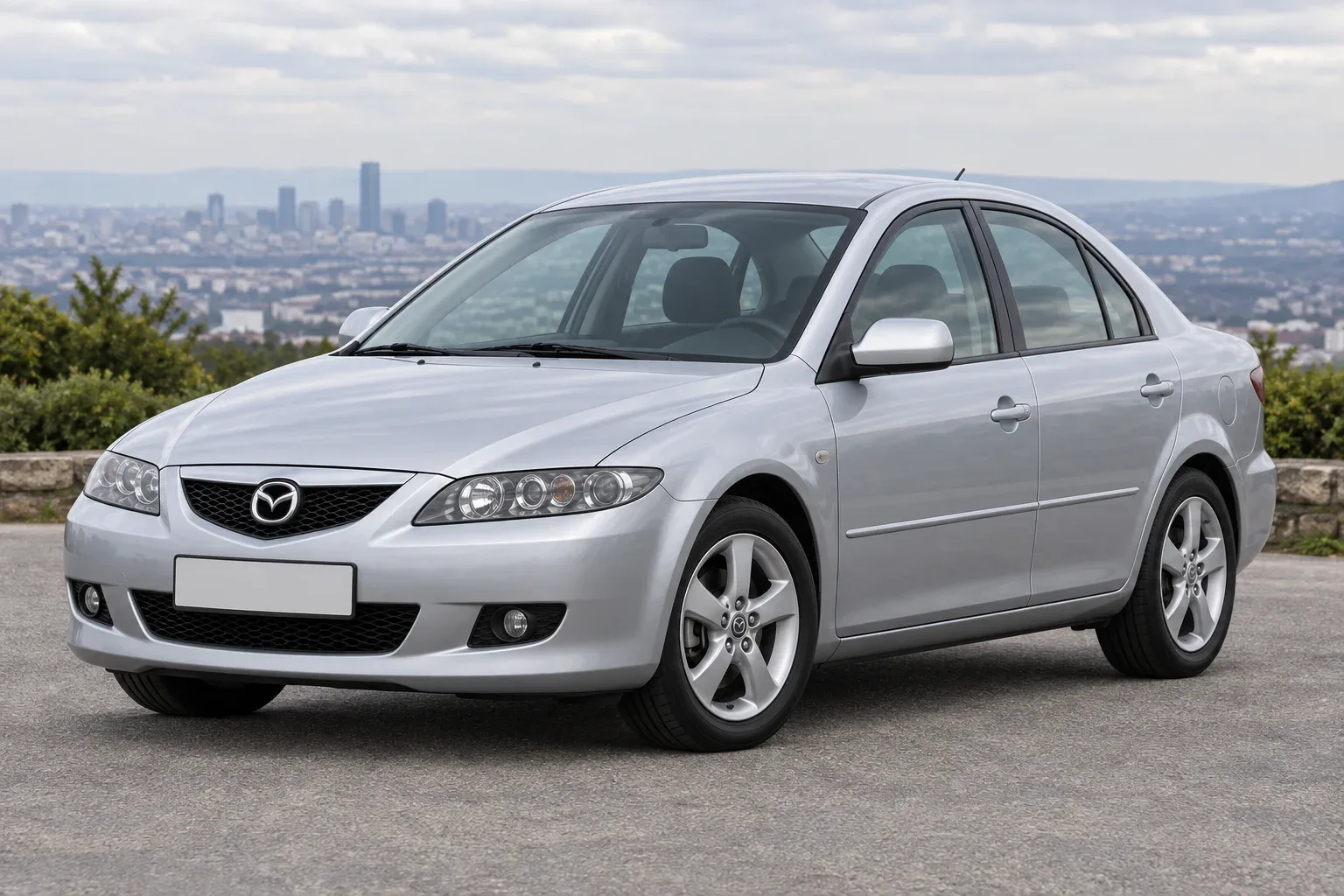
Mazda 6 GG
Valuation of the Mazda 6 GG (2002–2007): condition, paperwork, inspection and terms of sale.
Indicative purchase price
Below market value
Final price agreed after inspection.
Value my car1Why buyers choose this model
Mazda 6 first generation entered the European market in 2002, and in Russia appeared a year later - in 2003. "Six" was built on a common platform with Ford Mondeo. In 2005, the model underwent a minor update. In 2007, the first generation of Mazda 6 was replaced by the second. During production, more than a million copies of the Mazda 6 I were sold.
2What buyers check
Engines
On the "six" were installed gasoline fours with a working volume of 1.8 liters (120 hp), 2.0 l (141 and 147 hp) and 2.3 l (166 hp). On Mazda 6 for the American continent, a gasoline V-shaped six with a working volume of 3.0 liters with a capacity of 218 hp (245 hp) was also installed. Diesel engines were offered only in Europe and were represented by 2-liter units with a capacity of 120 and 136 hp until 2005 and 143 hp. after. Gasoline engines have a chain drive of the fuel-producing plant, which confidently overcomes the milestone of 250-300 thousand km. Powertrains are quite reliable and in most cases do not require an unforeseen opening. An example of this is the owners who have rolled 300-350 thousand km. Most engines, regardless of the working volume, begin to eat up oil after 120-150 thousand km. Appetites vary from 0.5 to 5-6 liters per 10,000 km. The manufacturer in the operating instructions claims that oil consumption is up to 0.5 liters per 1,000 km normal. In most cases, it is possible to significantly reduce oil appetite after replacing oil caps. But you can completely get rid of the "maslozhor" if, together with the caps, the piston rings are replaced, i.e., you carry out an "incomplete" overhaul. Some owners, tired of the high consumption of small, resorted to this method of solving the problem when mileage is more than 200,000 km. The most capricious in the line of gasoline engines Mazda 6 engine with a working volume of 3.0 liters. On the mirrors of the cylinders were repeatedly seen bullies, and the engine itself during operation began to "knock".
Transmission
Mazda 6 was equipped with a 5-speed manual or 4-speed automatic transmission. After restyling in 2005, the “six” began to install a 6-speed “mechanics” or 5-band “automatic”, except for versions with the 1.8 engine, for which the set of boxes remained the same. Owners of the Mazda 6 with a manual transmission face a floundering clutch pedal or its "heaviness". In the first case, the clutch hose is to blame - over time it loses strength, and a "hernia" appears at the site of damage. The problem arises when running more than 100-150 thousand km. The cost of the hose is small - about 500 rubles. Tight clutch pedal becomes after 150-200 thousand km, which is due to wear of the clutch disc and dirt under the anther of the clutch plug. In the end, the fight against the clutch pedal during gearshifts often led to the appearance of cracks in the place of fixing the pedal, and the pedal itself broke off. Clutch, as a rule, goes more than 100-150 thousand km. At neat drivers it reaches 200-250 thousand km. The automatic transmission uses oil, designed for the entire service life of the unit. But in fact, it is better to change the oil every 60,000 km. This is recommended by all specialists working with automatic transmissions. When running more than 80-120 thousand km, many drivers note the appearance of aftershocks during the switch from the 1st to the 2nd and from the 3rd to the 4th gear.
Walking
The external SRUS runs more than 120-150 thousand km. The rear and front hub bearing is delivered after 100-150 thousand km. The bearing is assembled with a hub and costs about 3-4 thousand rubles.
Silent blocks of levers go more than 100-150 thousand km. Approximately the same amount of shock absorbers. Ball supports may require replacement after 160-180 thousand km. Ballroom, according to the rules, changes with the lever (about 1.5-2 thousand rubles), but you can do and overpressing (500 rubles for ball).
When running more than 100-150 thousand km, leakage or tapping from the steering rack is often detected. The new rail will cost 40-60 thousand rubles. But you can get rid of it and repair – 10 000 rubles.
Souring calipers in guides is a common thing for Mazda 6 and is inevitable when running more than 120-150 thousand km. By the same time, the ossils / cuffs of calipers are handed over, and traces of corrosion may appear on the pistons. With the help of a remake of the caliper, it is easy to return to life.
Other problems and malfunctions
Unfortunately, the cars of 2002-2005 and some of the cars of 2006 are actively "blooming" in the rear arches. Also, foci of corrosion are found on the rear doors and front wings. On cars older than 6 years often breaks the locker / door-maker, which fixes the door in the open position. Because of the leaky seals of the trunk lid and taillights in the trunk after sinks and rains, water appears. In addition, welded body seams often leak in the trunk area. After treatment of seams with sealant leak disappears. Often, an attempt to replace the LED dimensions in the headlight led to its getting inside. Getting a fallen LED is not an easy task for the development of thinking. Someone removes the headlight and tries to shake out the elusive LED, someone uses a long wire with a magnet or tweezers. Anyway, who's big on it. Some owners got into a bad situation when the driver's door stopped opening. The reason is the breakage of the spring in the mechanism of the door lock. To reanimate the lock, had to pull the skin of the closed door, push through a narrow opening of the hand, and, groping for traction, try to open the door. Problems are presented and the central lock, which ceases to close or open one of the doors. Technically competent solution to the problem has not yet been found, except for the disconnection of the two-pin lock chip. Paradoxically, the castle starts to function. Salon Mazda 6 does not annoy numerous crickets. Sometimes they appear in the front panel, door linings and the central tunnel. Over time, the skin on the steering wheel and seats is wiped.
3Pre-purchase checklist
Engines
- But you can completely get rid of the "maslozhor" if, together with the caps, the piston rings are replaced, i.e., you carry out an "incomplete" overhaul.
- Some owners, tired of the high consumption of small, resorted to this method of solving the problem when mileage is more than 200,000 km.
- On the mirrors of the cylinders were repeatedly seen bullies, and the engine itself during operation began to "knock".
- Someone helps to replace spark plugs or coils with high-voltage wires.
- The best and most reliable option is to replace it with a BMW analogue.
- With diesel engines, there are no serious problems. The valve timing drive is belted.
- The mechanics recommend making its first replacement after 100,000 km, as there have been cases of breakage of the belt at a run of about 120,000 km. Turbochargers are pretty tenacious.
Transmission
- The problem arises when running more than 100-150 thousand km.
- km, which is due to the wear of the clutch disc and the ingress of dirt under the anther of the clutch plug.
- In the end, the fight against the clutch pedal during gearshifts often led to the appearance of cracks in the place of fixing the pedal, and the pedal itself broke off.
- The source of the problem lies in the design errors - the back cover of the box and the valve of the 3rd and 4th gear. Many services ask from 50 to 90 thousand rubles for the repair of the box. More adequate price of 20-40 thousand rubles.
- In fact, repairing the box on the first generation Mazda 6 is not so difficult. The braver ones can easily do it themselves.
Walking
- km often detect leakage or tapping from the steering rack. The new rail will cost 40-60 thousand rubles.
- But you can get rid of it and repair – 10 000 rubles.
- By the same time, the ossils / cuffs of calipers are handed over, and traces of corrosion may appear on the pistons.
Other problems and malfunctions
- Also, foci of corrosion are found on the rear doors and front wings.
- On cars older than 6 years often breaks the locker / door-maker, which fixes the door in the open position.
- After treatment of seams with sealant leak disappears.
- Someone removes the headlight and tries to shake out the elusive LED, someone uses a long wire with a magnet or tweezers. Anyway, who's big on it.
- Problems are presented and the central lock, which ceases to close or open one of the doors.
- Technically competent solution to the problem has not yet been found, except for the disconnection of the two-pin lock chip.
- The presence of a leak will tell the oiling of the problem place.
- Also, poor cooling can be caused by contamination of the air conditioner radiator or loss of leakage. The new radiator will cost 3-10 thousand rubles.
4Challenges of selling privately
The first generation 6 is still attractive after years. The car is not lost in the flow among younger and more modern cars. Choosing a used "six" you must carefully inspect the body for corrosion and make sure that the "automatic machine" is serviceable. In the future, you need to be ready to repair the suspension and brakes.
- But you can completely get rid of the "oil slug" if you replace the piston rings along with the caps, i.e. carry out an "incomplete" overhaul.
- Transmission: The problem arises when running more than 100-150 thousand km.
- Driving: km is often detected leakage or tapping from the steering rack. The new rail will cost 40-60 thousand rubles.
- Other problems and malfunctions: Also, corrosion foci are found on the rear doors and front fenders.
Shows, bargaining and re-registration take time: buyers look, promise to think and disappear. Fair price after inspection closes the auction on the spot. If money is needed urgently, the purchase takes away waiting and repeat displays.
5How selling to us works
Leave a request with the car data. We will discuss the preliminary assessment and inspection. After checking the status and documents, we agree on the final price and terms of the transaction.