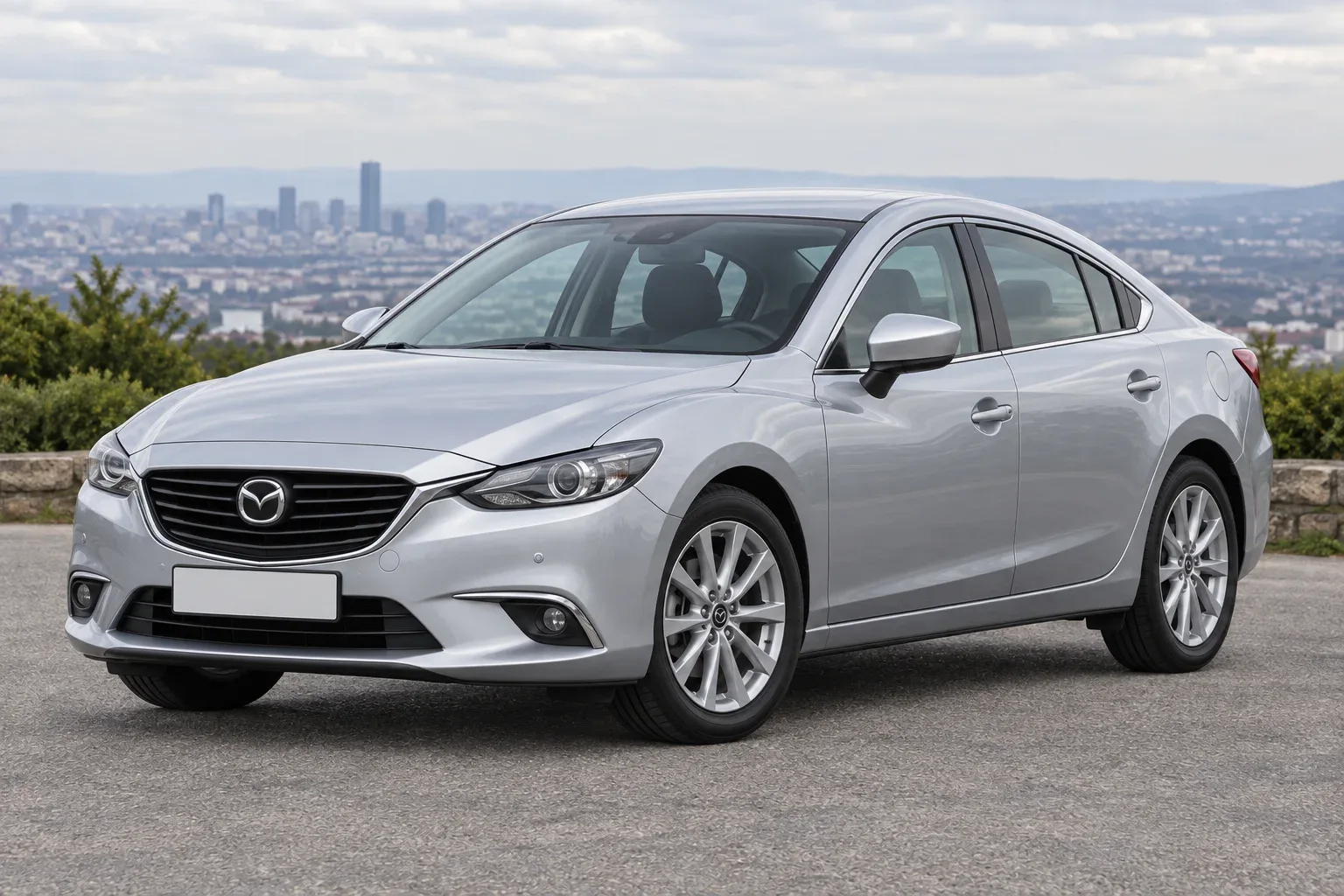
Mazda 6 GJ
Valuation of the Mazda 6 GJ (2012–2022): condition, paperwork, inspection and terms of sale.
Indicative purchase price
Below market value
Final price agreed after inspection.
Value my car1Why buyers choose this model
The world premiere of the third generation Mazda 6 took place at the Moscow Motor Show. The new GJ is the second car in Mazda’s range that combines Skyactiv technology and Kodo’s design style.
2What buyers check
Review
The world premiere of the third generation Mazda 6 took place at the Moscow Motor Show. The new GJ is the second car in Mazda’s range that combines Skyactiv technology and Kodo’s design style. The first Mazda 6s were shipped directly from Japan. In April 2013, assembly started in Vladivostok from ready-made car sets. The new Mazda 6 is more spacious. The body added 110 mm in length and 45 mm in width, and the wheelbase grew by 105 mm. As a result, the width of the cabin at the level of the shoulders of the front row increased by 20 mm (1450 mm). The back of the space in front of the knees increased by 43 mm. The Russians were officially offered only versions in the sedan. In the European markets, a universal was provided. Remarkably, it is shorter than the sedan by 65 mm, and the wheelbase is trimmed by 80 mm. To compensate for the lost centimeters, the second row sofa is moved closer to the rear axis. The interior is almost entirely inherited from the Mazda CX-5 crossover. The first facelift model was held in 2014 (2015 model year). Outside, the Japanese limited themselves to barely noticeable cosmetic retouching. There's more difference inside. This time the front panel design was inspired by the younger model of the Mazda 3 BM. In particular, the multimedia display was placed on top of the panel. In 2016 (2017 model year) there was another retouch, which affected the appearance and interior. In 2018 (2019 model year), the “six” has already experienced the third facelift. Mazda 6 GJ participated in crash tests according to EuroNCAP twice – in 2013 and in 2018. Both results are positive – 5 stars. A station wagon was used as a test subject.
Engines
Initially, the salons were supplied with copies with a 2-liter engine (150 hp). Mazda 6 with 2.5 appeared on sale in the summer of 2013, after the start of the assembly of the model in Vladivostok.
In 2018, the motor range was replenished with a 2.5-liter turbo engine (Skyactiv-G 2.5 T), developing 231 hp.
Until 2021, Europeans were available diesel versions with 2.2 Skyactiv-D (150 and 175 hp). Turbodiesel was not officially offered in Russia.
Mazda 6 was equipped with engines from the Skyactiv line. Of the technical features of gasoline engines, direct fuel injection and hydraulic valve gap compensators can be noted. the 2.5-liter unit is supplemented by a balancing shaft.
valve timing drive is chain drive. Questions about the longevity of the chain do not yet arise even with runs over 200,000 km.
Characteristic problems
Oil fogging in the area of the valve cover or the gas distribution phase sensor (OCV) closer to 80-120 thousand km of run is a common phenomenon. To eliminate it will have to replace the gaskets cost 1000-2000 rubles.
After 100-150 thousand km, it was possible to update the hydraulic tensioner of the drive belt (from 3000 rubles for an analog or 20,000 rubles for the original). He started rattling and clinging to the roller.
Ignition coils will serve more than 150-200 thousand km (from 1700 rubles for an analog or 9000 rubles for the original).
A little later, a number of owners faced a malfunction of the catalytic converter. The “check” lit up, and the diagnosis revealed the error “Low efficiency of the catalyst”. During the inspection, melting of the neutralizer cells was found.
Thermostat
In 2019, gasoline units received an electronic thermostat. If a conventional thermostat runs over 150-200 thousand km (700-1700 rubles), then the electronic could fail after 20-30 thousand km of run.
The main symptom is poor warming up in winter on idling mode. The new thermostat is only original and costs a lot of money – more than 60 000 rubles for machines with a manual transmission and 100 000 rubles for machines with an automatic.
Some services are taken for repair of a faulty part, for which they ask from 7000 to 30 000 rubles. The thermostat was later upgraded.
TNVD
So far, there are no systematic problems with TNVD. However, Mazda informed about possible malfunctions of the TNVD. The recall campaign affected cars produced from April 2018 to January 2019. In fact, isolated cases of failure of the TNVD were recorded among older copies with a mileage exceeding 100 00 km.
The cost of the pump is 60,000 rubles. It only comes in the original. The used part can be purchased for 18 000 rubles. For the work on the replacement will take about 3000 rubles.
Transmissions
The 2-liter engines were combined with the 6-speed Skyactiv-MT mechanics or the 6-speed Skyactiv-Drive automatic. Both boxes are Mazda’s own design. The 2.5 version was paired with a machine gun.
There are no comments on the manual transmission.
Automatic boxes are not problematic. However, sometimes there are complaints of tremors or kicks when switching.
There were also episodes with the overhaul of the machine due to problems with the hydroblock or bearing. The cost of restoration was more than 100-150 thousand rubles. Fortunately, all of these cases are isolated.
Walking
The Skyactiv-Chassis chassis features McPherson struts in the front and a multi-link circuit in the rear.
An electric powertrain is used in steering.
Leverages
Ball supports and rear silent blocks of the front levers wear out mainly to 100-150 thousand km. The front silentblock of the lever is almost eternal.
The original ball is only assembled with a lever (from 5700 rubles for an analog or 30,000 rubles for the original). The design of the standard lever allows you to replace the ball (from 1400 rubles), as well as the rear Silentblock, which happens in the original - 7400 rubles (substitutes - from 800 rubles).
Silent blocks of rear suspension usually reach 150-200 thousand km. The cost of the original Silentblock is around 1800 rubles, analogues start at 500 rubles. There are 7 of them on each side. For a complete bulkheading of the rear levers will need about 10 000 rubles, plus 14 000 rubles for work and about 3000 rubles for the mandatory adjustment of the angles of the wheel installation (fall-fall).
Shock absorbers
Front shock absorbers could catch or leak after 100,000 km of run (from 3000 rubles for an analog or 16 000 rubles for the original). Rear shock absorbers, by modern standards, are centenarians.
After 100-150 thousand km, it was possible to update the bearings (from 900 rubles for an analog or 2600 rubles for the original). And after 150-200 thousand km, the turn of the rear shock absorber supports came (from 1800 rubles for an analog or 3800 rubles for the original).
Stage bearings
The front bearings can fail after 100-150 thousand km of run, and the rear - usually after 150-200 thousand km.
Both are changing with the hub. For the front hub will have to pay from 4600 rubles for an analog or 16 000 rubles for the original, for the rear slightly less – from 2500 rubles for an analog or 13 000 rubles for the original.
Brake system
After the first update in 2015, the conventional mechanical parking brake gave way to the electromechanical.
The front and rear calipers may require attention after 150-200 thousand km. Front - due to wear of guides and anthers (500-900 rubles for a remake per wheel). Rear - due to problems with the parking brake (700 rubles for a repair kit).
To eliminate defects in the rear calipers, Mazda conducted a service campaign for cars of 2012-2015.
Drives.
After 150-200 thousand km in the center of attention may be the drive shafts. In particular, because of the right-wheel drive suspension bearing (from 1000 rubles for an analog or 2600 rubles for the original) or hinges. If the external SRUS can still be replaced separately (from 6000 rubles), the internal hinge has to be updated along with the semi-axis (from 12 000 rubles for an analog or 70-95 thousand rubles for the original).
Other problems and malfunctions
There are no global issues to the corrosion of body iron. The quality of the paint coating and corrosion resistance correspond to the average frame.
Failures in the mechanism of folding mirrors is a fairly common problem that occurs after 50-100 thousand km. The reason is the wear of the drive parts (motor, plastic gears) or a burnt-out transistor on the control board. For the new original drive will ask about 7000 rubles, and for the new control module – 12 000 rubles. The broken transistor can be replaced.
After passing 150-200 thousand km, can make noise or refuse the clutch of the air conditioner compressor (10-14 thousand rubles).
Over the years, Parktronic malfunctions are increasingly common. Usually due to oxidation and corrosion of contacts in the connectors, less often - due to breakdown of the sensor (2000-5000 rubles).
After 100-150 thousand km, the tip of the switch of automatic transmission modes can be worn (4000 rubles for the original). As a result, when the ignition is turned off, the tape recorder does not turn off. The functionality of the terminal can be restored by simple repair.
Active hood
A number of owners of the Mazda 6 GJ with an active hood have concerns about expensive repairs if activated. This can occur as a result of a minor accident, for example, hitting a dog at a low speed.
When the pedestrian protection system is triggered, pyropatrons are activated, which lift the hood. As a result, the hood and front wings are deformed. For the complete restoration of the system (8 sensors, wiring, pyropatrons, control unit), as well as repair of the wings and hood will need about 500 000 rubles!
To avoid unforeseen costs, some owners turn off the pyropatron and install a trick (resistor) in the chain.
3Pre-purchase checklist
Review
- To compensate for the lost centimeters, the second row sofa is moved closer to the rear axis.
- The Americans have tested the safety of the sedan. The result is similar.
Characteristic problems
- Oil fogging in the area of the valve cover or the gas distribution phase sensor (OCV) closer to 80-120 thousand km of run is a common phenomenon.
- A little later, a number of owners faced a malfunction of the catalytic converter.
- The “check” lit up, and the diagnosis revealed the error “Low efficiency of the catalyst”.
- During the inspection, melting of the neutralizer cells was found.
Thermostat
- km (700-1700 rubles), then the electronic could refuse after 20-30 thousand km of run.
- Some services are taken for repair of a faulty part, for which they ask from 7000 to 30 000 rubles. The thermostat was later upgraded.
TNVD
- So far, there are no systematic problems with TNVD.
- However, Mazda informed about possible malfunctions of the TNVD.
- In fact, isolated cases of failure of the TNVD were recorded among older copies with a mileage exceeding 100 00 km.
Transmissions
- Automatic boxes are not problematic.
- There were also episodes with the overhaul of the machine due to problems with the hydroblock or bearing.
Shock absorbers
- Front shock absorbers could catch or leak after 100,000 km of run (from 3000 rubles for an analog or 16 000 rubles for the original).
Brake system
- Front - due to wear of guides and anthers (500-900 rubles for a remake per wheel).
- Rear - due to problems with the parking brake (700 rubles for a repair kit).
Other problems and malfunctions
- There are no global issues to the corrosion of body iron.
- The quality of the paint coating and corrosion resistance correspond to the average frame.
- Failures in the mechanism of folding mirrors is a fairly common problem that occurs after 50-100 thousand km.
- The reason is the wear of the drive parts (motor, plastic gears) or a burnt-out transistor on the control board.
- km, can make noise or refuse the clutch of the air conditioner compressor (10-14 thousand rubles).
- Over the years, Parktronic malfunctions are increasingly common.
- Usually due to oxidation and corrosion of contacts in the connectors, less often - due to breakdown of the sensor (2000-5000 rubles).
- km can wear the tip of the switch modes automatic transmission (4000 rubles for the original).
Active hood
- A number of owners of the Mazda 6 GJ with an active hood have concerns about expensive repairs if activated.
- For the complete restoration of the system (8 sensors, wiring, pyropatrons, control unit), as well as repair of the wings and hood will need about 500 000 rubles!
4Challenges of selling privately
In summary, it should be noted that serious systematic problems have not yet been noticed. It is too early to judge the reliability of the new gasoline turbo engine, since the mileage is small, and it has not received widespread distribution. Resource factory parts are quite decent, but the cost of original spare parts is very tangible. However, the Mazda 6 GJ is a fairly reliable car, worthy of attention.
- Overview: To compensate for the lost centimeters, the second row sofa is moved closer to the rear axis.
- Engines: Initially, the salons were supplied with copies with a 2-liter engine (150 hp). Mazda 6 with 2.
- Transmissions: The automatic transmission is not problematic.
- Driving: The Skyactiv-Chassis branded chassis provides for Macpherson struts in the front and a multi-link scheme in the rear.
- Other problems and malfunctions: There are no global issues with body iron corrosion.
Shows, bargaining and re-registration take time: buyers look, promise to think and disappear. Fair price after inspection closes the auction on the spot. If money is needed urgently, the purchase takes away waiting and repeat displays.
5How selling to us works
Leave a request with the car data. We will discuss the preliminary assessment and inspection. After checking the status and documents, we agree on the final price and terms of the transaction.