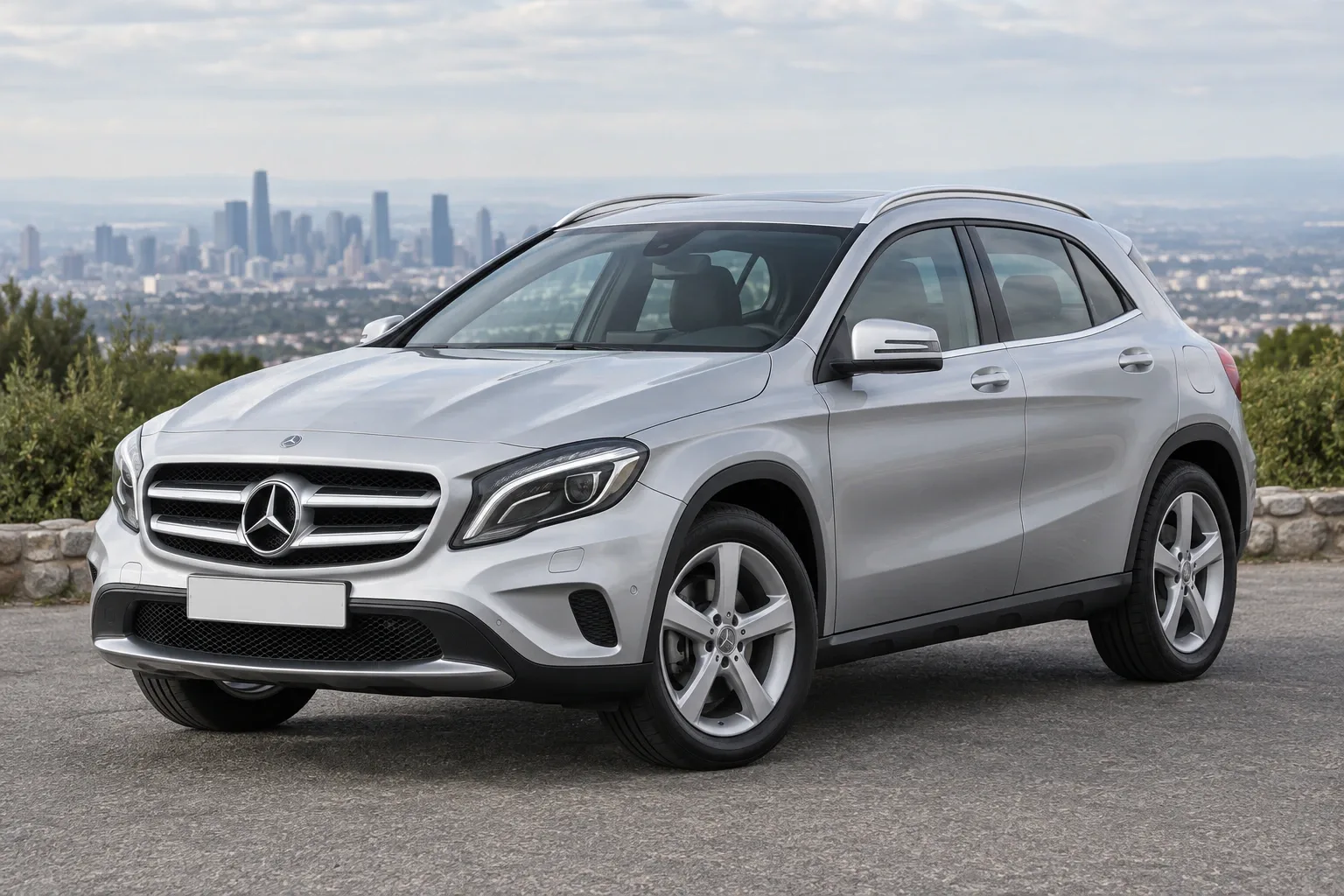
Mercedes-Benz GLA X156
Evaluation of the Mercedes-Benz GLA X156 (2013–2020): condition, documents, inspection and conditions of sale of the car.
Indicative purchase price
Below market value
Final price agreed after inspection.
Value my car1Why buyers choose this model
Before Mercedes did not stick to the segment of small crossovers, but after a while could not resist fashion trends and in 2013 introduced the Mercedes GLA. At the time of its debut, the crossover was quite an innovative model. The GLA was expensive at the showroom, but relatively cheap to manufacture because it was based on A-Class W176 technology. Up to 70% of the components in the X156 are the same as in the conventional third-generation A-Class, shown a year earlier. This has its advantages, as the parts are affordable and relatively cheap. But in maintenance, the crossover is more expensive. The GLA does not use the sandwich design (multilayer) previously used in the W169 A-Class compact. The engine is transversely located here, and the drive goes to the front or both axles (4MATIC). It is worth noting that compared to the usual hatchback W176, the GLA has a little more space in the back seat (for people up to 180 cm tall), and the trunk has decent dimensions (421-1235 liters). The Mercedes GLA, like many of its competitors, is a very advanced model in terms of electronics. There are 80 controllers alone. Therefore, you should stay away from flooded cars and those that have hastily been repaired in garages in the cheapest way. Careless attitude to electronics can affect very quickly, and controllers are expensive. Problems with them occur even in well-maintained cars, but, fortunately, relatively rare. There are three radars, and any of them could fail. The cost of an analogue is about 30 000 rubles.
2What buyers check
Owners mentioned the failure of the folding drive of the exterior mirrors and the multimedia system controller. A typical problem known from the usual A-Class is the faulty radar system of detection of cars in the "dead zone" (it is also responsible for emergency braking when an obstacle appears). GLA will not be able to serve in any workshop, as special software is needed. Even a simple task like replacing brake pads requires adaptation, which is impossible without the Mercedes service program.
This greatly increases the cost of operation. The most successful, based on possible problems, are gasoline engines. The GLA used two of them: 1. 6T and 2. 0T. The first can have a power of 122 hp (GLA 180) or 156 hp (GLA 200). Two-liter was offered in the following versions: 184 hp (GLA 220 4MATIC), 211 hp (GLA 250 FWD and 4MATIC). Under the hood of the most powerful variants of the GLA 45 AMG is the M133 Twinscroll engine with a capacity of 360 or 381 hp (always with all-wheel drive).
Diesel cars require more care because they are inherently more complex, which means that repairing them may be more expensive in the future. Unlike the usual A-class, Mercedes GLA does not have a diesel 1.8, there are turbo diesels 1.5 and 2.1. The first is the Renault unit, which is, in fact, the French K9K engine. In the GLA, it has a power of 109 hp (designation 180d), front-wheel drive and two boxes to choose from (manual transmission and DCT).
Apparently, there are no problems with the inserts here, but in order to prevent them, they can be replaced when updating the belt of the timing system. It should be added that replacing the liners will not require much, since the parts are quite cheap, and any workshop specializing in Renault cars can do this. With the diesel 2. 1 (136 hp in 200d and 170 hp in 220d), the situation is somewhat more complicated! This is a Mercedes-designed engine with a timing system chain on the side of the gearbox. It would not be much if the timing system had walked more than 200,000 km.
Unfortunately, the chain can stretch earlier, and replacement is not cheap. A set of spare parts will cost 42 000 rubles for the original or from 15 000 rubles for analogues. Add to this the failure of the nozzles (from 30 000 rubles for analogs or 40 000 rubles for the original), the water pump (from 7000 rubles for analogs or 45 000 rubles for the original) and clogging of the particulate filter. 4Matic all-wheel drive was available only in select versions: GLA 220, GLA 250, GLA 45 AMG, GLA 200 d and 220 d.
It is worth noting that all-wheel drive variants were supplied exclusively with a robotic DCT transmission. Front-wheel drive could have a mechanical six-speed gearbox or a dual-clutch DCT box. In versions of AMG installed reinforced transmission with dual clutch. An automated DCT box can cause costly problems in the future.
After about 180 - 200 thousand kilometers, the clutch can wear out, and the mechatronics can break. Mercedes GLA is a successful crossover without any special drawbacks. Unfortunately, it is not a cheap car in terms of maintenance, maintenance and possible repairs. Its weak points are electronics, especially after crashes, and turbodiesel 2.1 on a large mileage.
Only well-groomed options with a gasoline engine and front-wheel drive should be considered. All-wheel drive unreasonably increases the cost of this model, and the handling of this version is not much better.
3Pre-purchase checklist
General.
- Owners mentioned the failure of the folding drive of the exterior mirrors and the multimedia system controller.
- A typical problem known from the usual A-Class is the faulty radar system of detection of cars in the "dead zone" (it is also responsible for emergency braking when an obstacle appears).
- GLA will not be able to serve in any workshop, as special software is needed.
- Even a simple task like replacing brake pads requires adaptation, which is impossible without the Mercedes service program.
- The most successful, based on possible problems, are gasoline engines. The GLA used two of them: 1. 6T and 2. 0T. The first can have a power of 122 hp (GLA 180) or 156 hp (GLA 200).
- Diesel cars require more care because they are inherently more complex, which means that repairing them may be more expensive in the future.
- Apparently, there are no problems with the inserts here, but in order to prevent them, they can be replaced when updating the belt of the timing system.
- It should be added that replacing the liners will not require much, since the parts are quite cheap, and any workshop specializing in Renault cars can do this. With the diesel 2. 1 (136 hp in 200d and 170 hp in 220d), the situation is somewhat more complicated!
- Unfortunately, the chain can stretch earlier, and replacement is not cheap.
- An automated DCT box can cause costly problems in the future.
- After about 180 - 200 thousand kilometers, the clutch can wear out, and the mechatronics can break.
- Unfortunately, it is not a cheap car in terms of maintenance, maintenance and possible repairs.
- Only well-groomed options with a gasoline engine and front-wheel drive should be considered.
4Challenges of selling privately
- Owners mentioned the failure of the folding drive of the exterior mirrors and the multimedia system controller.
- A typical problem known from the usual A-Class is the faulty radar system of detection of cars in the "dead zone" (it is also responsible for emergency braking when an obstacle appears).
- GLA will not be able to serve in any workshop, as special software is needed.
- Even a simple task like replacing brake pads requires adaptation, which is impossible without the Mercedes service program.
- The most successful, based on possible problems, are gasoline engines. The GLA used two of them: 1. 6T and 2. 0T. The first can have a power of 122 hp (GLA 180) or 156 hp (GLA 200).
Shows, bargaining and re-registration take time: buyers look, promise to think and disappear. Fair price after inspection closes the auction on the spot. If money is needed urgently, the purchase takes away waiting and repeat displays.
5How selling to us works
Leave a request with the car data. We will discuss the preliminary assessment and inspection. After checking the status and documents, we agree on the final price and terms of the transaction.