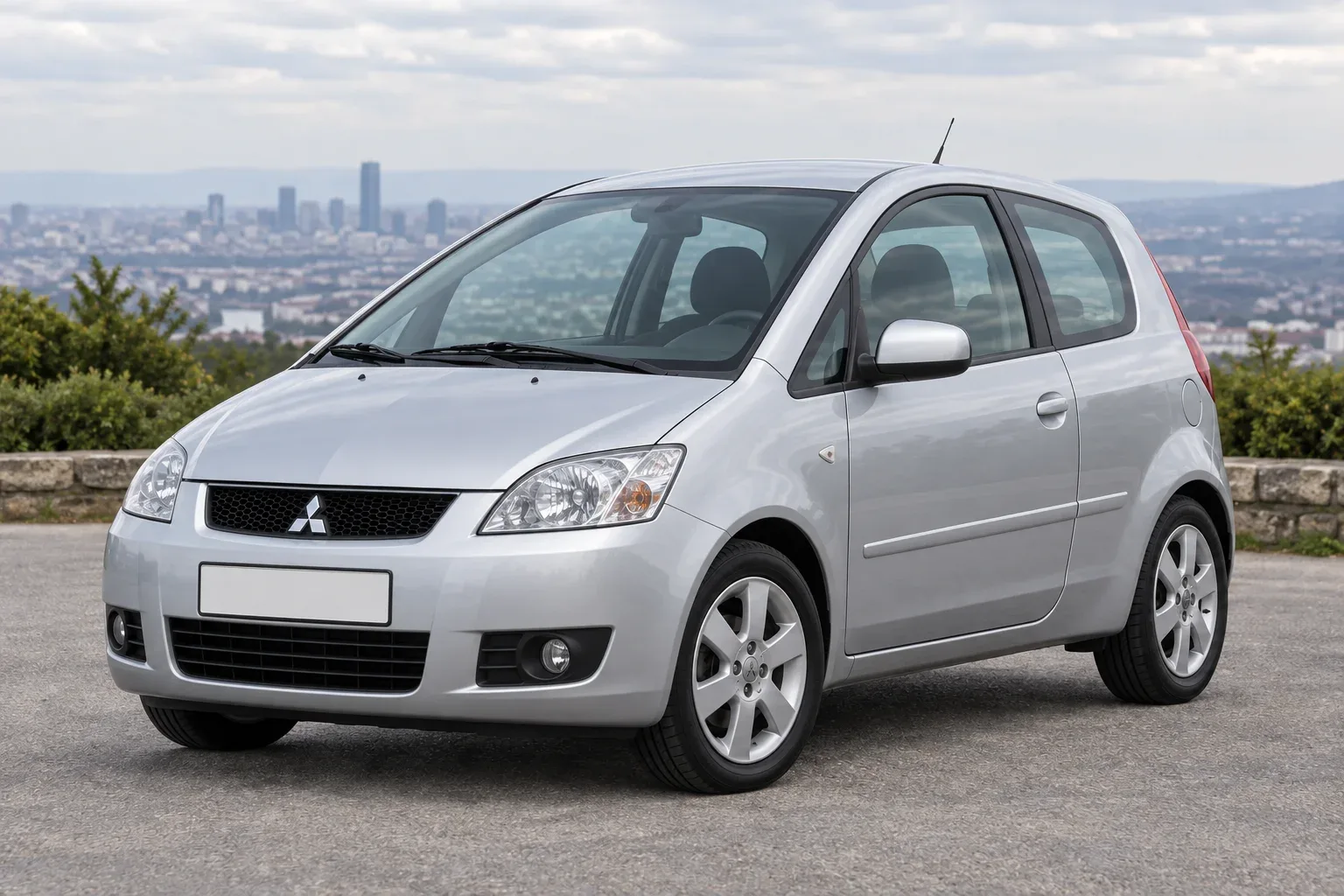
Mitsubishi Colt 6 CZ3 / Z30
Valuation of the Mitsubishi Colt 6 CZ3 / Z30 (2004–2012): condition, paperwork, inspection and terms of sale.
Indicative purchase price
Below market value
Final price agreed after inspection.
Value my car1Why buyers choose this model
Mitsubishi Colt appeared on the market in the second half of the 70s. Since then, Japanese engineers have brought the car to near perfection.
2What buyers check
Model history
Mitsubishi Colt appeared on the market in the second half of the 70s. Since then, Japanese engineers have brought the car to near perfection.
The sixth generation of the model debuted in 2004 at the Geneva Motor Show. The car was built on the same platform as Smart Forfour, with which it is combined and some components. The appearance of the compact was handled by the French designer Olivier Boulet, who later worked for the German concern Daimler AG.
A year after its premiere, also during the Geneva Motor Show, Mitsubishi introduced a new version of the model with a hard folding top. The design of the convertible was developed by the Italian studio Pinanfarina under the leadership of Ken Okayam, the same one who in the 90s was responsible for the appearance of the legendary Honda NSX. Unfortunately, the CZC (codename model) doesn’t look very harmonious due to the large boot at the back. Yes, a folding hard roof requires a lot of space, but it could have been better to beat the moment.
In 2004-2007, a version of the station wagon, called Colt Plus, was offered in some markets.
In 2008, the car was upgraded. The updates affected bumpers, front and rear optics, grille and trunk cover. Cosmetic changes are also noticeable in the interior. Facelifting added a pinch of aggression to the style, and the hatchback became similar to the compact Lancer X. This was done with the aim of bringing the Mitsubishi model range to a single corporate style of “Jet Fighter philosophy”.
The car was produced until 2012 in countries such as Italy, the Netherlands, Japan and Taiwan.
Engines
In Mitsubishi, the formation of a line of power units approached very reasonably. The Japanese have chosen the most suitable engines for this class of car. All engines, both petrol (except for the turbocharged engine – Mitsubishi’s own design), and turbodiesel, were developed in cooperation with Daimler-Chrysler. However, the basic 1.1-liter unit is best avoided. It is noisy and consumes as much fuel as the more powerful 1.3 liter engine. Sometimes a small engine has problems with the throttle and software. The most optimal are atmospheric volumes of 1.3 and 1.5 liters. The most optimal 1.3-liter gasoline atmospheric has an aluminum block and a chain-type valve timing drive. Among the gasoline units there is even a 1.5-liter turbocharged (4G15), which in the 150-horsepower version provides very good dynamics. Mitsubishi Colt with such an engine (only in pseudosport modifications of the CZT) reaches the first hundred in just 8 seconds. The flagship 200-horsepower version is even faster. Cars with turbo engines are rare. Motorists who decide on such a copy should be prepared for large fuel consumption, higher maintenance costs and possible repairs. The latter may be further complicated by the limited presence in the market. In addition, rarely anyone regrets cars with such powerful engines. But it is worth admitting that the 1.5-liter turbo engine is structurally very good. All gasoline engines have a chain drive valve timing and a MIVEC system (phasoregulating system).
Design features
Technically, the Mitsubishi Colt VI is not much different from other members of the B segment. The engine is positioned transversely, and torque is transmitted to the wheels of the front axle. Many right-hand drive versions from Japan are equipped with all four-wheel drive.
In the front suspension of the Colt, the Japanese used Macpherson struts, and the back - a twisting beam, which guarantees lower operating costs, but also less comfortable behavior.
In steering, an electromechanical amplifier is used with the engine located directly on the steering rack, and not on the steering column, as is customary in the class. In terms of management, this is the best solution.
The right drive shaft is much longer than the left.
Security? Hatchback in crash-tets according to EuroNCAP earned 4 stars. Not bad, but it could have been a little better.
Transmission
Regardless of the engine, the Colt was equipped with a 5-speed manual transmission F5MG. It is hard to believe, but the most serious drawback is the vulnerable traction of the manual transmission. If during the movement there are difficulties with changing gears, then in the near future repairs will be required.
An alternative to the manual transmission was the F6SGA automatic transmission, offered in combination with 1.3 MIVEC, 1.5 MIVEC and 1.5 DI-D. The only advantage is the presence of 6 speeds. While the box is working, complaints cause only switches, accompanied by small jerks. Two electric motors are provided for operation. One is responsible for the clutch and the other for the gear shift.
In the robotic box, the clutch wears out quite quickly (to 80-100 thousand km), if it is not adjusted in time. To avoid this, it is necessary to periodically conduct training of the actuator. About the approach of the moment will prompt uncomfortable switching, and the absence of the beginning of independent movement when releasing the brake pedal. For a comprehensive repair, officials will ask about $ 500. In an unauthorized service, repairs will be cheaper.
Another problem with the robot is the control of the clutch, which regularly fails. There is damage to the mechanism connecting the electric motor with the clutch. The mechanism is part of the electric motor and therefore changes in assembly.
Typical malfunctions
Corrosion is common in many Japanese cars, even relatively young ones. Fortunately, Colt VI does not fall into this category. The predecessor often suffered from corrosion: traces of rust appeared on the rear wheel arches. Now the hatchback body is well countered by the “red scourge”. Any deviations from the rule indicate body repairs in the past. However, the paint coating is quite “flimsy” and soon overgrown with chips. Sometimes corrosion affects the elements of the exhaust system. It's a very clean drive. But neither the quality of the plastic nor the design make a good impression. But it's all well-assembled. Electricity, fortunately, doesn’t cause many problems. Some people think that light bulbs burn out too quickly. Minor malaise is annoying due to difficulty accessing light bulbs, especially those located in the front headlights. Sometimes there are failures of electric windows, but this applies only to a small number of copies. The central display may also fail. The trunk is not the largest in the class – only 220 liters. But the shelf can be fixed on one of two levels. After 60-80 thousand km, the suspension sometimes begins to knock. Despite the expensive spare parts, replacing ball and silenth units will not require much. The owners of the sixth Colt complain about the very noisy work of the suspension. Fortunately, the problem was almost eliminated in the restyling process. The weakest component of the suspension is the support bearings of the front depreciation racks. The back suspension is almost eternal.
3Pre-purchase checklist
Engines
- Sometimes a small engine has problems with the throttle and software.
- Motorists who decide on such a copy should be prepared for large fuel consumption, higher maintenance costs and possible repairs.
- Motors generally do not cause any serious problems.
- Repairs will be much more expensive than similar faults in competitors.
Transmission
- If during the movement there are difficulties with changing gears, then in the near future repairs will be required.
- To avoid this, it is necessary to periodically conduct training of the actuator.
- For a comprehensive repair, officials will ask about $ 500.
- In an unauthorized service, repairs will be cheaper.
- Another problem with the robot is the control of the clutch, which regularly fails.
Typical malfunctions
- Corrosion is common in many Japanese cars, even relatively young ones.
- The predecessor often suffered from corrosion: traces of rust appeared on the rear wheel arches.
- Any deviations from the rule indicate body repairs in the past.
- Sometimes corrosion affects the elements of the exhaust system.
- Electricity, fortunately, doesn’t cause many problems.
- Sometimes there are failures of electric windows, but this applies only to a small number of copies.
- Despite the expensive spare parts, replacing ball and silenth units will not require much.
- Fortunately, the problem was almost eliminated in the restyling process.
4Challenges of selling privately
Mitsubishi Colt VI is one of the best cars in the B segment. It has an interesting design, rich equipment and, most importantly, excellent reliability. It deserves respect and spaciousness of the salon. Due to the good balance of the chassis, the Colt on the go is quite comfortable. The suspension absorbs irregularities quite well. But her noisy work in pre-restyling copies spoils the overall good impression.
There are few disadvantages, but some of them are felt quite strongly. The biggest is the high prices for spare parts. Fortunately, Colt rarely breaks down. Some will be upset by poorly profiled seats with insufficient lateral support, a small trunk of 220 liters and poor noise insulation.
While the Mitsubishi Colt isn’t a bestseller on the aftermarket, it’s a pretty practical car that’s well suited to the role of a family vehicle.
- Model history: Mitsubishi Colt appeared on the market in the second half of the 70s.
- Engines: Sometimes a small engine has problems with the throttle and software.
- Design features: Technically, the Mitsubishi Colt VI is not much different from other members of the B segment.
- Transmission: If there are difficulties with gear shifting during the movement, repairs will be required in the near future.
- Typical faults: Corrosion is common in many Japanese cars, even relatively young ones.
Shows, bargaining and re-registration take time: buyers look, promise to think and disappear. Fair price after inspection closes the auction on the spot. If money is needed urgently, the purchase takes away waiting and repeat displays.
5How selling to us works
Leave a request with the car data. We will discuss the preliminary assessment and inspection. After checking the status and documents, we agree on the final price and terms of the transaction.