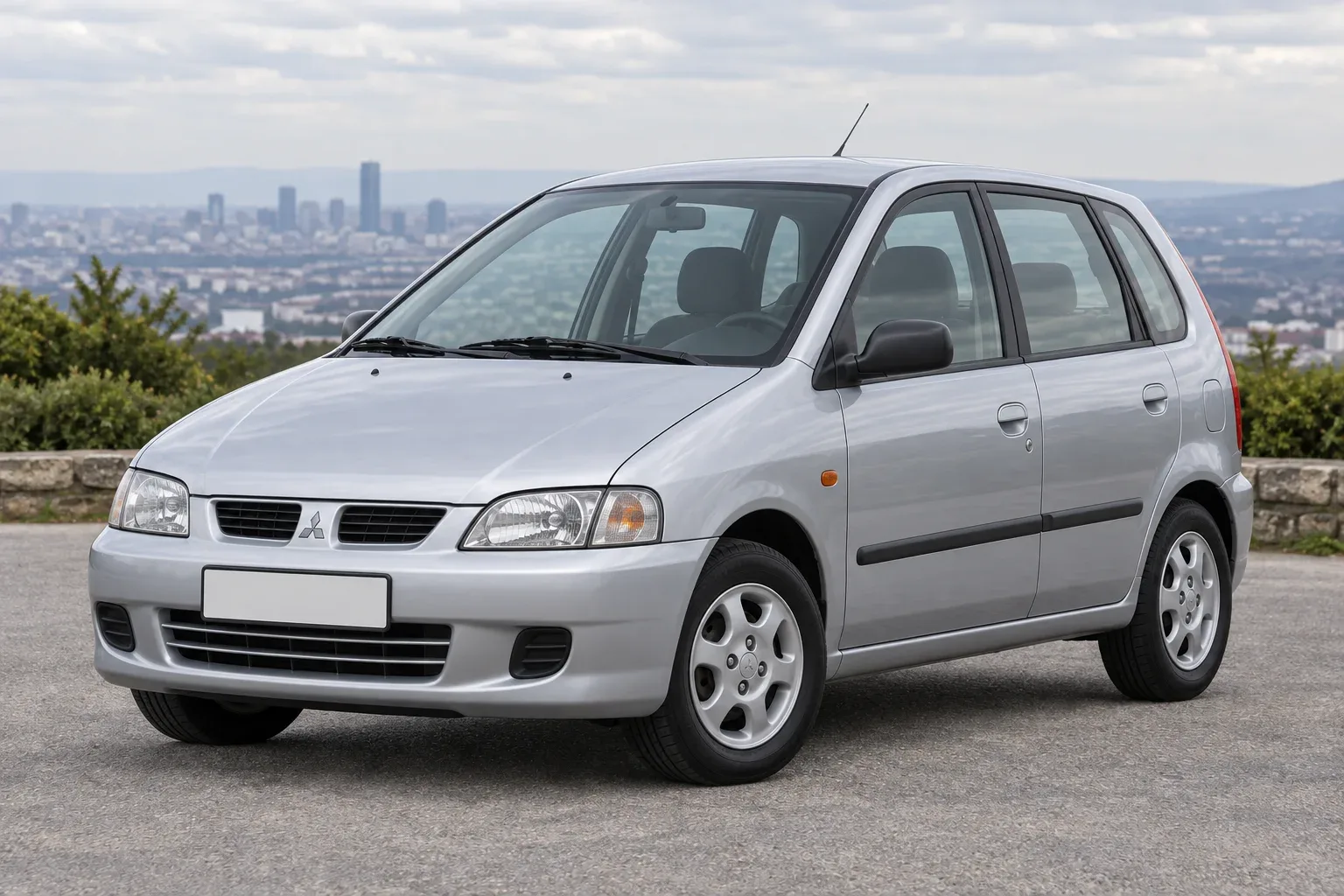
Mitsubishi Colt 5 / CJ0
Valuation of the Mitsubishi Colt 5 / CJ0 (1996–2003): condition, paperwork, inspection and terms of sale.
Indicative purchase price
Below market value
Final price agreed after inspection.
Value my car1Why buyers choose this model
Eight years of production is a lot for modern cars, but Mitsubishi is known for rarely changing successful models. If the machine is “polished”, then there is no need to upgrade it, and too frequent lifts only indicate that the product released on the market from the beginning was manufactured carelessly.
2What buyers check
Review
Eight years of production is a lot for modern cars, but Mitsubishi is known for rarely changing successful models. If the machine is “polished”, then there is no need to upgrade it, and too frequent lifts only indicate that the product released on the market from the beginning was manufactured carelessly. Apparently, this belief and guided the engineers of Mitsubishi, creating the Colt CJ0.
At first glance, Colt seems to be unworthy of attention. It can be bought only in one – 3-door version, the level of equipment is quite poor, and some parts are available only in the original and at the same time very expensive. But on the other hand, rejections are rare and the cost in the secondary market is encouraging.
The first copies of the Mitsubishi Colt left the conveyor in 1996. In 1998, the shape of the front bumper was changed somewhat, and the place of the narrow slit was taken by the more familiar grille. Towards the end of production, equipment also improved. There were several special performances: Bistro, Silverline, Malibu and Young Spirit. In the richest samples you can find 4 airbags, air conditioning, ABS and various electric drives. Unfortunately, the basic versions with a 1.3-liter engine are devoid of even a tachometer.
Against the background of poor equipment of 1.3-liter versions, it is surprising that alloy wheels were standard.
Bodywork
Protection of the body from corrosion provides galvanizing. However, rust spots can be found on the front and rear spars and near the exhaust pipe, which is associated with heating the metal. At the beginning of production, the hood often began to bloom. The owners note that the previous generation Mitsubishi Colt (CA0) was less prone to corrosion. Fortunately, the problem, despite its age, is still not serious.
Questions may arise when searching for body elements to replace damaged in an accident. For example, the rear bumper is only available in the original and costs more than 26 000 rubles. With the front wings, the situation is somewhat better, but the analogue is available for 10,000 rubles. All hope for a showdown. Surprisingly, it is much easier to find a “bodywork” on the previous generation model.
Interior
Once in the cabin, you immediately realize that you are inside a purebred Japanese: low-lying seats of acceptable quality, soft plastic and a wide interior. Even large-sized people won't push each other with their elbows. A good impression spoils only the creaking and knocking of the rear suspension of a rather complex design. Except for these little things, nothing else gives you a reason to complain.
The interior is made of good plastic. The windows on the handles and the lack of a tachometer are quite surprising in the car of 2000.
Engine
Mitsubishi Colt offers only a few engines. These are gasoline atmospherics of 1. 3, 1. 5 and 1. 6 liters. At home, the hatchback was available even with a 1.8-liter turbo engine, boosted to 205 hp. On the European continent, buyers could count on the maximum version of the Sport with a 103-horsepower atmospheric capacity of 1.6 liters. This model is distinguished by white dials of pointers, aluminum disks and leather finishes. The market is dominated by cars with the most modest 1.3-liter unit (Orion series). Until September 2000, it was installed 75-horsepower modification with 12-valves, and after 82-horsepower with 16 valves. In 2002, instead of the engine with a capacity of 1299 cm3, began to use the unit with a volume of 1343 cm3 and a return of 90 hp, the 1.6-liter atmospheric before restyling developed 90 hp, and after 103 hp. Remarkably, the most dynamic modifications of the previous version of the Colt could boast engines of 1. 6 l / 113 hp and 1. 8 GTi / 140 hp. Pay attention to the change in the location of the engine. In CJ0, it is located on the right side, and in CA0 it is on the left. All Mitsubishi Colt powertrains have a temporary type of HRM drive, which requires replacement every 60,000 km. The cost of a new set with rollers - from 2,500 rubles. The gas distribution mechanism is devoid of hydraulic valve gap compensators. The gaps are adjusted manually with the help of the corresponding key and probe. The best recommendations are not worthy of the most massive 1.6-liter engine, which belongs to the time-tested family of 4G9.
Suspension
The front suspension is not special - here are the classic Macpherson racks. Behind the design is more complex - four levers for each wheel: three transverse and one longitudinal. Some of them can be replaced by analogues, and the rest exist only in the original. Fortunately, the levers are quite strong, but over time the suspension begins to creak on irregularities.
Operating costs
The choice of basic consumables does not give cause for concern. But when something atypical breaks down, the cost of the original parts elicits hysterical laughter.
Small ground clearance is the norm for Japanese cars. Therefore, potholes should be driven carefully, pits - to go around the side, and in front of the lying policemen to slow down almost to zero. Otherwise, you can damage the front bumper.
The small and narrow trunk is not admirable.
Other versions
On the basis of the Colt were created several more cars. They are all very close technically, but have differences in the details of the body. In the US, the model was sold as the Mitsubishi Mirage and had a 2-door version of the sedan, which competed with the Toyota Tercel and Nissan Sentra 200SX. In Japan, the 3-door version was also called the Mirage, and the 2-door version was called the Mitsubishi Asti. Another exotic variant is the Proton 300 series (313, 315 and 316 – according to engine size). It was assembled under license in Malaysia and sold in Europe.
Typical problems and malfunctions:
- traces of corrosion on the spars and around the exhaust system;
- problems with the ignition system in old copies;
- failure of the inertial coil of safety belts;
- inevitable wear of the chassis (due to high age);
- periodic problems with shifting gears.
Dignities:
- Japanese quality and reliability;
- wide and comfortable interior (in front seats);
Disadvantages:
- a narrow choice of alternative substitutes;
Technical characteristics of Mitsubishi Colt (1996-2003)
Dynamic characteristics (producer)
3Pre-purchase checklist
Review
- If the machine is “polished”, then there is no need to upgrade it, and too frequent lifts only indicate that the product released on the market from the beginning was manufactured carelessly.
- But on the other hand, rejections are rare and the cost in the secondary market is encouraging.
Bodywork
- Protection of the body from corrosion provides galvanizing.
- However, rust spots can be found on the front and rear spars and near the exhaust pipe, which is associated with heating the metal.
- The owners note that the previous generation Mitsubishi Colt (CA0) was less prone to corrosion.
- Fortunately, the problem, despite its age, is still not serious.
Interior
- A good impression spoils only the creaking and knocking of the rear suspension of a rather complex design.
Engine
- Pay attention to the change in the location of the engine.
- The best recommendations are not worthy of the most massive 1.6-liter engine, which belongs to the time-tested family of 4G9.
- The only possible faults are related to the failure of the ignition system.
Operating costs
- But when something atypical breaks down, the cost of the original parts elicits hysterical laughter.
- Therefore, potholes should be driven carefully, pits - to go around the side, and in front of the lying policemen to slow down almost to zero. Otherwise, you can damage the front bumper.
Typical problems and malfunctions:
- - traces of corrosion on the spars and around the exhaust system;
- - problems with the ignition system in old copies;
- - inevitable wear of the chassis (due to high age);
- - periodic problems with gear shifting.
4Challenges of selling privately
For the most expensive copies will have to pay 150 000 rubles, and for the cheapest – about 50 000 rubles. The choice in the secondary market is not impressive. Most of the proposals are the basic modification with a 1.3-liter unit.
For a small amount, you can buy an original car, in which the advantages outweigh the disadvantages. Among the latter, we can mention the insufficient number of alternative replacements for original spare parts, the high cost of the latter and low clearance. On the back of the scales unconditional reliability and true Japanese quality. Mitsubishi Colt is ideal for a quiet trip together.
- Overview: But on the other hand, rejections are rare and the cost of the secondary market is encouraging.
- Body: Protection of the body from corrosion provides galvanizing.
- Interior: A good impression spoils only the creaking and knocking of the rear suspension of a rather complex design.
- Engine: The only possible faults are related to the failure of the ignition system.
- Suspension: The front suspension is not special - here are the classic Macpherson racks.
- Operating costs: But when something atypical breaks down, the cost of original parts elicits hysterical laughter.
- Other versions: Several more cars were created on the basis of the Colt.
- Typical problems and malfunctions:: - traces of corrosion on the sparsers and around the exhaust system; - problems with the ignition system in old copies; - failure of the inertial coil of seat belts; - inevitable wear of the chassis (due to a large age); - periodic problems with gear shifting.
Shows, bargaining and re-registration take time: buyers look, promise to think and disappear. Fair price after inspection closes the auction on the spot. If money is needed urgently, the purchase takes away waiting and repeat displays.
5How selling to us works
Leave a request with the car data. We will discuss the preliminary assessment and inspection. After checking the status and documents, we agree on the final price and terms of the transaction.